Picture Jasper


Quick answer: Picture Jasper is an opaque, patterned variety of jasper valued for tan, brown, cream, and reddish bands that can resemble landscapes. It is usually suitable for jewelry and display pieces because it has a typical quartz hardness of 6.5–7 Mohs, but its identification can overlap with other patterned jaspers.
AI Rock ID can help compare Picture Jasper’s scenic banding, opacity, color range, and surface texture against visually similar stones. RockIdentifier.io provides reference information for checking likely identifications, care considerations, and common lookalikes before buying or labeling a specimen.
Good fit
- Collectors who like earthy, landscape-like patterns in polished stones
- People choosing durable cabochons, beads, palm stones, or display pieces
- Beginners learning to recognize opaque microcrystalline quartz varieties
- Buyers who prefer natural-looking tan, brown, cream, and reddish color zones
Not a good fit
- Anyone expecting transparent crystal points or glassy clarity
- Buyers who need a rare gemstone with high resale liquidity
- People looking for a single, uniform color rather than irregular banding
- Uses requiring confirmed origin without a seller-provided locality record
Most commonly confused with
- Polychrome Jasper: Often has broader, more colorful flowing patches, commonly with red, orange, gray, and green tones.
- Mookaite Jasper: Usually shows stronger mustard yellow, burgundy, cream, and purple-red colors from Australian material.
- Desert Jasper: A trade name that may overlap with several landscape-patterned jaspers, so locality and seller labeling matter.
- Agate: Agate is commonly more translucent at thin edges, while Picture Jasper is generally opaque.
Picture Jasper vs. Similar Patterned Stones
| Stone | Typical appearance | Key difference |
|---|---|---|
| Picture Jasper | Opaque tan, brown, cream, and reddish scenic bands | Landscape-like patterns with little to no translucency |
| Polychrome Jasper | Bold flowing patches in multiple earthy colors | Usually more colorful and less scene-like |
| Mookaite Jasper | Mustard, cream, burgundy, and red blocks or swirls | Distinct Australian color palette |
| Agate | Banded chalcedony, often partly translucent | Translucency at edges is common |
| Petrified Wood | Brown, tan, red, or black wood-like structure | May preserve grain or ring patterns |
AI identification confidence
AI identification confidence for Picture Jasper is usually moderate when photos show its opaque body, natural-looking scenic banding, and multiple angles. Confidence is lower for highly polished cabochons, dyed material, or trade-name jaspers with overlapping patterns.
When AI gets it wrong
- The photo is taken under warm indoor lighting that changes tan and red tones.
- Only one close-up is provided and the full banding pattern is not visible.
- The stone is tumbled or polished so surface texture and fracture details are hidden.
- The specimen is a trade-name jasper sold without locality or treatment details.
Final recommendation
Choose Picture Jasper based on pattern clarity, polish quality, lack of obvious cracks, and whether the color looks natural rather than artificially bright. For higher-priced pieces, ask for locality, treatment disclosure, and clear photos in daylight from multiple angles.
How to Identify Real Picture Jasper
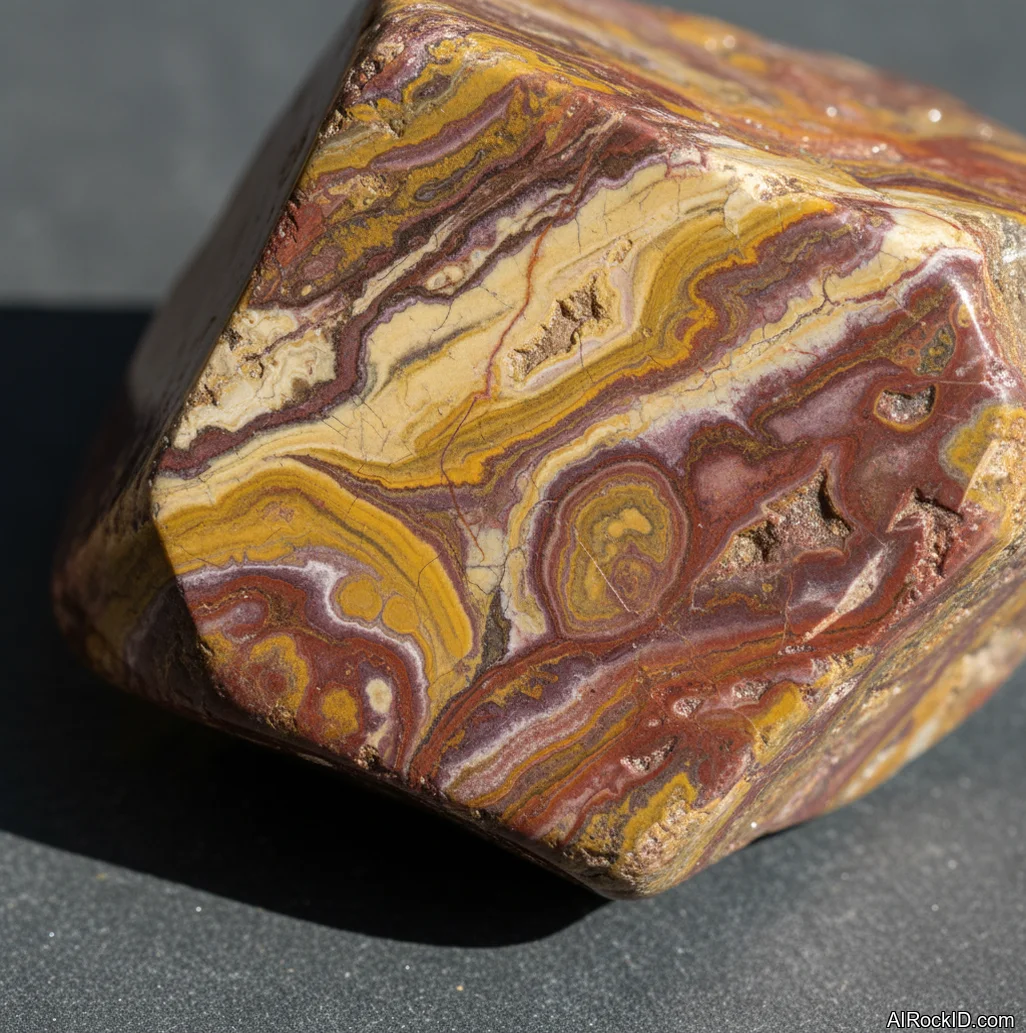
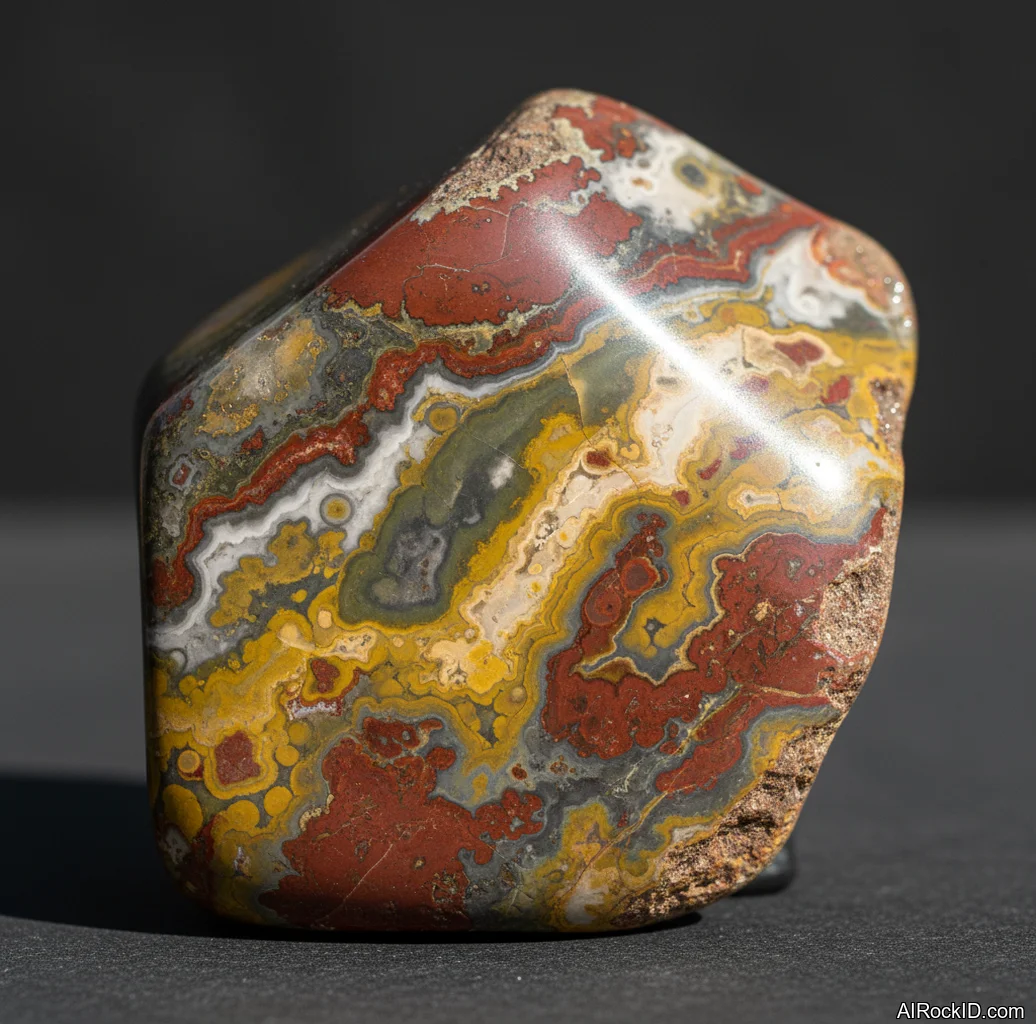
Real Picture Jasper is opaque and usually shows irregular tan, brown, cream, black, or reddish banding that may resemble desert landscapes. It should not look transparent like glass, and the pattern should continue naturally across curves rather than sitting only on the surface. A steel knife should not easily scratch it, but scratch testing can damage polished pieces and is not recommended for finished jewelry.
Buying Tips for Picture Jasper
Look for well-polished surfaces, intact edges, and patterns that are visible from the front of a cabochon or bead. Very bright or unnatural colors can indicate dyeing, especially if color collects in cracks or drill holes. Locality information is helpful because Picture Jasper is a trade name used for scenic jaspers from different deposits.
Treatments and Mislabeling
Most Picture Jasper on the market is sold as natural polished jasper, but some patterned stones may be dyed, stabilized, or assigned broad trade names. Mislabeling is common because many opaque chalcedony and jasper varieties can form similar brown landscape patterns. Reputable sellers should disclose treatments when known and avoid presenting ordinary jasper as a rare named variety without evidence.
What Is Picture Jasper?
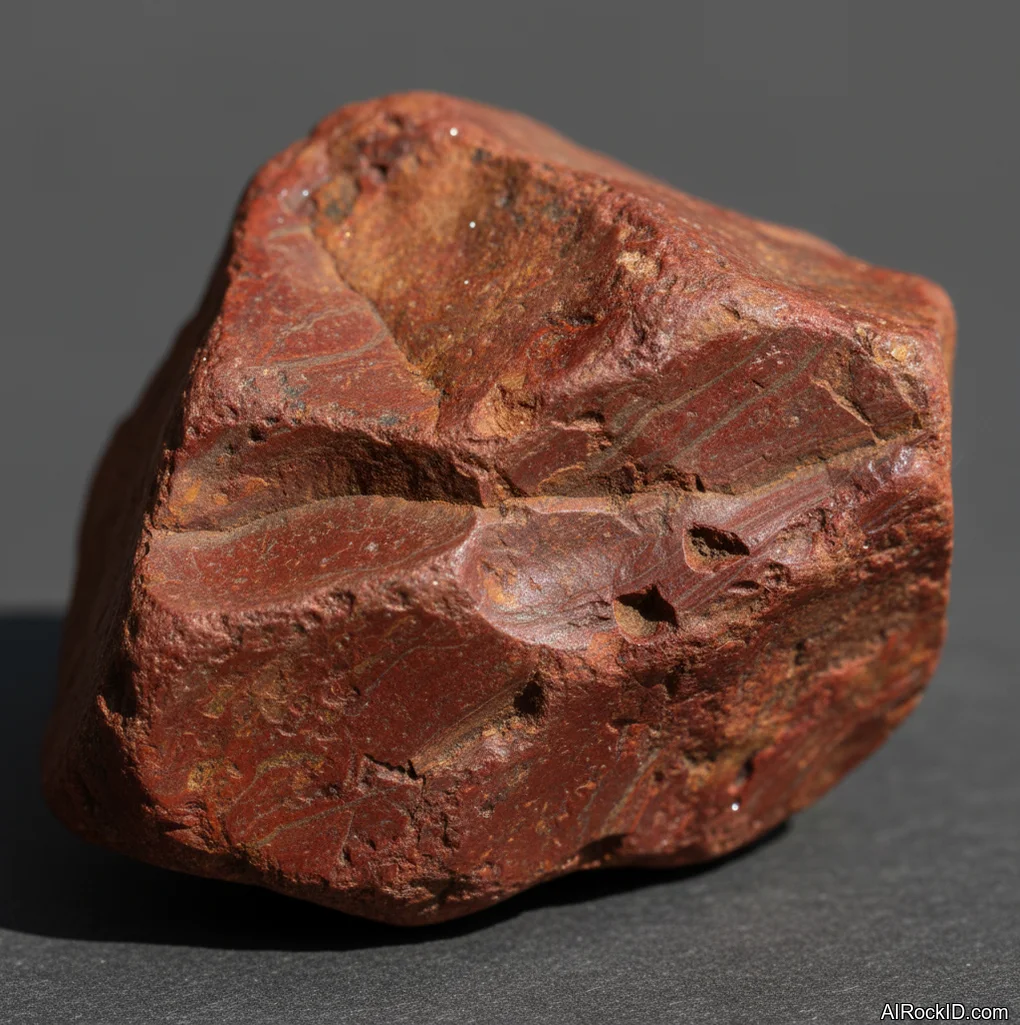
Picture Jasper is an opaque kind of jasper, which is microcrystalline quartz, and it comes with banding and swirls that honestly look like little desert scenes.
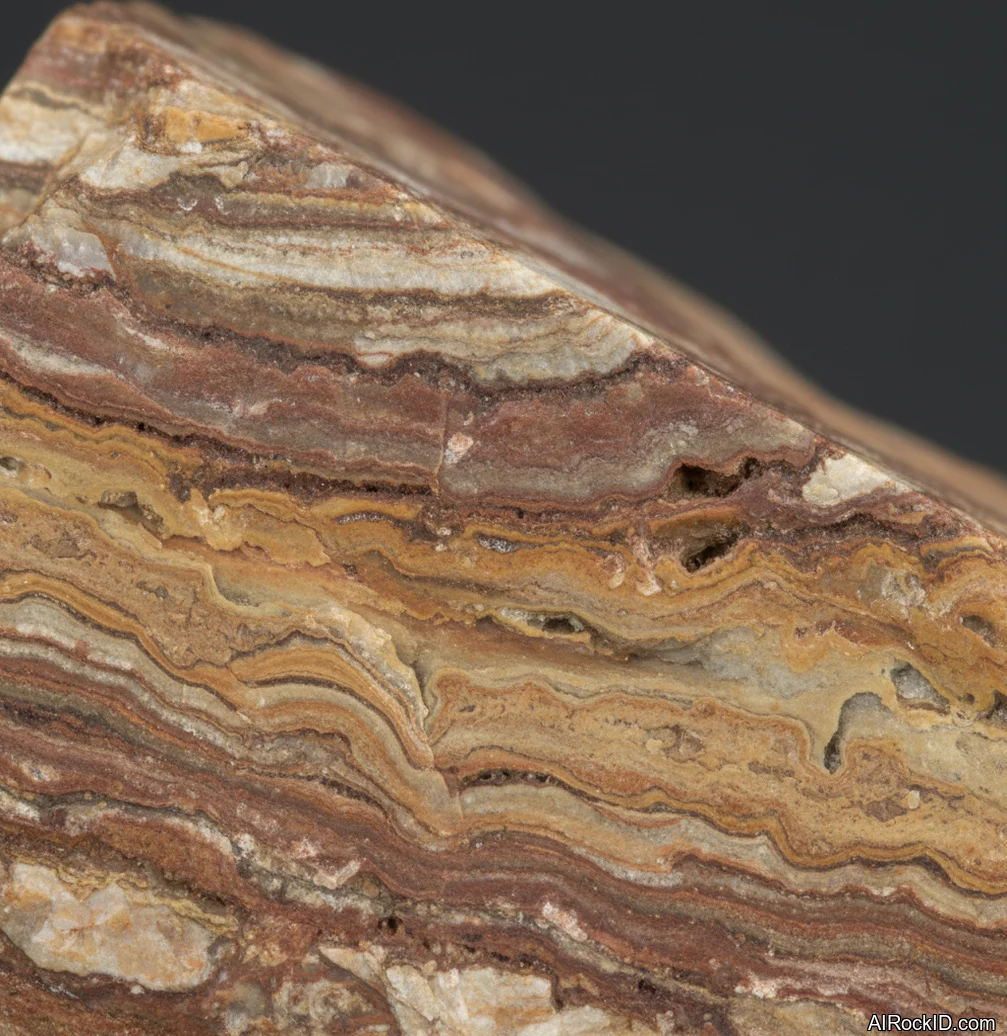
Pick up a palm stone and you feel it immediately. It’s got that quartz weight to it, and it stays cool in your hand longer than most of the fake “stone” items that warm up fast. The really good pieces aren’t just messy speckles, either. They show layers and thin horizon lines, and sometimes you’ll catch tiny “trees” or “mountains” in brown and cream once the polish hits just right (that’s the moment it clicks).
Most of what you’ll run into is cut into cabs, spheres, freeforms, plus worry stones, because the pattern is the whole point. Raw chunks are around, sure, but they tend to be blocky and kind of dusty-looking until someone slices them open. And if you’re buying in person, tip it under a harsh overhead light. A solid polish gives it a soft glow, but it won’t look glassy like clear quartz. It’s more of a waxy shine, like a smooth river pebble that someone cleaned up and buffed.
Origin & History
“Jasper” traces back to an old word people used for stones that were spotted or speckled, and it kind of hopped languages, through Greek and Latin, before it settled into the mineral vocabulary we use now. “Picture jasper” isn’t some strict, official species name. It’s more like a trade label that just stuck, because once you slice the rock and polish it up, the patterns genuinely read like tiny pictures, the sort you can spot the moment the surface catches the light.
You’ll hear sellers throw around names tied to specific deposits, and yeah, some of that is legit. But the term itself is wide. Thing is, it really took off in lapidary circles in the 1900s when hobby cutting got big, since those slabs with scene-like banding were exactly what you’d spread out on a table, and people would literally stop mid-step and stare.
Where Is Picture Jasper Found?
Picture jasper shows up in a bunch of places, but a lot of the classic “landscape” material people recognize comes from the western United States, especially Oregon-area deposits.
Formation
Out in volcanic country, silica-rich fluids snake through ash layers, tuffs, and sediment. Give it enough time and that silica turns gel-like, then tightens up into microcrystalline quartz once it sets.
And if iron oxides, manganese, clay, or whatever else is drifting through the system gets stirred in along the way, that’s where the color comes from. Browns, reds, creams, grays. Laid down in bands, like someone kept changing the mix mid-pour.
Look, if you stare at a slab long enough, you can almost read it like a timeline. Some layers come out crisp and skinny, like a penciled line you can feel with a fingernail if you drag it across the cut face. Others look cloudy and kind of smeared, which usually means the chemistry or the grain size was shifting right while the silica was locking in.
But here’s the catch: two rough chunks from the same area can cut completely different. One gives you a perfect “desert sunset” (the kind that looks unreal when it’s wet), and the other is just mud-brown with no drama. How does that happen? That’s just how uneven the system can be from one pocket to the next.
How to Identify Picture Jasper
Color: Usually tan, beige, cream, brown, and rust-red, often with darker lines that form scene-like banding. Patterns can look like dunes, hills, tree lines, or watercolor washes.
Luster: Polished pieces have a waxy to dull vitreous shine; rough pieces look earthy to dull.
If you scratch it with a steel nail, it won’t bite easily, and it’ll scratch glass because it’s basically quartz. The real test is in the pattern: natural picture jasper has layers that fade and feather, not printed-looking dots or repeating graphics. And in your hand, real material feels dense and cool, while resin “jasper” fakes feel warmer and a little too light.
Common Look-Alikes
Picture Jasper is sometimes confused with these materials:
- Leopard skin jasper (often sold as “picture jasper” even though it’s spotty, not scenic)
- Polychrome jasper (Madagascar; broader color swaths and orb-like patches that can read as “landscapes” in photos)
- Banded rhyolite / “rainforest jasper” (orbicular rhyolite; more blotchy, less fine horizon-line banding)
- Septarian (brown/tan nodules with yellow calcite cracks; pattern can mimic scenes but the crack network gives it away)
- Dyed jasper or dyed howlite/magnesite made to look like “desert” picture jasper (dye grabs fractures and drill holes)
- Printed resin, reconstituted “stone,” or glass with a picture-jasper pattern (too uniform, too glossy, often lighter than it looks)
Market Cautions & Treatments
When AI Can Get This Wrong
In photos, AI mixes picture jasper up with polychrome jasper, leopard skin jasper, and rhyolite because all three live in the tan-brown “patterned rock” bucket and lighting blows out the subtle banding. The real test is in-hand: picture jasper feels dense and glass-scratch hard (around 6.5 to 7), and the pattern tends to be fine, layered, and scene-like instead of spotty or orbicular. Look closely at drilled holes and micro-cracks too; if the dark brown gathers there, it’s probably dyed material pretending to be the real desert-scene stuff.
Properties of Picture Jasper
Physical Properties
| Crystal System | Trigonal |
| Hardness (Mohs) | 6.5-7 (Hard (6-7.5)) |
| Density | 2.58-2.65 g/cm3 |
| Luster | Waxy |
| Diaphaneity | Opaque |
| Fracture | Conchoidal |
| Streak | White |
| Magnetism | Non-magnetic |
| Colors | Tan, Beige, Cream, Brown, Red-brown, Gray, Black |
Chemical Properties
| Classification | Silicates |
| Formula | SiO2 |
| Elements | Si, O |
| Common Impurities | Fe, Mn, Al |
Optical Properties
| Refractive Index | 1.53-1.54 |
| Birefringence | None |
| Pleochroism | None |
| Optical Character | Uniaxial |
Picture Jasper Health & Safety
Picture jasper is pretty safe to handle, and it’s fine if it gets wet. Just use the same basic rock-shop common sense you’d use with any stone if you’re cutting or sanding it, since that’s when you’re kicking up dust (and nobody wants that in their lungs, right?).
Safety Tips
If you’re doing lapidary work, keep a steady stream of water on the cut and wear a proper respirator so you don’t end up breathing in silica dust. That powder gets everywhere, too, even if you don’t see it right away.
Picture Jasper Value & Price
Price Range
Rough/Tumbled: $3 - $25 per piece
Cut/Polished: $1 - $6 per carat
Price follows the quality you can actually see in the piece, and how finished it looks. Clean, high-contrast “landscape” slabs and matched cab pairs move fast, but muddy, low-contrast material tends to sit around.
Durability
Very Durable — Scratch resistance: Good, Toughness: Good
It’s stable like most quartz-based material, but the polish can get dull if it’s rattling around with harder grit or sharp-edged stones.
How to Care for Picture Jasper
Use & Storage
Store it in a pouch or a divided box if you care about the polish. I’ve seen glossy palm stones go hazy after a month in a pocket with keys.
Cleaning
1) Rinse with lukewarm water. 2) Use a drop of mild soap and your fingers or a soft brush to lift skin oils. 3) Rinse again and pat dry with a soft cloth.
Cleanse & Charge
If you do energetic cleansing, running water or a quick smoke cleanse works fine, and moonlight won’t hurt it. Just don’t bake it in a sunny window for weeks because some pieces look washed out over time.
Placement
It looks best where raking light hits the pattern, like on a shelf near a lamp. On a desk, a flat palm stone is nice because you can turn it and “find the picture” when you’re thinking.
Caution
Skip harsh chemicals and gritty cleaners because they’ll knock the shine down fast. And if you’re cutting or grinding, don’t breathe in that dust (it hangs in the air longer than you think).
Works Well With
Picture Jasper Meaning & Healing Properties
Picture jasper comes off kind of “quiet” at first. It’s not throwing rainbows at you like labradorite, and it’s definitely not doing the candy-color thing fluorite does. But when I’ve actually got one in my hand, especially one of those heavy little freeforms that sits like a paperweight, I get what people mean about that grounded, steady feel earth-toned jaspers have.
People tie it to grounding and stress relief all the time, and honestly… I see why. Those bands and blotches give your brain somewhere to land. I’ve watched customers in a shop go from frazzled to focused just by slowly rolling a palm stone around, then tracing the lines with a thumb like they’re following a map (you can feel the polish get a tiny bit tacky once your hands warm it up). But that’s comfort, not medical care. If anxiety or sleep stuff is really messing with you, treat the stone like a soothing object, not some kind of fix.
Thing is, metaphysical claims get weird when they get super specific. Picture jasper isn’t going to “cure” anything. Still, it can be a solid companion for meditation, journaling, or just practicing staying present. And if you like rituals, it pairs nicely with being outside. I’ll toss a piece in my bag on hikes, and it just feels right carrying something that literally looks like the terrain I’m walking through. Why not?
Common mistakes
- Assuming every tan-and-brown patterned jasper is Picture Jasper
- Identifying a stone from one polished close-up without checking translucency at the edges
- Confusing scenic jasper patterns with preserved wood grain in Petrified Wood
- Treating trade names as proof of a specific mine or locality
- Overpaying for common material because the pattern is described with vague rarity claims
- Ignoring dye signs such as unusually vivid color in cracks, pits, or bead holes
Identify Picture Jasper from a photo
Compare Picture Jasper traits, care tips, value clues, and common lookalikes with a clear photo.