Dalmatian Stone


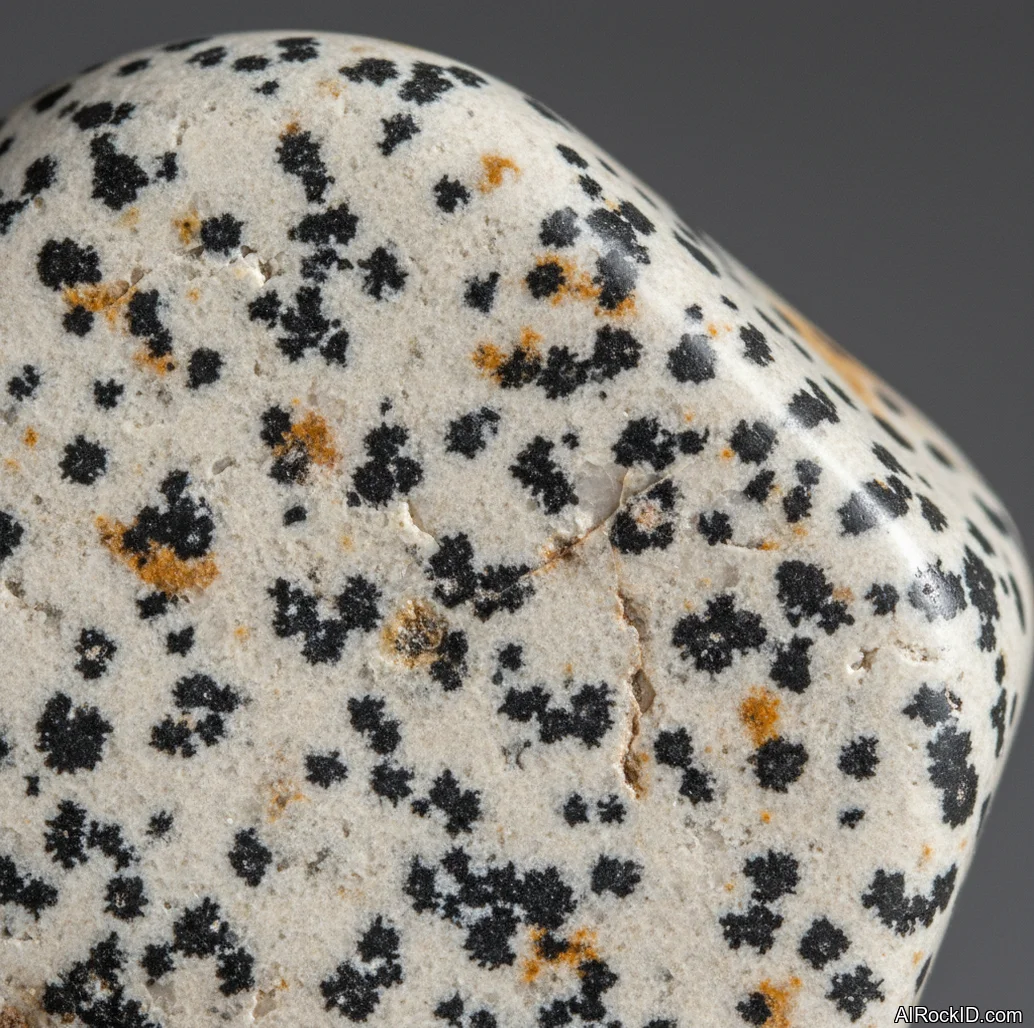
Quick answer: Dalmatian Stone is a spotted, feldspar-rich igneous rock often sold as tumbled stones, beads, and carvings. Its cream-to-tan base with black tourmaline-like spots makes it visually distinctive, though it can be confused with jasper, aplite, or dyed lookalikes.
AI Rock ID can help screen Dalmatian Stone by checking its spotted pattern, base color, texture, and likely mineral mix from a clear photo. RockIdentifier.io provides visual identification support, but lab testing is needed for certainty when material is dyed, mislabeled, or sold under trade names.
Good fit
- Collectors who want an affordable, recognizable spotted stone
- Beginners learning to compare trade names with geological descriptions
- Jewelry buyers looking for neutral cream-and-black beads
- People who prefer durable tumbled stones for handling or display
Not a good fit
- Anyone needing a rare or high-value collector mineral
- Buyers who require a precisely verified mineral formula without testing
- Outdoor jewelry use where frequent impact or abrasion is expected
- Collectors avoiding trade names or mixed-rock materials
Most commonly confused with
- Dalmatian Jasper: Often used as a trade synonym, but the material is usually not true jasper because it is feldspar-rich rather than microcrystalline quartz.
- Snowflake Obsidian: Snowflake obsidian has a black glassy base with gray-white snowflake patterns, the reverse of Dalmatian Stone’s pale base with dark spots.
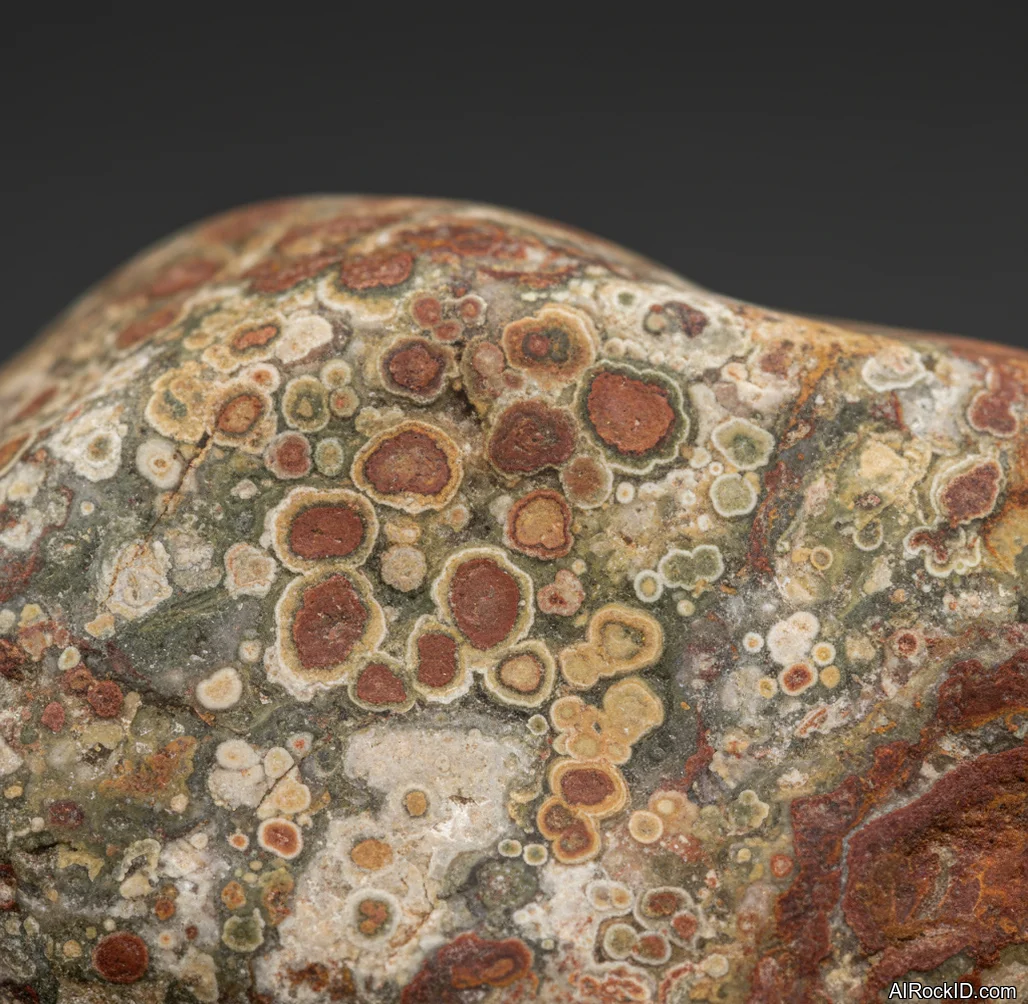
- Leopard Skin Jasper: Leopard skin jasper shows ringed or orbicular brown, tan, and red patterns rather than simple black spots on a cream base.
- Aplite: Aplite can be pale and feldspar-rich, but it usually lacks the evenly scattered black spot pattern associated with Dalmatian Stone.
Dalmatian Stone vs. Common Lookalikes
| Material | Typical Look | Key Difference | Mohs Hardness |
|---|---|---|---|
| Dalmatian Stone | Cream to tan base with black spots | Feldspar-rich rock with dark mineral inclusions | About 6–7 |
| Snowflake Obsidian | Black glass with gray-white patches | Glassy volcanic texture and reversed color pattern | About 5–5.5 |
| Leopard Skin Jasper | Brown, tan, red, and cream orb patterns | More circular or landscape-like markings | About 6.5–7 |
| Dyed Howlite | White or colored stone with gray to dark veining | Softer, more porous, and commonly dyed | About 3–3.5 |
| Aplite | Light-colored granular rock | Usually lacks distinct black dot pattern | Variable, often about 6 |
AI identification confidence
AI identification confidence is usually moderate to high when Dalmatian Stone is photographed in good light and shows a pale feldspar-rich base with scattered black spots. Confidence drops when the stone is polished into small beads, heavily dyed, overexposed, or shown without scale.
When AI gets it wrong
- The photo shows only one small bead or a very close crop with no overall pattern.
- The black spots are actually paint, dye, or surface staining rather than natural inclusions.
- The stone is labeled as jasper even though the visual and geological features fit a feldspar-rich rock.
- Lighting makes the cream base appear white, gray, or yellow and changes the apparent contrast.
Final recommendation
Choose Dalmatian Stone when you want a durable, affordable spotted rock and the cream base with black inclusions is the main attraction. For authenticity, compare the pattern, hardness, and seller description rather than relying only on the trade name.
How to Check Dalmatian Stone Authenticity
Authentic Dalmatian Stone typically has dark inclusions that appear embedded in the rock, not printed or painted on the surface. Be cautious with unusually bright colors, perfectly uniform spots, or listings that avoid showing close-up photos. A simple hardness comparison can help separate it from softer lookalikes such as dyed howlite, but destructive scratch tests should not be used on finished jewelry.
Dalmatian Stone Buying Tips
Look for even polishing, natural-looking spot distribution, and seller photos taken in neutral lighting. Beads and tumbles are usually inexpensive, while larger carvings cost more because of size and workmanship rather than rarity. The name “Dalmatian Jasper” is common in retail listings, but buyers should understand that it is usually a trade name rather than a strict geological label.
Best Photo Tips for Identifying Dalmatian Stone
Photograph the stone in daylight or neutral indoor light on a plain background. Include one close-up image and one full-stone image so the spot pattern, grain, and polish can be evaluated together. Avoid heavy filters, flash glare, or wet surfaces because they can make the base color and inclusions look misleading.
What Is Dalmatian Stone?
Dalmatian Stone is a spotted, feldspar-rich igneous rock (you’ll also see it sold as “Dalmatian jasper”) with black inclusions, usually tourmaline. Look, the name isn’t subtle. It genuinely resembles a Dalmatian coat: a cream-to-tan base with those peppered black dots, and it generally polishes up really well.
If you grab a tumbled piece, the first thing you notice is the heft. It feels like a solid stone in your hand, not that glassy obsidian vibe, and not weirdly light like some dyed howlite fakes. The surface is typically smooth but not greasy, and under bright light you can sometimes spot tiny, sugary-looking quartz patches that read a little grayer than the warmer feldspar around them.
Most of what turns up in shops is tumbled, carved, or drilled into beads. Raw chunks are out there too, but they’re just not as photogenic (kind of lumpy, honestly). And since “jasper” gets thrown around as a catch-all trade word, you’ll run into plenty of confident labels that aren’t quite right.
Origin & History
Dalmatian Stone doesn’t have that neat little “first described by” date you get with a lot of single-mineral species, because it isn’t a newly defined mineral at all. It’s a commercial name for a rock. Simple as that.
The name comes straight from what it looks like in your hand. Cream-colored base, black spots, basically the dog’s coat. You don’t need a microscope to get the joke.
In the modern gem trade, it really started popping up as tumbled stones and bead strands in the late 20th century, back when lapidary suppliers were pushing a ton of patterned material with easy, friendly names (the kind that sell fast in a bin). Most dealers still call it Dalmatian jasper, even though it’s not a true jasper in the strict geological sense.
Where Is Dalmatian Stone Found?
Most commercial Dalmatian Stone on the market is reported from Mexico, with smaller amounts sold from the USA and other mixed-source lapidary rough.
Formation
Look at the texture for a second and it’s pretty clear this is an igneous rock, not a microcrystalline silica jasper. The base is mostly feldspar with little bits of quartz, and the black “spots” aren’t paint-like dots at all. They’re separate minerals that crystallized out of the melt or showed up as the rock cooled down and then altered.
Put it next to a true jasper and you’ll feel the difference right away. Jasper has that tight, waxy, microcrystalline slickness, but Dalmatian Stone feels a touch grainy when it’s unpolished (almost like fine sandpaper if you run a thumb across it). And those black inclusions? In the trade they’re usually called tourmaline, often schorl, though some pieces are reported with amphibole like arfvedsonite. Either way, they tend to look like scattered grains and little blobs, not crisp, ink-dot specks.
How to Identify Dalmatian Stone
Color: Cream, beige, or light tan base with scattered black spots; some pieces show grayish quartz patches or faint brown streaking.
Luster: Polished pieces have a vitreous to slightly waxy luster depending on how quartz-rich the mix is.
Pick up a strand of beads and check if every bead has identical dot patterns. If it looks copy-pasted, you’re probably looking at a printed or resin product. The real test is a loupe: natural spots have fuzzy edges or uneven grain boundaries, not perfectly round ink dots. And if you scratch it with a steel nail, it usually resists better than soft dyed stones, but it won’t feel “glass hard” like pure quartz.
Common Look-Alikes
Dalmatian Stone is sometimes confused with these materials:
- Dyed howlite or dyed magnesite sold as “Dalmatian jasper” (black specks are often dye spots that bleed into cracks)
- Leopard skin jasper / leopardite rhyolite (more orbicular rings and blotches, less pepper-dot spotting)
- Snowflake obsidian (black glass with gray “snowflakes”, opposite color balance and a glassy feel)
- Speckled granite or diorite (salt-and-pepper igneous rock, usually more gray/white and crystalline-looking)
- Dalmatian-print resin or glass souvenir stones (too uniform, too glossy, and sometimes oddly warm in the hand)
Market Cautions & Treatments
When AI Can Get This Wrong
At first glance, phone-ID apps mix Dalmatian Stone up with leopard skin jasper and even snowflake obsidian because all three read as “spotted” in a thumbnail. Photos hide the key tells: Dalmatian Stone’s cream-to-tan feldspar base looks waxy-polished, while dyed howlite looks flat and chalky and often shows dark bleed lines in pits. The real test is physical: a steel pin won’t bite easily, and the stone should feel solid and cool in the hand, not lightweight or warm like resin.
Properties of Dalmatian Stone
Physical Properties
| Crystal System | Amorphous |
| Hardness (Mohs) | 6.0-7.0 (Hard (6-7.5)) |
| Density | 2.60-2.75 |
| Luster | Vitreous |
| Diaphaneity | Opaque |
| Fracture | Uneven |
| Streak | white |
| Magnetism | Non-magnetic |
| Colors | cream, beige, tan, black, gray |
Chemical Properties
| Classification | Silicates |
| Formula | Mixture; commonly KAlSi3O8–NaAlSi3O8 (feldspars) + SiO2 (quartz) with black inclusions such as NaFe3Al6(BO3)3Si6O18(OH)4 (schorl tourmaline) or NaNa2Fe5Si8O22(OH)2 (arfvedsonite) |
| Elements | Si, O, Al, Na, K, Fe, B, H |
| Common Impurities | Ca, Mg, Ti, Mn |
Optical Properties
| Refractive Index | 1.52-1.55 |
| Birefringence | None |
| Pleochroism | None |
| Optical Character | Isotropic |
Dalmatian Stone Health & Safety
Handling it is pretty low risk. But if you cut it or grind it, you can kick up silica-bearing dust, and you really don’t want to breathe that stuff in.
Safety Tips
Use water when you’re grinding. Wear a respirator that actually fits your face for stone dust (not the loose one that fogs your glasses). And when you’re done, scoop up the slurry and wipe it down instead of letting it dry out and sweeping it up. Why make dust on purpose?
Dalmatian Stone Value & Price
Price Range
Rough/Tumbled: $3 - $25 per tumbled stone (about 20-40 mm) or $8 - $40 per 100 g rough
Price mostly comes down to the pattern and the polish. Pieces with that clean, creamy background and crisp black spotting usually cost more. But if the color drifts muddy or brown, or the slab’s got a bunch of fractures you can feel with a fingernail (even after it’s been polished), the price drops fast.
Durability
Durable — Scratch resistance: Good, Toughness: Good
It’s generally stable in normal household conditions, but hard knocks can chip edges, especially on carvings with thin points.
How to Care for Dalmatian Stone
Use & Storage
Store it like you would most tumbled stones: in a pouch or a divided box so it doesn’t rattle against softer material. If you’ve got polished spheres, keep them off sunny windowsills just to avoid heat cycling and tiny stress cracks.
Cleaning
1) Rinse with lukewarm water and a drop of mild soap. 2) Use a soft toothbrush to get grime out of pits around the black spots. 3) Rinse well and dry with a soft cloth.
Cleanse & Charge
If you do energy-style cleansing, running water or a quick smoke cleanse is plenty. I avoid salt soaks because it’s messy and doesn’t do the polish any favors long term.
Placement
On a desk it holds up fine, and it doesn’t mind being handled. I like it where you’ll actually pick it up, because the pattern is half the fun.
Caution
If you’re going to cut, drill, or grind it, don’t breathe the dust. Seriously. Keep it wet while you work (a little slurry is normal), and wear the right PPE so you’re not coughing grit out later. And skip the ultrasonic cleaner. You don’t need it, and on lower-grade rough it can actually make existing fractures worse. Why risk it?
Works Well With
Dalmatian Stone Meaning & Healing Properties
Most people grab Dalmatian Stone when they want something upbeat, but not floaty. And yeah, that sounds kind of squishy. But I’ve watched people in the shop pick a piece up, grin without even noticing, then keep rolling it in their palm like a worry stone. You can see it happen.
In crystal-healing circles, it usually gets talked about as grounding with a “play nice” feel to it, like softening cynicism or helping you stay steady without getting rigid. Thing is, that’s spiritual practice, not medicine. If anxiety or mood stuff is chewing up your day, sure, a stone can work as a tactile cue (something to hold, something to come back to), but it isn’t treatment. Full stop.
The name is honestly the biggest headache. Calling it jasper makes people assume it’ll act exactly like jasper across the board, and it won’t. Energetically, people tend to lump it in with the earthy jaspers. Physically, it’s a mixed rock, so one piece can feel more “quartz-y” and another can read more feldspar-heavy, even if they came out of the same bin. I’ve had beads that drilled like butter, and I’ve had others that fought the bit the whole time (same setup, same day). Go figure.
Common mistakes
- Assuming every stone sold as Dalmatian Jasper is true jasper.
- Confusing black-spotted cream Dalmatian Stone with black-based snowflake obsidian.
- Using metaphysical labels as proof of mineral identity.
- Judging authenticity only by polish quality rather than pattern, hardness, and texture.
- Assuming all black spots are tourmaline without mineral testing.
- Overpaying for common tumbled material because it is described with rare-sounding trade names.
Identify Dalmatian Stone from a photo
Compare Dalmatian Stone traits, care tips, value clues, and common lookalikes with a clear photo.