Garnet In Wollastonite


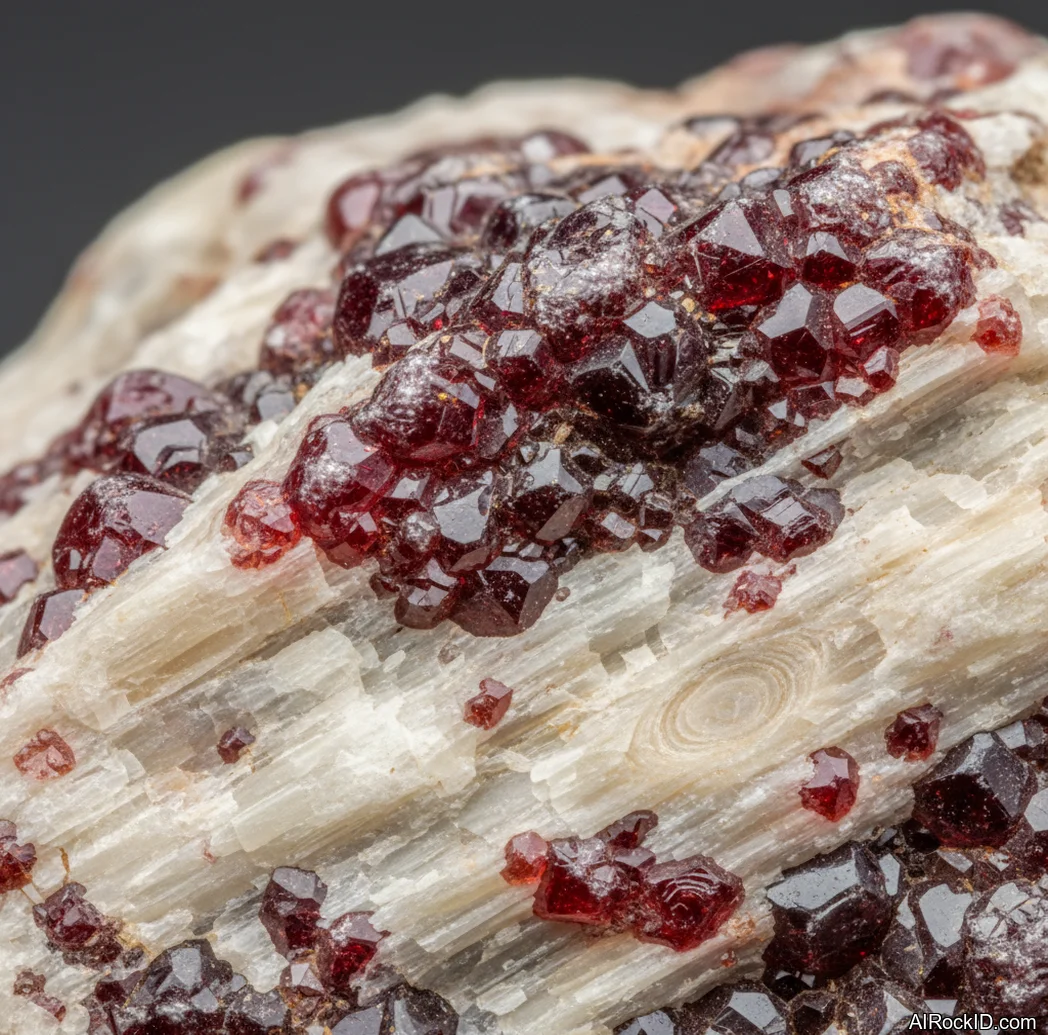
Quick answer: Garnet in wollastonite is a rock-and-mineral association, usually showing reddish brown to orange garnet crystals set in a white, gray, or cream wollastonite matrix. It is often sold as decorative rough, palm stones, carvings, or collector pieces rather than as a single-species mineral specimen.
AI Rock ID can help compare garnet in wollastonite against visually similar red-and-white or brown-and-white mineral pieces using color, texture, and matrix clues. RockIdentifier.io treats visual identification as a starting point, so a hardness check, streak observation, or expert review may still be useful for valuable or unusual specimens.
Good fit
- Collectors who like visible crystal-in-matrix specimens
- Buyers looking for decorative rough or carvings with natural contrast
- Beginners learning to recognize garnet-bearing metamorphic rocks
- People who prefer durable display stones over delicate, soluble, or flaky minerals
Not a good fit
- Anyone needing a precisely identified garnet species without lab testing
- Buyers expecting transparent gem-quality garnet throughout the piece
- Jewelry use where uneven hardness between garnet and wollastonite may affect polishing and wear
- Situations requiring confirmation of treatment, dye, or exact locality from appearance alone
Most commonly confused with
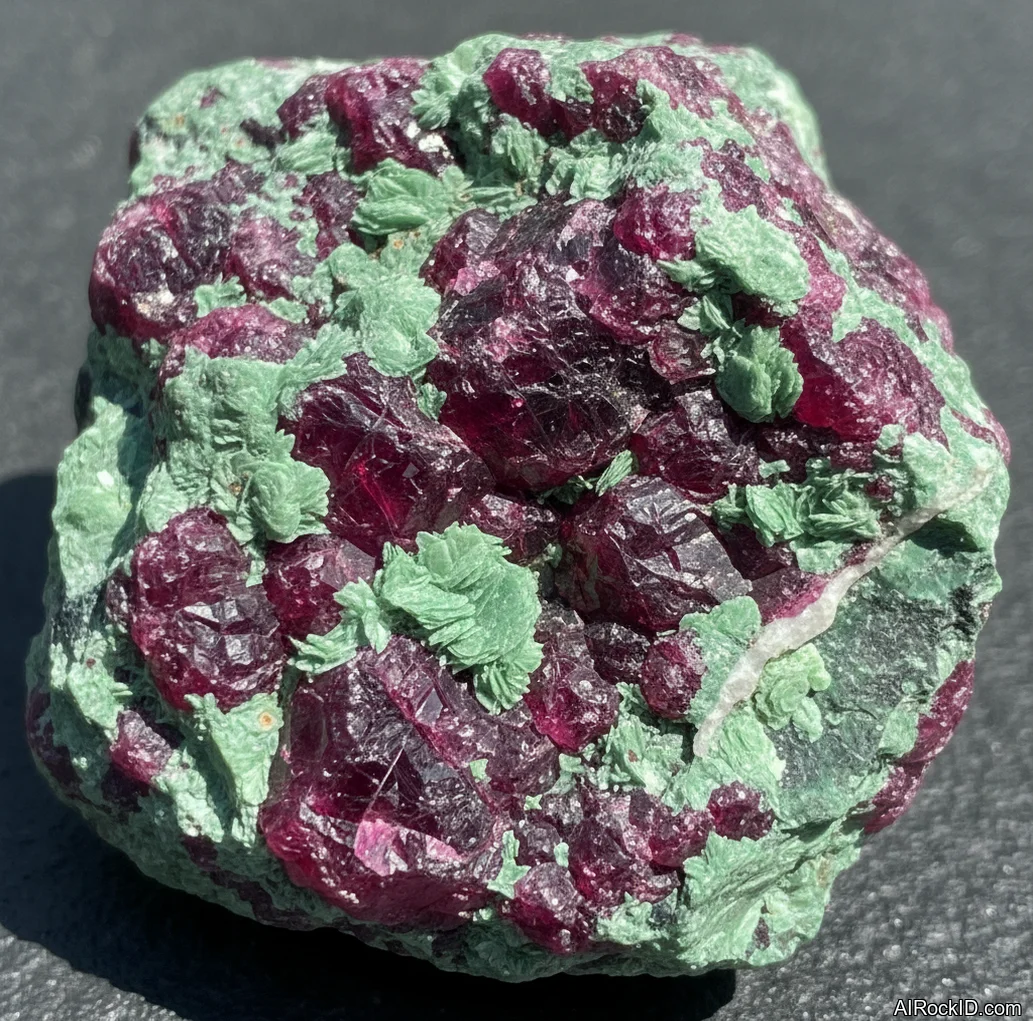
- Ruby in Zoisite: Ruby in zoisite usually shows red to pink corundum with green zoisite and often black hornblende, not a mostly white wollastonite matrix.
- Garnet in Schist: Garnet in schist has a flaky, mica-rich matrix, while garnet in wollastonite is typically more granular to fibrous and pale.
- Eudialyte: Eudialyte often appears as pink to red patches in dark or gray alkaline rock and lacks distinct garnet crystal form.
- Cinnabar in Matrix: Cinnabar is usually brighter scarlet to deep red, has a much higher density, and is softer than garnet.
Garnet in Wollastonite Lookalike Comparison
| Specimen | Typical Look | Key Difference |
|---|---|---|
| Garnet in wollastonite | Red-brown to orange garnet in white, gray, or cream matrix | Pale wollastonite matrix with harder garnet crystals |
| Ruby in zoisite | Red to pink areas with green and black matrix | Green zoisite is a major visual clue |
| Garnet in schist | Rounded garnets in shiny, layered mica rock | Matrix splits or flakes along mica layers |
| Eudialyte | Pink to red patches in gray, black, or white rock | Usually patchy masses rather than obvious garnet crystals |
| Rhodonite | Pink stone with black veins or patches | Lacks separate garnet grains in wollastonite |
AI identification confidence
AI identification is usually more reliable when the specimen shows distinct reddish garnet crystals against a pale wollastonite matrix in clear, natural lighting. Confidence drops when the stone is polished, dyed, heavily weathered, or photographed without scale and multiple angles.
When AI gets it wrong
- Polished carvings may blur the boundary between garnet and matrix.
- Red dye, resin filling, or surface polish can make unrelated stones look like garnet-bearing material.
- Green, black, or pink matrix minerals may point to ruby in zoisite, eudialyte, or rhodonite instead.
- A photo alone usually cannot confirm whether the garnet is grossular, almandine, or another garnet species.
Final recommendation
For buying, prioritize clear photos that show natural color, visible crystal boundaries, and both dry and polished surfaces when possible. If the listing claims rare locality, exact garnet species, or high value, ask for provenance or testing rather than relying only on appearance.
How to Photograph Garnet In Wollastonite for Identification
Use daylight or neutral white light and photograph the specimen dry before adding any close-up images. Include a ruler or coin for scale, and capture both the garnet-rich areas and the pale matrix. Sharp side views can help show whether the red material forms crystals, rounded grains, or surface patches.
Buying Checks for Garnet In Wollastonite
A useful listing should describe the piece as a mixed mineral or rock specimen, not as solid garnet. Look for consistent color through chipped or natural edges, because surface-only red color can indicate dye or coating. For carvings, expect minor pits or uneven polishing where garnet and wollastonite respond differently to abrasion.
Authenticity Clues in Garnet In Wollastonite
Natural pieces commonly show irregular garnet distribution, small fractures, and variation in matrix color. Perfectly uniform red spots, unnaturally bright color concentrated in cracks, or a waxy coating may justify closer inspection. Simple observations such as hardness contrast and magnified crystal texture can help separate natural garnet-bearing material from altered decorative stone.
What Is Garnet In Wollastonite?
Garnet in wollastonite is a natural rock where red to brown garnet crystals sit locked into a white to gray wollastonite matrix.
Grab a chunk and the contrast hits you first. The garnets look like tiny button dots, sometimes like rounded dodecahedrons, sitting in this pale, almost sugary-looking background. And the feel gives it away fast: those garnet bumps are glassy-smooth under your fingertip, but the wollastonite around them feels drier, a little fibrous, kind of like very fine-grit sandpaper (especially along the lighter streaks).
People glance at it and call it “ruby in marble,” but that’s not what it is. Most of what’s sold as garnet in wollastonite is more of a lapidary mix than a collector crystal specimen, since the wollastonite in these pieces usually doesn’t show up as crisp, sharp blades. But when the garnets are nicely formed and spaced out, it still makes a killer display slab, or a palm stone you keep picking up without thinking.
Origin & History
Wollastonite got its official write-up in 1818, and it was named after the English chemist and mineralogist William Hyde Wollaston. “Garnet,” on the other hand, is an older group name, pulled from the Latin *granatum*, a nod to pomegranate seeds. And yeah, that comparison tracks because good red garnets sitting in pale rock really do look like little seeds scattered through it.
Thing is, “garnet in wollastonite” isn’t a formal species name. It’s more of a trade and collector label. Most dealers use it for calc-silicate skarn or metamorphosed limestone where garnet grew right alongside wollastonite during contact metamorphism. The first time I ran into it at a show, it was tossed in the same bins as “garnet in marble” and “ruby in zoisite,” so you should expect a bit of label slippage (it happens).
Where Is Garnet In Wollastonite Found?
It turns up in calc-silicate skarns and metamorphosed limestones worldwide, with market material commonly coming from Brazil, Russia, and parts of the western USA.
Formation
Look at the geology and it clicks pretty fast. Wollastonite (a calcium silicate) shows up when limestone or other calcium-rich rocks get cooked by heat and reactive fluids, usually right near an intrusive body. Get silica in there too and, yep, you’re in wollastonite territory.
Now, mix in aluminum plus a bit of iron and garnet can grow right alongside it. That’s why you’ll sometimes see garnet crystals sitting in a pale matrix that has that baked, contact-metamorphism look to it (kind of like it’s been toasted). But here’s the catch: that same material can grade from clean, white wollastonite with just a few garnets sprinkled in to darker, messier skarn with a bunch of other stuff mixed in. And if the seller cherry-picked, you’ll end up with the pretty end of that range.
How to Identify Garnet In Wollastonite
Color: Most pieces show brick-red to deep reddish-brown garnets in a white, off-white, or light gray wollastonite matrix. Some matrix looks slightly greenish-gray if other skarn minerals are present.
Luster: Garnet is typically vitreous, while wollastonite runs vitreous to silky on fibrous areas.
Pick up the stone and run your thumb across it. You can usually feel the garnet crystals as harder, smoother bumps against the chalkier or faintly fibrous wollastonite. If you scratch an inconspicuous spot with a steel nail, the wollastonite may mark or scratch, but the garnet won’t. The real test is a hand lens: garnet often shows rounded dodecahedral faces, while wollastonite looks like fine blades or a sugary mass rather than clean cleavage blocks.
Common Look-Alikes
Garnet In Wollastonite is sometimes confused with these materials:
- Garnet in calcite (red garnet bumps in a white matrix, but calcite shows obvious cleavage and fizzes in acid)
- Rhodonite (massive pink to reddish rock that can pass in photos, but it’s usually more uniformly pink and lacks hard, glassy garnet nubs)
- Eclogite (red garnet in a darker green matrix; sellers sometimes call any garnet-in-matrix “eclogite” even when the host is pale)
- Garnet in marble (similar red-on-white look, but the host is sugary calcite/dolomite, not the slightly fibrous wollastonite feel)
- Dyed “garnet in white matrix” composites (color-boosted red spots or stabilized matrix, often sold as natural garnet in wollastonite)
- Red glass chips in white resin or cement (crafty fakes that mimic the dotty look, but they feel warmer and the red pieces are too uniform)
Market Cautions & Treatments
When AI Can Get This Wrong
At first glance, AI loves to call pale-matrix red-spot rocks “garnet in marble” or even “rhodonite,” because photos flatten the fibrous wollastonite texture and the garnets just read as red dots. Look closely at the surface: wollastonite often shows a faint silky, fibrous grain, while calcite/marble looks more sugary with cleavage flashes. The real test is quick: a drop of weak acid will fizz on calcite/marble hosts but won’t react the same way on wollastonite, and the garnet nubs should feel harder and slicker than the matrix when you rub a fingertip across them.
Properties of Garnet In Wollastonite
Physical Properties
| Crystal System | Monoclinic |
| Hardness (Mohs) | 4.5–7.5 (Medium (4-6)) |
| Density | 2.85–3.65 g/cm3 |
| Luster | Vitreous |
| Diaphaneity | Opaque |
| Fracture | Uneven |
| Streak | white |
| Magnetism | Non-magnetic |
| Colors | white, gray, red, reddish-brown, brown |
Chemical Properties
| Classification | Silicates |
| Formula | CaSiO3 + X3Y2(SiO4)3 (garnet group; commonly Ca3Al2(SiO4)3 to Ca3Fe2(SiO4)3) |
| Elements | Ca, Si, O, Al, Fe |
| Common Impurities | Mn, Mg, Ti |
Optical Properties
| Refractive Index | 1.63–1.89 |
| Birefringence | 0.010–0.015 |
| Pleochroism | None |
| Optical Character | Biaxial |
Garnet In Wollastonite Health & Safety
It’s safe to handle and put on display, and typical specimens don’t come with any special toxicity worries. But it’s still a rock, so if you’re cutting it on a saw or sanding it down (and you can smell that gritty dust in the air), don’t breathe the dust in.
Safety Tips
If you’re going to shape this stuff, put on a respirator first. And keep a little water on it while you work so the dust doesn’t go flying everywhere. Then wash your hands when you’re done.
Garnet In Wollastonite Value & Price
Price Range
Rough/Tumbled: $10 - $120 per piece
Price swings based on a few really obvious things once you’ve actually had the material in your hands. How clean and white the wollastonite looks (some pieces are bright, almost chalky white, and others come off a bit gray), how red and well-formed the garnets are, and whether you’re buying a chunky display piece you can set on a shelf or just small tumbled material.
Durability
Moderate — Scratch resistance: Fair, Toughness: Fair
It’s generally stable, but the softer wollastonite matrix can scuff and undercut in jewelry-style wear even when the garnet itself is tough.
How to Care for Garnet In Wollastonite
Use & Storage
Store it so the softer matrix isn’t rubbing against harder stones. I keep mine in a tray with little dividers because the wollastonite can pick up scuffs fast.
Cleaning
1) Rinse briefly under lukewarm water. 2) Use a soft toothbrush with a drop of mild soap to clean around garnet bumps. 3) Rinse again and pat dry, then let it air-dry fully before putting it away.
Cleanse & Charge
If you do ritual-style cleansing, stick to smoke, sound, or a quick rinse and dry. Long salt soaks can be rough on porous matrix surfaces even when the minerals themselves are fine.
Placement
Look closely at your lighting. Side light brings out the garnet relief and makes the white matrix look less flat on a shelf.
Caution
Don’t assume the hardness is even across the whole thing. Garnet will take a nice polish, sure, but the wollastonite’s the weak link. It can undercut, the edges can chip, and if you carry it in your pocket it’ll start looking scuffed and worn fast (especially along the sharper corners).
Works Well With
Garnet In Wollastonite Meaning & Healing Properties
Compared to plain garnet, this mix gets described more like “energy with a brake pedal.” That’s the vibe people mean. You’ve got garnet, which a lot of folks link with drive and getting your body moving, and then there’s that pale calcium-silicate matrix that comes off calmer, steadier, more grounded.
Hold a polished palm stone and you’ll notice it right away: the surface isn’t uniform. Your thumb slides along smooth matrix, then catches on a garnet spot that’s a little firmer and subtly raised. I’ve seen people in a tense conversation rub those tiny bumps without even realizing they’re doing it, like a worry stone that actually gives your hand something to do. That’s the real-life use I see most. Not big promises.
But look, keep it honest. Any “healing” talk here is personal and traditional, not medical care. If you like stones as reminders, this one’s a solid pairing for staying steady while you push through a task (especially when you’re tempted to floor it and burn out).
Common mistakes
- Assuming every red area is gem-quality garnet suitable for faceting
- Calling the entire specimen garnet when it is a garnet-bearing matrix rock
- Identifying the garnet species as grossular from appearance alone
- Mistaking polished surface color for natural internal color
- Using one close-up photo without scale to judge authenticity or value
- Expecting the wollastonite matrix and garnet crystals to polish or wear at the same rate
Identify Garnet In Wollastonite from a photo
Compare Garnet In Wollastonite traits, care tips, value clues, and common lookalikes with a clear photo.