Eudialyte


Quick answer: Eudialyte is best recognized by its pink to red color, occurrence with dark and light minerals in nepheline syenite, and moderate hardness. Because similar-looking red minerals can occur in patterned rocks, visual identification is useful but not always conclusive.
AI Rock ID can help compare a suspected eudialyte specimen against similar red and pink minerals using visible features such as color, texture, and host rock. RockIdentifier.io provides crystal and rock references that can support identification, buying checks, and care decisions.
Good fit
- Collectors who like uncommon minerals from alkaline igneous rocks
- People looking for pink-red stones with natural black, white, or gray matrix patterns
- Cabochon and specimen collectors who can handle moderate-hardness minerals with care
- Buyers who prefer distinctive natural patterning over uniform color
Not a good fit
- Jewelry that will receive heavy daily wear or frequent knocks
- Buyers who need a very hard, scratch-resistant gemstone
- Anyone expecting every piece to show bright, even red color
- Collectors who cannot verify provenance or labeling on expensive specimens
Most commonly confused with
- Rhodonite: Rhodonite is usually a manganese silicate with pink color and black veining, while eudialyte commonly occurs in nepheline syenite with mixed red, black, white, or gray minerals.
- Thulite: Thulite is a pink variety of zoisite and often has a more granular pink appearance rather than the complex alkaline-rock association typical of eudialyte.
- Rhodocrosite: Rhodochrosite is a carbonate with lower hardness and commonly shows banding or cleavage, unlike the silicate mineral eudialyte.
- Garnet: Red garnet is usually harder and often forms distinct crystals or massive grains rather than the patterned syenite-hosted appearance of many eudialyte pieces.
Eudialyte vs Similar Pink and Red Stones
| Stone | Typical Look | Key Difference | Mohs Hardness |
|---|---|---|---|
| Eudialyte | Pink-red areas in black, white, or gray alkaline rock | Commonly associated with nepheline syenite | 5-6 |
| Rhodonite | Pink to rose with black manganese veining | Usually more vein-like black patterning | 5.5-6.5 |
| Rhodochrosite | Pink to red, sometimes banded | Carbonate; softer and reacts to acid testing by professionals | 3.5-4 |
| Thulite | Pink, granular to massive | Zoisite variety; generally lacks eudialyte's typical syenite matrix | 6-6.5 |
| Garnet | Deep red grains or crystals | Harder, commonly glassy, often forms equant crystals | 6.5-7.5 |
AI identification confidence
AI identification confidence for eudialyte is moderate when the photo clearly shows red to pink patches within a mixed alkaline rock matrix. Confidence is lower for close-up images without scale, polished cabochons with no visible matrix, or specimens labeled only by color.
When AI gets it wrong
- A polished stone shows only red color and hides the host rock texture.
- Lighting makes brown, purple, or black minerals appear red.
- The specimen is rhodonite, rhodochrosite, or ruby in matrix with similar pink-red contrast.
- The image lacks scale, multiple angles, or a clear view of luster and grain pattern.
Final recommendation
Choose eudialyte when the specimen has a credible source, natural-looking red zones, and matrix features consistent with alkaline igneous rock. For higher-priced pieces, ask for locality information and consider confirmation from a qualified mineral dealer or gem lab.
How to Check Eudialyte Before Buying
Look for natural variation rather than perfectly uniform red color, because many eudialyte pieces occur as patterned material with other minerals. Ask whether the piece is rough, polished, stabilized, dyed, or assembled, especially for cabochons and beads. Locality information can add confidence, since notable eudialyte sources include alkaline complexes such as those in Greenland, Russia, Canada, and Norway.
Photographing Eudialyte for Identification
Use daylight or neutral lighting and include both close-up and full-stone photos. A useful image should show the red mineral, surrounding matrix, luster, and scale. Avoid strong saturation filters, because they can make rhodonite, garnet, or altered feldspar look more like eudialyte.
Authenticity Clues for Polished Eudialyte
Natural eudialyte cabochons commonly show irregular patches, mineral boundaries, and mixed host-rock colors. Very bright, even red pieces without visible mineral texture should be checked carefully for dyeing, mislabeling, or a different material. A simple scratch test is not recommended on finished stones, but hardness and specific gravity observations by a professional can help separate lookalikes.
What Is Eudialyte?
Eudialyte is a complex sodium-calcium-cerium iron manganese zirconium cyclosilicate, and it usually turns up as pink to raspberry-red grains in alkaline igneous rocks.
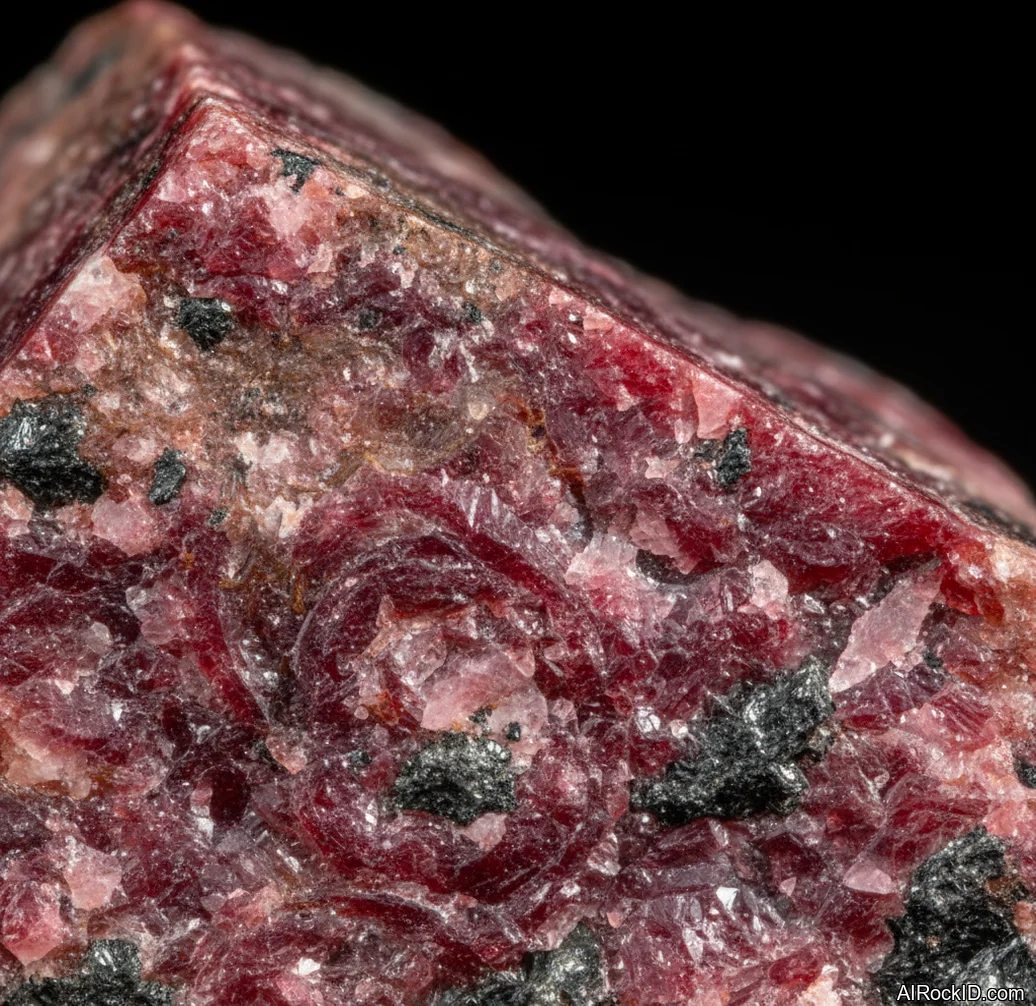
Pick up a chunky piece in matrix and, honestly, it’s usually not the “sparkly crystal” type of mineral. It’s more like little blobs of red jam caught in gray rock, with thin black needles or a few greenish bits threading through. Under those bright shop LEDs, the red can look almost unreal. But tilt it in normal room light and it chills out, going softer, rosier, kind of waxy.
And here’s what collectors figure out pretty quickly. It’s not super hard. A polished cab will take a shine, sure, but it’ll also grab tiny scuffs if you drop it in a pocket with quartz or feldspar. I’ve handled eudialyte that feels a touch “greasier” than garnet or ruby. Not oily. Just that resinous slip you notice when you rub your thumb across a polished face (you can feel it right away).
Origin & History
Greenland’s where this story really kicks off. Eudialyte got its first proper description in 1819, when the German mineralogist Friedrich Stromeyer worked on material from the Ilímaussaq area, and that spot is still one of the classic places people bring up when alkaline complexes come up.
The name’s built from Greek roots for “well” and “decomposable,” which sounds kind of strange until you’ve actually seen it: a tiny chip hits acid and it starts fizzing, then softens and breaks down way faster than the tougher silicates sitting next to it. And back in the day, old-timers called it “almandine spar” in the trade because that reddish color can trick your eye at first glance, but once you test it, it’s clearly not garnet. Different beast.
Where Is Eudialyte Found?
It turns up in alkaline igneous complexes, especially nepheline syenites and related rocks. Russia’s Kola Peninsula and Greenland are the big classic sources, with good material also coming out of places like Mont Saint-Hilaire and Poços de Caldas.
Formation
Alkaline rocks are the whole trick here. Eudialyte shows up late when sodium-rich magmas are cooling down, and the chemistry gets strange enough to cram in zirconium, rare earth elements, plus a bunch of other misfit elements that just don’t squeeze into simpler minerals.
Look at a typical piece up close and you’ll usually catch it hanging around nepheline, alkali feldspar, aegirine, sodalite, and sometimes arfvedsonite. It’s “late-stage” because it likes those evolved little pockets and skinny veins where the melt or fluids got super concentrated. But it’s not some pegmatite show-off like tourmaline. Most of the time it’s granular and kind of sprinkled through the rock, and you end up hunting for those best red patches (the ones that actually pop).
How to Identify Eudialyte
Color: Most eudialyte is pink, raspberry-red, or purplish red, usually in a gray or white matrix. It can also look brownish red or even dull if it’s weathered.
Luster: Luster ranges from vitreous to resinous, especially on polished surfaces or fresh breaks.
Pick up a piece in nepheline syenite and check the feel of the red areas. Real eudialyte in matrix doesn’t feel like glassy garnet; it’s a little softer and the polish looks more “wet” than “sparkly.” If you scratch it with a steel point, it can mark more easily than garnet would. The problem with look-alikes is that red feldspar and garnet can sit in similar rocks, so hardness and that resinous luster are your quick field tells.
Common Look-Alikes
Eudialyte is sometimes confused with these materials:
- Rhodonite (especially in gray/black matrix, sold as "pink in granite")
- Thulite (pink zoisite, often lumped in with "pink feldspar" pieces)
- Rhodocrosite (tumbled pink-red pieces get mislabeled as eudialyte a lot)
- Garnet in matrix (almandine or spessartine grains can read as the same red specks in photos)
- Dyed magnesite or dyed howlite (hot pink/red dye used to fake "eudialyte" tumble stones)
- Red/pink glass sold as "raspberry eudialyte" (especially as cheap beads or cabochons)
Market Cautions & Treatments
When AI Can Get This Wrong
AI photo ID gets tripped up when eudialyte is just small red grains in a gray rock, because it looks like rhodonite, garnet-in-matrix, or even a random "pink granite" snapshot. The real test is a quick hardness check and a loupe: eudialyte (5 to 6) won’t act like garnet (harder) and it tends to show those irregular, jelly-like patches with dark aegerine needles threading through the matrix. If the photo is a polished bead strand, AI will often call dyed magnesite or glass "eudialyte" unless you can spot dye pooling around holes or obvious bubbles.
Properties of Eudialyte
Physical Properties
| Crystal System | Trigonal |
| Hardness (Mohs) | 5-6 (Medium (4-6)) |
| Density | 2.8-3.1 g/cm3 |
| Luster | Resinous |
| Diaphaneity | Translucent to opaque |
| Fracture | Uneven |
| Streak | white |
| Magnetism | Non-magnetic |
| Colors | pink, raspberry red, purplish red, brownish red |
Chemical Properties
| Classification | Silicates (cyclosilicate) |
| Formula | Na4(Ca,Ce)2(Fe,Mn)ZrSi8O22(OH,Cl)2 |
| Elements | Na, Ca, Ce, Fe, Mn, Zr, Si, O, H, Cl |
| Common Impurities | Sr, Nb, REE, K |
Optical Properties
| Refractive Index | 1.60-1.64 |
| Birefringence | 0.020 |
| Pleochroism | Weak |
| Optical Character | Uniaxial |
Eudialyte Health & Safety
Normal handling’s fine, and if it gets splashed or you rinse it off quick, that’s usually fine too. But if you’re sawing, grinding, or polishing it and you see that fine powder hanging in the air or settling on your hands, don’t breathe it in.
Safety Tips
If you’re going to cut or sand it, keep it wet with water, crack some windows or set up ventilation, and wear a real respirator rated for fine particulates (not one of those flimsy paper masks).
Eudialyte Value & Price
Price Range
Rough/Tumbled: $15 - $250 per specimen
Cut/Polished: $5 - $40 per carat
Price jumps around depending on how saturated the color is, how clean that red looks, and if it’s sitting in a good-looking matrix with aegirine or nepheline. You do see transparent, facet-grade rough, but it’s rare, and when it shows up the price climbs in a hurry.
Durability
Moderate — Scratch resistance: Fair, Toughness: Fair
It’s stable in a display case, but it can chip and abrade easier than harder gems, especially when it’s cut thin.
How to Care for Eudialyte
Use & Storage
Store it away from harder stones, because quartz and topaz will scuff it up fast. I keep mine in a box with little dividers or wrapped in soft cloth.
Cleaning
1) Rinse quickly with lukewarm water and a drop of mild soap. 2) Use a soft toothbrush only on the matrix, not aggressive scrubbing on the polished eudialyte. 3) Pat dry and let it air-dry fully before putting it back in a closed container.
Cleanse & Charge
If you do energetic cleaning, use smoke, sound, or a dry method. Skip salt bowls and harsh soaking, since the matrix minerals around it can be touchy.
Placement
A shelf is better than a windowsill. Direct sun isn’t great for a lot of pink and red minerals long-term, and it’s just not worth finding out the hard way.
Caution
Skip ultrasonic cleaners and steam, and don’t be rough on it if it’s set in a ring or bracelet. That surface scratches fast, and the edges can chip if they take a hit (like knocking against a countertop or a metal zipper).
Works Well With
Eudialyte Meaning & Healing Properties
A lot of folks who grab eudialyte for metaphysical reasons are, honestly, reacting to the color first. That deep pink-red jammed into a dark matrix just hits as heart with some backbone. In my own little pile, it’s one of the only stones I notice myself touching without thinking, like during a tense phone call I’ll end up rubbing the polished face with my thumb until it warms up. Super tactile. You can feel the tiny shifts where the red meets the darker host rock (and if it’s been tumbled, there’s usually that slick, almost waxy glide on the high spots).
Compared to rose quartz, eudialyte reads more grown-up to me. Less sweet. More “yeah, feelings are real, but so are boundaries.” But look, I’m going to be blunt. That’s my personal symbolism, not medicine. If you’re dealing with anxiety, burnout, or anything serious, crystals are a comfort object at best, not a replacement for care. Period.
Put two pieces next to each other and it makes sense why people talk about different vibes. The bright, clean red material tends to feel upbeat and motivating. The darker, brownish-red stuff packed into a heavy matrix? Quieter. More grounding. Either way, it’s a solid stone for journaling, goal-setting, and doing the unglamorous work you keep dodging, because it’s hard to romanticize a mineral that basically looks like red grit stuck in gray rock. (And yeah, that’s kind of the point, isn’t it?)
Common mistakes
- Identifying any pink stone with black markings as eudialyte without checking the host rock.
- Assuming brighter red color always means higher quality or authenticity.
- Confusing rhodochrosite with eudialyte even though rhodochrosite is much softer.
- Using a single close-up photo for identification without scale or matrix context.
- Buying expensive specimens without locality, treatment, or seller information.
Identify Eudialyte from a photo
Compare Eudialyte traits, care tips, value clues, and common lookalikes with a clear photo.