Green Hopeite


Quick answer: Green Hopeite is an uncommon zinc phosphate mineral most often valued by collectors for its rarity, pale green color, and association with phosphate mineral localities. Because it is soft and not widely available as jewelry material, identification should focus on crystal habit, color, luster, locality, and careful comparison with similar green minerals.
AI Rock ID can help screen a possible Green Hopeite specimen by comparing visible traits such as color, luster, crystal form, and matrix. RockIdentifier.io provides educational identification support, but rare phosphate minerals may still require lab testing or expert confirmation.
Good fit
- Collectors interested in rare zinc phosphate minerals
- Specimens kept in display cases rather than handled frequently
- Mineral collections organized by phosphate species or type locality
- Users comparing pale green crystalline minerals on matrix
Not a good fit
- Daily-wear rings, bracelets, or pocket stones
- Situations where a durable, scratch-resistant crystal is needed
- Buyers who need simple visual identification without locality data
- Cleaning methods involving soaking, acids, or ultrasonic machines
Most commonly confused with
- Smithsonite: Smithsonite is a zinc carbonate that often forms botryoidal or massive material and is typically harder than Hopeite.
- Variscite: Variscite is an aluminum phosphate that is usually waxy to vitreous and more commonly occurs as nodules or massive green material.
- Hemimorphite: Hemimorphite is a zinc silicate that may appear pale green or blue-green but commonly shows radiating, crusty, or botryoidal habits.
- Adamite: Adamite is a zinc arsenate, often brighter yellow-green, and may fluoresce strongly under UV light.
Green Hopeite vs. Similar Green Minerals
| Mineral | Key chemistry | Typical appearance | Main distinction |
|---|---|---|---|
| Green Hopeite | Hydrated zinc phosphate | Pale green, vitreous, soft crystals | Rare phosphate mineral often tied to zinc deposits |
| Smithsonite | Zinc carbonate | Botryoidal, massive, or crystalline | Carbonate chemistry and higher hardness |
| Variscite | Aluminum phosphate | Waxy to vitreous green masses | Usually nodular or massive rather than delicate crystals |
| Hemimorphite | Zinc silicate | Crusts, sprays, or botryoidal forms | Silicate chemistry and common blue-green tones |
| Adamite | Zinc arsenate | Yellow-green to green crystals | Arsenate mineral, often fluorescent |
AI identification confidence
AI identification confidence for Green Hopeite is usually moderate to low from photos alone because several pale green zinc and phosphate minerals overlap in color and luster. Confidence improves when the image includes crystal habit, matrix, scale, locality, and multiple angles under natural light.
When AI gets it wrong
- The specimen is labeled only by color, such as “green zinc mineral,” without locality data.
- Photos are taken under strong artificial lighting that shifts pale green tones.
- The surface is massive, powdery, or weathered instead of showing clear crystal form.
- A similar zinc mineral such as smithsonite, hemimorphite, or adamite occurs from the same deposit.
Final recommendation
For buying Green Hopeite, prioritize specimens with clear provenance, close-up photos, and seller notes about the producing locality. For important purchases, request confirmation from a mineral dealer, museum reference, or laboratory rather than relying on color alone.
Buying and Authenticity Checklist
A Green Hopeite listing should include the mineral name, locality, specimen size, and clear photographs of the crystals and matrix. Be cautious with vague labels such as “green phosphate” or “rare green zinc crystal” when no locality or supporting details are provided. Because Green Hopeite is rare, unusually cheap, large, or perfectly colored specimens should be checked carefully against similar minerals.
Photo Tips for Identification
Use natural, indirect light and include at least one close-up, one full-specimen view, and one image with a ruler or coin for scale. Photograph the crystal habit, luster, and matrix instead of relying only on color. If possible, include the label or locality information because rare phosphate minerals are often identified in context.
Locality Matters
Locality information is especially important for Green Hopeite because rare phosphate minerals are often associated with specific zinc-rich deposits. A specimen from a known Hopeite-producing locality is easier to evaluate than an unlabeled pale green crystal. Provenance does not prove identity by itself, but it can make visual identification more reliable.
What Is Green Hopeite?
Green Hopeite is just hopeite that shows up green. It’s still the same mineral: a hydrated zinc phosphate with the formula Zn3(PO4)2·4H2O.
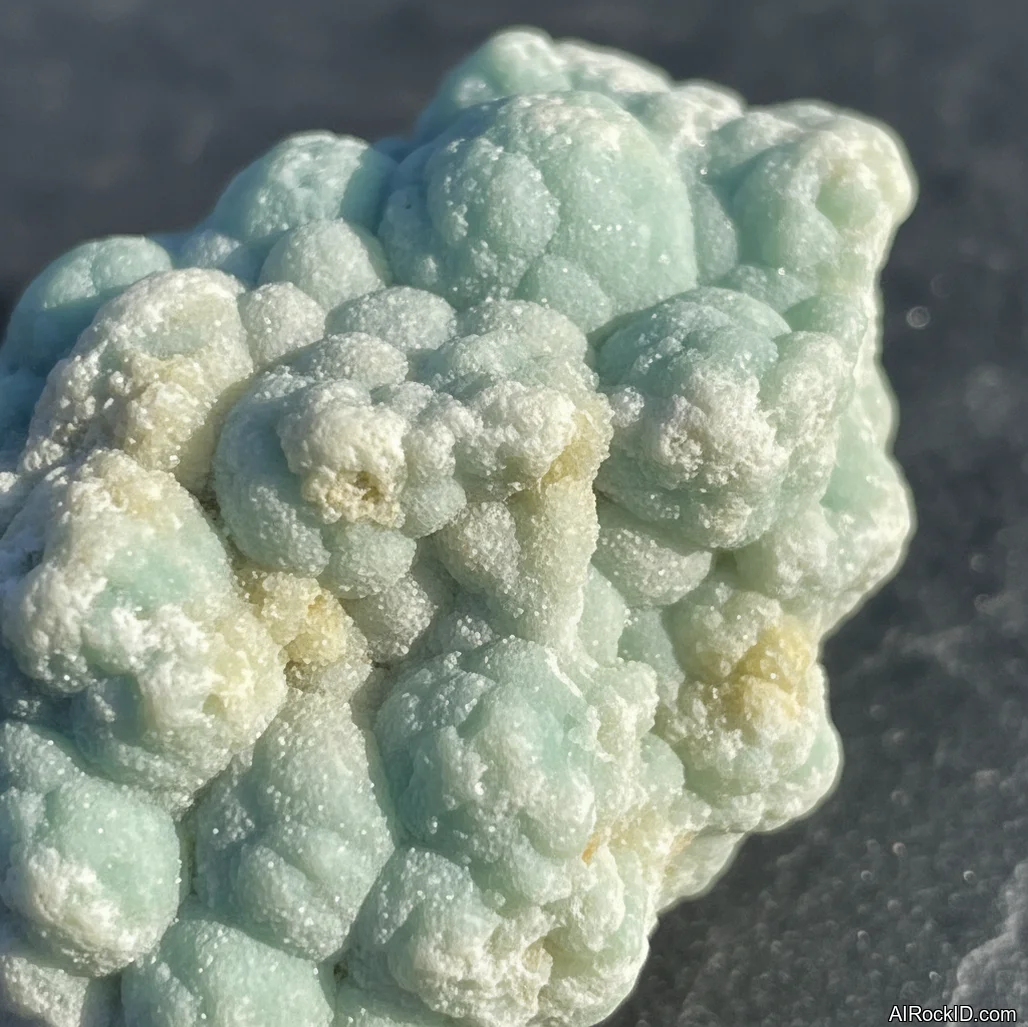
Hold a piece in your hand and the first thing you notice is the weight, or lack of it. It doesn’t feel heavy for its size. And the texture’s a dead giveaway too: where the crystal faces are clean it has that weird “porcelain meets glass” slickness, but if you rub a thumb over the micro-crystalline spots, it turns a little chalky (almost dusty).
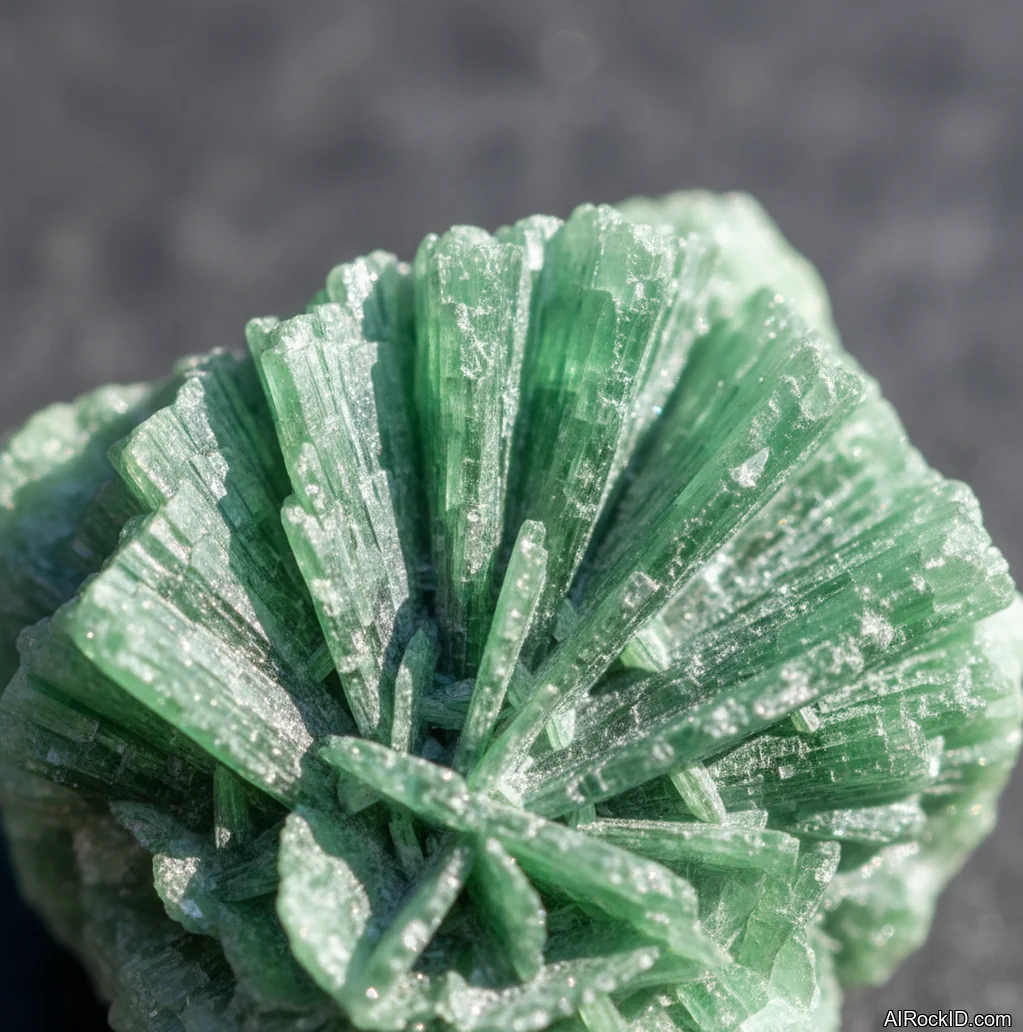
The color usually isn’t some neon, gemmy green. It’s more like pale celery, a yellow-green, sometimes with a gray cast. And if you put it right up to a strong light, the edges can look a touch lighter. Subtle stuff.
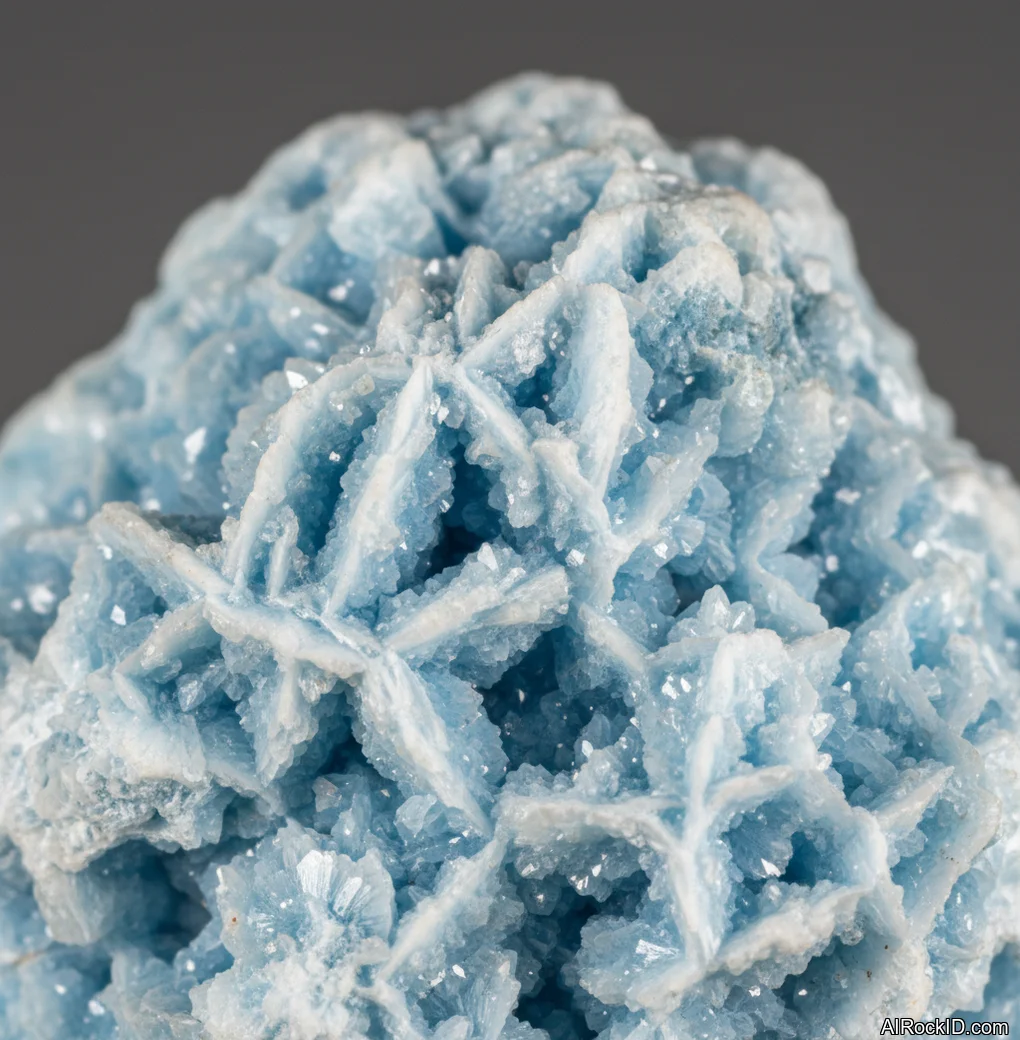
But here’s the catch: a lot of hopeite you’ll see online is white, colorless, or bluish, and sellers will slap “green hopeite” on anything that has even a hint of green. Real green material tends to carry the color through the crystal, not just sit on top like a surface stain. Tilt it under a lamp and you’ll see quick little flashes off flat faces, then it goes dull again when you move it a few degrees. That stop-and-start sparkle. It’s a solid clue you’re looking at actual crystals, not just a botryoidal coating.
Origin & History
Hopeite got its first proper description back in 1820, when Armand Lévy wrote it up from material found with zinc ores. The mineral’s name tips its hat to Thomas Charles Hope, a Scottish chemist and physician.
Green hopeite isn’t its own separate species. It’s the same hopeite, just pushed into a green tint when tiny trace elements and the local chemistry skew the color away from the usual colorless-to-white appearance. And if you’ve ever flipped through older museum drawers or dealer flats, you’ll notice it’s often filed simply as “zinc phosphate” instead of being singled out as “green hopeite,” so it’s easy to pass right over unless you already know what you’re looking at.
Where Is Green Hopeite Found?
Hopeite forms in oxidized zones of zinc deposits, and the greener material is most often tied to classic zinc localities where phosphate-rich waters circulated through the ore.
Formation
Most hopeite shows up late in the game, right up near the surface in the oxidized zone of a zinc deposit. It’s basically zinc-rich material meeting phosphate-bearing fluids, then dropping out as crystals when the groundwater chemistry shifts. Not a deep, hot magma-chamber thing at all. It’s more like an afterthought mineral. After the main show.
Look at what it’s sitting with and the whole story usually snaps into focus. If it’s alongside smithsonite, hemimorphite, limonite, or other oxidized zinc minerals, that fits perfectly. I’ve handled pieces where hopeite is just dusted across a rusty-brown matrix, slightly gritty to the touch (and it’ll leave that faint iron smell on your fingers), and the pale green pops way more than you’d guess from the color by itself. Funny how that works, right?
How to Identify Green Hopeite
Color: Pale green to yellow-green, sometimes gray-green; color is commonly light and can be uneven across a cluster.
Luster: Vitreous to pearly on clean crystal faces, duller where it’s granular.
If you scratch it with a copper coin, it usually marks, and a steel nail will bite fast, so don’t do that on a showpiece. The real test is how the faces reflect light: hopeite can look glassy on flat surfaces but turns kind of satiny on broken spots. And if it’s sold as “green” but the color only sits in cracks or on the surface, you may be looking at staining from nearby copper minerals rather than true green hopeite.
Common Look-Alikes
Green Hopeite is sometimes confused with these materials:
- Smithsonite (especially pale green botryoidal pieces sold as "green zinc carbonate")
- Hemimorphite (blue-green to green crusts and drusy coatings on matrix)
- Prehnite (pale green botryoidal masses and crusts, often mislabeled when it’s just a soft green zinc mineral)
- Fluorite (very pale green cubes or chunks, but fluorite feels harder and cleaves in big flat sheets)
- Dyed howlite or dyed magnesite (cheap "green" tumbles; dye sits in pits and drill holes)
- Green glass or resin fakes (cast pieces with bubbles and a too-even green tone)
Market Cautions & Treatments
When AI Can Get This Wrong
At first glance in photos, AI mixes green hopeite up with smithsonite and hemimorphite because all three do that soft mint-to-yellow-green with a waxy shine and rounded surfaces. The real test is simple and physical: hopeite is lighter than it looks, it can go a bit chalky on micro-crystalline spots when you rub it, and it scratches easier than fluorite or prehnite. If you’ve got UV handy, many hopeite pieces show some fluorescence, but photos rarely capture that, so a quick scratch test and a feel test beat any camera guess.
Properties of Green Hopeite
Physical Properties
| Crystal System | Orthorhombic |
| Hardness (Mohs) | 3.5-4 (Soft (2-4)) |
| Density | 3.05-3.15 |
| Luster | Vitreous |
| Diaphaneity | Transparent to translucent |
| Fracture | Uneven |
| Streak | white |
| Magnetism | Non-magnetic |
| Colors | pale green, yellow-green, gray-green, colorless, white |
Chemical Properties
| Classification | Phosphates |
| Formula | Zn3(PO4)2·4H2O |
| Elements | Zn, P, O, H |
| Common Impurities | Cu, Fe, Mn |
Optical Properties
| Refractive Index | 1.596-1.639 |
| Birefringence | 0.043 |
| Pleochroism | Weak |
| Optical Character | Biaxial |
Green Hopeite Health & Safety
Normal handling’s fine, just don’t grind it up or do anything that kicks zinc-mineral dust into the air (seriously, you don’t want to be breathing that). Treat it like a display piece, the kind you set on a shelf and leave alone, not something you crush into powder or soak for rituals.
Safety Tips
Wash your hands after you’ve been handling specimens for a while, and don’t snack while you’re sorting minerals. And if you need to trim the matrix, put on a mask, keep the dust down by working wet, then wipe everything up with a damp rag when you’re done.
Green Hopeite Value & Price
Price Range
Rough/Tumbled: $40 - $600 per specimen
Clean, well-formed crystals with a true green body color get expensive in a hurry, and the price really spikes if there’s a known locality on the label. And honestly, most dealers treat it more like a collector mineral than something for lapidary work, because it’s soft and usually doesn’t get cut.
Durability
Nondurable — Scratch resistance: Fair, Toughness: Poor
It can chip and bruise easily, and repeated handling will dull the luster on sharp crystal edges.
How to Care for Green Hopeite
Use & Storage
Store it in a perky box or a cabinet where it won’t rattle against harder minerals. I keep soft zinc phosphates separated because one ride to a show can turn crisp edges into crumbs.
Cleaning
1) Use a soft, dry brush to lift dust from between crystals. 2) If needed, rinse quickly in cool water and pat dry immediately. 3) Let it air-dry fully before boxing it back up.
Cleanse & Charge
If you do energy-style cleansing, stick to smoke, sound, or a short rest on a dry selenite plate. I wouldn’t leave it buried in damp salt where it can pick up grime and get knocked around.
Placement
A shaded shelf is best so you can enjoy the sparkle without risking accidental bumps. Put it where you won’t grab it one-handed in a hurry.
Caution
Skip ultrasonic cleaners, acids, or any of the harsh stuff. And don’t just drop it in your pocket next to quartz or feldspar where it’ll get scuffed up, and don’t go at it like it’s a hard gem you can polish hard and fast.
Works Well With
Green Hopeite Meaning & Healing Properties
Green hopeite looks “quiet” the first time you see it. The green’s gentle, not loud, and the way people talk about it is more settling than energizing. When I’ve had a piece sitting on my desk, I’ll catch myself zoning out and staring at it on a long call because the flat faces sort of wink as the light moves, like they’re there and then not there.
In today’s crystal scene, green stones usually get tied to the heart area and a calmer emotional rhythm. But hopeite is a collector mineral first, full stop. Most people aren’t tossing it in a pocket every day since it nicks easily and it really doesn’t like being knocked around. So if you’re working with it spiritually, I’d treat it like an altar or shelf stone, keep it somewhere safe, and don’t expect miracles.
And yeah, the boring disclaimer still stands. Any calming or focus feeling is personal and subjective, and it’s not a substitute for medical care. I like it as a “slow down, look again, notice what’s right in front of you” kind of piece, especially when the green is natural and you can see it running through the crystal instead of sitting on the surface like a stain.
Common mistakes
- Identifying any pale green mineral as Green Hopeite based on color alone
- Assuming a seller name is correct without checking locality or mineral associations
- Using hardness or scratch tests on a fragile collector specimen
- Cleaning the specimen with water, acids, or ultrasonic tools before confirming stability
- Confusing zinc phosphate minerals with zinc carbonates, silicates, or arsenates from the same type of deposit
Identify Green Hopeite from a photo
Compare Green Hopeite traits, care tips, value clues, and common lookalikes with a clear photo.