Adamite


Quick answer: Adamite is a zinc arsenate mineral best recognized by its yellow, green, or yellow-green crystals and vitreous to resinous luster. It is mainly a collector mineral rather than a jewelry stone because it is relatively soft, fragile, and contains arsenate.
AI Rock ID can help compare an Adamite specimen against visually similar green and yellow minerals using color, crystal habit, luster, and matrix clues. RockIdentifier.io provides educational identification support, but lab testing or expert review is recommended for valuable, rare, or safety-sensitive arsenate minerals.
Good fit
- Collectors who want colorful secondary zinc minerals from oxidized ore deposits
- Specimens with well-formed crystals on matrix for display in a protected case
- People comparing fluorescent minerals, since some Adamite can fluoresce strongly
- Collectors comfortable handling arsenate minerals with basic safety precautions
Not a good fit
- Everyday jewelry, rings, or pocket stones because Adamite is soft and brittle
- Children’s collections unless the specimen is sealed, supervised, and handled carefully
- Wet cleaning, tumbling, or rough handling
- Anyone seeking a mineral that can be safely ground, soaked, or used in elixirs
Most commonly confused with
- Mimetite: Mimetite is a lead arsenate/chloride mineral that is often yellow to orange and heavier than Adamite.
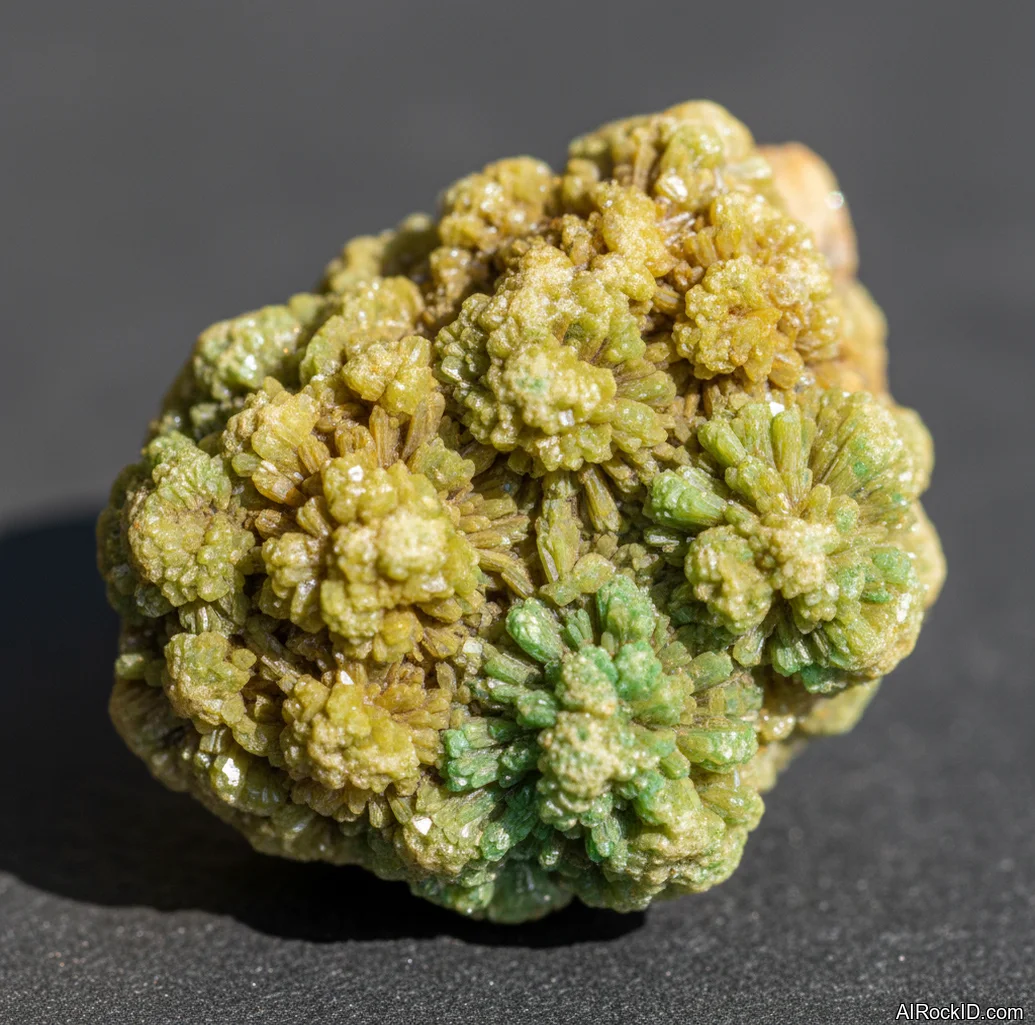
- Pyromorphite: Pyromorphite commonly forms green to yellow hexagonal barrel crystals and is a lead phosphate, not a zinc arsenate.
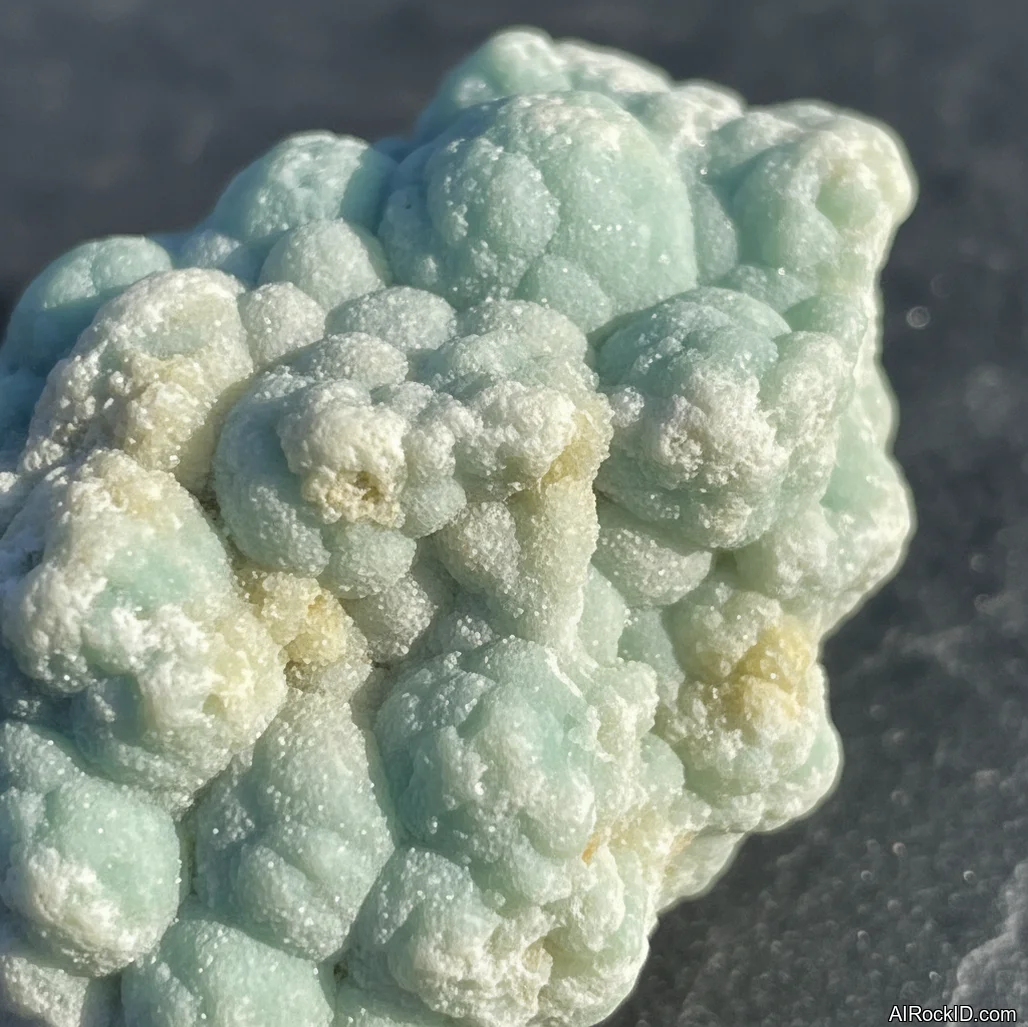
- Smithsonite: Smithsonite is a zinc carbonate that often appears botryoidal or massive rather than as sharp Adamite-style crystals.
- Wulfenite: Wulfenite usually forms thin tabular orange, yellow, or red crystals with a different square to platy habit.
Adamite vs. Common Lookalikes
| Mineral | Typical clue | Key difference |
|---|---|---|
| Adamite | Yellow to green crystals, often on limonite-rich matrix | Zinc arsenate; some specimens fluoresce bright green |
| Mimetite | Yellow, orange, or brown hexagonal crystals | Lead mineral; noticeably high density for its size |
| Pyromorphite | Green to yellow barrel-like crystals | Lead phosphate with heavier feel and different chemistry |
| Smithsonite | Botryoidal, crusty, or massive zinc carbonate | Usually lacks distinct pointed Adamite crystal clusters |
| Wulfenite | Thin square or tabular crystals | Molybdate mineral with platy habit rather than prismatic Adamite habit |
AI identification confidence
AI identification confidence for Adamite is moderate when the photo shows clear crystal habit, color, matrix, and scale. Confidence is lower for massive yellow-green material, altered specimens, or pieces photographed without locality information.
When AI gets it wrong
- Green or yellow color alone can cause confusion with pyromorphite, mimetite, smithsonite, or wulfenite.
- Fluorescence can support an Adamite ID, but it is not diagnostic because not every Adamite fluoresces and other minerals may glow.
- Photos taken under strong saturation, UV light, or colored LEDs can distort Adamite’s natural appearance.
- Locality data is important because Adamite is strongly associated with oxidized zinc-arsenic deposits.
Final recommendation
Choose Adamite as a labeled mineral specimen from a reputable seller, especially when the listing includes locality, crystal size, matrix, and lighting conditions. For high-value or unusually colored pieces, request provenance or expert confirmation rather than relying only on appearance.
How to Buy Adamite Specimens
Adamite is usually sold as a display specimen rather than a cut gem. Look for clear photos in natural light, close-ups of the crystals, a listed locality, and notes about fluorescence only if the seller provides UV-light images. Specimens from classic localities may cost more, especially when crystals are sharp, undamaged, and strongly colored.
Authenticity and Treatment Clues
Most Adamite specimens are natural mineral pieces, but color-enhanced photos and vague locality labels can make buying difficult. Be cautious with overly saturated neon-green images, listings that do not show the matrix, or specimens described only as “green crystal” without mineral identification. A genuine collector listing should separate normal lighting photos from UV fluorescence photos.
Locality Matters for Adamite
Adamite occurs in oxidized zones of zinc-bearing deposits, often with minerals such as limonite, smithsonite, and other secondary ore minerals. Locality can help distinguish Adamite from lookalikes and can affect collector interest. Well-known Adamite-producing areas include Mexico, Namibia, Greece, and parts of the United States.
What Is Adamite?
Adamite is a zinc arsenate hydroxide mineral with the formula Zn2AsO4OH. If you’ve only ever seen it in photos, the first thing that hits you in person is the sparkle. It’s real. Even tiny crystals will kick back sharp little flashes when you roll the piece under a desk lamp, especially the pale green and yellow material.
Grab a cabinet specimen and you notice something else pretty quickly: this isn’t a tough, toss-it-around mineral. The crystals often sit on crumbly limonite or goethite, and a lot of pieces have delicate sprays or a drusy crust that’ll punish sloppy handling (ask me how I know). But when it’s good, it’s really good. Some Ojuela specimens have that electric “mint green” color, and a few even glow under UV like there’s a lightbulb hiding in the pocket.
And compared to the more common green minerals people mix it up with, adamite tends to look cleaner and more glassy than most willemite. It also doesn’t have that slightly “greasy” vibe you sometimes see on smithsonite. At first glance, sure, it can just read as another green druse. But look closer. The crystal habit usually gives it away: little prismatic to bladed crystals, sometimes packed into tight clusters that look like sugar crystals, if sugar crystals were tougher and a little meaner.
Origin & History
France is where adamite first picked up its name. Back in 1866, French mineralogist Charles Friedel described it from material out of Chañarcillo, Chile. He named it for the French chemist Antoine Jérôme Balard, whose student was actually named Adam, and in that French scientific circle at the time, that little connection was enough for the name to stick.
Most collectors meet adamite the way you’d expect: through the classic Mexican and European mining districts. So it’s got that old-school “mine mineral” feel, the kind that looks right sitting in a shallow cardboard flat with a bit of dust still tucked in the crevices. And then UV lights showed up everywhere at shows and suddenly people cared a lot more. A tray of green crystals is nice. But a tray of green crystals where a couple pieces snap to neon under shortwave? That’s when folks stop walking and lean in.
Where Is Adamite Found?
Adamite shows up in oxidized zones of zinc and arsenic-bearing deposits, especially classic carbonate replacement and polymetallic districts. The specimens people chase most often come from Ojuela (Mexico) and Tsumeb (Namibia).
Formation
Most adamite shows up in the oxidation zone above zinc-rich ore bodies when there’s arsenic in the mix, usually because primary sulfides like sphalerite and arsenopyrite are breaking down. Groundwater does the heavy lifting. It threads its way through fractures and vugs, hauling zinc and arsenate along, and when the chemistry finally clicks, adamite drops out, lining cavity walls or straight-up replacing earlier minerals.
Raw Ojuela pieces are a perfect snapshot of that “secondary mineral architecture” idea. You’ll run into adamite crusted over limonite that formed after pyrite (you can sometimes still pick out the old pyrite shapes under the brown, kind of rusty skin), sitting right beside calcite, hemimorphite, smithsonite, and sometimes little bits of mimetite. But here’s the catch. The flashiest crystals often grew late, basically right on the surface, so they’re fragile. That’s why shipping damage is so common if the specimen isn’t packed like a newborn (seriously, one hard knock and the tips are gone).
How to Identify Adamite
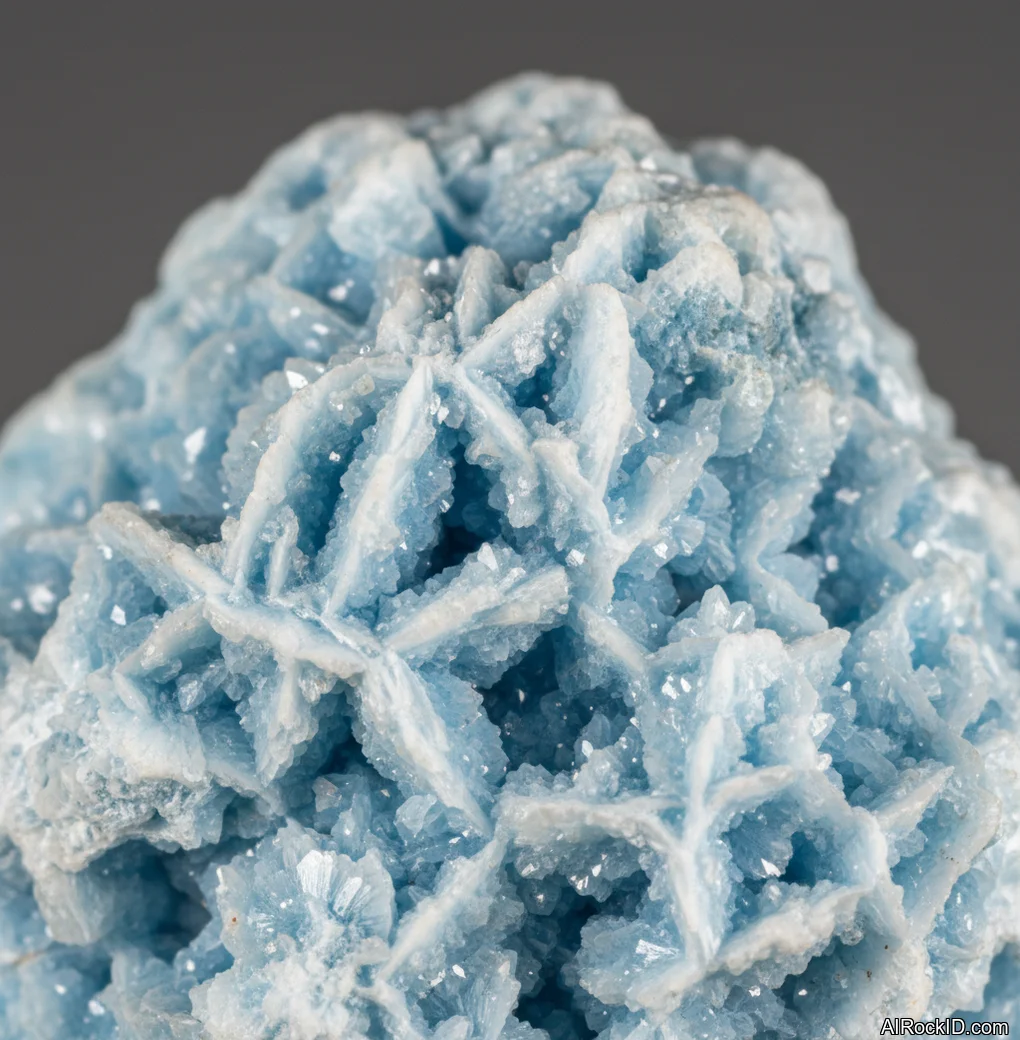
Color: Adamite ranges from yellow and yellow-green to bright apple green, with rarer pinkish or colorless crystals; copper-bearing material trends greener. Some pieces show zoned color, especially on drusy crusts.
Luster: Luster is typically vitreous, sometimes edging toward resinous on dense crusts.
Look closely at the habit: adamite commonly forms short prismatic to bladed crystals and sparkly druse rather than botryoidal masses. Under UV light, many specimens fluoresce green to yellow-green, but not all do, so don’t use fluorescence as your only test. The real test is how it behaves in a box: adamite crystals chip and shed tiny points pretty easily, while tougher green minerals like quartz just don’t.
Common Look-Alikes
Adamite is sometimes confused with these materials:
- Pyromorphite (especially the yellow-green hexagonal barrels from Morocco and China)
- Mimetite (yellow to honey tones; can sit on similar iron-oxide matrix)
- Apatite (green apatite crystals in matrix can photograph almost identical)
- Wulfenite (yellow tabular crystals, sometimes sold alongside Ojuela material and mixed up in listings)
- Dyed quartz/chalcedony sold as "green adamite" (color concentrated in pits and along fractures)
- Green/yellow glass sold as "adamite" or "uranium glass" (uniform color, rounded bubbles, feels light for size)
Market Cautions & Treatments
When AI Can Get This Wrong
At first glance, photos of sparkly yellow-green adamite get tagged as pyromorphite, mimetite, or even apatite because all three can show the same candy colors on brown ironstone. AI struggles most when the shot is backlit or over-saturated, since adamite’s sharp little flashes can look like resin-coated pieces. The real test is hardness and feel: adamite won’t scratch glass, and a loupe check for hexagonal barrel shapes (pyromorphite/mimetite) versus adamite’s more wedgey, bladed, or drusy sparkle helps a lot.
Properties of Adamite
Physical Properties
| Crystal System | Orthorhombic |
| Hardness (Mohs) | 3.5-4 (Soft (2-4)) |
| Density | 4.3-4.5 g/cm3 |
| Luster | Vitreous |
| Diaphaneity | Transparent to translucent |
| Fracture | Uneven |
| Streak | white |
| Magnetism | Non-magnetic |
| Colors | yellow, yellow-green, green, colorless, pink |
Chemical Properties
| Classification | Arsenates |
| Formula | Zn2AsO4OH |
| Elements | Zn, As, O, H |
| Common Impurities | Cu, Co, Mn, Fe, Ca |
Optical Properties
| Refractive Index | 1.708-1.766 |
| Birefringence | 0.058 |
| Pleochroism | Weak |
| Optical Character | Biaxial |
Adamite Health & Safety
Adamite’s fine to keep on a shelf and handle carefully, but treat it like what it is: an arsenic-bearing mineral. The real trouble starts when you’ve got dust in the air, a crumbly or busted-up matrix shedding grit (you can feel that sandy, chalky stuff on your fingertips), or water that’s been used to soak it and now might be contaminated.
Safety Tips
Wash your hands after you’ve handled it. Keep it out of the kitchen and away from any food prep surfaces (counters, cutting boards, that whole zone). And don’t put it in an ultrasonic cleaner. If you absolutely have to trim the matrix, wear a respirator and do it wet so the dust stays put. Dust gets everywhere fast, and it’s a pain to clean up once it’s in the air.
Adamite Value & Price
Price Range
Rough/Tumbled: $20 - $600 per specimen
Cut/Polished: $40 - $250 per carat
Price mostly comes down to color, how crisp the crystals look, and whether the piece is sitting on a solid, good-looking matrix like limonite that gives it that nice contrast. And if it’s fluorescent, or it’s got that fine Ojuela or Tsumeb provenance, yeah, it can jump up a bracket pretty fast.
Durability
Nondurable — Scratch resistance: Fair, Toughness: Poor
Adamite is stable in normal indoor conditions, but crystals and matrix are often fragile and can chip or shed points with minor knocks.
How to Care for Adamite
Use & Storage
Store adamite in a perky box or a padded flat where nothing can rattle into the crystals. If it came wrapped with a “crystal side up” note, listen to it.
Cleaning
1) Use a soft, dry brush or a bulb blower to remove loose dust. 2) If needed, use a barely damp cotton swab on the matrix only, avoiding crystal faces. 3) Let it air-dry completely before closing it back up.
Cleanse & Charge
If you do energy-style cleansing, stick to smoke, sound, or a dry bowl method. Skip water because of the arsenic content and because many matrices are porous and stain easily.
Placement
A stable shelf away from foot traffic is best, especially for drusy pieces that chip if you breathe on them wrong. Keep it out of direct sun if you’re worried about any subtle color shift over years.
Caution
Don’t soak it in water. Don’t make “gem water” with it either. And seriously, don’t do anything that kicks up dust, like sanding or grinding. If it’s an arsenic-bearing mineral, treat it like you would a basic lab sample: keep it off your food and hands, don’t touch your face, and wash up when you’re done.
Works Well With
Adamite Meaning & Healing Properties
Pay attention to the way people in crystal spaces talk about adamite and you’ll keep hearing the same two ideas: “spark” and “nerves.” Honestly, that lines up with how it comes across in your hand. A bright green drusy piece has this buzzy, lit-up look, like it’s about to say something and can’t wait. I’ve had one sitting on my desk and I swear I end up reaching for it in the middle of boring work because those tiny crystals catch the light from whatever angle and kind of yank your focus back.
If you’re using it metaphysically, I’d keep it pretty down-to-earth. Motivation, focus, getting unstuck. Not miracle stuff. And yeah, it’s an arsenate, so I treat it as a look-and-hold stone, not a “sleep with it under your pillow” situation. The thing that bugs me about a lot of crystal advice online is how it skips the real mineral side of things. You can like the woo and still respect chemistry, right?
One more collector-to-collector thing. Cuprian adamite, the greener copper-bearing stuff, gets called “stronger” all the time. I can’t measure that. But I can tell you it looks stronger. Put a pale yellow adamite next to a saturated green one and your eyes go straight to the green, every time. And that alone shifts how you experience it in meditation or intention work (even if it’s just because your attention keeps landing there).
Common mistakes
- Assuming every bright green zinc mineral is Adamite
- Using fluorescence as the only identification test
- Cleaning Adamite with water, acids, ultrasonic cleaners, or harsh brushes
- Buying a specimen without checking whether photos show natural light or UV light
- Handling broken or powdery arsenate specimens without washing hands afterward
- Treating Adamite as a durable jewelry stone
Identify Adamite from a photo
Compare Adamite traits, care tips, value clues, and common lookalikes with a clear photo.