Green Onyx


Quick answer: Green Onyx is commonly sold as green banded chalcedony, a microcrystalline quartz with a waxy to vitreous luster. Because the trade name is used broadly, some pieces may be dyed, treated, or mislabeled green agate or calcite.
AI Rock ID can help compare Green Onyx against similar green stones by analyzing color zoning, banding, translucency, and surface texture from a photo. RockIdentifier.io provides identification support, but results should be checked against hardness, streak, luster, and seller information for higher confidence.
Good fit
- Collectors who want a green chalcedony variety with visible banding
- Jewelry buyers looking for a quartz-family stone with moderate durability
- Beginners practicing identification of banded chalcedony and agate
- Shoppers comparing natural, dyed, and trade-name green stones
Not a good fit
- Buyers who need a guaranteed untreated stone without lab or seller documentation
- Projects requiring a very soft stone that can be carved with simple hand tools
- Anyone expecting the term “onyx” to always mean black-and-white banded onyx
Most commonly confused with
- Green Agate: Often the same chalcedony material in trade; green agate may be dyed and usually shows agate-style banding.
- Black Onyx: Black onyx is dark chalcedony, usually uniform black or black-and-white, rather than green.
- Calcite: Green calcite is softer, cleaves more easily, and reacts more readily to acid than quartz-family chalcedony.
- Jade: Jade has a tougher, more fibrous or granular structure and different optical appearance than banded chalcedony.
Green Onyx vs Similar Green Stones
| Stone | Typical clue | Key difference |
|---|---|---|
| Green Onyx | Banded or cloudy green chalcedony | Quartz family; about Mohs 6.5–7 |
| Green Agate | Curved or concentric banding | Often overlaps in trade naming with Green Onyx |
| Green Calcite | Soft, glassy to pearly, often cleavable | Much softer; about Mohs 3 |
| Jade | Waxy, tough, compact texture | Usually nephrite or jadeite, not chalcedony |
| Aventurine | Subtle glitter from inclusions | Quartzite texture rather than chalcedony bands |
AI identification confidence
AI identification is usually moderate for Green Onyx when photos show banding, translucency, and a polished surface. Confidence drops when the stone is uniformly green, heavily dyed, photographed under strong color lighting, or shown without scale.
When AI gets it wrong
- Uniform green pieces may be labeled as jade, aventurine, glass, or dyed agate.
- Close-up photos without a hardness reference can make calcite and chalcedony look similar.
- Bright saturation may indicate dye, but color alone cannot confirm treatment.
- Polished beads and carvings often hide natural banding, fracture patterns, and diagnostic texture.
Final recommendation
Choose Green Onyx when the stone shows chalcedony-like banding, takes a good polish, and is sold with clear treatment disclosure. For higher-value jewelry or natural-color claims, request seller documentation or independent gem testing.
How to Check Green Onyx Authenticity
Look for fine banding, a waxy to vitreous polish, and a hardness consistent with chalcedony. A steel knife should not easily scratch true quartz-family chalcedony, while softer lookalikes such as calcite are easier to mark. Very even neon-green color, dye concentrated in cracks, or color rubbing onto a cloth can suggest treatment or artificial coloring.
Buying Green Onyx Beads and Cabochons
Green Onyx is widely sold as beads, cabochons, carvings, and decorative slabs. Ask whether the material is natural color, dyed, stabilized, or sold under a broad trade name such as green agate. Consistent bead color across a strand may be attractive, but it can also indicate dyeing or sorting.
Photo Tips for Green Onyx Identification
Photograph Green Onyx in daylight or neutral white light with a coin or ruler for scale. Include one close-up of the bands, one image of the whole piece, and one photo against a plain white or gray background. Avoid heavy filters because they can make dyed chalcedony, aventurine, jade, and glass harder to separate.
What Is Green Onyx?
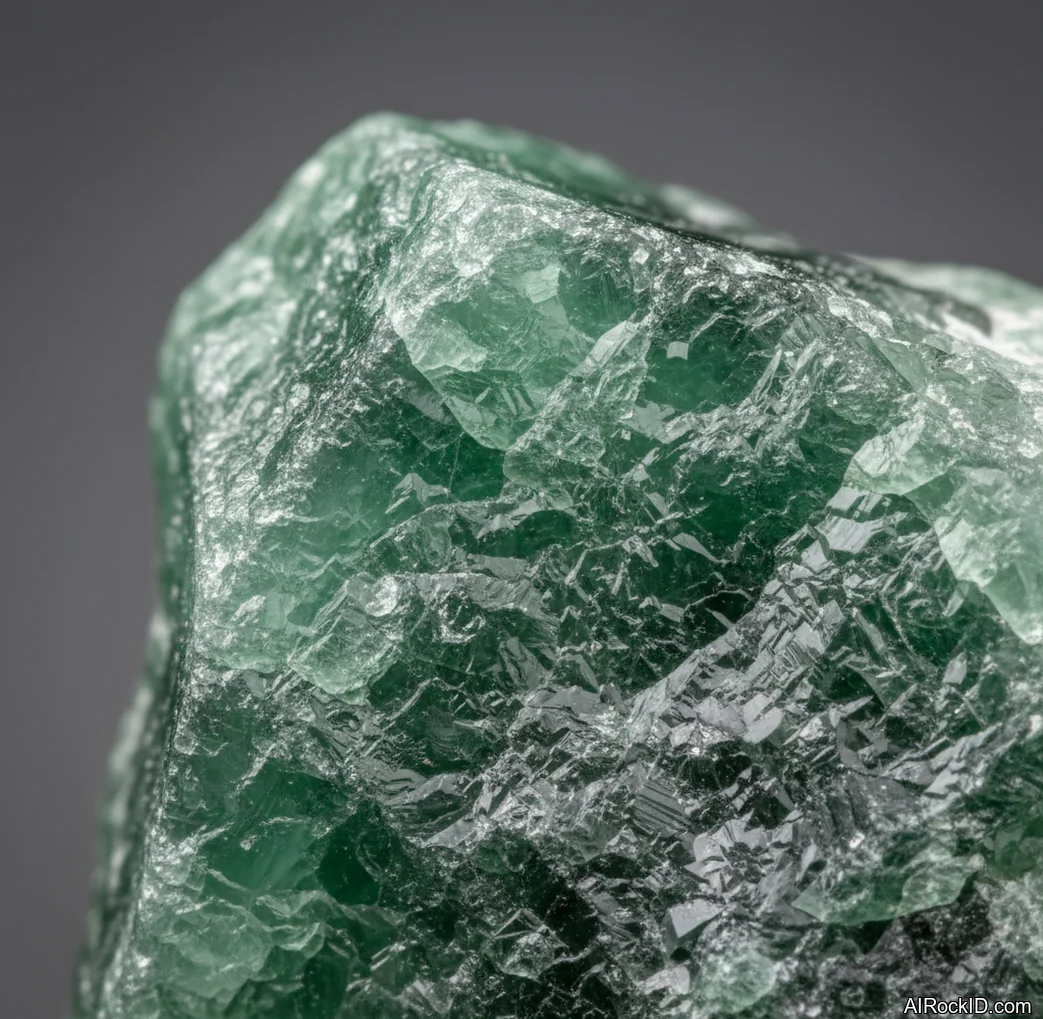
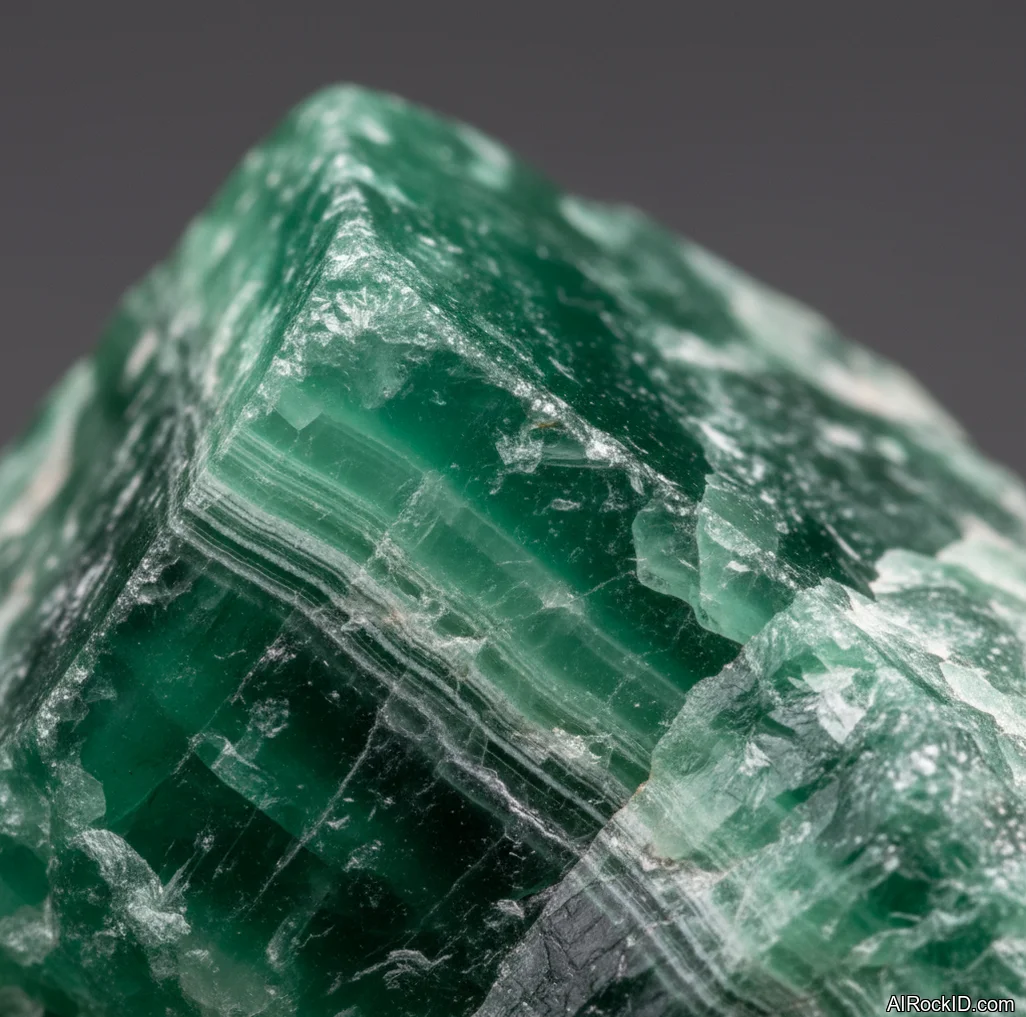
Green Onyx is a green, banded variety of chalcedony (microcrystalline quartz) that gets sold in the gem trade as onyx.
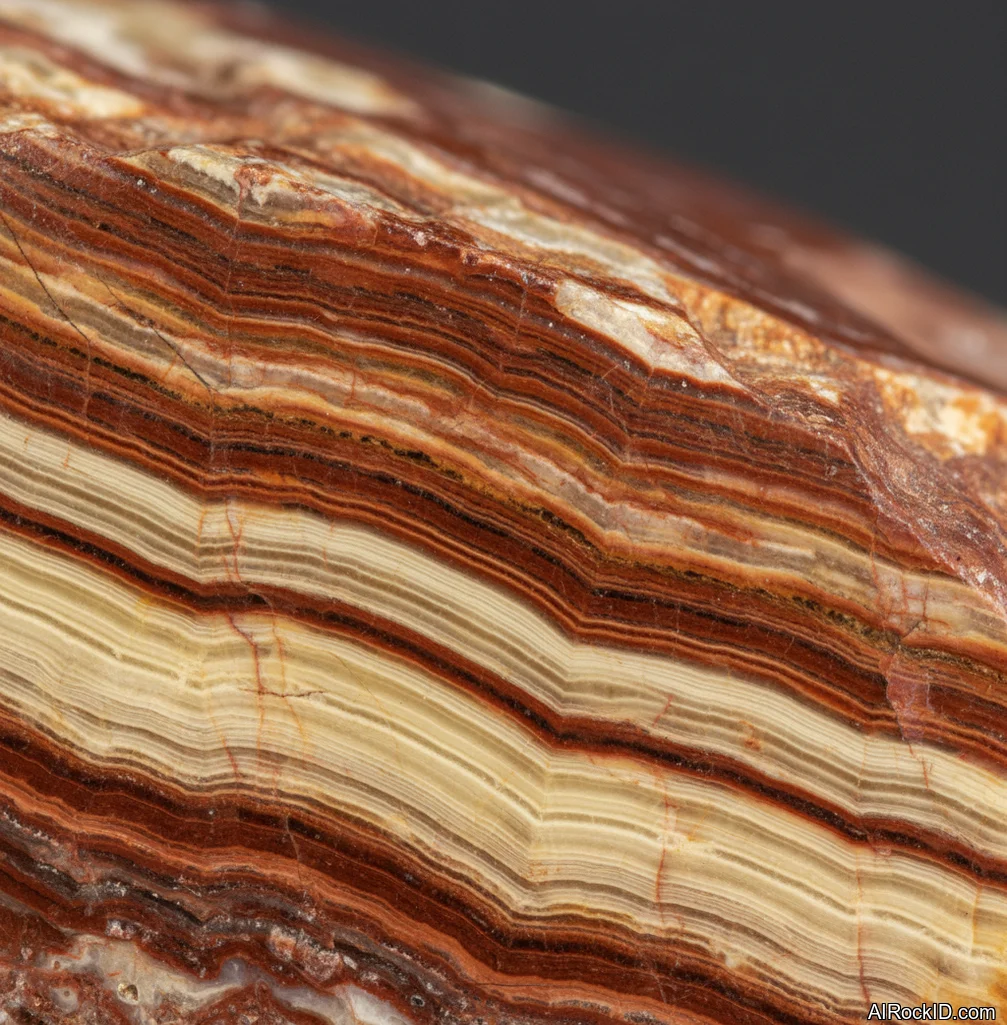
Look, the first time you see a good piece, it almost looks like it should glow from the inside. Especially if it’s sliced thin or held up to a light. The color can swing from pale celery to a deeper bottle green, and the banding might come off sharp like stripes, or it can blur out like watercolor that’s dried a little uneven.
Thing is, a lot of what’s labeled “green onyx” in carvings and tiles is actually banded calcite. Not chalcedony. The chalcedony material has a different feel in your hand. Grab a palm stone and it stays cool longer than glass, and when it’s polished well it has that smooth, slightly waxy drag that quartz varieties tend to get (you can feel it as you rub your thumb across the surface).
Most of what you’ll run into is tumbled, cabbed, or carved. Collectors go for clean, crisp banding, but that’s also where things get messy. Some pieces are dyed to make the green louder. And you can usually catch it when the color pools along tiny fractures, or when the bands look too evenly saturated across the whole stone. Too perfect. You know?
Origin & History
“Onyx” comes from the Greek *onyx*, meaning “claw” or “fingernail.” It was first used for layered stones with those pale bands that look a bit like the edge of a nail. In mineral terms, true onyx is banded chalcedony, which is a variety of quartz, and people have been using it since antiquity for cameos, seals, and small carvings because it takes a crisp polish and holds fine detail (you can feel it when the surface goes slick and glassy under your fingers).
“Green Onyx,” though, is mostly a modern trade name, not something that got formally “first described” as its own mineral species. Thing is, the label gets slapped on two different materials: green banded chalcedony (the quartz one) and green banded calcite from places like Pakistan and Mexico, which is often sold as “onyx marble.” Dealers usually aren’t trying to pull one over on you. But a little tag on a tray at a show won’t always tell you which one you’re actually holding, so it’s smart to check hardness and the style of the banding.
Where Is Green Onyx Found?
Green banded chalcedony shows up in several quartz-producing regions, while the common “green onyx” carving material is frequently banded calcite from Pakistan and Mexico.
Formation
Look at the banding for a second and you’re basically staring at chemistry changes that got stuck in time. Chalcedony forms when silica rich fluids snake through cracks and little pockets in rock, then drop microcrystalline quartz in thin layers as things cool and shift. Some of those layers are insanely fine, and that’s why the bands pop so sharply once you’ve taken it to a wheel and polished the surface smooth (you can almost feel that glassy slickness under a fingertip).
The green color usually comes from tiny inclusions or trace elements, often nickel bearing or iron bearing minerals mixed in, depending on the deposit. But here’s the catch: a lot of that bright, perfectly even green you see for sale is dye, because natural green chalcedony with strong banding just isn’t as consistent as the catalogs want you to believe. Raw pieces from legit deposits tend to show more variation, more quiet zones, plus those little cloudy patches that (weirdly) can seem to vanish once the material’s cut down into smaller stones. Why? Because you’re literally slicing away the messy parts.
How to Identify Green Onyx
Color: Typically pale to medium green with white, cream, or lighter green bands; color may be uniform if dyed. Natural pieces often show subtle mottling or cloudy zones between bands.
Luster: Waxy to vitreous luster when polished.
If you scratch it with a steel knife and it doesn’t bite, you’re likely in quartz territory. Chalcedony at Mohs 6.5 to 7 will scratch window glass, while calcite “onyx marble” (Mohs 3) won’t. The real test is a quick hardness check on an inconspicuous spot and then a look with a loupe: dyed pieces often show darker color concentrated along tiny cracks or around drill holes.
Common Look-Alikes
Green Onyx is sometimes confused with these materials:
- Dyed white/cream chalcedony or agate sold as "green onyx" (dye sits in bands and cracks)
- Calcite or aragonite marketed as "green onyx" (softer, reacts to acid, shows cleavage)
- Serpentine (often sold as "new jade"; waxier look and lower hardness)
- Green aventurine quartz (sparkly mica flecks that onyx/chalcedony doesn’t have)
- Green glass imitations (too uniform, sometimes shows round bubbles and feels warmer fast)
- Dyed quartzite or dyed marble used for carvings (color looks sprayed-on and collects in pits)
Market Cautions & Treatments
When AI Can Get This Wrong
Phone photos trip up hard on Green Onyx because banded green chalcedony, calcite onyx, and serpentine can all look like the same glossy green-and-cream stripes once the camera boosts saturation. At first glance, AI will call dyed agate "green onyx" and it’ll call calcite "chalcedony" because both get sold as onyx in listings. The real test is simple: chalcedony should scratch glass cleanly, calcite won’t and it reacts to weak acid, and dyed material often shows darker green parked in cracks and around drilled holes.
Properties of Green Onyx
Physical Properties
| Crystal System | Trigonal |
| Hardness (Mohs) | 6.5-7 (Hard (6-7.5)) |
| Density | 2.58-2.64 g/cm3 |
| Luster | Waxy |
| Diaphaneity | Translucent |
| Fracture | Conchoidal |
| Streak | White |
| Magnetism | Non-magnetic |
| Colors | Green, White, Cream, Pale yellow-green |
Chemical Properties
| Classification | Silicates |
| Formula | SiO2 |
| Elements | Si, O |
| Common Impurities | Fe, Ni, Mn, C |
Optical Properties
| Refractive Index | 1.530-1.540 |
| Birefringence | 0.004-0.009 |
| Pleochroism | None |
| Optical Character | Uniaxial |
Green Onyx Health & Safety
Green Onyx (chalcedony) is usually safe to handle and keep on display. But if you’re cutting or grinding it, stick to normal lapidary safety, because the silica dust is the real issue (that fine, chalky powder that ends up everywhere).
Safety Tips
If you’re going to shape it, keep it wet and grind it that way, and wear a respirator that’s actually rated for fine particulate. Don’t dry sand quartz.
Green Onyx Value & Price
Price Range
Rough/Tumbled: $5 - $60 per piece
Cut/Polished: $1 - $8 per carat
Price mostly comes down to the band contrast, how crisp and glassy the polish looks up close, and whether it’s actually confirmed chalcedony instead of the softer calcite that sometimes gets sold under the same name. Look, big carvings get expensive fast. But small cabochons? They usually stay pretty affordable.
Durability
Durable — Scratch resistance: Good, Toughness: Good
Chalcedony is stable in everyday handling, but dyed material can fade with strong sun and harsh cleaners.
How to Care for Green Onyx
Use & Storage
Store it so it doesn’t rub against softer stones or get grit ground into the polish. I keep polished onyx and chalcedony in a cloth bag or a tray with dividers.
Cleaning
1) Rinse with lukewarm water. 2) Use a drop of mild soap and your fingers or a soft brush to lift skin oils. 3) Rinse again and dry with a soft cloth.
Cleanse & Charge
If you do energetic cleaning, stick to gentle options like running water, smoke, or a night on a windowsill out of direct sun. Skip salt soaks if you don’t know whether your piece is chalcedony or calcite.
Placement
Compared to sparkly quartz points, Green Onyx reads calmer on a shelf and looks best under soft, angled light that catches the banding. Set it on a dark wood or matte black base and the stripes pop.
Caution
Skip bleach, ammonia, and ultrasonic cleaners, especially if the stone’s dyed or you can see little fractures running through it. And don’t park it in direct sun for hours, either, if the color looks kind of too-even and “painted on,” like it was boosted on purpose.
Works Well With
Green Onyx Meaning & Healing Properties
Pick up a piece of Green Onyx and the first thing you notice is the temperature. It’s got that steady, cool-in-your-palm feel that makes you pause, even if you didn’t mean to. And in the shop, I’ve watched customers do the same little ritual every time: they keep rolling it between their fingers, flipping it end over end, hunting for a band they like, a “good line” to follow with their thumb. That hands-on part is a big reason people connect it with grounding and staying on task.
Most people who lean into the metaphysical side tie Green Onyx to self-control, patience, and emotional steadiness. I’m not treating it like medicine. It’s more of a prompt, honestly. So if you leave a piece on your desk, that little bit of weight and the slick polish can snap you out of doom-scrolling for a second. Sometimes that tiny interruption is all it takes to get your attention back.
But here’s the part people skip. A lot of what gets sold as “Green Onyx” is calcite, and day-to-day it acts like a different stone. Calcite scratches if you look at it wrong, and if you carry it in a pocket the shine goes cloudy fast (especially if it’s knocking around with keys). If you want something you can actually carry, make sure it’s chalcedony, do the glass scratch test, and ask the seller straight up what it is. Why guess?
Common mistakes
- Assuming every green stone sold as onyx is untreated natural-color chalcedony.
- Confusing Green Onyx with green calcite because both can appear translucent and polished.
- Using color alone to separate Green Onyx from green agate, jade, aventurine, or glass.
- Overlooking dye in fractures, drill holes, and deeper banded zones.
- Expecting all onyx to be black; onyx and agate names are often used inconsistently in the gem trade.
Identify Green Onyx from a photo
Compare Green Onyx traits, care tips, value clues, and common lookalikes with a clear photo.