Prehnite


Quick answer: Prehnite is a translucent to semi-translucent calcium-aluminum silicate best known for pale green, yellow-green, or gray-green colors and rounded, botryoidal forms. It is often confused with jade, serpentine, chrysoprase, and green calcite, so texture, hardness, luster, and transparency are important identification clues.
AI Rock ID can help compare a suspected prehnite specimen against similar green minerals by analyzing visible color, luster, crystal habit, and surface texture. RockIdentifier.io provides crystal identification support and reference information for distinguishing prehnite from common lookalikes.
Good fit
- Collectors who like soft green minerals with translucent or waxy-looking surfaces
- Beginners who want a durable display stone that is harder than calcite or fluorite
- People comparing pale green tumbled stones, cabochons, or botryoidal specimens
- Buyers who prefer stones with subtle color rather than bright dyed material
Not a good fit
- Rings or high-impact jewelry that may receive frequent knocks
- Anyone needing a precise species ID from color alone
- Buyers looking for vivid emerald-green color without enhancement
- Outdoor displays with prolonged direct sunlight exposure
Most commonly confused with
- Jade: Jade is tougher and usually has a denser, more fibrous or granular look, while prehnite is commonly more translucent with a waxy to pearly luster.
- Serpentine: Serpentine is generally softer and can show a greasy luster, while prehnite is harder and often forms rounded or botryoidal masses.
- Chrysoprase: Chrysoprase is a nickel-bearing chalcedony with a more even apple-green color and higher hardness than prehnite.
- Green Calcite: Green calcite is much softer, cleaves more readily, and reacts to acid, unlike prehnite.
Prehnite vs. Common Green Lookalikes
| Stone | Typical Clue | Hardness |
|---|---|---|
| Prehnite | Pale green, translucent, waxy to pearly, often botryoidal | 6–6.5 |
| Jade | Dense, tough, fibrous or granular appearance | 6–7 |
| Chrysoprase | More even apple-green chalcedony, glassy to waxy | 6.5–7 |
| Green Calcite | Soft, perfect cleavage, acid reaction | 3 |
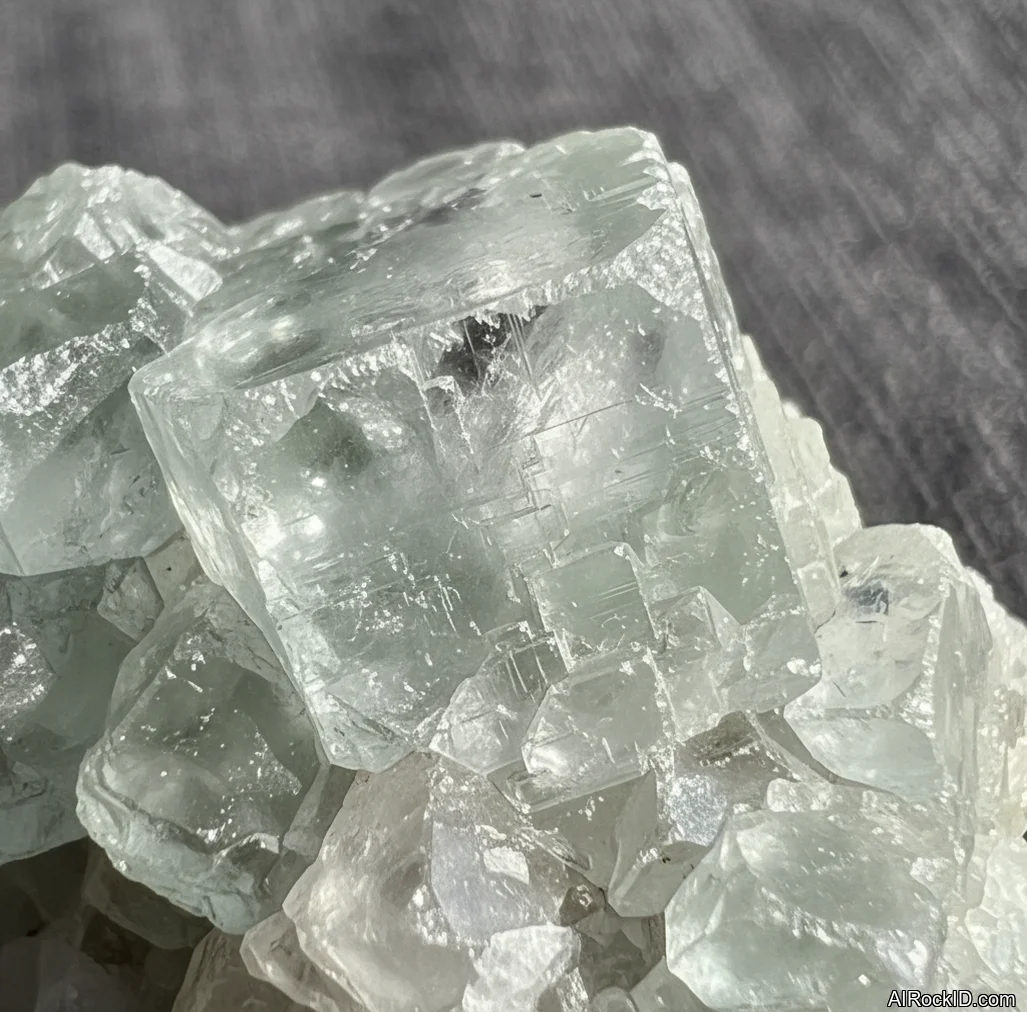
| Green Fluorite | Cubic cleavage, glassy luster, scratches more easily | 4 |
AI identification confidence
AI identification for prehnite is most reliable when the photo shows natural habit, translucency, surface luster, and color under neutral lighting. Confidence is lower for polished green cabochons or tumbled stones because several minerals share similar pale green colors and waxy surfaces.
When AI gets it wrong
- A polished stone lacks visible crystal habit, cleavage, or matrix.
- Lighting makes the stone appear more saturated, yellow, or gray than it is in person.
- Dyed quartz, dyed chalcedony, or treated serpentine is photographed without disclosure.
- The specimen is a mixed-mineral rock containing prehnite with epidote, quartz, or calcite.
Final recommendation
For identification, compare prehnite against green calcite, fluorite, serpentine, jade, and chrysoprase rather than relying on color alone. For buying, look for consistent translucency, natural-looking color, accurate labeling, and clear seller photos taken in neutral light.
How to Check Prehnite Authenticity
Authentic prehnite commonly appears pale green to yellow-green with a soft, waxy, vitreous, or pearly luster and may show rounded botryoidal surfaces. Very bright neon green color, perfectly uniform dye-like saturation, or vague labels such as “green jade” can indicate a need for closer verification. A simple scratch comparison should be done cautiously because it can damage a specimen, but prehnite should not be scratched easily by a copper coin or fingernail.
What to Look for When Buying Prehnite
Clear photos in daylight or neutral white light are useful because prehnite’s color can shift under warm lighting. Desirable specimens often show translucency, clean green color, attractive rounded form, or contrasting matrix minerals such as epidote. In jewelry, check for secure settings and avoid pieces advertised for heavy daily wear if the design exposes the stone to impact.
Prehnite in Natural Specimens
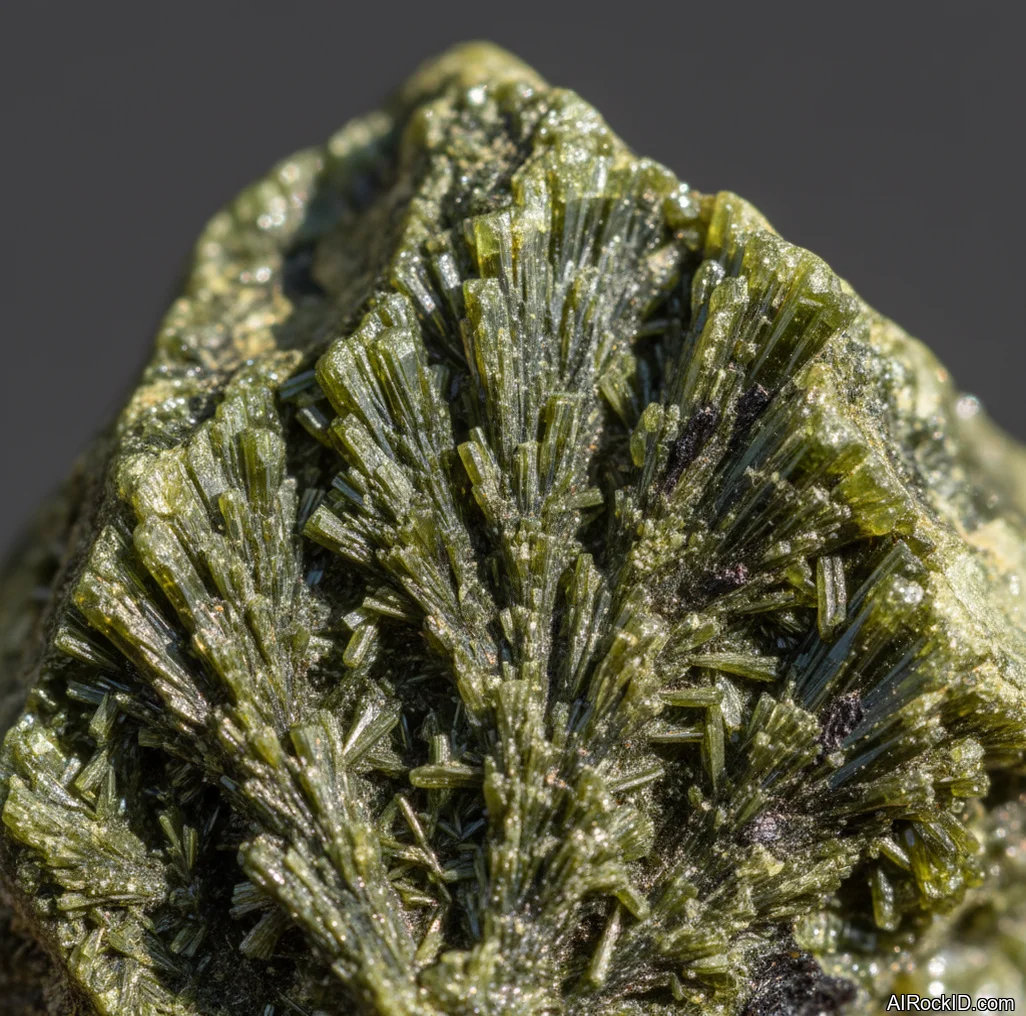
Prehnite often occurs in cavities and fractures of volcanic rocks and may appear with epidote, quartz, calcite, or zeolite minerals. Natural specimens can show botryoidal, stalactitic, tabular, or crust-like habits, which are useful clues for identification. Matrix material does not make a specimen less authentic, but it can affect how the piece is labeled and valued.
What Is Prehnite?
Prehnite is a calcium aluminum silicate mineral with the formula Ca2Al(AlSi3O10)(OH)2, and it usually shows up as pale green, translucent masses or those rounded, botryoidal crusts.
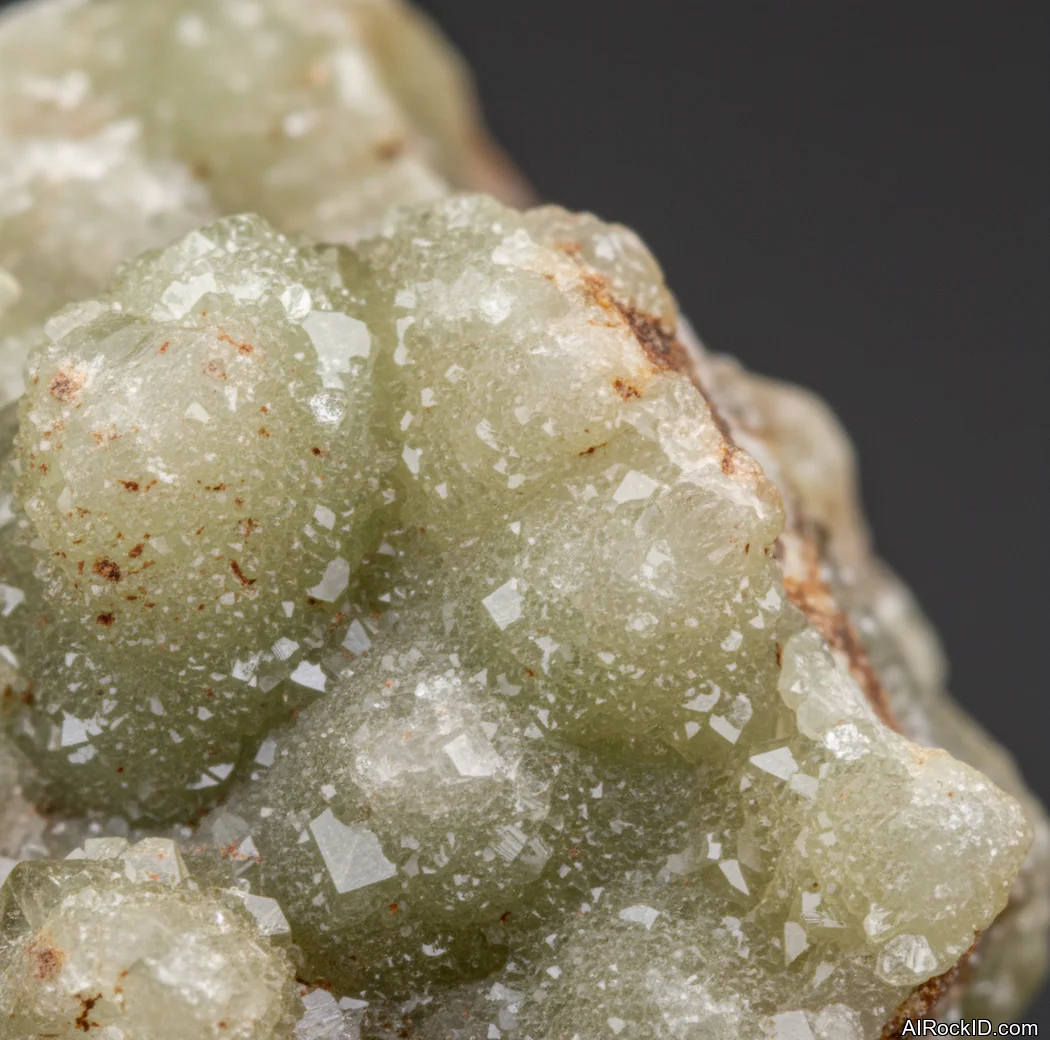
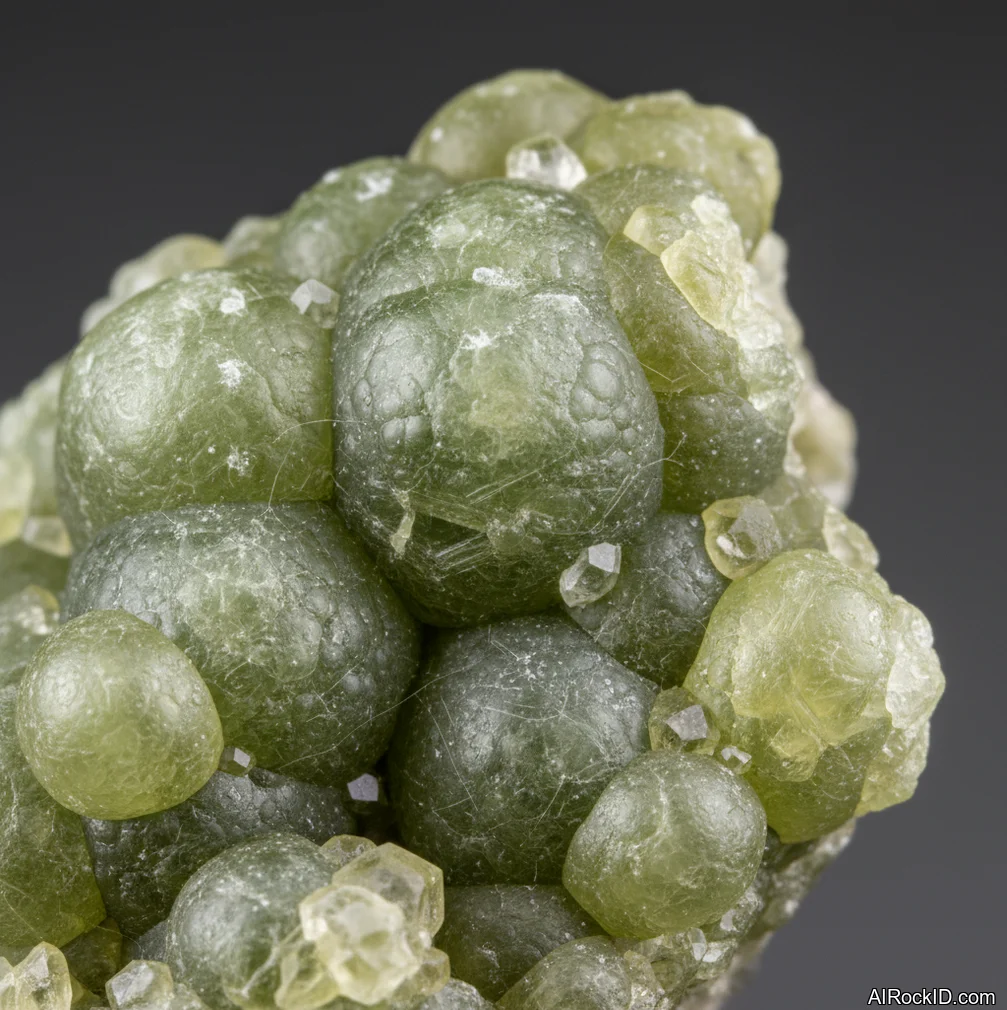
Grab a chunky botryoidal piece and you notice the surface immediately. Slick. Waxy. Almost like dragging your thumb over a dry bar of soap (the kind that’s been sitting on the sink for weeks). A lot of what turns up at shows has that grape-like skin, and now and then you’ll spot tiny pockets where it chipped and you can actually see the fibrous interior tucked inside. The color is typically a soft celery green, but it can slide toward yellow-green, or even fade to nearly colorless along the edges when the light catches it just right.
Next to jade, prehnite feels lighter, and on a fresh break it comes off a bit more “glassier.” But don’t let a label with “jade” on it fool you. It’s not as tough as people expect. I’ve seen buyers drop it into a pocket with quartz points, walk around all day, and later pull it out with little bruises and scratches. Happens fast.
Origin & History
South Africa is where this story starts. Prehnite got its first proper description in 1788, and the name comes from Hendrik von Prehn, a Dutch military officer who hauled specimens from the Cape of Good Hope back to Europe.
Collectors eat up the trivia that it’s often cited as the first mineral named after a person. You’ll see that line everywhere. Old mineral books, museum tags with the corners curling a bit, even dealer cards you’ve handled a hundred times. And yeah, it’s a handy thing to keep in your back pocket when you’re flipping through flats at a show, trying to remember what you’re looking at.
Where Is Prehnite Found?
It shows up in basalt and other volcanic rocks worldwide, plus some metamorphic settings. The most familiar collector material is from places like South Africa, Australia, China, and classic zeolite localities in the USA.
Formation
Look at where it actually shows up and the pattern jumps out fast. Prehnite is a low-temperature mineral, and it loves hanging out in cavities, fractures, and little vein spaces, especially in basaltic lava flows where fluids can slip through the rock and react as they go.
Most of the time it forms during hydrothermal alteration, kind of late in the whole process, once calcium and aluminum are on hand and the chemistry lines up. In zeolite pockets, you’ll spot it as botryoidal crusts, lumpy masses, or fan-shaped aggregates (the kind that look like a spray of tiny blades if you tilt the piece under a lamp). It’ll often be sitting with calcite, quartz, epidote, datolite, apophyllite, plus the usual zeolite crowd. But here’s the catch: clean, well-formed single crystals do exist, sure, but they aren’t the kind of thing you casually bump into in a $10 bargain bin. Those are the good pieces.
How to Identify Prehnite
Color: Usually pale green to yellow-green, sometimes gray-green or nearly colorless. It often has a “milky glow” rather than sharp saturation.
Luster: Waxy to vitreous, especially on rounded botryoidal surfaces.
Pick up a piece and tilt it under a bright light. Good prehnite has that greasy, almost candle-wax sheen on the bumps, and the light seems to sink in a bit instead of bouncing right off. If you scratch it with a steel nail, you usually won’t get much, but quartz will mark it fast. The problem with look-alikes is they copy the color, not the feel, so pay attention to that cool, slick surface and the typical grape texture.
Common Look-Alikes
Prehnite is sometimes confused with these materials:
- Botryoidal smithsonite (especially the pale green "grape" material)
- Chrysoprase / green chalcedony (tumbled or cabbed, same soft apple-green vibe)
- Serpentine (sold as "new jade" in carvings and palm stones)
- Dyed quartz/chalcedony sold as "green prehnite" (color often too loud or too even)
- Green glass resin "grape" clusters (tourist fakes that mimic botryoidal crusts)
- Hydrogrossular garnet (green massive chunks and cab material)
Market Cautions & Treatments
When AI Can Get This Wrong
At first glance, phone ID loves to call botryoidal prehnite "smithsonite" or "chrysoprase" because all it sees is pale green blobs with a shine. Photos also miss the feel: prehnite’s surface often looks wet and waxy, while smithsonite tends to read more glassy or sugary in close-ups. The real test is a quick hardness check and a hand lens: prehnite should scratch window glass with effort (6 to 6.5), and you won’t see the round gas bubbles that give away green glass fakes.
Properties of Prehnite
Physical Properties
| Crystal System | Orthorhombic |
| Hardness (Mohs) | 6-6.5 (Hard (6-7.5)) |
| Density | 2.80-2.95 g/cm3 |
| Luster | Waxy |
| Diaphaneity | Translucent |
| Fracture | Uneven |
| Streak | White |
| Magnetism | Non-magnetic |
| Colors | Pale green, Yellow-green, Gray-green, Colorless, White |
Chemical Properties
| Classification | Silicates |
| Formula | Ca2Al(AlSi3O10)(OH)2 |
| Elements | Ca, Al, Si, O, H |
| Common Impurities | Fe, Mn |
Optical Properties
| Refractive Index | 1.611-1.669 |
| Birefringence | 0.018-0.021 |
| Pleochroism | Weak |
| Optical Character | Biaxial |
Prehnite Health & Safety
Prehnite’s generally seen as non-toxic, so it’s safe to handle in your hands. But if you’re cutting or sanding it, treat it like any other stone: watch the dust, wear a mask, and don’t let that fine powder get in your lungs (it clings to your skin and turns everything a chalky gray). Basic lapidary dust precautions still apply.
Safety Tips
If you’re shaping prehnite, keep a steady trickle of water on it, make sure you’ve got decent ventilation, and don’t breathe the dust. That fine powder hangs in the air longer than you’d think. Wash your hands after a long cutting session, the same way you would with any silicate.
Prehnite Value & Price
Price Range
Rough/Tumbled: $10 - $250 per specimen
Cut/Polished: $3 - $25 per carat
Price swings a lot depending on translucency, how even the color is, and if you’re holding a clean cabbing chunk that takes a nice polish or one of those crumbly matrix pieces that sheds grit when you rub it. And if it’s got sharp, showy associations with zeolites or some rare crystal form, the number can jump way higher than your average palm stone.
Durability
Moderate — Scratch resistance: Good, Toughness: Fair
It’s generally stable in normal indoor conditions, but it can chip on edges and take surface scratches if it rides around with harder stones.
How to Care for Prehnite
Use & Storage
Store it away from quartz points and corundum like you would with any 6-ish hardness mineral. A small bag or a compartmented box saves the surface from getting scuffed.
Cleaning
1) Rinse with lukewarm water and a drop of mild soap. 2) Use a soft toothbrush to get into botryoidal grooves without digging at them. 3) Rinse again and pat dry, then air-dry fully before putting it back in a closed box.
Cleanse & Charge
If you do metaphysical cleansing, keep it simple: gentle running water, smoke, or sound. I avoid harsh salt soaks because they’re just unnecessary and can mess with attached matrix minerals.
Placement
On a shelf, it looks best under side lighting so the rounded surfaces glow. Keep it out of strong window sun if you’re trying to preserve that soft, even color over years.
Caution
Don’t steam clean it. And don’t just drop it loose in your pocket with harder stones rattling around. Prehnite *will* take a really nice polish, but the surface bruises pretty easily and that shine goes dull fast if it’s getting knocked about.
Works Well With
Prehnite Meaning & Healing Properties
In the shop, prehnite always winds up in the “quiet green” tray. People scoop one up, rub their thumb over that slick, cool surface, and you can literally watch their shoulders drop a notch. That’s not a medical claim. It’s just what happens when someone’s holding a smooth stone that looks like soft light.
If you’re into crystal traditions, prehnite usually gets lumped in with heart-centered, calming stuff. I’ve heard folks call it helpful for clearing out emotional clutter, and for keeping your attention from flying off in ten directions. But day-to-day, it’s way simpler than that: it’s a tactile reminder. When I’m sorting flats or doing inventory (the kind where you’re counting the same item three times because your brain won’t sit still), having a prehnite worry stone on the table keeps my fingers busy and my mind steadier.
But I’m going to push back on one thing. Some sellers talk like prehnite can replace sleep, therapy, or meds. It can’t. Treat it like a routine tool, like a timer, a notebook, a walk around the block, or even just something to fidget with while you reset. The stone might nudge your mood a bit, sure. It won’t do the work for you.
Common mistakes
- Identifying every pale green tumbled stone as prehnite without checking hardness or luster.
- Confusing green calcite with prehnite because both can be translucent and pastel green.
- Assuming the name “new jade” means true jade or prehnite; it often refers to serpentine.
- Expecting all prehnite to be bright green, even though gray-green, yellow-green, and nearly colorless pieces occur.
- Using metaphysical labels as identification evidence instead of physical mineral properties.
Identify Prehnite from a photo
Compare Prehnite traits, care tips, value clues, and common lookalikes with a clear photo.