Red Tourmaline Rubellite


Quick answer: Red tourmaline rubellite is identified by its pink-red to purplish red color, vitreous luster, and tourmaline crystal habit with striated prism faces when crystals are intact. Because several red gemstones can look similar in photos, hardness, refractive properties, inclusions, and lab testing are important for confident identification.
AI Rock ID can help screen a suspected red tourmaline rubellite from a clear photo by comparing color, habit, luster, and visible inclusions. RockIdentifier.io provides crystal identification support, but gem-quality rubellite should be confirmed by a qualified gemologist when value or treatment disclosure matters.
Good fit
- Collectors who want a red to pink-red tourmaline variety rather than a different red gemstone
- Jewelry buyers looking for a durable gemstone with a Mohs hardness around 7 to 7.5
- People comparing natural rubellite with treated, synthetic, or mislabeled red stones
- Specimen collectors interested in prismatic tourmaline crystals or matrix pieces
Not a good fit
- Buyers who need a stone that can be identified by color alone
- People seeking a low-cost red gemstone in large clean sizes
- Jewelry settings exposed to repeated hard knocks or rough wear
- Anyone relying on crystals as a substitute for medical care
Most commonly confused with
- Pink Tourmaline: Pink tourmaline is usually lighter or less saturated; rubellite is the stronger red to pink-red variety of elbaite tourmaline.
- Ruby: Ruby is corundum, typically harder at Mohs 9, and has different refractive properties and fluorescence behavior.
- Red Spinel: Red spinel is singly refractive and usually lacks tourmaline’s strong pleochroism and lengthwise crystal striations.
- Garnet: Red garnet is singly refractive and commonly appears deeper brownish red, while rubellite often shows pink-red tones and pleochroism.
Red Tourmaline Rubellite vs Similar Red Gems
| Stone | Key ID Clue | Typical Difference |
|---|---|---|
| Red tourmaline rubellite | Doubly refractive, pleochroic, often elongated or striated | Pink-red to purplish red elbaite tourmaline |
| Ruby | Mohs 9 corundum with distinct gemological readings | Usually harder and may show stronger red fluorescence |
| Red spinel | Singly refractive with spinel optical properties | Can look very similar in color but is not tourmaline |
| Red garnet | Singly refractive, no tourmaline pleochroism | Often darker red to brownish red |
| Pink tourmaline | Same mineral group, lighter or less saturated color | Color boundary with rubellite can be subjective |
AI identification confidence
AI identification confidence is usually moderate for rubellite when the photo shows a natural crystal habit, lengthwise striations, and a consistent pink-red color. Confidence is lower for faceted stones because ruby, spinel, garnet, glass, and synthetic materials can appear similar in ordinary lighting.
When AI gets it wrong
- The stone is faceted and photographed without scale, refractive testing, or multiple lighting angles
- Color is altered by strong backlighting, filters, phone camera saturation, or warm indoor light
- The specimen is a dyed or coated material being sold as tourmaline
- The sample is a red gemstone simulant such as glass, synthetic spinel, or composite material
Final recommendation
Choose red tourmaline rubellite when you want the red to pink-red variety of elbaite tourmaline and can verify identity through reliable seller disclosure or testing. For valuable stones, request treatment information and an independent gem report rather than relying only on color or trade names.
How to Check Authenticity Before Buying
Authentic rubellite should be sold with a clear name, such as red tourmaline or rubellite tourmaline, rather than vague terms like “red crystal” or “ruby tourmaline.” For faceted gems, ask whether the stone is natural, treated, synthetic, or assembled, and request a gemological report for higher-value purchases. Natural inclusions are common, but inclusions alone do not prove authenticity because some simulants and treated stones can also show internal features.
Photo Tips for Identifying Red Tourmaline Rubellite
Photograph the stone in daylight or neutral white light, and include a ruler or coin for scale. If the crystal is rough, capture the lengthwise striations, termination, cross-section, and any matrix. If the stone is faceted, take images from the face-up view, side view, and under different lighting because rubellite can show pleochroism.
Treatment and Disclosure Notes
Some tourmaline may be heated or irradiated to improve or modify color, and disclosure standards can vary by seller and region. Treatment status can affect price, collectibility, and buyer confidence. Laboratory testing is the most reliable way to separate some treated stones from untreated stones when visual clues are inconclusive.
What Is Red Tourmaline Rubellite?
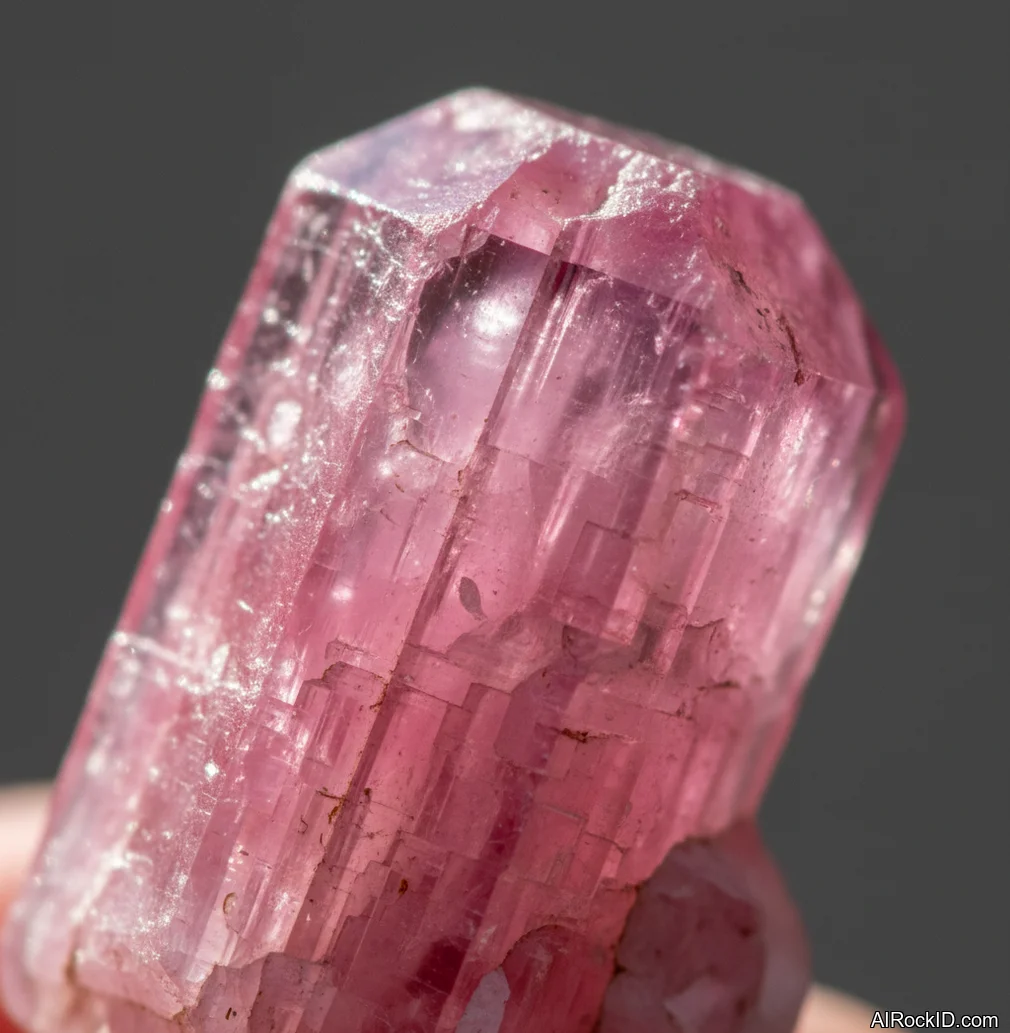
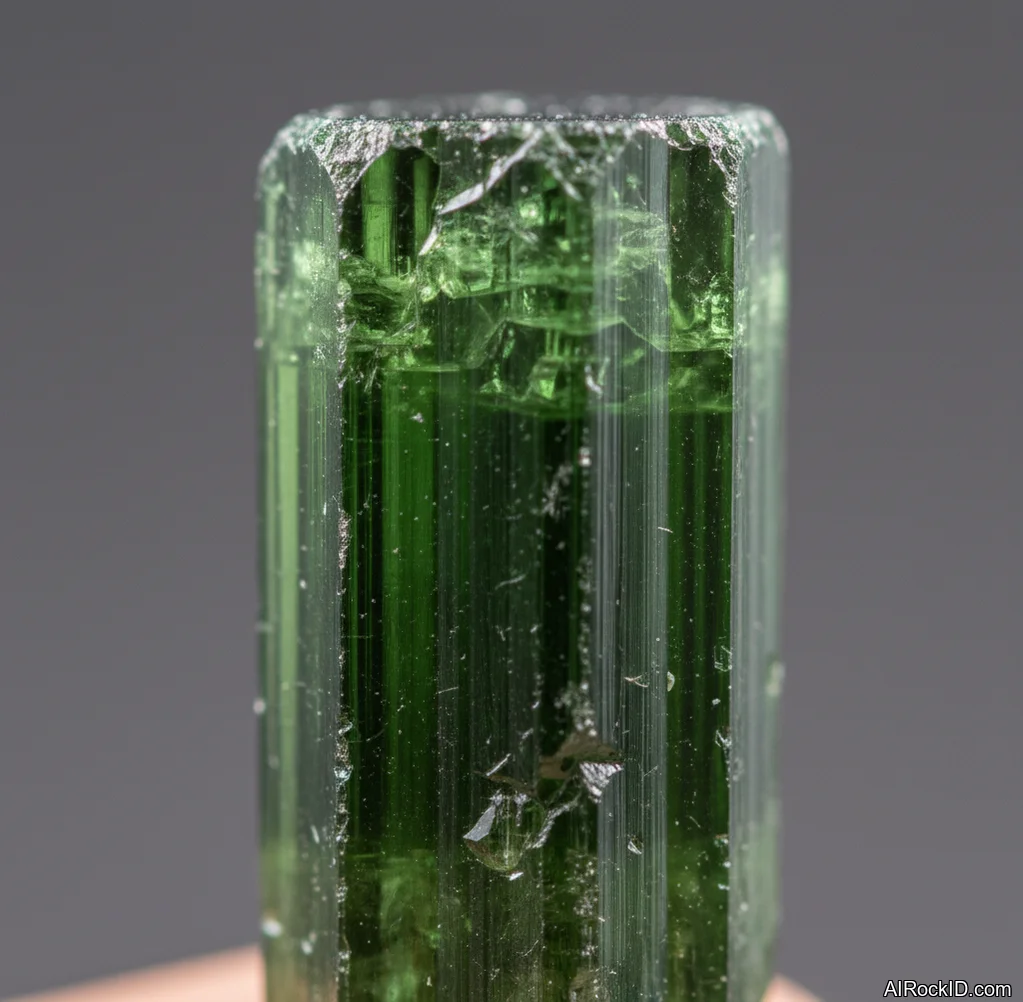
Red Tourmaline Rubellite is the red to pink-red variety of elbaite tourmaline. In your hand it’s got that familiar tourmaline feel: cool the second you touch it, then it warms up quickly, and those lengthwise striations? You can literally snag them with a fingernail if the faces are crisp.
Thing is, a lot of people will point at any pink tourmaline and call it “rubellite.” The trade usually keeps that name for stones that stay red under different lighting. That’s the whole trick here. I’ve opened parcels where one crystal looked like cherry candy in sunlight, then slid a little mauve under indoor LEDs. True rubellite hangs onto the red better. Not forever. Not under every bulb. But enough that you stop second-guessing what you’re seeing.
Look closer and it clicks why collectors go after the good stuff. The best crystals have clean prism faces, strong vertical grooves, and color that isn’t just sitting on the surface. But, yeah, reality: rubellite is often included, and you’ll run into little healed fractures that flare up like threads when you tilt the stone.
Origin & History
“Tourmaline” traces back to the Sinhalese word *turamali*, which was used for mixed-color stones brought out of Sri Lanka. And early on, Europeans basically used that name as a catch-all, lumping a bunch of different gems together under “tourmaline” before anyone got picky about what was what.
Rubellite, as a color term, shows up later in the gem trade. Thing is, once people started separating out tourmaline species, they also started caring about a steady, true red color, not just “pink” that shifts around depending on the stone.
Elbaite, which is the common species behind rubellite, was described in the early 1900s and named for Elba, Italy, where tourmaline occurs. In older collections, you’ll still run into labels like “rubellite (Brazil)” with no species listed at all. That’s pretty normal for dealer flats and those old estate boxes from mid-century shows (the kind with the slightly dusty foam and handwritten tags).
Where Is Red Tourmaline Rubellite Found?
Rubellite comes out of granitic pegmatites, with Brazil and Madagascar supplying a lot of the market and classic U.S. material coming from California’s pegmatite districts.
Formation
Rubellite usually shows up late in a granitic pegmatite’s life, when the melt is packed with boron, lithium, plus a whole stew of other elements that just don’t slot neatly into the earlier minerals. Tourmaline is basically a chemical trash can, and I mean that as a compliment. It’ll grab whatever’s floating around and turn it into those long prisms growing in pockets, seams, or miarolitic cavities.
But compared to black schorl, rubellite is pickier. It needs the chemistry to line up, especially manganese if you want those red and pink colors to actually happen. You’ll often see it hanging out with quartz, cleavelandite (that sugary albite), lepidolite, and sometimes beryl. And if you’ve ever picked up a pocket piece, you know the textures aren’t subtle: tourmaline feels slick and glassy under your fingers, while cleavelandite has that stacked playing cards feel (thin, a little scratchy at the edges).
How to Identify Red Tourmaline Rubellite
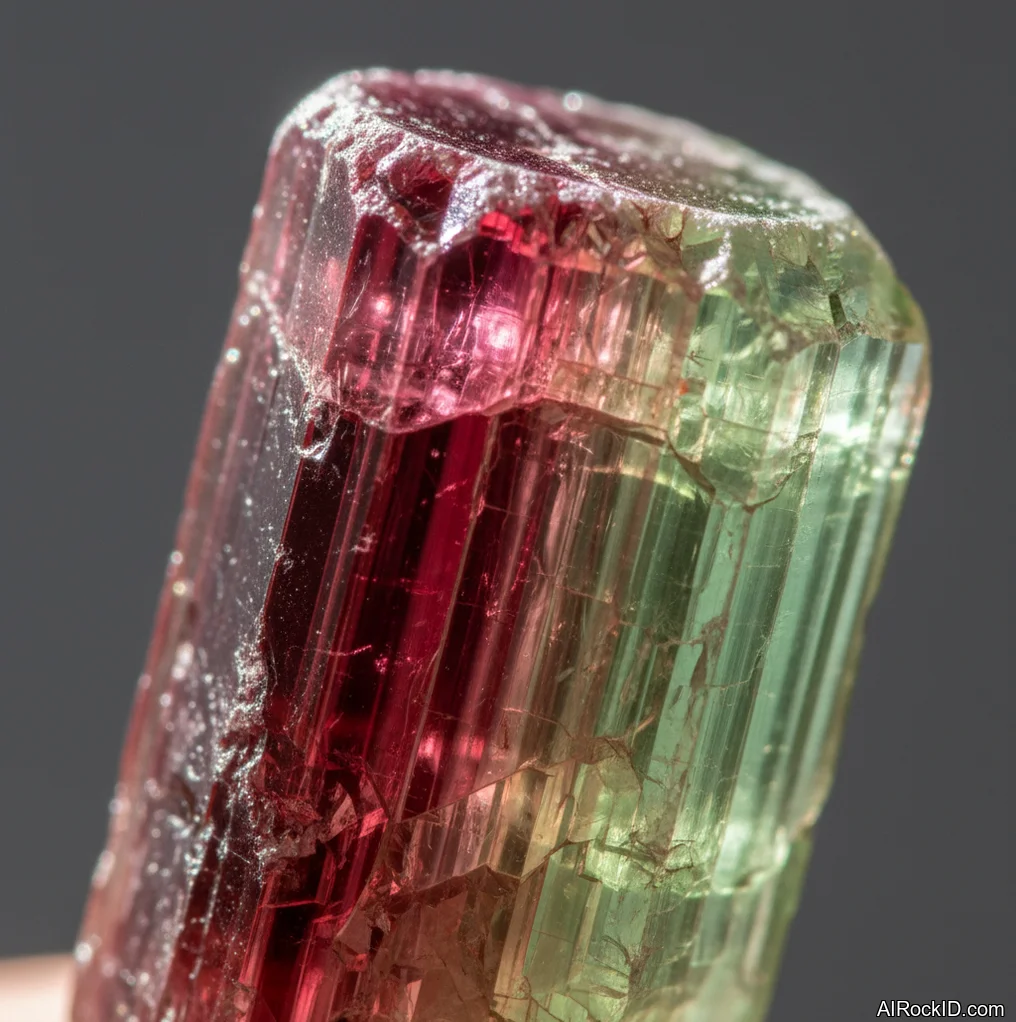
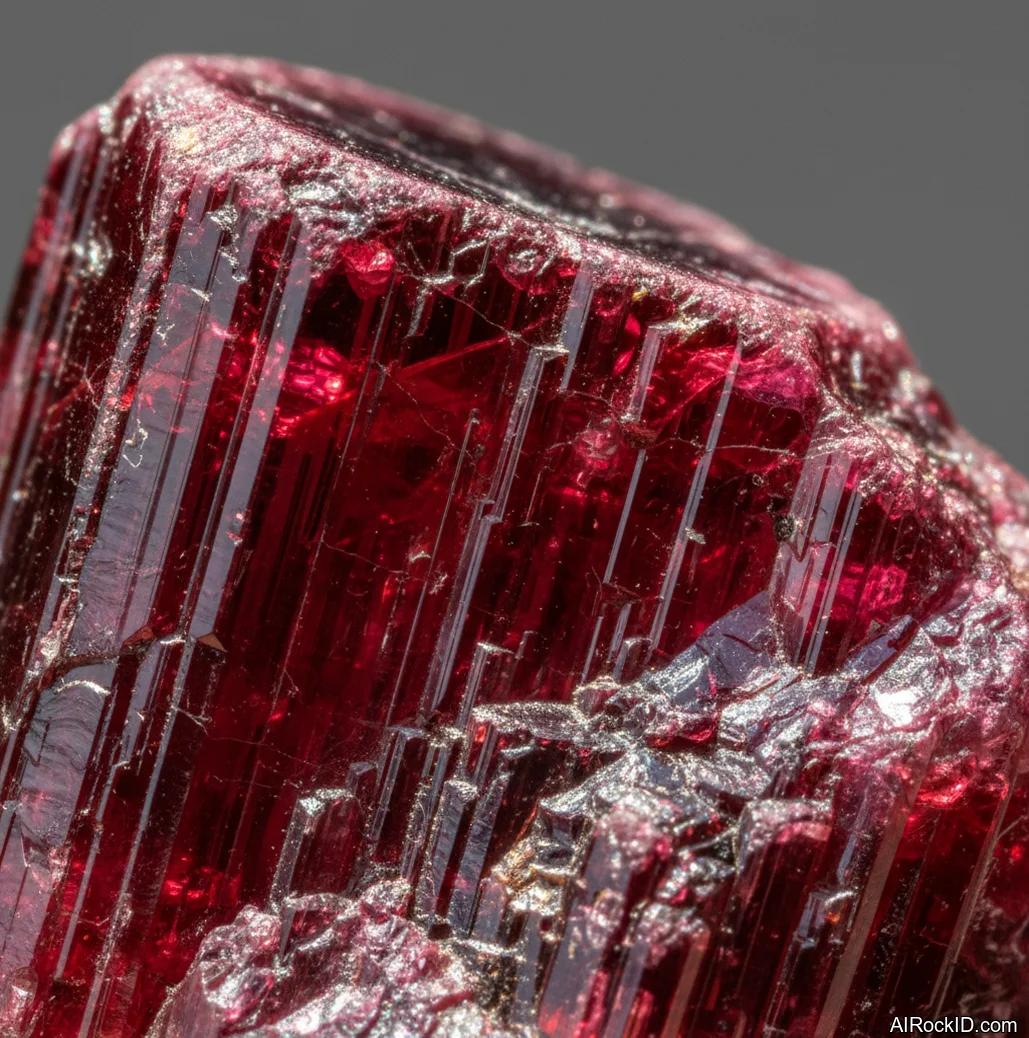
Color: Pink-red to raspberry red, sometimes with purplish or orangey notes; better rubellite keeps a red tone under multiple light sources. Zoning is common, with lighter cores or tips.
Luster: Vitreous, especially on clean prism faces.
Pick up a crystal and run your finger along the length. Those parallel grooves are classic tourmaline, and they’re hard to fake convincingly on a natural prism. The real test is a loupe: you’ll often see growth tubes, tiny feathers, and slight color zoning instead of a perfectly uniform “painted” red. But don’t overdo the scratch testing, tourmaline is hard enough to mark softer stones and you can chip a sharp termination if you get careless.
Common Look-Alikes
Red Tourmaline Rubellite is sometimes confused with these materials:
- Pink tourmaline (elbaite) that shifts to more pink or purplish under different lighting but still gets sold as “rubellite”
- Red spinel (especially clean faceted stones that stay red in any light)
- Rhodolite garnet (pyrope-almandine, the raspberry-red stuff that can look dead-on in photos)
- Red beryl (bixbite) in small faceted stones, often mistaken because both can be hot pink-red and pricey
- Dyed pink quartz/chalcedony sold as “rubellite” beads or cabochons (watch for dye in drill holes and cracks)
- Red/pink glass imitations (cheap “rubellite” carvings and beads that feel warm fast and show round bubbles)
Market Cautions & Treatments
When AI Can Get This Wrong
At first glance, AI mixes rubellite up with rhodolite garnet and red spinel because photos flatten the one thing that matters: the tourmaline habit and the lengthwise striations. If the picture doesn’t show crystal faces, AI also gets tricked by dyed pink quartz beads and red glass since they share that candy-raspberry color. The real test is physical: look for parallel striations you can catch with a fingernail on crisp faces, and check for pleochroism when you rotate it, rubellite usually shifts a bit while spinel doesn’t.
Properties of Red Tourmaline Rubellite
Physical Properties
| Crystal System | Trigonal |
| Hardness (Mohs) | 7-7.5 (Hard (6-7.5)) |
| Density | 3.02-3.26 |
| Luster | Vitreous |
| Diaphaneity | Transparent to translucent |
| Fracture | Uneven |
| Streak | White |
| Magnetism | Non-magnetic |
| Colors | red, pink-red, raspberry, purplish red, orangey red |
Chemical Properties
| Classification | Silicates |
| Formula | Na(Li,Al)3Al6Si6O18(BO3)3(OH)4 |
| Elements | Na, Li, Al, Si, O, B, H |
| Common Impurities | Mn, Fe, Ca, Mg, F |
Optical Properties
| Refractive Index | 1.614-1.666 |
| Birefringence | 0.014-0.040 |
| Pleochroism | Strong |
| Optical Character | Uniaxial |
Red Tourmaline Rubellite Health & Safety
It’s safe to handle, and it won’t mind a quick splash of water. Just use the normal common sense stuff: if you’re sanding, shaping, or polishing it and you see that fine powder hanging in the air, don’t breathe it in (wear a mask, crack a window, that kind of thing).
Safety Tips
If you’re going to cut or sand it, don’t do it dry. Use water to keep the dust down, crack a window or run a fan for ventilation, and wear a proper respirator that’s actually rated for fine particulates.
Red Tourmaline Rubellite Value & Price
Price Range
Rough/Tumbled: $15 - $300 per specimen
Cut/Polished: $50 - $800 per carat
Price shoots up fast when the red stays red under different lighting, the stone’s clear, and the size is there. A clean crystal with crisp, sharp terminations (the kind that’ll actually catch on a cloth if you wipe it) costs a lot more than a tumbled stone, even when the color looks basically the same.
Durability
Durable — Scratch resistance: Good, Toughness: Fair
It wears well in jewelry, but it can chip along edges and it doesn’t love hard knocks on thin prongs.
How to Care for Red Tourmaline Rubellite
Use & Storage
Store rubellite so it can’t bang against quartz or harder gems. I keep mine in a perky box with a bit of foam because sharp tourmaline terminations chip easier than people think.
Cleaning
1) Rinse with lukewarm water and a drop of mild soap. 2) Use a soft toothbrush to clean along the lengthwise grooves. 3) Rinse well and pat dry; don’t heat it to “speed dry” in the sun.
Cleanse & Charge
If you do energetic cleansing, smoke, sound, or a quick rinse and dry are the low-risk options. Avoid salt soaks if the piece has fractures or attached cleavelandite.
Placement
Keep it out of constant windowsill sun if you’re picky about color over the long haul. A shelf is fine, but I like a spot where you can tilt it and actually see the pleochroism flash.
Caution
Skip ultrasonic and steam cleaners, especially if the stone has inclusions or any little fractures. And don’t just toss it in your pocket rattling around with keys or other crystals, because it’ll get scratched up fast.
Works Well With
Red Tourmaline Rubellite Meaning & Healing Properties
Pick up a piece of rubellite and, yeah, that whole “vibe” thing people talk about suddenly doesn’t sound so woo. It’s got that warm color that your brain tags as “heart” in about half a second. And it’s one of the few stones where the color can look like it’s lit from the inside, even when the crystal has those tiny natural threads running through it (you can usually catch them when you tilt it under a lamp).
In crystal circles, rubellite gets linked to love, compassion, and emotional repair. I file it under support stones, not miracle stones. If you’re doing journaling, therapy, or you’re just trying to soften your own edges, rubellite can be an easy companion because it keeps tugging your attention back toward feelings you’d normally sidestep.
But look, there’s a real limit here: some rubellite feels intense. Strong pleochroism and that deep red can land as “amped up” instead of calming, especially if the piece is very dark. When that happens, I’ll pair it with something grounding like smoky quartz, or I’ll just move it off my desk so it isn’t staring me down all day. And none of this is medical care, obviously. It’s a focus tool, a personal symbol, that kind of thing.
Common mistakes
- Assuming every red or pink-red transparent stone is rubellite
- Using the word “rubellite” for any pink tourmaline without considering color saturation
- Confusing red tourmaline with ruby because of trade names or seller descriptions
- Judging authenticity only from photos without checking hardness, refractive properties, or seller documentation
- Overlooking possible treatments when comparing prices
- Cleaning included rubellite with harsh methods before checking stability or setting condition
Identify Red Tourmaline Rubellite from a photo
Compare Red Tourmaline Rubellite traits, care tips, value clues, and common lookalikes with a clear photo.