Lepidolite


Quick answer: Lepidolite is a soft, lithium-rich mica most often recognized by its lilac, pink, lavender, or grayish-purple color and flaky cleavage. It is best identified by combining color, pearly luster, softness, and its common occurrence with pegmatite minerals such as quartz, feldspar, tourmaline, and spodumene.
AI Rock ID can help compare a suspected lepidolite specimen against visually similar purple or pink minerals using color, texture, luster, and crystal habit. RockIdentifier.io provides crystal identification support, but lab testing may be needed for exact mica-group species or lithium content.
Good fit
- Collectors who want a recognizable purple or pink mica specimen
- Beginners learning to identify soft minerals with perfect cleavage
- People comparing pegmatite minerals such as mica, quartz, feldspar, and tourmaline
- Decorative use in low-contact displays, bowls, or specimen trays
Not a good fit
- Rings, bracelets, or daily-wear jewelry exposed to abrasion
- Outdoor displays where water, sunlight, and temperature swings may damage the surface
- Anyone needing a durable carving or pocket stone that can withstand frequent handling
- Buyers who require confirmed lithium content without seller documentation or testing
Most commonly confused with
- Amethyst: Amethyst is harder quartz with a glassy luster, while lepidolite is softer and often shows pearly, flaky mica layers.
- Sugilite: Sugilite is usually denser, tougher, and more opaque purple, while lepidolite is softer and micaceous.
- Purple Fluorite: Purple fluorite has cubic cleavage and a glassy luster, while lepidolite splits into thin flexible sheets.
- Charoite: Charoite commonly has swirling fibrous patterns, while lepidolite has platy mica texture and pearly sheen.
Lepidolite vs Similar Purple Minerals
| Mineral | Key look | Hardness | Main distinction |
|---|---|---|---|
| Lepidolite | Lilac to pink mica, pearly flakes | 2.5–4 | Splits into thin sheets |
| Amethyst | Purple transparent to translucent quartz | 7 | Glassy and much harder |
| Purple fluorite | Purple, often cubic or massive | 4 | Cubic cleavage, glassy luster |
| Sugilite | Opaque purple massive material | 5.5–6.5 | Tougher and not flaky |
| Charoite | Purple with swirling fibrous patterns | 5–6 | Distinctive chatoyant-looking swirls |
AI identification confidence
AI identification confidence for lepidolite is usually moderate when photos show its flaky mica texture, pearly sheen, and lavender-to-pink color. Confidence is lower for polished pieces, tumbled stones, dyed material, or close-up photos without scale and side lighting.
When AI gets it wrong
- Polished lepidolite may lose the visible flaky texture that helps distinguish it from other purple stones.
- Dyed quartz, dyed marble, or resin composites can imitate purple coloration in photos.
- Fine-grained pink or purple mica may be labeled lepidolite even when it is another mica-group mineral.
- Strong lighting or color filters can make gray, pink, or purple minerals appear more similar than they are.
Final recommendation
Choose lepidolite when the specimen shows a natural pearly mica texture, lilac-to-pink color, and a seller description consistent with pegmatite origin. For jewelry or frequent handling, select protected settings or display specimens because lepidolite is relatively soft and cleaves easily.
How to Spot Authentic Lepidolite
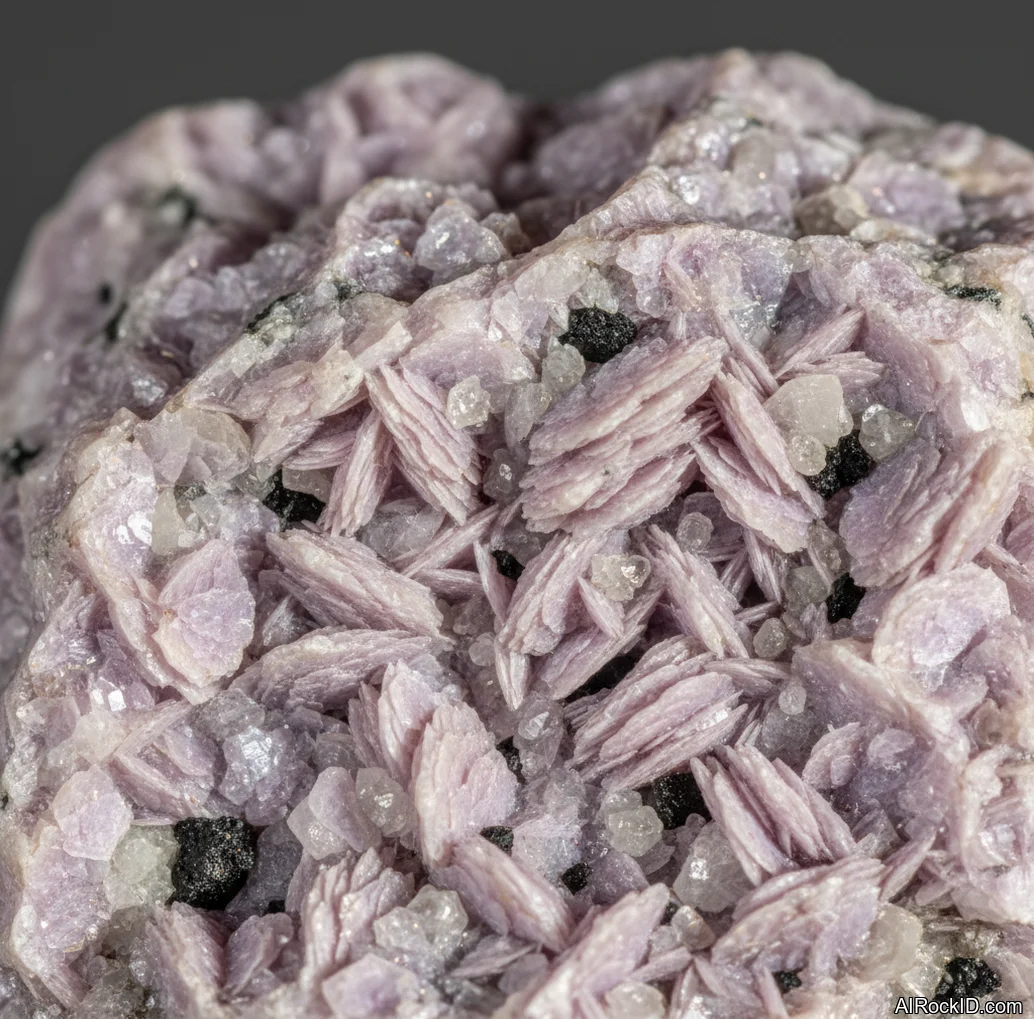
Authentic lepidolite usually shows a platy or scaly mica texture with a pearly to silvery luster. Natural pieces may be lavender, lilac, pink, grayish purple, or mixed with quartz and feldspar. A specimen that is uniformly bright purple, glassy, or unusually hard may be another mineral, dyed stone, or composite material.
Buying Tips for Lepidolite
Ask whether the piece is natural, dyed, stabilized, or part of a mixed pegmatite rock. Tumbled stones and cabochons should be checked for surface coatings, cracks, and crumbly edges because lepidolite is soft and can shed mica flakes. Locality information, such as Brazil, Madagascar, the United States, or Africa, can add context but does not by itself prove authenticity.
Best Photo Angles for Identification
Photograph lepidolite in indirect daylight with one image showing the whole specimen and another showing the surface texture up close. A side-lit photo can reveal the pearly sheen and layered cleavage that separate lepidolite from quartz, fluorite, and other purple minerals. Including a ruler or coin helps estimate scale and crystal habit.
What Is Lepidolite?
Lepidolite is a lithium-rich mica mineral from the phyllosilicate (sheet silicate) group. Most pieces you run into are lilac, pink, or that washed-out pale purple, and it splits into thin plates like any other mica. Grab a chunk and you’ll notice that “stack of pages” feel immediately, especially on rough bits where the edges practically beg to flake off.
It can pass for just a purple rock at first. But tip it under a shop light and the whole face starts flashing back at you. That shimmer isn’t something a polish “adds.” It’s just the cleavage faces doing the usual mica thing.
And unlike amethyst or fluorite, lepidolite doesn’t often show up with those clean, pointy crystal tips. It’s usually platy masses, books, or crumbly aggregates. Kinda messy. That’s the charm.
Next to muscovite, lepidolite typically feels a touch softer and a little “greasy” on your fingertips, and if you rub an edge you’ll often get tiny flakes left behind (they stick to your skin like dust). But here’s the annoying part: some sellers slap “lepidolite” on any purple mica. I’ve seen purple muscovite, and even mica-rich schist, sold under the same name. So yeah, color by itself doesn’t tell the whole story.
Origin & History
Back in 1792, Martin Heinrich Klaproth pinned lepidolite down as its own mineral species after working with mica-heavy pegmatite material. The name’s straight from the Greek “lepidos,” meaning “scale,” which makes total sense once you’ve seen how it cleaves, flaking off into thin, scale-like plates that feel a bit like stiff little sheets.
And historically, lepidolite’s a big deal because it’s one of the classic lithium-bearing minerals. Long before “lithium” turned into a battery buzzword, mineralogists were hunting for where it actually sat in rocks, and lepidolite kept popping up in those early lithium studies. Why that one so often? It just was.
Where Is Lepidolite Found?
Most good collector material comes out of granitic pegmatites, especially in Brazil and Madagascar, with classic North American occurrences in California pegmatite districts.
Formation
Raw pegmatite chunks can tell you a ton about how lepidolite actually forms. It shows up late, way down at the tail end of a granitic melt cooling off, when the leftover fluids are crammed with the “weird” elements: lithium, rubidium, cesium, fluorine, and sometimes manganese.
And those late-stage fluids don’t just sit there. They snake through little fractures and odd pockets, and that’s where the classic pegmatite stuff turns up: mica books, spodumene, tourmaline, beryl, plus the rest of the usual crew.
Look closely at a lepidolite mass and you’ll usually catch it mixed in with quartz and feldspar. Sometimes you’ll see white cleavelandite feldspar in thin blades (the kind that look like little fans when the light hits). I’ve cracked open pieces where the lepidolite is basically this purple filling wedged between blocky feldspar crystals, dust falling off and that faint slick mica feel on your fingers. But it doesn’t only live in pegmatites. It also turns up in greisenized granite and in altered zones where fluids have gone back through and reworked the original rock.
How to Identify Lepidolite
Color: Typical color ranges from pale lilac to pinkish purple, sometimes gray-lavender or even yellowish in altered material. Stronger purple is often tied to manganese content, but color can vary a lot within one piece.
Luster: Pearly to vitreous on cleavage faces, with a mica-like shimmer that flashes when you tilt it.
Pick up a piece and try to catch an edge with your fingernail. If it wants to peel into thin sheets or leave tiny flakes, you’re in mica territory. If you scratch it with a copper penny, many pieces will mark, and it definitely won’t feel like quartz-hard material. The real test is to look for that perfect basal cleavage, the “book pages” break that gives a clean, flat reflection when you roll it under light.
Common Look-Alikes
Lepidolite is sometimes confused with these materials:
- Purple mica or muscovite (sometimes sold loosely as “purple mica” when it’s lepidolite)
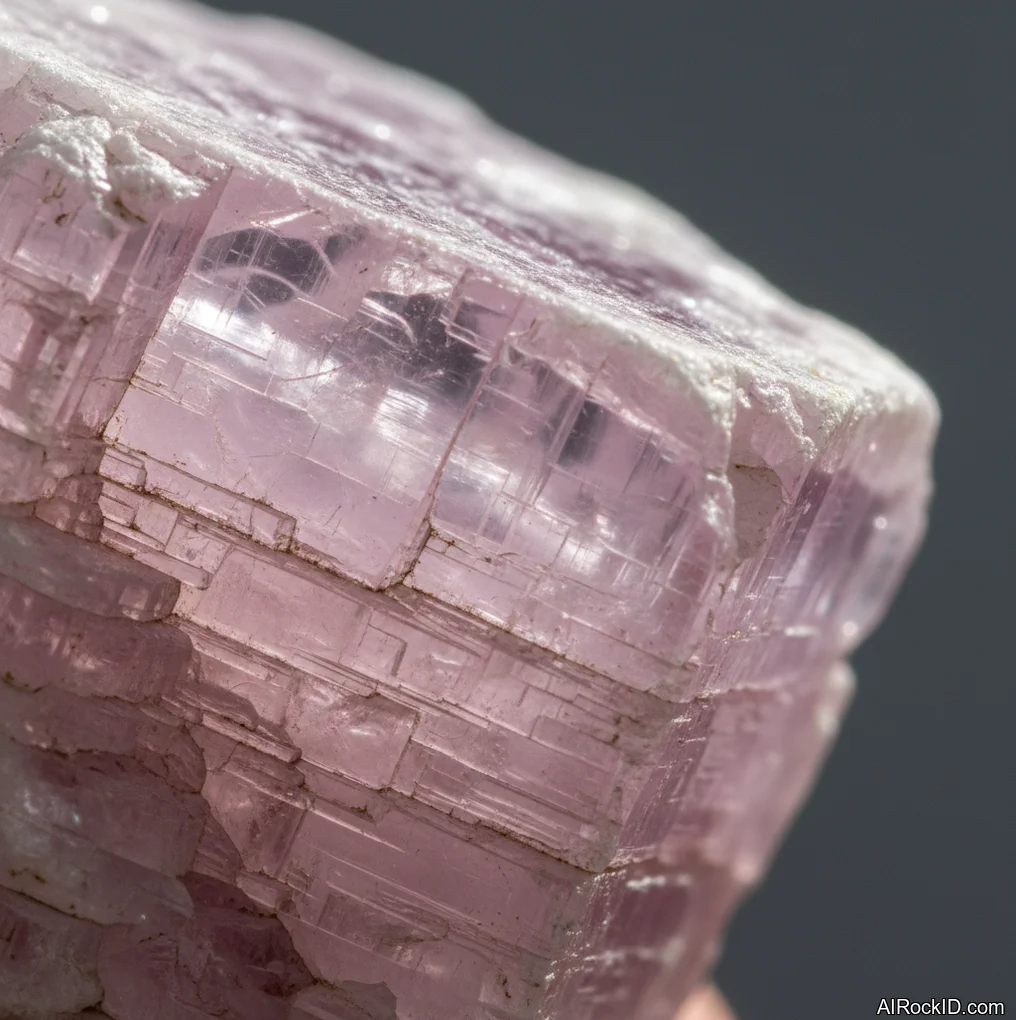
- Kunzite (pale lilac spodumene, especially when it’s in chunky, cleavagey pieces)
- Purple fluorite (tumbled fluorite can mimic that soft lavender look in photos)
- Dyed quartzite or dyed agate sold as “lepidolite” (color sits in pits and fractures)
- Man-made purple glass (tumbled “healing stones” that feel too smooth and look too clean)
- Lepidolite-in-quartz / “lavender quartz” mixed material (often mislabeled as pure lepidolite)
Market Cautions & Treatments
When AI Can Get This Wrong
Phone photos love to flatten lepidolite into “just purple”, so AI often calls it amethyst, fluorite, or dyed quartzite when the mica flash doesn’t catch the light. The real test is movement: tilt it and you should get that mica shimmer from tiny plate faces, not a glassy glow. If you can, do a quick scratch check on an unimportant spot. Lepidolite scratches with a copper coin or even a fingernail on softer areas, while fluorite and quartz won’t.
Properties of Lepidolite
Physical Properties
| Crystal System | Monoclinic |
| Hardness (Mohs) | 2.5-4 (Soft (2-4)) |
| Density | 2.8-2.9 |
| Luster | Pearly |
| Diaphaneity | Transparent to translucent |
| Fracture | Uneven |
| Streak | White |
| Magnetism | Non-magnetic |
| Colors | Lilac, Pink, Purple, Lavender, Gray, White, Yellowish |
Chemical Properties
| Classification | Silicates (phyllosilicate mica) |
| Formula | K(Li,Al)3(Al,Si,Rb)4O10(F,OH)2 |
| Elements | K, Li, Al, Si, O, F, H, Rb |
| Common Impurities | Mn, Fe, Cs, Rb, Na |
Optical Properties
| Refractive Index | 1.55-1.62 |
| Birefringence | 0.035-0.040 |
| Pleochroism | Weak |
| Optical Character | Biaxial |
Lepidolite Health & Safety
Handling is pretty low risk. But like any mica-heavy rock, if you start grinding it up or running a saw through it, you’ll kick off tiny, glittery flakes that get everywhere (they stick to your fingertips and even your shirt cuffs). Normal display on a shelf and casual handling are safe.
Safety Tips
If you have to cut or sand it, keep it wet with water, put on eye protection, and don’t skip a proper respirator that’s rated for fine particulates. Dust in your eyes or lungs? Not worth it.
Lepidolite Value & Price
Price Range
Rough/Tumbled: $5 - $120 per specimen
Cut/Polished: $2 - $20 per carat
Price goes up fast when the color’s cleaner, the mica books are bigger, and the pieces actually glitter without turning to dust in your hands. The solid cabbing rough with no cracks costs more, but the crumbly material that drops little flakes all over the bag (and sticks to everything) is cheaper for a reason.
Durability
Nondurable — Scratch resistance: Poor, Toughness: Poor
It’s stable as a mineral, but it cleaves and flakes easily, so edges and corners get beat up fast in pockets or jewelry.
How to Care for Lepidolite
Use & Storage
Store it in a perky box or wrap it, because lepidolite corners chip and the mica plates can peel if it rattles around. I keep my nicer books flat so they don’t flex and shed.
Cleaning
1) Rinse quickly with lukewarm water to knock off dust. 2) Use a very soft brush (makeup brush works) and gentle soap if needed. 3) Pat dry and let it air dry fully before boxing it up.
Cleanse & Charge
If you do the metaphysical side, smoke cleansing or sound is the least fussy since it won’t bang up the edges. A short moonlight sit is fine, but don’t leave it in a sunny window for days.
Placement
On a shelf, give it a stable base and keep it away from high-traffic spots where it’ll get bumped. A small acrylic stand helps show the flash without handling it constantly.
Caution
Skip ultrasonic cleaners, steam cleaning, and any kind of rough tumbling. It’s just not worth it. And don’t count on it wearing like quartz in rings or bracelets. Thing is, cleavage will win every time.
Works Well With
Lepidolite Meaning & Healing Properties
Pick up a piece of lepidolite and you instantly get why people grab it when they’re trying to dial things down. It’s got this soft, almost papery feel, and the shimmer is low-key, not loud. In my own stash, it’s the one I’ll slide across the counter to someone who can’t stop fidgeting, because it’s genuinely nice to rub (even though, yeah, it can leave a faint mica dust on your thumb).
In crystal tradition, lepidolite gets linked with calming, settling the mind, and taking the edge off emotional spikes. I treat that as a personal practice thing, not medicine. If you’ve got real anxiety or sleep problems, that’s a health conversation, not a rock conversation. But as a desk stone, or a quick “hold this and breathe for a minute” piece, lepidolite does that job well.
But don’t let the marketing spiral. Some shops lean way too hard on the fact that it’s lithium-bearing and start hinting it’ll act like lithium medication. No. The lithium is locked into the mineral structure, and you’re not getting a dose from holding it. What you *do* get is a steady tactile cue. Cool in your hand, silky along the cleavage, and a little sparkle when you tilt it under a light. That part’s real. And honestly, sometimes that’s enough, right?
Common mistakes
- Assuming every lilac or pink stone is lepidolite without checking hardness and luster
- Confusing polished lepidolite with amethyst because both can appear purple in photos
- Using color alone to separate lepidolite from other mica minerals
- Buying very bright purple material without asking whether it has been dyed or stabilized
- Cleaning lepidolite with water soaking, ultrasonic cleaners, or harsh chemicals
- Expecting lepidolite to perform like a durable gemstone in daily-wear jewelry
Identify Lepidolite from a photo
Compare Lepidolite traits, care tips, value clues, and common lookalikes with a clear photo.