Blueberry Fluorite


Quick answer: Blueberry Fluorite is a trade name for blue to blue-purple fluorite, a calcium fluoride mineral with a Mohs hardness of 4. It is attractive for its color zoning and translucency, but it scratches easily and has strong cleavage that can chip if dropped.
AI Rock ID can help screen Blueberry Fluorite by comparing visible color, crystal habit, luster, transparency, and cleavage clues from a photo. RockIdentifier.io should be used as an identification aid, while final confirmation may require hardness, specific gravity, fluorescence, or expert inspection.
Good fit
- Collectors who want blue to violet-blue fluorite color zoning
- Display specimens, palm stones, and low-wear decorative pieces
- Beginners learning to recognize cubic cleavage and glassy luster
- Buyers who prefer a common mineral with many affordable examples
Not a good fit
- Rings, bracelets, or other jewelry exposed to daily abrasion
- Ultrasonic cleaners, steam cleaning, or rough handling
- Situations where a water-safe or high-hardness stone is required
Most commonly confused with
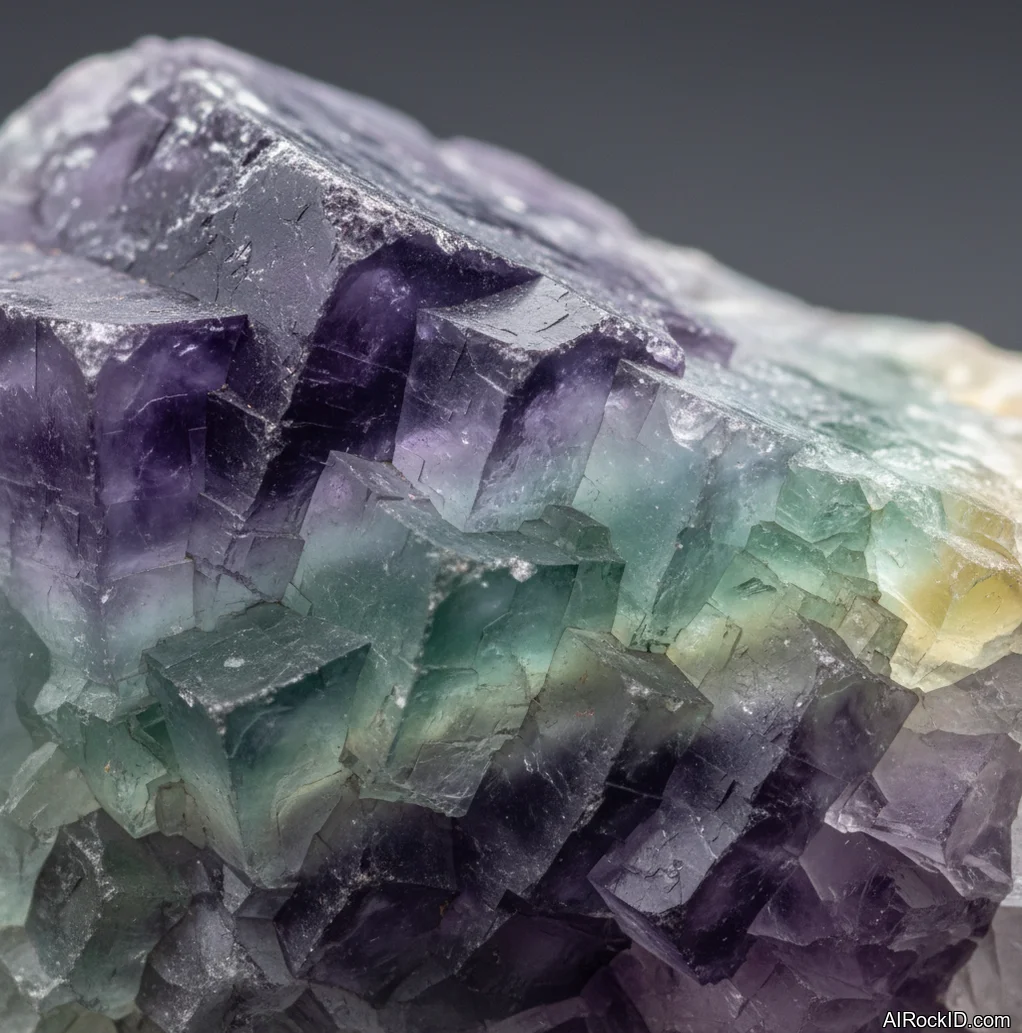
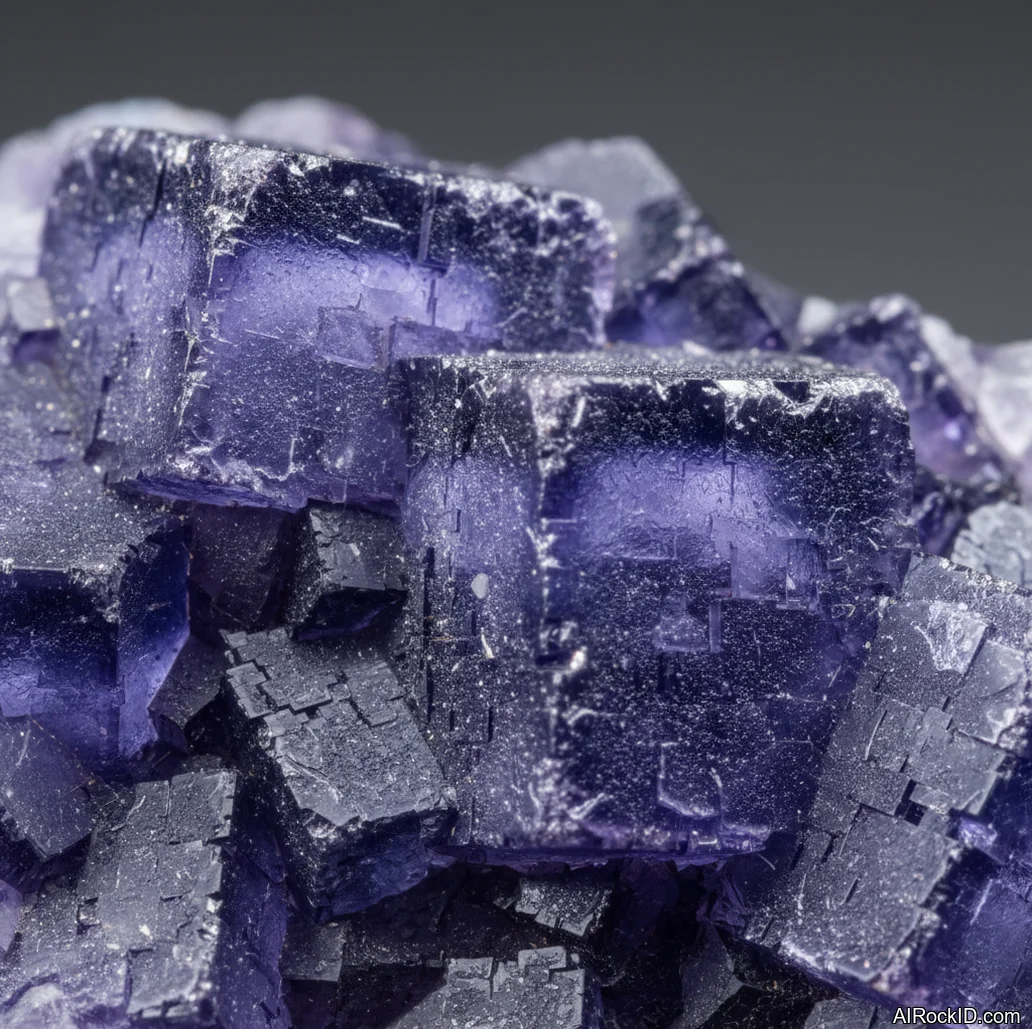
- Purple Fluorite: Purple fluorite is usually more violet overall, while Blueberry Fluorite is marketed for blue to blue-purple tones.
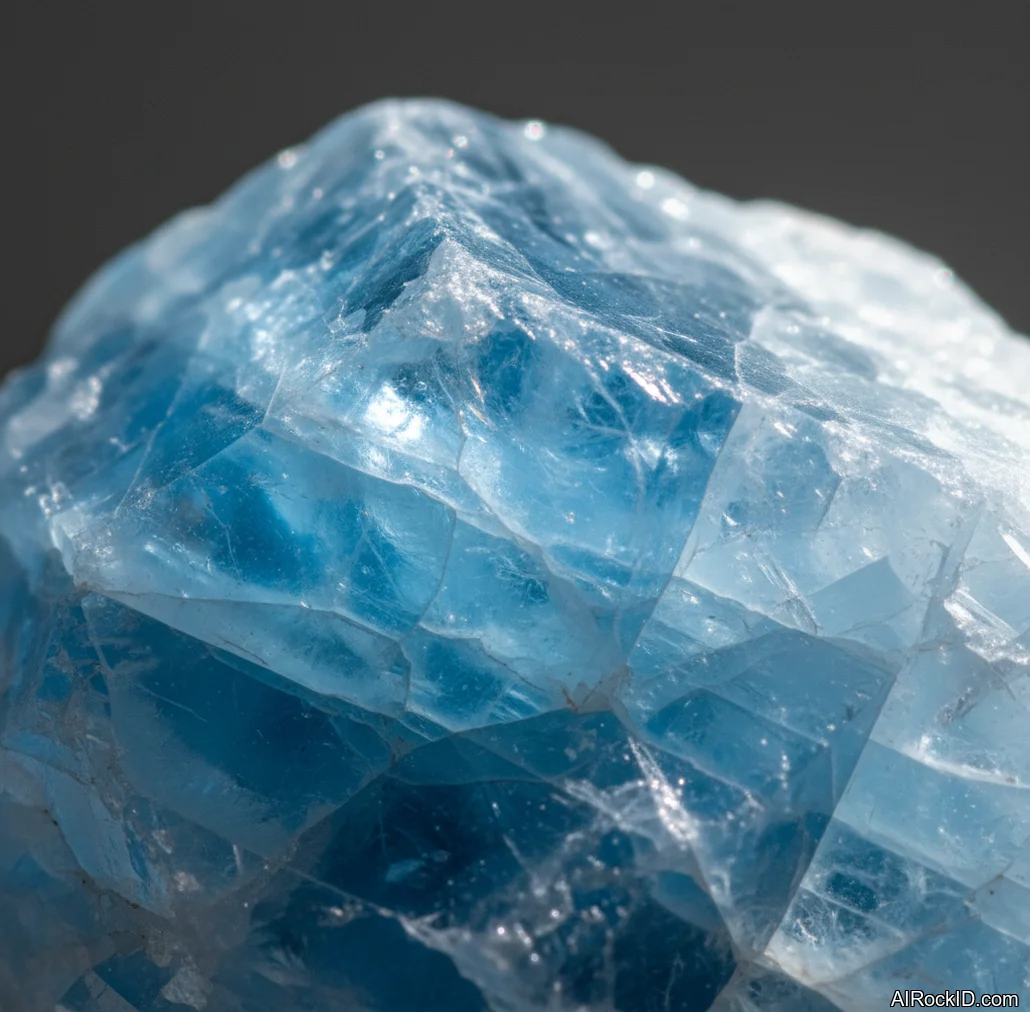
- Blue Calcite: Blue calcite is softer and reacts to acid, while fluorite has a glassier look and different cleavage.
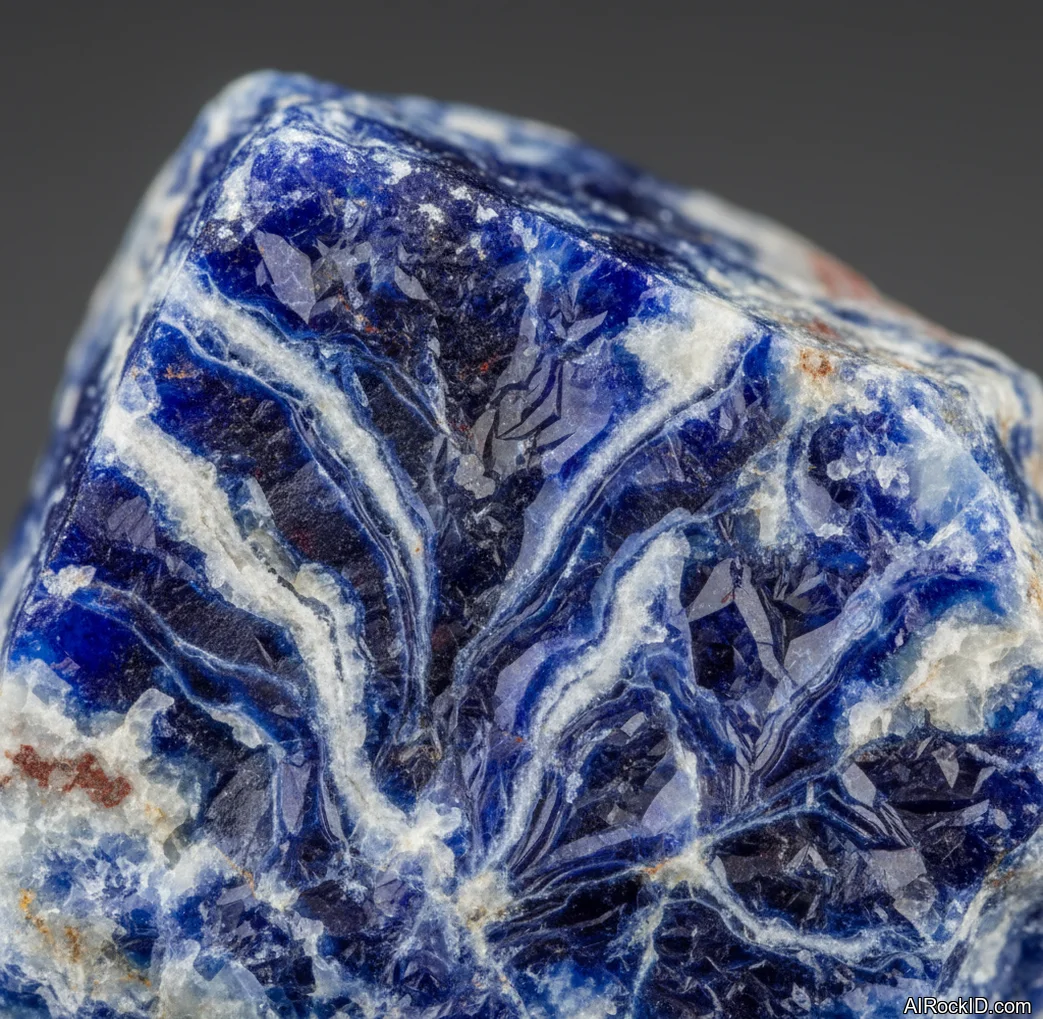
- Sodalite: Sodalite is typically opaque with white veining, while Blueberry Fluorite is often translucent to transparent.
- Amethyst: Amethyst is quartz with Mohs 7 hardness and no fluorite-style perfect cleavage.
Blueberry Fluorite vs Similar Blue-Purple Stones
| Material | Typical appearance | Key ID clue | Hardness |
|---|---|---|---|
| Blueberry Fluorite | Blue to blue-purple, often translucent with zoning | Perfect cleavage; cubic or stepped breaks | Mohs 4 |
| Purple Fluorite | Violet to purple, may be banded | Same fluorite properties; color is usually more purple | Mohs 4 |
| Blue Calcite | Pale blue, often waxy to vitreous | Effervesces with acid; softer than fluorite | Mohs 3 |
| Sodalite | Opaque royal blue with white or gray patches | No transparent zoning; granular massive texture | Mohs 5.5–6 |
| Amethyst | Purple transparent quartz | Harder; lacks fluorite cleavage | Mohs 7 |
AI identification confidence
Photo-based AI identification is usually moderate for Blueberry Fluorite when the image shows blue-purple zoning, transparency, and cleavage surfaces. Confidence drops when the specimen is tumbled, heavily polished, dyed, photographed under colored light, or shown without scale.
When AI gets it wrong
- A polished blue-purple stone lacks visible cleavage or crystal form.
- Lighting makes purple fluorite, amethyst, or glass appear more blue than it is.
- The specimen is opaque and may be sodalite, blue calcite, or dyed stone.
- A listing uses a trade name without mineral test details or locality information.
Final recommendation
Choose Blueberry Fluorite if you want a blue to blue-purple fluorite specimen for display, study, or gentle handling. For daily-wear jewelry or a tougher blue-purple stone, a harder mineral such as quartz may be more practical.
How to Check Blueberry Fluorite Authenticity
Authentic Blueberry Fluorite should match fluorite’s basic traits: Mohs 4 hardness, vitreous luster, and perfect cleavage that can create flat stepped surfaces. Be cautious with unusually vivid, uniform color, visible dye concentration in cracks, air bubbles, or listings that use only a trade name without naming fluorite. A scratch test should only be done on an inconspicuous area or a rough fragment because fluorite damages easily.
Buying Tips for Blueberry Fluorite
Look for clear photos under neutral lighting, especially if color zoning is part of the appeal. Ask whether the stone is natural, dyed, coated, stabilized, or irradiated, because treatments can affect value and expectations. Chips along edges and cleavage planes are common in fluorite, so inspect corners, points, and polished surfaces before buying.
Best Uses for Blueberry Fluorite
Blueberry Fluorite is best suited for cabinet specimens, display pieces, carvings, spheres, and occasional-use pendants. It is less suitable for rings or everyday bracelets because it is soft and cleaves easily. In metaphysical traditions, blue and purple fluorite are often associated with focus, calm, and intuitive work, but these uses are cultural or spiritual rather than medical.
What Is Blueberry Fluorite?
Blueberry Fluorite is just a trade name dealers use for blue to blue-purple fluorite (calcium fluoride) that has that “blueberry” kind of color, often with zoning and strong cubic cleavage.
Grab a chunk and you notice it immediately: it feels cool in your hand, and the surface has that glassy, almost slick feel. And the cleavage is basically fluorite’s whole thing. Tip it under a shop light and those flat faces flash bright for a second, then they go dull again the moment you shift the angle. The best “blueberry” pieces I’ve actually handled aren’t one flat, uniform blue, either. You’ll see milky bands running through them, darker inky corners, and sometimes there’s even a faint green rim that only shows up when you slowly rotate the stone (blink and you miss it).
But here’s the catch: a lot of what’s sold as Blueberry Fluorite is just regular blue fluorite from whatever parcel a dealer picked up recently, with the name slapped on because it sells. That doesn’t mean it’s fake. It just means you’re buying the color and the look, not some formally recognized variety.
Origin & History
Fluorite got described as a mineral species back in the 18th century, and early mineralogical literature credits Carl Linnaeus (1735) for it, with later mineralogists tightening things up and formalizing the species concept.
The name “fluorite” comes from the Latin *fluere*, meaning “to flow,” because people used fluorite as a flux in smelting. It really does behave that way in practice, too: toss it in and it helps things melt cleaner (you can almost see the glassy surface soften and run).
“Blueberry Fluorite,” though? That isn’t some old, historical mineral name. It’s a modern trade nickname dealers use for fluorite in that saturated blue to blue-purple color range, usually showing up as chunky cleavage pieces, cubes, or polished freeforms.
Where Is Blueberry Fluorite Found?
Blue to blue-purple fluorite that gets sold as “Blueberry” shows up wherever fluorite does, especially in hydrothermal districts that also produce cubes and color-zoned material.
Formation
Most fluorite grows in hydrothermal veins. Hot, mineral-rich fluids push through cracks in limestone, dolostone, or whatever rock is hosting the vein, and as the fluid cools, calcium and fluoride meet up and crystallize into cubic fluorite. You’ll often find it sitting right next to calcite, quartz, barite, plus sulfides.
Look, if you’ve got a color-zoned piece in your hand, you can practically see the pulses of fluid that came through. One stage lays down a pale blue band. Then it flips to purple. Then a clear stripe shows up. Later you’ll notice a darker rim on the outside. And in person, those zones can feel a little different on the cleavage faces, too. One band seems to grab fingerprints faster than the next (it’s subtle), like the surface is just a touch rougher under the skin.
How to Identify Blueberry Fluorite
Color: Blueberry Fluorite runs medium to deep blue, indigo, or blue-purple, sometimes with lighter icy zones or faint green edges. Color banding and corner zoning are common.
Luster: Vitreous luster on fresh cleavage faces, like broken glass.
If you scratch it with a steel nail, it’ll usually mark because fluorite is Mohs 4. The real test is cleavage: break or chip happens in flat planes, and you’ll see repeated step-like faces instead of a random jagged break. Under UV light, many fluorites fluoresce (often blue), but the reaction varies a lot by locality, so don’t use UV alone as a pass or fail.
Common Look-Alikes
Blueberry Fluorite is sometimes confused with these materials:
- Blue Chalcedony
- Tanzanite (lower grade, opaque pieces)
- Dyed Quartz (blue or purple, often labeled as 'blueberry quartz')
- Blue Glass (especially old slag glass or colored art glass)
- Yttrium Fluorite (stabilized and colored artificially)
- Heat-treated Amethyst (turns deep blue-purple sometimes)
Market Cautions & Treatments
When AI Can Get This Wrong
Photo ID apps mix up Blueberry Fluorite with blue glass and dyed quartz all the time, especially if the cubic cleavage isn't visible. In-person, the cool touch and those razor-straight cleavage faces are the big tells. If you can snap a photo with a bright flash, the real stuff will often show quick, mirror-like flashes on flat faces, while glass and dyed quartz won't react the same way.
Properties of Blueberry Fluorite
Physical Properties
| Crystal System | Cubic |
| Hardness (Mohs) | 4 (Soft (2-4)) |
| Density | 3.18 g/cm3 |
| Luster | Vitreous |
| Diaphaneity | Transparent to translucent |
| Fracture | Uneven |
| Streak | White |
| Magnetism | Non-magnetic |
| Colors | Blue, Blue-purple, Indigo, Violet, Colorless, Green (minor zoning) |
Chemical Properties
| Classification | Halides |
| Formula | CaF2 |
| Elements | Ca, F |
| Common Impurities | Y, Ce, Eu, Sm, Fe |
Optical Properties
| Refractive Index | 1.433-1.435 |
| Birefringence | None |
| Pleochroism | None |
| Optical Character | Isotropic |
Blueberry Fluorite Health & Safety
Normal handling is totally fine, and a quick splash of water isn’t going to hurt it. But don’t cut or grind it in a way that kicks up dust, and keep any little chips off the floor and out of reach of kids and pets.
Safety Tips
If you’re lapping or carving fluorite, keep it wet with water, make sure you’ve got decent ventilation, and wear a proper respirator so you’re not breathing in that super-fine dust.
Blueberry Fluorite Value & Price
Price Range
Rough/Tumbled: $8 - $120 per piece
Cut/Polished: $3 - $25 per carat
Price mostly comes down to color saturation, how clean the cube faces are, how sharp the zoning looks, and the size. And damage is a huge deal with fluorite, because one ugly chip on an edge (the kind you can feel when you run a fingernail along it) can take a display cube and dump it straight into the bargain bin.
Durability
Nondurable — Scratch resistance: Fair, Toughness: Poor
Fluorite cleaves easily and can lose polish or chip from minor knocks, so it’s better as a display mineral than an everyday wear stone.
How to Care for Blueberry Fluorite
Use & Storage
Store it by itself or wrapped, because harder stones will scuff it and fluorite will chip on edges fast. I keep my nicer cubes in small perky boxes so they don’t rattle around.
Cleaning
1) Rinse quickly in lukewarm water. 2) Use a soft brush with a drop of mild soap for dirt in corners. 3) Rinse and pat dry, then air dry fully before putting it back in a closed box.
Cleanse & Charge
For a simple reset, I use smoke, sound, or a quick selenite plate session. Don’t bake it in sun on a windowsill, because fluorite can fade and the heat swings can stress tiny fractures.
Placement
Put it somewhere it won’t get bumped, like a shelf away from doorways and pets. If you’ve got overhead lighting, angle it so the cleavage faces catch the light without glare.
Caution
Skip ultrasonic cleaners and steam cleaners, and don’t just toss it loose in your pocket with your keys. Fluorite has perfect cleavage, so if you handle it like quartz it’s going to chip, plain and simple.
Works Well With
Blueberry Fluorite Meaning & Healing Properties
In the metaphysical world, blue and blue-purple fluorite is supposed to help with mental quiet and cleaner thinking. Honestly, that lines up with how it feels in my hand. It’s cool and steady, almost a little clinical, like touching something that’s been sitting in a shaded drawer all day.
When I’m sorting flats of specimens late at night, I’ll keep a fluorite palm stone nearby. Not because it’s magic, but because it nudges me to slow down and stop flinging my attention everywhere. Weirdly effective. Just enough.
Pick up a polished freeform and you’ll notice a funny little trick it pulls. Fluorite can look “deep” even when it isn’t all that transparent, because the color zoning messes with your eyes and makes it seem like there are layers stacked inside. People take that layered look and map it onto thoughts and feelings, like separating what’s noise from what’s useful. Is that a story we’re telling ourselves? Sure. But it’s a decent one, and it’s harmless if you keep it in the right lane.
But it’s not medicine. If you’re dealing with anxiety, sleep issues, or anything that’s wrecking your day-to-day, crystals can be a comfort object or a focus tool, not a replacement for real support. I use fluorite more like a reminder to do the boring stuff that actually helps: write the list, drink water, put the phone down, then go to bed. (Yeah, the basics.)
Common mistakes
- Assuming every blue-purple fluorite specimen is a distinct mineral species rather than a trade-named color variety.
- Testing hardness aggressively and leaving permanent scratches on a polished surface.
- Cleaning fluorite with ultrasonic, steam, acidic, or abrasive methods.
- Confusing transparent blue-purple glass with fluorite when bubbles or mold marks are present.
- Judging color from heavily edited seller photos without requesting daylight images.
Identify Blueberry Fluorite from a photo
Compare Blueberry Fluorite traits, care tips, value clues, and common lookalikes with a clear photo.