Chalcanthite


Quick answer: Chalcanthite is a vivid blue, water-soluble copper sulfate mineral that is best treated as a display or reference specimen rather than a handling stone. Its color can be striking, but its softness, solubility, and copper toxicity make careful identification and storage important.
AI Rock ID can help flag chalcanthite-like specimens by comparing color, crystal habit, luster, and visible surface features from a photo. RockIdentifier.io should be used as a screening tool, not as a substitute for lab testing when toxicity, solubility, or specimen authenticity is a concern.
Good fit
- Collectors who want a labeled reference specimen of a copper sulfate mineral
- Educational displays about evaporite minerals, mine oxidation zones, or soluble minerals
- Users comparing bright blue minerals by appearance and handling requirements
- Photography or mineral study when the specimen can remain dry and contained
Not a good fit
- Jewelry, pocket stones, or frequent handling
- Homes with children or pets unless the specimen is sealed and inaccessible
- Aquariums, terrariums, gardens, or any water-contact use
- Crystal elixirs, water cleansing, or skin-contact practices
Most commonly confused with
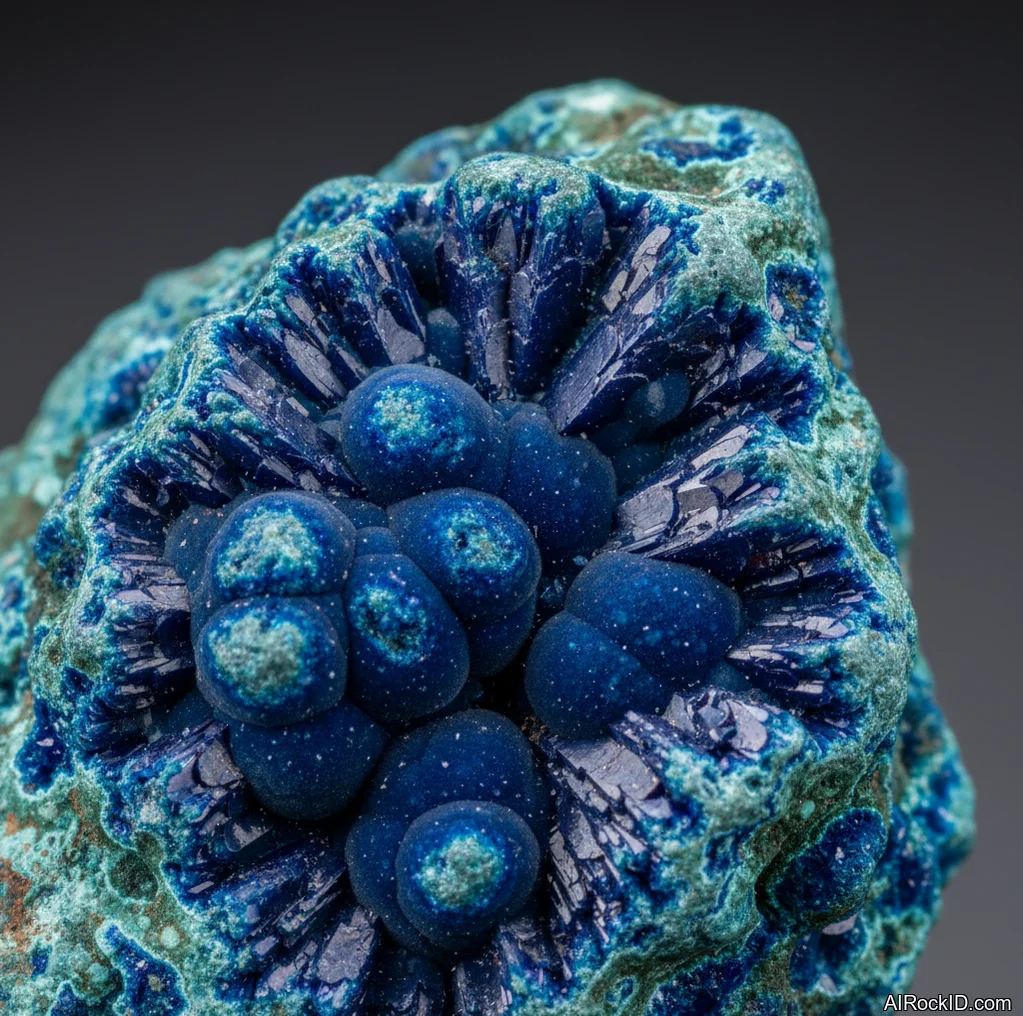
- Azurite: Azurite is a darker blue copper carbonate that is not highly water-soluble like chalcanthite.
- Linarite: Linarite can be intense blue but commonly forms smaller prismatic crystals and contains lead.
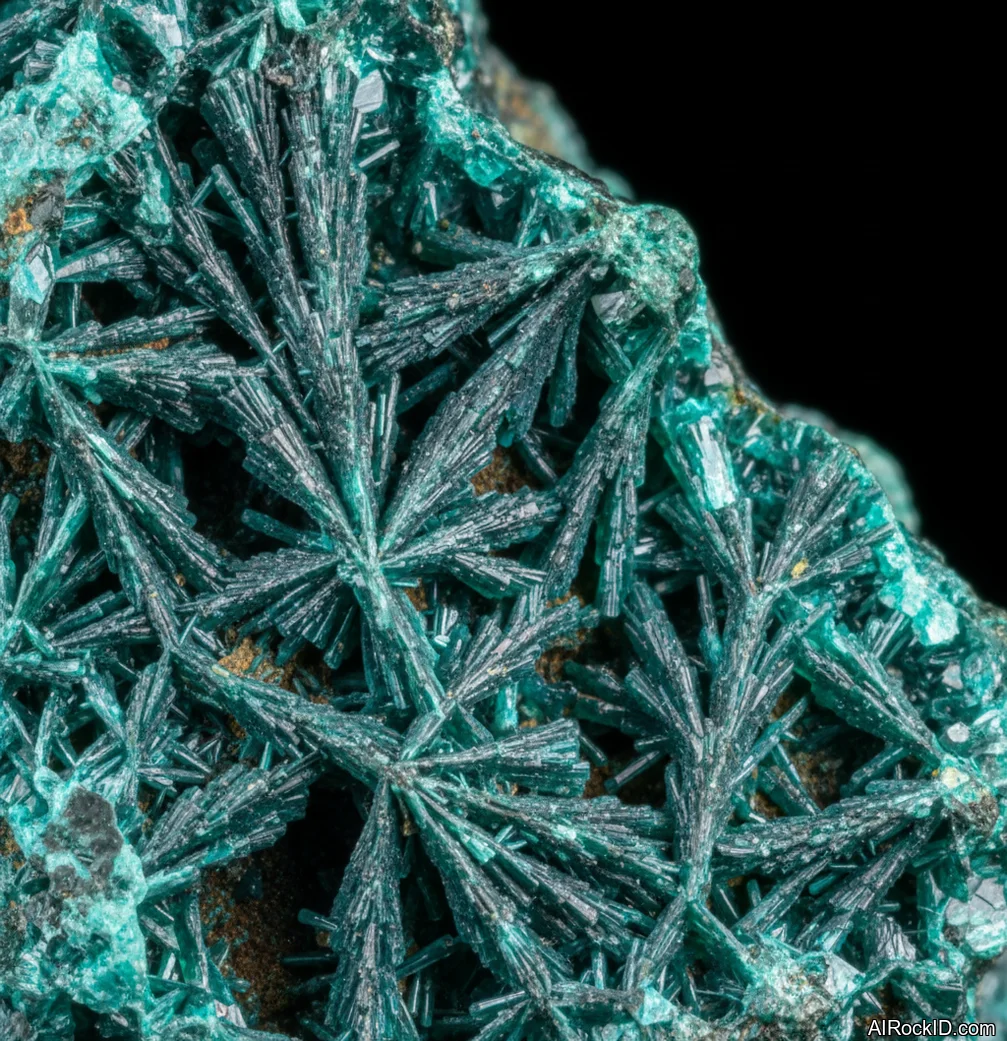
- Shattuckite: Shattuckite is usually blue to blue-green and more fibrous or massive rather than sugary and water-soluble.
- Cavansite: Cavansite forms bright blue crystal sprays, often on matrix, and is not a copper sulfate.
Chalcanthite Lookalike Comparison
| Specimen | Typical Clue | Key Difference | Handling Note |
|---|---|---|---|
| Chalcanthite | Electric blue, glassy to sugary crystals | Water-soluble copper sulfate | Keep dry and avoid skin contact |
| Azurite | Deep blue crystals or earthy masses | Copper carbonate, usually darker blue | Avoid dust; not water-soluble like chalcanthite |
| Linarite | Bright blue prismatic crystals | Lead-bearing sulfate mineral | Handle as a toxic lead mineral |
| Cavansite | Blue sprays or rosettes on matrix | Vanadium silicate, not copper sulfate | Fragile but not known for dissolving readily |
| Dyed Quartz | Uniform or stained blue color | Quartz hardness is about Mohs 7 | Dye may bleed, but quartz itself is durable |
AI identification confidence
AI photo identification may be moderately confident when chalcanthite shows vivid blue color, glassy crystals, and a known mine or laboratory-grown context. Confidence drops when the specimen is wet, altered, dyed, photographed under saturated lighting, or shown without scale and hardness context.
When AI gets it wrong
- Overexposed photos can make azurite, cavansite, or dyed quartz appear chalcanthite-blue.
- Laboratory-grown copper sulfate crystals may be labeled as natural chalcanthite without enough provenance to verify origin.
- Small blue crusts on matrix can resemble several copper secondary minerals in photos.
- A photo cannot safely confirm solubility or toxicity; avoid testing by taste or direct skin contact.
Final recommendation
Choose chalcanthite only if the goal is mineral study or contained display, not everyday handling or decorative use in humid areas. For most casual collectors, a less soluble blue mineral such as azurite or quartz is easier to store and safer to handle with normal precautions.
Natural vs. Lab-Grown Chalcanthite
Many bright blue chalcanthite specimens on the market are laboratory-grown copper sulfate crystals rather than naturally formed mineral specimens. Lab-grown examples can be visually attractive but should be labeled clearly because they do not carry the same locality or geological context as natural material. Natural chalcanthite is uncommon as stable display material because it forms in arid copper mine environments and can alter or dissolve with moisture.
Buying and Authenticity Checks
Ask sellers whether a chalcanthite specimen is natural, lab-grown, or grown on matrix, and request the locality when natural origin is claimed. Be cautious of perfectly uniform, oversized, intensely blue crystals sold without provenance, as these are often grown from copper sulfate solution. A reputable listing should mention water solubility and handling precautions rather than presenting chalcanthite as a normal jewelry or healing stone.
Photo Identification Tips
Photograph chalcanthite in dry, indirect light with a neutral background and a scale reference. Include close-up images of crystal faces, the matrix, and any powdery or altered areas. Do not wet the specimen to improve color for photos, because water can dissolve or damage chalcanthite.
What Is Chalcanthite?
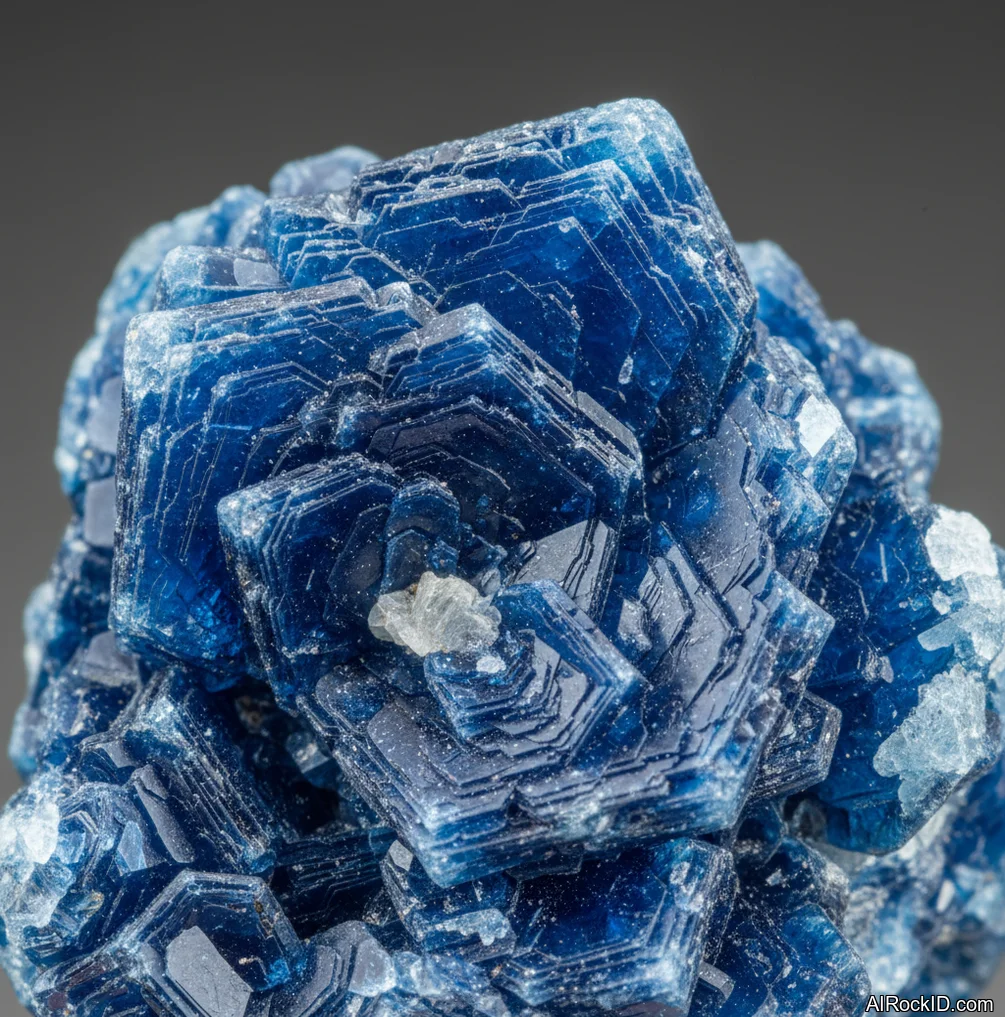
Chalcanthite is a hydrated copper sulfate mineral with the formula CuSO4·5H2O. In person, it’s that unreal electric blue that makes you stop dead in the aisle at a show, like somebody dumped neon sports drink on a rock and it decided to crystallize anyway.
Grab a piece and the first thing you clock is the texture. It can feel weirdly “sugary,” like crystal frosting that’ll crumble if you breathe on it. But it’s sneaky, too. A lot of specimens are just a crust sitting on top of other material, so they don’t always feel as light as you’d expect for something this soft (you can tell when the blue layer thins out around an edge).
And here’s the collector reality: it’s water-soluble, and it dehydrates. Leave it in a humid room and it can slump or get that fuzzy look, and if it dries out too hard it can go pale and dusty. I keep mine sealed up, and I don’t let people handle it the way they’d handle quartz. Not even close.
At first glance it’s the dream blue crystal. But it’s not a “wear it, carry it, toss it in a bowl of water” mineral. It’s more like a fragile chemistry-set mineral you display carefully, admire for a minute, and then tuck back into its little box.
Origin & History
“Chalcanthite” is built from Greek, basically *chalkos* for copper and *anthos* for flower, which makes sense once you’ve seen the way those bright blue crystals pop up like little blooms on damp mine walls. It got nailed down as an official mineral species in the 1800s, back when people were finally sorting out all the sulfate salts showing up around mine workings and giving them proper names.
Old mining books call it “blue vitriol,” and that’s not some romantic nickname. Copper sulfate was genuinely useful for a long time, showing up in dyeing, early chemistry, then later as a fungicide. So yeah, collectors go after it for the color, but it also comes with a practical, gritty backstory tied to ore processing and mine drainage.
Where Is Chalcanthite Found?
It forms as an evaporite and mine-efflorescence mineral in dry mine workings and oxidized copper deposits, especially where copper-rich waters can evaporate.
Formation
Most chalcanthite you run into is a second-round mineral, not something that cooled down deep underground and popped out as a tidy crystal. Water seeps through copper sulfide ore, picks up copper and sulfate along the way, and then, when that brew reaches open air in a dry pocket, it starts drying out and the salt builds up.
If you’ve ever held a decent piece up close, the growth pattern kind of gives itself away. You get those frozen drip trails, thin crusty patches, even little stepped stacks of crystals that look like they formed in a hurry on a timber or a mine wall. And honestly, a lot of the time, they did. But that same “grew fast in the open” origin is exactly why it’s so finicky. Change the humidity and it reacts right now, either melting back into solution or drying out, and neither one does your crisp crystal faces any favors.
How to Identify Chalcanthite
Color: Usually intense azure to deep blue, sometimes leaning greenish-blue if it’s mixed with other sulfates or picking up impurities. Fresh material can look almost electric under bright white light.
Luster: Vitreous to slightly silky on clusters, especially when the faces are tiny and packed.
The real test is behavior, not just color: chalcanthite will slowly dissolve or get tacky if you put a drop of water on it, and it can leave a pale blue smear on a damp surface. Don’t do a taste test and don’t lick your fingers after touching it, because it’s copper sulfate. Compared to dyed quartz or glass, chalcanthite feels softer and more fragile, and the color often looks like it’s coming from the crystal itself instead of sitting in cracks.
Common Look-Alikes
Chalcanthite is sometimes confused with these materials:
- Azurite (especially vivid, fine-druse pieces that photograph the same electric blue)
- Linarite (deep azure crystals on matrix, often mistaken for chalcanthite crusts in photos)
- Blue vitriol / man-made copper sulfate crystals grown from solution (lab-grown chalcanthite sold as “natural”)
- Dyed quartz or dyed calcite clusters sold as “chalcanthite” (dye pools in cracks and around the base)
- Blue glass slag or “aqua” decorative glass chunks (too smooth, too uniform, and usually heavier than you expect for the size)
Market Cautions & Treatments
When AI Can Get This Wrong
At first glance, phone pics turn chalcanthite into “any bright blue mineral,” so AI loves to call it azurite or linarite, especially when it’s just a blue crust on dark matrix. The real test is physical: chalcanthite is soft (a fingernail can mark it), it sheds blue powder, and it’ll start to slump or dissolve if it gets damp, but azurite won’t do that. If the photo shows perfect, glassy, clean-edged crystals with zero crumbly spots, it’s often lab-grown copper sulfate being sold as natural.
Properties of Chalcanthite
Physical Properties
| Crystal System | Triclinic |
| Hardness (Mohs) | 2.5 (Soft (2-4)) |
| Density | 2.10-2.30 g/cm3 |
| Luster | Vitreous |
| Diaphaneity | Transparent to translucent |
| Fracture | Uneven |
| Streak | Light blue to blue-white |
| Magnetism | Non-magnetic |
| Colors | Azure blue, Deep blue, Blue-green |
Chemical Properties
| Classification | Sulfates |
| Formula | CuSO4·5H2O |
| Elements | Cu, S, O, H |
| Common Impurities | Fe, Zn, Mg |
Optical Properties
| Refractive Index | 1.514-1.543 |
| Birefringence | 0.029 |
| Pleochroism | Weak |
| Optical Character | Biaxial |
Chalcanthite Health & Safety
Treat it like a toxic salt mineral. Keep contact to a minimum. No eating or drinking anywhere near it, seriously. And once you’re done, wash your hands right away (get under the nails too). But don’t mess with the crumbly bits. If it starts flaking or you can feel that gritty, chalky texture, stop and avoid making dust. Dust gets everywhere.
Safety Tips
If the material is friable, put on gloves. Keep it stored in a sealed box. And don’t ever soak or rinse it. To clean up around the display, use a damp disposable wipe (the kind that feels slightly cool in your hand), then toss it out.
Chalcanthite Value & Price
Price Range
Rough/Tumbled: $10 - $150 per specimen
Price can jump around depending on how clear the crystals are, how saturated the color looks, and whether you’ve got a stable, well-stored older piece or a fresh crust that wants to crumble the second you touch it. Big, clean clusters cost more, mainly because they’re a pain to keep intact and dry (one bump and you’ll hear that gritty little snap as a point breaks off).
Durability
Fragile — Scratch resistance: Poor, Toughness: Poor
It is water-soluble and can dehydrate in dry air or deteriorate in humidity, so it requires sealed storage.
How to Care for Chalcanthite
Use & Storage
Keep chalcanthite in a sealed display box or jar with stable humidity, away from kitchens and bathrooms. I like acrylic perky boxes, and I label them so nobody “cleans” it by accident.
Cleaning
1) Do not use water, soap, or ultrasonic cleaners. 2) Use a soft dry brush or canned air at a distance to remove loose dust. 3) If you must wipe the container, clean the outside only and wash hands afterward.
Cleanse & Charge
Skip water or salt cleansing. If you do any ritual cleansing, use dry methods like smoke, sound, or simply setting it aside in a closed box.
Placement
Best on a shelf where it won’t get bumped, and not in direct sun or near a humidifier. A closed cabinet is safer than an open coffee table.
Caution
Toxic and water-soluble. Keep it away from kids and pets. And don’t stash it somewhere it can drip onto other minerals (I’ve seen water leave little trails down the side of a shelf). Wash your hands after you handle it, and don’t mess with it right before you eat or touch your face. Why risk it?
Works Well With
Chalcanthite Meaning & Healing Properties
Look at chalcanthite up close and you immediately get why people bring up “clarity.” That blue is almost too crisp, like somebody turned the saturation all the way up. When I’m sorting flats after a show, it’s the one that grabs me first even if it’s sitting on the far table under bad fluorescent light.
And yeah, I’ve watched people use it during meditation or while journaling as a visual point to lock onto, sort of like how you’d stare at a candle flame. No big ritual. Just something bright and steady to bring your attention back.
But here’s the blunt part: it’s not a pocket stone. It’s toxic, it crumbles, and it dissolves. Treat it like a display buddy, not something you’re rubbing on your skin or dropping into a bath. I’ve handled enough soft sulfates to know they leave that faint, dusty residue on your fingertips (you feel it before you even see it), and chalcanthite is exactly the kind of thing you don’t want on your hands when you forget and grab a snack.
Symbol-wise, I peg it as more “truth-telling” and mental cleanup than anything soft and sentimental. It’s a copper mineral, after all, and copper minerals tend to get tied to communication themes. So keep it practical: set it on your desk to set the tone, then close the lid and go do the work.
And if you want actual health help, that’s chemistry, not medicine. Talk to a professional, and keep the mineral safely sealed.
Common mistakes
- Assuming every vivid blue crystal is chalcanthite without checking hardness, solubility, and provenance.
- Buying large, perfect crystals as natural specimens when they may be lab-grown copper sulfate.
- Rinsing chalcanthite with water, which can dissolve or damage the specimen.
- Using chalcanthite in jewelry, crystal grids with water, or elixir practices.
- Handling broken or powdery material without washing hands afterward.
- Storing chalcanthite in humid rooms, bathrooms, or near open containers of water.
Identify Chalcanthite from a photo
Compare Chalcanthite traits, care tips, value clues, and common lookalikes with a clear photo.