Chrysanthemum Stone


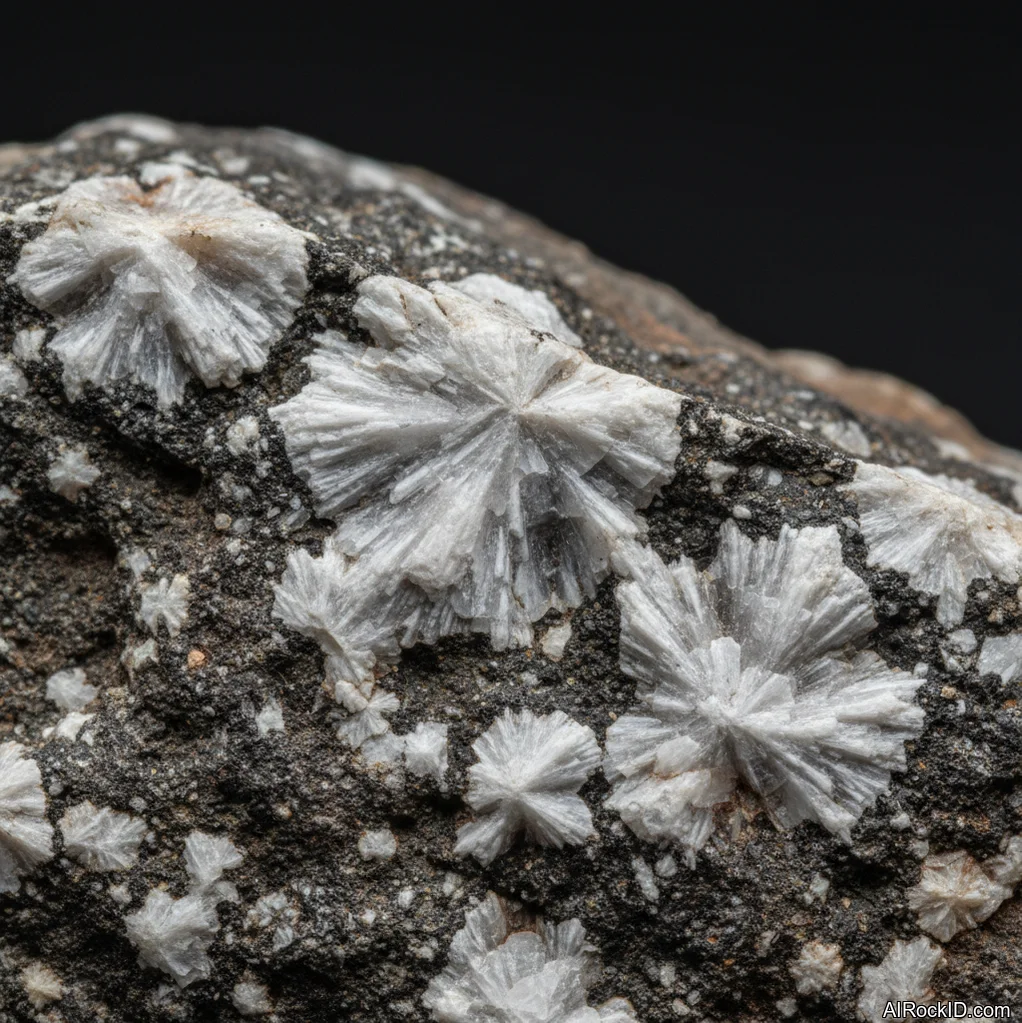
Quick answer: Chrysanthemum Stone is identified by pale, flower-like mineral sprays set in a darker limestone, dolomite, or shale-like matrix. The main identification challenge is separating natural flower patterns from carved, painted, or assembled decorative stones.
AI Rock ID can help screen Chrysanthemum Stone by checking the contrast, radial flower pattern, and dark host rock visible in a photo. RockIdentifier.io can be used as a starting point for identification, but close inspection is still important for polished, carved, or enhanced pieces.
Good fit
- Collectors who like patterned ornamental stones with natural contrast
- Buyers looking for a display specimen, carving, or desk stone rather than jewelry
- Beginners who want a recognizable stone with distinctive visual features
- People comparing Chinese ornamental stones and flower-patterned rocks
Not a good fit
- Rings, bracelets, or high-wear jewelry because the material is relatively soft
- Outdoor placement where weathering, moisture, or freezing can damage the matrix
- Buyers who need a transparent gemstone or faceted crystal
- Anyone expecting identical flower patterns from piece to piece
Most commonly confused with
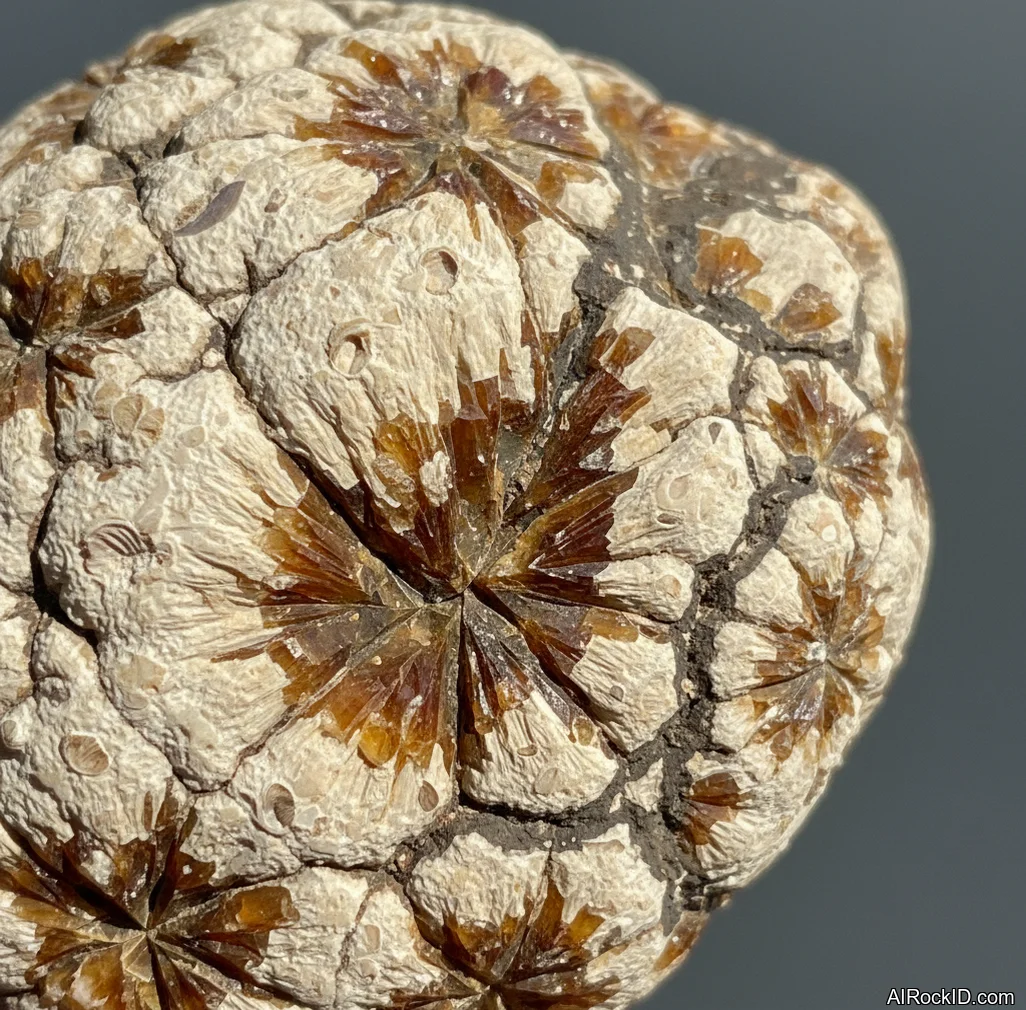
- Fossil Coral: Fossil coral shows repeated coral cell or honeycomb structures rather than large chrysanthemum-like mineral sprays.
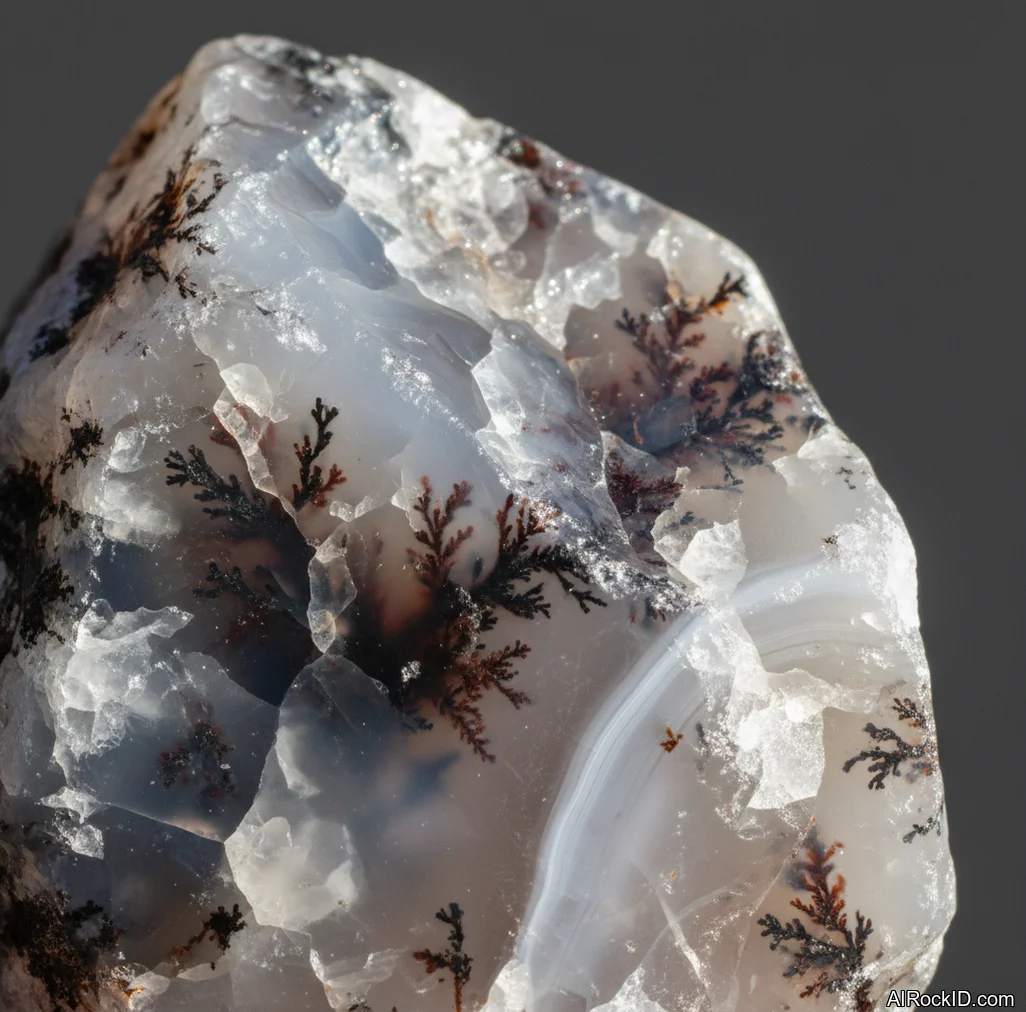
- Flower Jasper: Flower jasper usually has softer orbicular or patchy floral-looking patterns in jasper, not sharp white sprays in a black matrix.
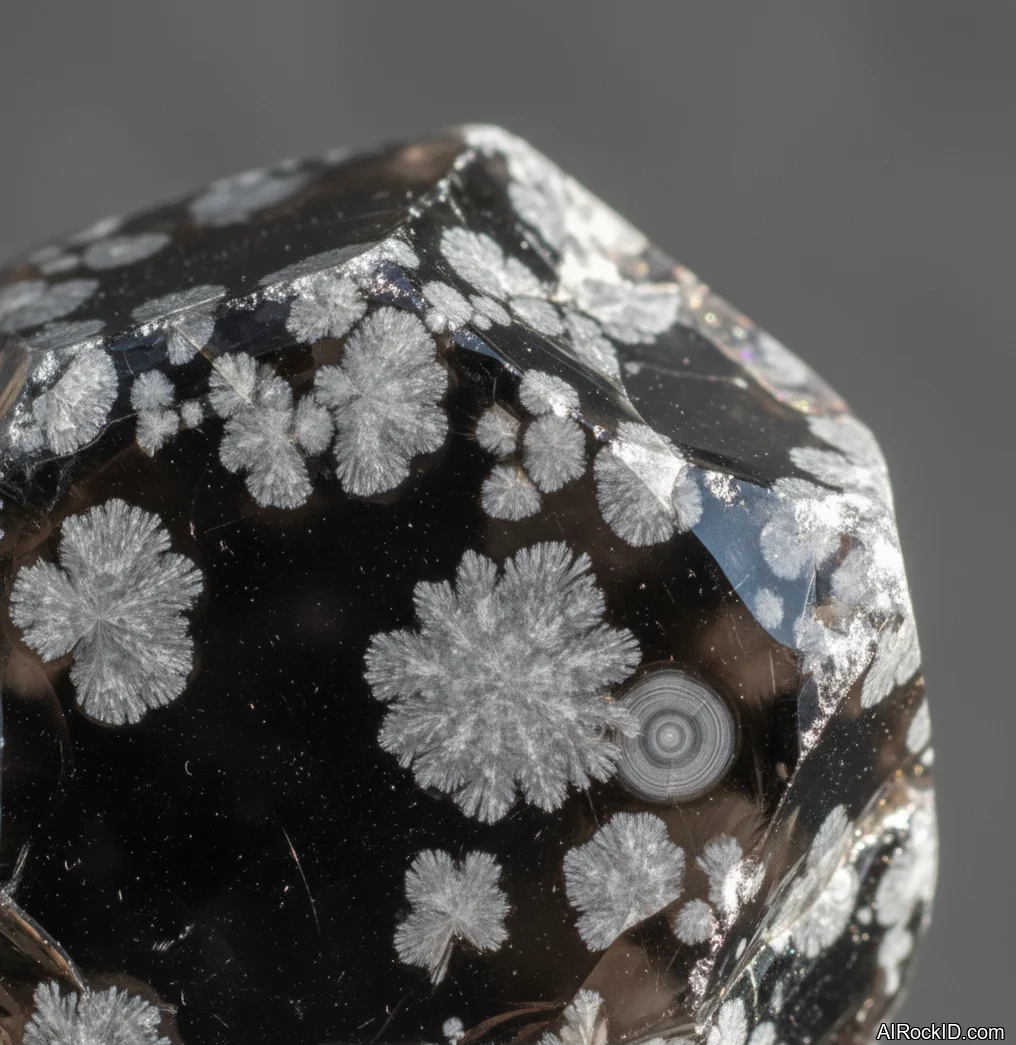
- Snowflake Obsidian: Snowflake obsidian has gray-white cristobalite spots in volcanic glass, not raised or radiating flower forms in sedimentary rock.
- Septarian: Septarian has polygonal cracks filled with calcite or aragonite instead of petal-like radial crystal clusters.
Chrysanthemum Stone vs. Similar Patterned Stones
| Material | Typical Pattern | Key Difference |
|---|---|---|
| Chrysanthemum Stone | White or pale radial flower forms on dark matrix | Flower sprays are mineral growths in the host rock |
| Fossil Coral | Honeycomb, star, or cell-like fossil pattern | Biological coral structure is repeated across the stone |
| Snowflake Obsidian | Rounded gray-white snowflake spots in black glass | Glassy volcanic texture and non-floral spots |
| Septarian | Yellow, brown, or white crack-fill network | Angular crack pattern rather than petal-like sprays |
| Painted Decorative Stone | Bright white surface flower design | Pattern may sit only on the surface or look unnaturally uniform |
AI identification confidence
AI identification is often moderately reliable when the photo shows a clear dark matrix with natural-looking white radial flower patterns. Confidence drops for polished carvings, close-up photos without scale, low-contrast specimens, or pieces with possible paint or resin filling.
When AI gets it wrong
- The photo shows only one small white area without the surrounding matrix.
- A polished surface creates glare that hides whether the pattern is natural or applied.
- The stone has been carved so the flower shape is enhanced by tool marks.
- The specimen is actually fossil coral, snowflake obsidian, or another patterned black-and-white rock.
How to Spot Authentic Chrysanthemum Stone
Authentic Chrysanthemum Stone usually has flower-like mineral forms that appear integrated with the dark host rock rather than sitting as a flat surface design. Look for natural variation in petal length, spacing, and relief; perfectly repeated flowers or stark paint-like borders can be warning signs. On broken or unfinished edges, the pale mineral should look like part of the rock, not a coating.
Buying Tips for Chrysanthemum Stone
When buying online, request photos from multiple angles, including close-ups of the flower edges and any unpolished back or base. Larger, well-centered flower patterns often cost more, but value also depends on carving quality, matrix condition, and whether repairs or fillers are present. Ask sellers whether the piece is natural, carved to enhance the flower, dyed, painted, or stabilized.
Best Uses for Chrysanthemum Stone
Chrysanthemum Stone is best suited for display pieces, palm stones, bookends, cabochons, and carvings that do not receive heavy impact. Its relative softness and mixed mineral composition make it less practical for rings or items exposed to frequent abrasion. A stable indoor location helps preserve both the dark matrix and pale flower pattern.
What Is Chrysanthemum Stone?
Chrysanthemum Stone is a patterned rock where white mineral “flowers” (usually calcite, sometimes celestine) shoot out in spokes through a dark limestone or mudstone matrix.
Hold a polished piece in your hand and you’ll clock two things right away. It’s cool to the touch. And it’s got that heavy-for-its-size heft carbonate rocks tend to have, the kind you feel in your palm even before you really look at it. The “petals” aren’t painted on, either. Tip it under a shop light and the flower blades flash differently than the darker background, especially on pieces where the calcite has that slightly sugary look instead of being glassy smooth.
Most of what’s for sale ends up cut into slabs, freeforms, eggs, or those little palm stones people keep on a desk. Raw chunks are out there, but they don’t look nearly as nice until somebody cuts and polishes them. But here’s the thing: sellers will slap “chrysanthemum stone” on basically any floral pattern. Real material has those crisp radial sprays that look like a firework caught mid-burst and turned to stone.
Origin & History
China’s the original home for this stuff, and the name is a straight nod to that chrysanthemum-flower pattern you see in the stone. In the West, it really got on people’s radar through the lapidary and mineral trade in the 20th century. But in China? It’s been picked up, collected, and carved as an ornamental stone for ages. You can feel that history when you handle a carved piece, too. The surface is usually polished slick, but the “petals” catch the light a little differently when you tilt it.
Most dealers will call it “Hunan chrysanthemum stone” like it’s a brand name stamped on the box. That’s because the most famous material comes from Hunan Province, and the location label just stuck in the market. Same idea as “Utah variscite” or “Montana agate.” And once a name like that gets baked into pricing sheets and show tags, it’s hard to shake, right?
Where Is Chrysanthemum Stone Found?
Most commercial chrysanthemum stone on the market comes from Hunan, China, with smaller occurrences reported from places like Japan and Canada.
Formation
Look closely at those “flowers” and you’re really just seeing mineral growth inside a sedimentary host. The dark stuff is usually limestone or mudstone. Later on, mineral-rich fluids push through tiny pathways in the rock, and crystals start growing outward from little seed points, so you get those radial sprays.
Most of the time, calcite is the main culprit for the white petals, and that tracks once you’ve actually handled a few pieces. The petals feel a bit softer than the matrix if you drag a fingernail across a polished face, and if you’ve ever knocked one against the edge of a table, you find out fast the carbonate part can chip (ask me how I know). Some material gets reported with celestine or other minerals in the flower zones, but in the day-to-day shop world, “calcite flower in limestone” is the safe bet.
Thing is, internet descriptions love to make it sound like one single mineral. It’s not. It’s a rock with a pattern, and the exact recipe shifts depending on the deposit.
How to Identify Chrysanthemum Stone
Color: Usually a charcoal to black matrix with white to creamy-white radial “flowers” that look like petals or fireworks. Some pieces show gray matrix or slightly tan flowers depending on the cut and polish.
Luster: Polished faces are typically waxy to dull on the matrix with a slightly brighter waxy look on the white mineral sprays.
Pick up a piece and feel the temperature. Real chrysanthemum stone stays cool like limestone does, while a lot of resin or plastic décor pieces feel warmer. If you scratch it with a copper coin in an inconspicuous spot, the white “petals” may mark or powder a bit because calcite is only Mohs 3. And look for depth: on a cut slab, the flowers should have internal structure, not a flat printed look.
Common Look-Alikes
Chrysanthemum Stone is sometimes confused with these materials:
- Chinese Writing Stone (black limestone with pale fossil/orthoceras or calcite markings sold as “script” patterns)
- Snowflake Obsidian (black volcanic glass with gray-white spherulites, often mistaken for “flowers” in photos)
- Porcelain Jasper / Exotica Jasper (black-and-cream orbicular jasper with rosettes that read as petals when polished)
- Black marble or limestone with calcite veining (random white veins can get marketed as “chrysanthemum” even when there’s no radial flower growth)
- Dyed black limestone/marble with bleached or resin-filled white “flowers” (high-contrast souvenir pieces, especially small palms and hearts)
- Painted or printed resin/glass “chrysanthemum” cabochons (flat pattern under a dome, no real mineral texture)
Market Cautions & Treatments
When AI Can Get This Wrong
At first glance, AI tends to call it snowflake obsidian because both read as black with white bursts, and polished photos hide the texture difference. The real test is touch and scratch: chrysanthemum stone stays cool and chalky-feeling at the edges and it’ll scratch with a copper coin or a steel pin, while obsidian is glassy, sharper-edged, and won’t take that scratch. Close-up photos of the edge help a lot because the “petals” in chrysanthemum stone are mineral growths that cut through the rock, not flat spherulites sitting in glass.
Properties of Chrysanthemum Stone
Physical Properties
| Crystal System | Trigonal |
| Hardness (Mohs) | 3 (Soft (2-4)) |
| Density | 2.71 g/cm3 |
| Luster | Waxy |
| Diaphaneity | Opaque |
| Fracture | Uneven |
| Streak | white |
| Magnetism | Non-magnetic |
| Colors | black, charcoal gray, white, cream |
Chemical Properties
| Classification | Carbonates |
| Formula | CaCO3 |
| Elements | Ca, C, O |
| Common Impurities | Fe, Mn, Mg |
Optical Properties
| Refractive Index | 1.486-1.658 |
| Birefringence | 0.172 |
| Pleochroism | None |
| Optical Character | Uniaxial |
Chrysanthemum Stone Health & Safety
Chrysanthemum stone is safe to pick up, handle, and keep on a shelf. But if you’re going to cut it or grind it, treat it like any other lapidary material: use the usual precautions.
Safety Tips
If you’re going to shape it, put on a respirator and keep a little water running so the dust doesn’t go everywhere. Carbonate rock dust is still dust, and it’ll hang in the air and get in your throat if you let it.
Chrysanthemum Stone Value & Price
Price Range
Rough/Tumbled: $8 - $120 per piece
Price comes down to how crisp and even the flower sprays look, the punchy contrast between the white and the black, and whether the polish is actually clean (no hazy patches when you tilt it under a light). And those big display slabs with a bunch of well-centered blooms? They move fast, because the cutting waste is real.
Durability
Nondurable — Scratch resistance: Poor, Toughness: Fair
It’s stable on a shelf, but the calcite-based “petals” scratch easily and edges can chip if it gets knocked around.
How to Care for Chrysanthemum Stone
Use & Storage
Store it where it won’t rub against quartz, agate, or anything harder. I keep mine in a padded tray because one messy drawer will haze the polish in a week.
Cleaning
1) Rinse quickly with lukewarm water. 2) Use a drop of mild soap and your fingers or a very soft cloth to lift oils. 3) Pat dry and don’t let it sit wet in a bowl for hours.
Cleanse & Charge
If you do energy-style care, stick to smoke, sound, or moonlight. I skip salt and I don’t leave it soaking because it’s a soft carbonate-based material.
Placement
A stable shelf or desk corner works best, somewhere it won’t get bumped. Side lighting makes the “petals” pop, so a lamp at an angle looks better than overhead light.
Caution
Don’t use acids or anything acidic to clean it. Calcite reacts with that stuff and you’ll end up with etching. And don’t toss it in a pocket or pouch with harder stones, either. It scratches crazy fast, like the kind of scuffs you notice the moment you pull it out (especially on the smoother faces).
Works Well With
Chrysanthemum Stone Meaning & Healing Properties
In metaphysical circles, chrysanthemum stone gets called a “pattern stone,” the kind of thing people reach for when they’re thinking about timing, cycles, steady growth. And honestly, I get it. Those radial, flower-like bursts almost force your brain into that orderly mode, the same way frost veins on a window or a fern curling open does.
Grab a palm stone on a rough day and it grounds you in the most literal sense. It’s got that satisfying heft, and the surface is cool at first touch, like it’s been sitting in shade, which yanks your attention out of your thoughts for a beat. That part isn’t theoretical. I’ve felt it. If you use crystals more like reminders or focus anchors, this one works because your eyes can just latch onto the bloom pattern and stay there.
But look, I’m not selling it as medicine. If you’re dealing with anxiety or sleep stuff, think of it as a calming object on the nightstand, not a stand-in for actual care. And the soft calcite side? That’s the catch. It’ll scuff up fast, so don’t toss it in your pocket with keys (unless you like little scratches and dull spots).
Common mistakes
- Assuming every white flower pattern on a black rock is Chrysanthemum Stone.
- Buying from a single front-facing photo without checking the back, sides, or surface texture.
- Confusing carved or painted flower designs with natural mineral sprays.
- Using vinegar or acidic cleaners, which can react with carbonate-rich matrix material.
- Wearing soft Chrysanthemum Stone in high-impact jewelry settings.
- Expecting all specimens to come from the same locality or show identical mineral composition.
Identify Chrysanthemum Stone from a photo
Compare Chrysanthemum Stone traits, care tips, value clues, and common lookalikes with a clear photo.