Crazy Lace Agate


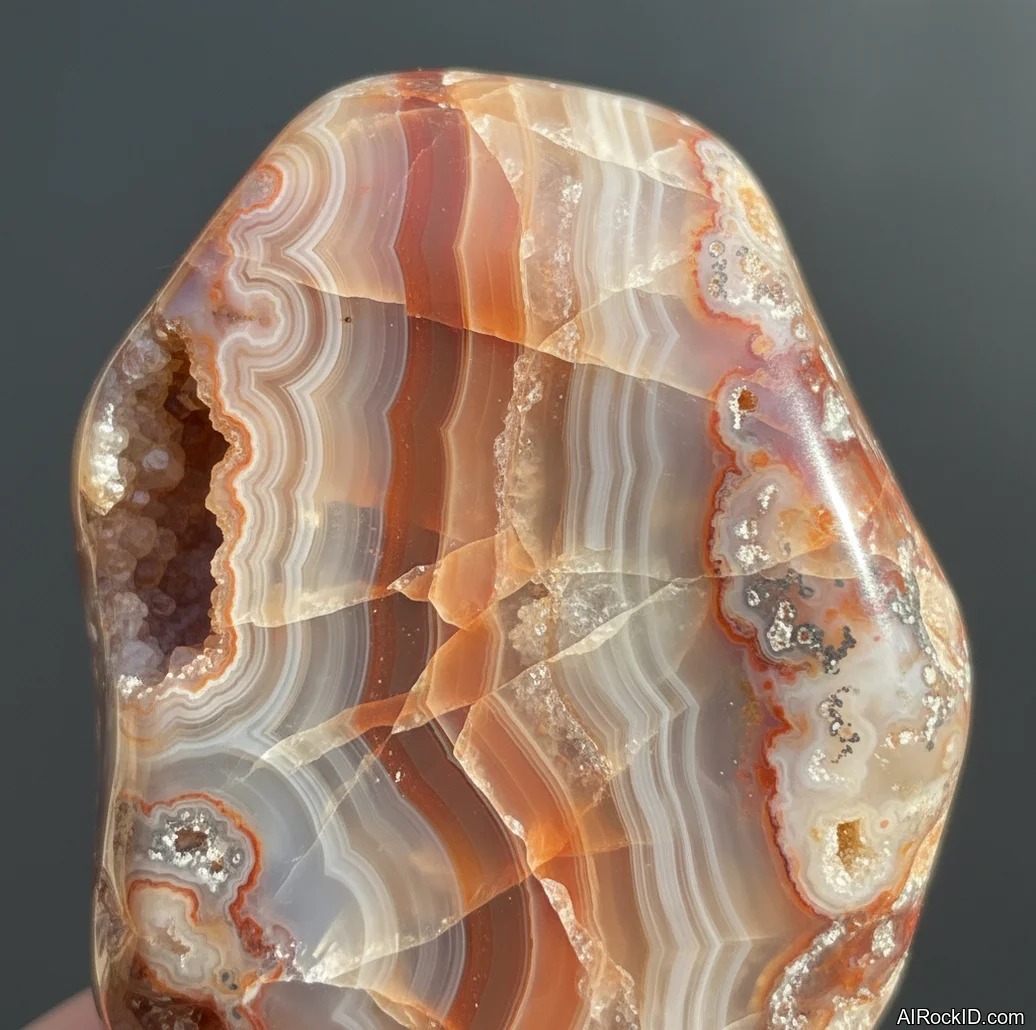
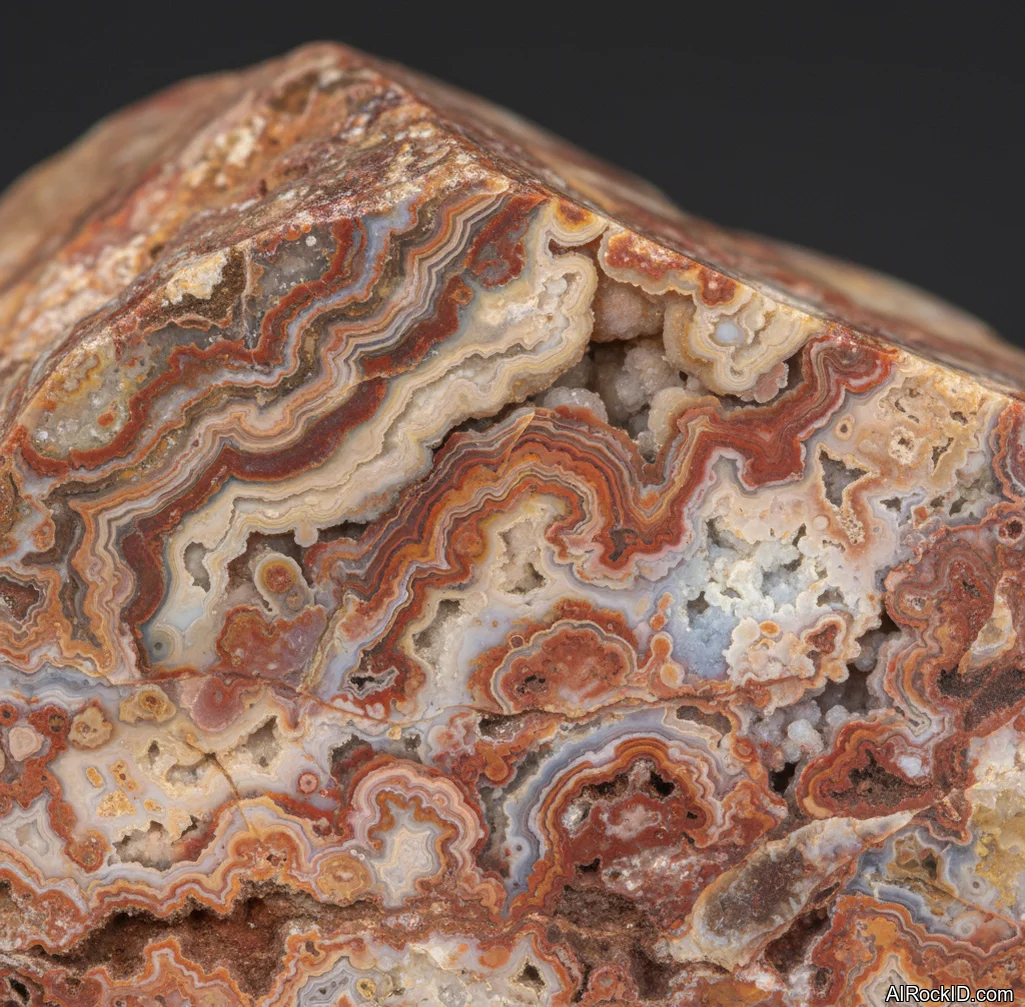
Quick answer: Crazy Lace Agate is best identified by its tight, irregular bands and swirling “lace” patterns in cream, red, brown, gray, yellow, or orange tones. It is a variety of banded chalcedony, so it should feel dense, take a good polish, and be hard enough to resist scratching from a steel knife.
AI Rock ID can help compare a photographed Crazy Lace Agate specimen with visually similar banded stones based on pattern, color, and surface texture. RockIdentifier.io provides crystal identification support, but final confirmation is stronger when visual results are checked against hardness, luster, and known locality information.
Good fit
- Collectors who like intricate banding and highly patterned cabochons
- Jewelry buyers looking for a durable quartz-family stone for pendants, beads, or rings
- Beginners who want a distinctive agate that is usually recognizable by pattern
- Specimen owners trying to compare Mexican banded chalcedony with similar agates
Not a good fit
- Anyone expecting every piece to show the same color or pattern
- Buyers who need a rare or high-value gemstone rather than a decorative chalcedony
- Identification based only on color, because dyed agates can mimic some tones
Most commonly confused with
- Laguna Agate: Laguna Agate often has sharper, highly defined fortification bands, while Crazy Lace Agate commonly shows more tangled, looping lace-like patterns.
- Botswana Agate: Botswana Agate is usually softer in color with gray, pink, or brown parallel banding rather than the busy swirls typical of Crazy Lace Agate.
- Sardonyx: Sardonyx usually has straighter red, brown, black, or white bands and less chaotic lace-like patterning.
- Dyed Agate: Dyed agate may show unnaturally bright colors concentrated in cracks, pits, or porous bands.
Crazy Lace Agate vs. Similar Banded Stones
| Stone | Typical pattern | Key difference |
|---|---|---|
| Crazy Lace Agate | Swirls, loops, eyes, and tangled lace bands | Busy, irregular patterning in warm and neutral colors |
| Laguna Agate | Crisp fortification bands | Bands are often more sharply outlined and structured |
| Botswana Agate | Fine parallel or curved bands | Usually grayer, softer, and less chaotic in pattern |
| Sardonyx | Straight to gently curved contrasting bands | Commonly red-brown, black, and white with cleaner band separation |
| Dyed Agate | Banded or patchy color | Color may be unusually vivid or concentrated in fractures |
AI identification confidence
AI identification is often moderately confident for Crazy Lace Agate when the photo clearly shows lace-like banding, polished surface texture, and natural color variation. Confidence drops when the stone is tumbled, heavily dyed, poorly lit, or photographed too close to distinguish band structure.
When AI gets it wrong
- Overexposed photos can make natural cream, yellow, and red bands look artificially dyed.
- Close-up images without scale may confuse Crazy Lace Agate with other banded chalcedonies.
- Highly polished cabochons can hide translucency and make agate look like jasper.
- Single-color or weakly banded pieces may be identified only as generic agate.
How to Check Crazy Lace Agate Authenticity
Authentic Crazy Lace Agate should show natural-looking bands that continue through the surface rather than sitting only in cracks or pits. A steel knife should not easily scratch it, because chalcedony is harder than common steel. Very bright pink, blue, purple, or neon green pieces should be treated as dyed unless the seller clearly discloses treatment.
Buying Tips for Crazy Lace Agate
Look for clear, attractive banding, good polish, and stable material without open cracks if the stone will be used in jewelry. Cabochons and beads are usually priced by size, pattern quality, polish, and craftsmanship rather than rarity alone. Ask whether the stone is natural, dyed, stabilized, or fracture-filled when color appears unusually strong.
Photo Tips for Identifying Crazy Lace Agate
Photograph the stone in indirect daylight on a plain background to show banding accurately. Include one close-up of the pattern, one full-stone image, and one photo near a ruler or coin for scale. Avoid strong filters because they can make natural agate colors look treated.
What Is Crazy Lace Agate?
Crazy Lace Agate is a banded variety of chalcedony (microcrystalline quartz), and it’s known for those looping, lace-like patterns.
Pick up a polished piece and you notice the quartz heft immediately. Not heavy like hematite, just that steady, solid weight that makes it feel planted in your palm. The polish tends to be slick and glassy (the kind that almost wants to slide between your fingers if your hands are dry), and the patterning looks layered, like someone drizzled caramel and cream in slow spirals, then locked it all in place. Some stones run warm with reds and honey tones. Others go cooler with gray, lavender, or smoky bands.
Most people see “agate” and expect tidy, straight stripes. But crazy lace doesn’t behave. The bands curl, knot up, and loop back around, and a lot of cabochons have those little “eyes” where the banding circles a tiny center. And yeah, almost everything you’ll run into is cut or tumbled. Rough chunks are out there too, but they’re usually pretty ugly on the outside until you slab them, which is honestly half the fun, right?
Origin & History
“Agate” has been around forever. The name traces back to the Achates River (today’s Dirillo) in Sicily, where people were picking up banded stones in ancient times. Crazy Lace Agate, though, is just a trade name, not an official mineral species name, and it stuck because the banding really does look like lace that’s been twisted into knots.
Most dealers call it a Mexico classic, and honestly, that’s fair. It turned into a reliable lapidary stone in the 20th century when material from northern Mexico started flowing into the US market for cabbing, carvings, plus those big display freeforms you see sitting under hot show lights at gem shows (the kind that feel cool and slick when you pick them up). If you’ve ever stood at a slab bin and thumbed through piece after piece, watching the patterns flash as you tilt them, you already know why it got that nickname.
Where Is Crazy Lace Agate Found?
The best-known Crazy Lace Agate comes from northern Mexico, especially Chihuahua and Durango. It shows up in lapidary rough, slabs, and tumbled stones worldwide through the trade.
Formation
Look at the banding up close and you’re basically staring at a logbook of silica-rich fluids pulsing in and filling open space over time. Crazy lace forms when microcrystalline quartz (chalcedony) settles out in thin layers inside cavities or fractures, usually in volcanic rock like rhyolite or another silica-rich host.
The “crazy” part kicks in when the growth conditions won’t sit still. Flow paths shift, the cavity is an odd shape, the chemistry cycles (and then cycles again), and the bands start curling, wrapping, and looping instead of stacking up as neat, parallel stripes. Iron oxides and other trace material stain certain layers red, orange, yellow, or brown. But it’s still quartz at the end of the day, so it takes a bright polish, feels glassy-smooth under your thumb, and holds up well in daily wear.
How to Identify Crazy Lace Agate
Color: Most pieces show cream, tan, gray, and reddish to orange bands in tight swirls or loops. Banding can be high-contrast or soft and smoky depending on the rough.
Luster: Polished Crazy Lace Agate has a vitreous to waxy luster typical of chalcedony.
If you scratch it with a steel knife, it usually won’t bite the surface, but the stone will scratch glass. The real test is the pattern: tight, lace-like banding with “eyes” and curls instead of straight agate stripes. And when you hold it up to a strong flashlight, thinner edges often glow a little because chalcedony is commonly translucent along the rim.
Common Look-Alikes
Crazy Lace Agate is sometimes confused with these materials:
- Mexican lace agate (other banded chalcedony sold under the same name, often less "loopy" and more straight-banded)
- Botswana agate (tight, parallel gray-tan banding that can read as lace in photos)
- Banded calcite / "Mexican onyx" (softer, reacts to acid, often sold as agate to tourists)
- Dyed agate (especially hot pink, purple, or electric blue "crazy lace" that’s really dyed banded chalcedony)
- Jasper with orbicular or brecciated patterns (can mimic the busy lace look once polished)
- Glass or resin "agate" fakes (swirly patterns cast in, sometimes sold as cheap palm stones)
Market Cautions & Treatments
When AI Can Get This Wrong
At first glance, phone cameras mix Crazy Lace Agate up with Botswana agate and banded calcite because all three photograph as tan-and-cream stripes. Busy polish glare also makes jasper patterns look "lacey" in AI scans. The real test is a quick hardness and acid check: Crazy Lace should scratch glass and won’t fizz on a drop of vinegar, while calcite won’t scratch glass and will react.
Properties of Crazy Lace Agate
Physical Properties
| Crystal System | Trigonal |
| Hardness (Mohs) | 6.5-7 (Hard (6-7.5)) |
| Density | 2.58-2.64 g/cm3 |
| Luster | Vitreous |
| Diaphaneity | Translucent to opaque |
| Fracture | Conchoidal |
| Streak | White |
| Magnetism | Non-magnetic |
| Colors | Cream, Tan, Brown, Red, Orange, Gray, White, Yellow |
Chemical Properties
| Classification | Silicates |
| Formula | SiO2 |
| Elements | Si, O |
| Common Impurities | Fe, Mn, Al |
Optical Properties
| Refractive Index | 1.530-1.540 |
| Birefringence | 0.004 |
| Pleochroism | None |
| Optical Character | Uniaxial |
Crazy Lace Agate Health & Safety
Crazy Lace Agate is non-toxic, so it’s safe to handle with bare hands. The only real issue comes up when you’re cutting or grinding it. That’s when you can end up with fine silica dust in the air (you’ll notice that chalky grit that settles on your fingers and the table), and that’s the part you need proper controls for.
Safety Tips
If you’re sawing or sanding, do it wet and don’t skip the right respirator, the kind rated for fine particulate dust. That powder gets everywhere (you can feel it on your lips if you’re not careful). And once you’re done with lapidary work, go wash your hands.
Crazy Lace Agate Value & Price
Price Range
Rough/Tumbled: $5 - $60 per piece
Cut/Polished: $1 - $6 per carat
Prices jump around depending on how tight the pattern is, how hard the colors pop against each other, and whether the polish comes out glassy or shows those faint haze lines you catch when you tilt it under a light. Big slabs with strong, consistent patterning cost more, and matched pairs for earrings are pricier than a mixed tumbled lot where nothing really matches.
Durability
Durable — Scratch resistance: Good, Toughness: Good
It’s stable quartz, so normal light and everyday handling are fine, but sharp blows can chip edges because it fractures conchoidally.
How to Care for Crazy Lace Agate
Use & Storage
Store it in a pouch or a compartmented box if it’s polished, because quartz can scratch softer stones sitting next to it. If it’s a slab, keep paper between pieces so they don’t scuff each other.
Cleaning
1) Rinse with lukewarm water and a drop of mild soap. 2) Use a soft toothbrush to get into crevices or around drilled holes. 3) Rinse well and dry with a soft cloth.
Cleanse & Charge
For a simple reset, rinse and let it dry fully, or set it on a windowsill for indirect light. If you’re using salt, keep the stone out of gritty salt piles that can dull a polish over time.
Placement
On a desk or shelf, angle it so side light rakes across the face. That’s when the lace pattern pops and you see the layers instead of just the top color.
Caution
If your piece has any fractures or a glued setting, skip the harsh chemicals and don’t use an ultrasonic cleaner either. And don’t let it take a hit on tile. Even with its high hardness, the edges can still chip (ask me how I know).
Works Well With
Crazy Lace Agate Meaning & Healing Properties
Most people grab Crazy Lace Agate when they want something steady that still has some personality. In my own stash, it’s the one I drop into my pocket on days that feel like they’re coming apart at the seams, because the pattern is busy but the stone itself feels calm and grounded in that very quartz kind of way. Smooth. Cool in your hand. And you can just rub your thumb over it without even noticing you’re doing it.
A lot of folks connect it with cheerfulness and a lighter mood, and yeah, I see it. Those looping bands look playful, almost like a topographic map that got bored and started moving. But look, it’s not a magic switch. What it’s actually good at, if you’re into this stuff, is being a tactile anchor. A palm stone with a solid polish is basically a worry stone that won’t wear down fast (and it keeps that slick, glassy feel instead of getting gritty).
Keep the claims in the right lane. Any “healing” talk here is tradition and personal practice, not medical care. So if you’re using it for mood or stress, I’d treat it like a simple attention and routine tool: hold it while you do breathing, leave it on your nightstand, tuck it next to your journal, keep it in your bag. And if you’re buying one for that, choose the piece you actually like. I’ve stood over those shop bins where half the stones felt kind of dead to me, then one had these tight little red loops and I couldn’t stop tilting it under the light to watch the bands shift. That’s the one that gets used. Why force it?
Common mistakes
- Assuming every Mexican banded agate is Crazy Lace Agate without checking the pattern style.
- Calling any bright banded agate natural without considering dye treatment.
- Identifying the stone by color alone instead of band shape, hardness, luster, and translucency.
- Mistaking opaque patterned jasper for agate when no translucent edges are visible.
- Using metaphysical labels as proof of mineral identity.
Identify Crazy Lace Agate from a photo
Compare Crazy Lace Agate traits, care tips, value clues, and common lookalikes with a clear photo.