Dumortierite


Quick answer: Dumortierite is best recognized by its denim-blue to violet-blue color, tough fibrous or columnar habit, and frequent occurrence as blue inclusions in quartz. It can resemble sodalite, lapis lazuli, blue aventurine, and dyed quartz, so checking texture, hardness, and host material is important.
AI Rock ID can help compare dumortierite against visually similar blue minerals using color, texture, and crystal habit from a photo. RockIdentifier.io provides identification support, but close lookalikes and treated stones may still require hardness testing, magnification, or expert review.
Good fit
- Collectors who want a durable blue mineral with a Mohs hardness commonly around 7–8.5
- Buyers comparing blue quartz specimens that may contain natural dumortierite inclusions
- Jewelry wearers looking for a tough blue stone when properly cut and set
- Mineral enthusiasts interested in borosilicate minerals from metamorphic rocks and pegmatites
Not a good fit
- Anyone needing a guaranteed gem identification from color alone
- Buyers who want a transparent blue gemstone similar to sapphire or aquamarine
- Collectors avoiding stones that may be confused with dyed or treated quartz
Most commonly confused with
- Sodalite: Sodalite is usually softer, often has white veining, and is commonly more massive than fibrous dumortierite.
- Lapis Lazuli: Lapis lazuli often contains pyrite flecks and calcite patches, which dumortierite typically lacks.
- Blue Aventurine: Blue aventurine is quartz with sparkly inclusions, while dumortierite often appears as fibrous blue material or blue inclusions in quartz.
- Dyed Quartz: Dyed quartz may show color concentration in cracks or pores, unlike natural dumortierite inclusions that follow mineral growth patterns.
Dumortierite vs Similar Blue Stones
| Stone | Typical Clue | Key Difference |
|---|---|---|
| Dumortierite | Fibrous blue masses or blue inclusions in quartz | Hard, tough borosilicate mineral |
| Sodalite | Blue with white veining | Softer and commonly more blocky or massive |
| Lapis Lazuli | Deep blue with pyrite or calcite | Often shows gold pyrite flecks |
| Blue Aventurine | Blue quartz with glittery effect | Sparkle is usually from platy inclusions |
| Dyed Quartz | Very even or crack-concentrated blue color | Color may collect along fractures |
AI identification confidence
AI identification confidence for dumortierite is moderate when photos show fibrous blue texture, quartz association, and natural uneven coloration. Confidence is lower for polished beads, tumbled stones, or uniformly blue pieces because several minerals and dyed materials can look similar in photos.
When AI gets it wrong
- Polished dumortierite beads can look like sodalite, lapis lazuli, or dyed quartz without visible texture.
- Blue quartz with tiny inclusions may be labeled dumortierite even when the inclusion mineral is not confirmed.
- Strong lighting or saturation can make gray-blue stones appear more vivid than they are.
- Photos without scale or close-up detail can hide pyrite, calcite, dye concentration, or fibrous structure.
Final recommendation
For buying dumortierite, favor sellers who describe whether the material is massive dumortierite, dumortierite-in-quartz, or treated quartz. Natural specimens should show believable variation in color and texture rather than an unnaturally uniform blue surface.
How to Spot Natural Dumortierite in Quartz
Natural dumortierite in quartz usually appears as blue to violet-blue fibers, streaks, clouds, or patches enclosed within translucent to milky quartz. The blue areas should look integrated with the quartz rather than sitting only on cracks, pits, or surface scratches. Very bright, even blue color throughout a low-cost quartz piece may indicate dye or another treated material.
Buying Checklist for Dumortierite
Ask whether the piece is solid dumortierite, dumortierite-bearing quartz, or a trade-name blue quartz. Check for clear photos in natural light, close-ups of the surface, and disclosure of any dyeing or stabilization. For higher-priced jewelry or specimens, request locality information or seller documentation when available.
Notable Dumortierite Sources
Dumortierite is reported from metamorphic rocks, pegmatites, and aluminum-rich geological settings in several regions worldwide. Notable sources include parts of France, Brazil, Madagascar, Sri Lanka, Canada, and the United States. Locality can affect appearance, but it should not be used as the only proof of identity.
What Is Dumortierite?
Dumortierite is a blue to violet borosilicate mineral, Al7BO3(SiO4)3O3, and you usually see it as fibrous to columnar masses in metamorphic rocks and pegmatites.
Grab a chunky piece and you’ll notice it’s tougher than it looks. It’s got that dry mineral feel in your palm, not waxy like some jaspers, and the better blue material stays cool even after you’ve been holding it while you talk at a show table.
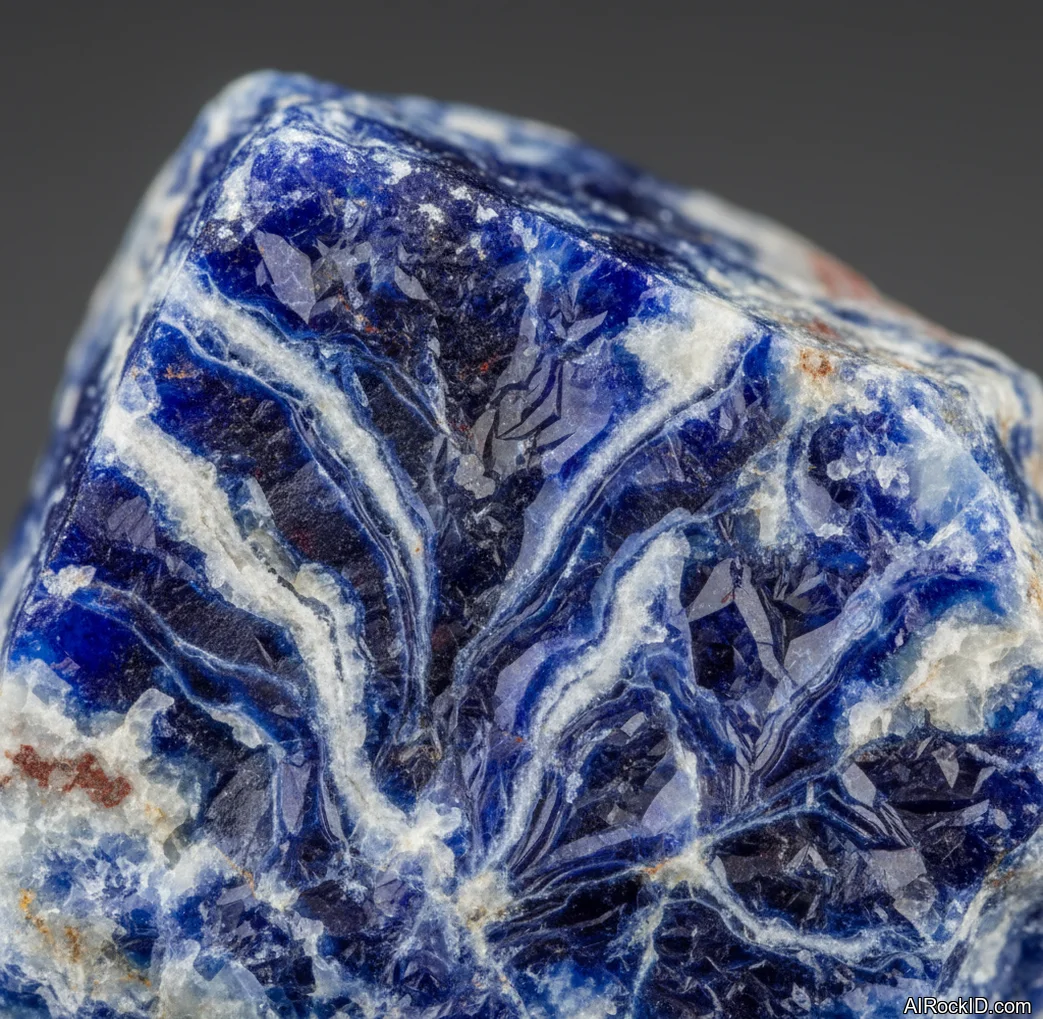
A lot of dumortierite gets sold as “blue quartz” at first glance, since the blue often shows up as little threads or cloudy patches inside quartz. But once you’ve handled enough of it, the difference starts to jump out at you: dumortierite is what’s making the color, and the quartz is just the host. In hand specimens, the really good pieces have denim-blue streaks that look like tiny paintbrush fibers when you tilt them under a lamp (it’s hard to unsee once you’ve noticed it).
Origin & History
France is where the name comes from. Dumortierite got its first proper write-up in 1881 from the French mineralogist Ferdinand Gonnard, and he named it after Eugène Dumortier, a French paleontologist.
Thing is, it doesn’t come with that long “ancient gem” backstory some stones have. Clean, well-formed crystals just aren’t common, and a lot of what you actually run into is those compact blue masses (the kind that look solid and a little stubborn when you try to get a clean edge). And that’s why collectors pay attention: it’s a real mineral species, but it can pass for a bunch of other blue material until you learn the little tells. How many times have you seen a blue chunk and thought you knew what it was?
Where Is Dumortierite Found?
Most material in shops comes out of Brazil and Madagascar, with smaller amounts from the USA, Namibia, and Sri Lanka. It turns up in high-grade metamorphic terrains and in some granitic pegmatites.
Formation
Look where dumortierite actually shows up and a pretty clear pattern pops out: it wants aluminum-rich ground, and it really helps if there’s boron in the mix. So you’re usually looking at high-grade metamorphic rocks like gneiss and schist, plus pegmatites that hit the right chemistry late in the melt.
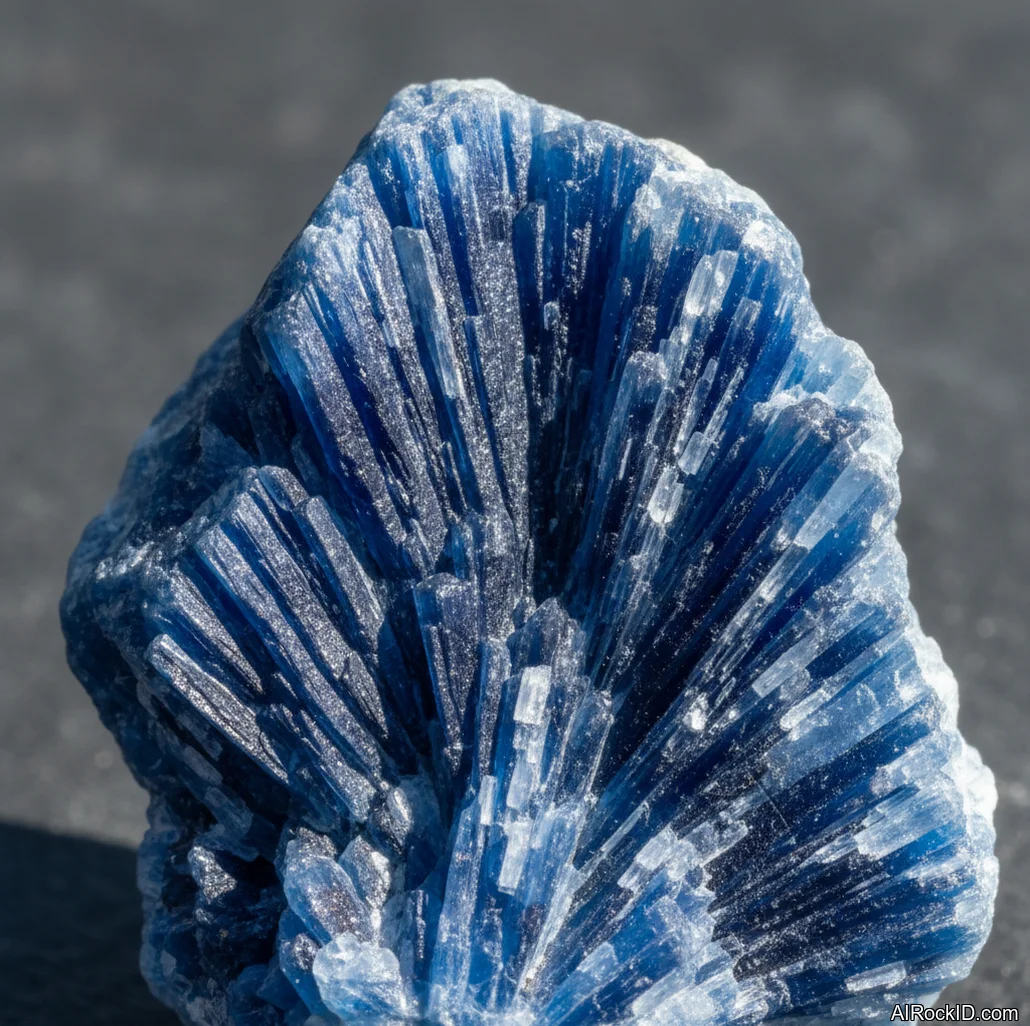
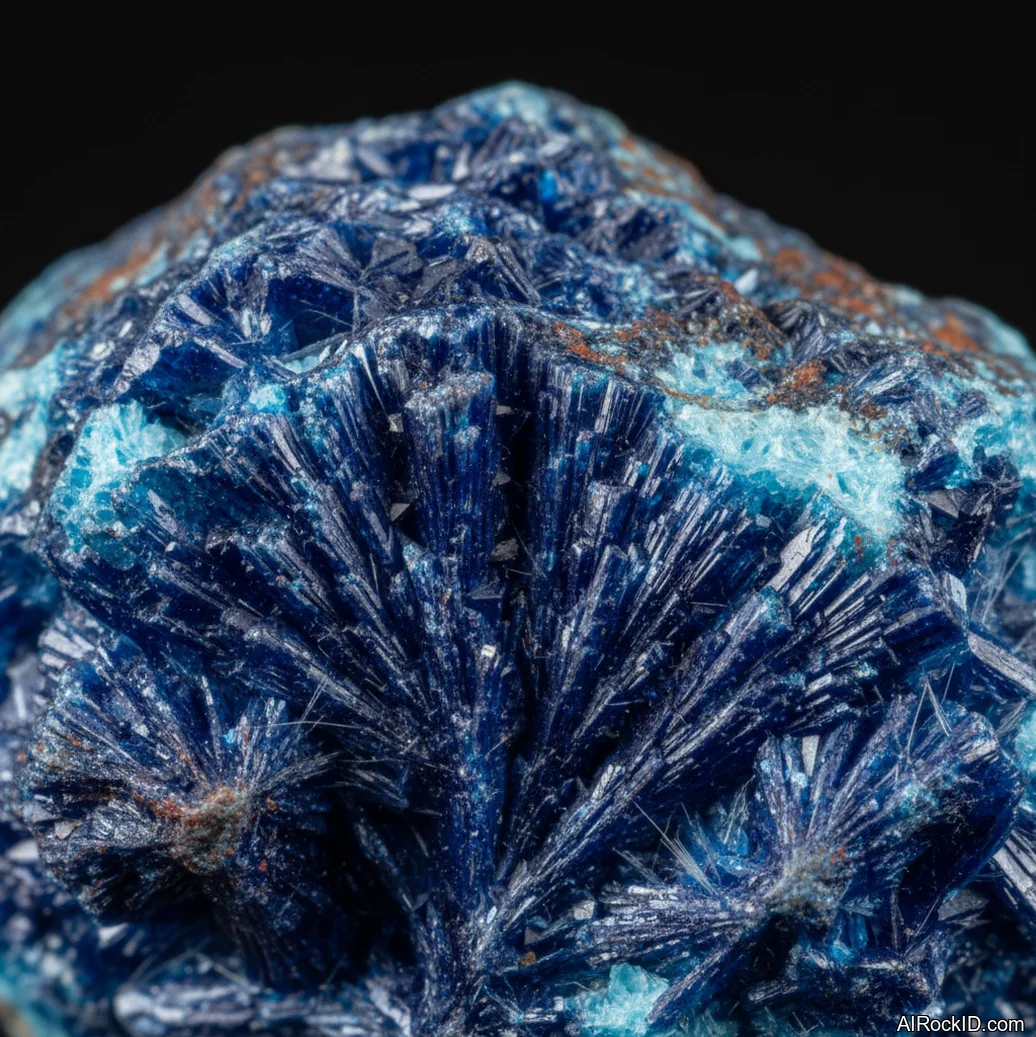
In metamorphic rocks, it tends to grow as fibrous or columnar clumps, kind of tucked into quartz, feldspar, or mica-heavy zones. In pegmatites, you’ll see chunkier masses and, once in a while, better-formed crystals, but don’t go hunting for perfect points like you’d expect from tourmaline. It’s more “threads and bundles” than “clean prisms.” That’s just how it is.
How to Identify Dumortierite
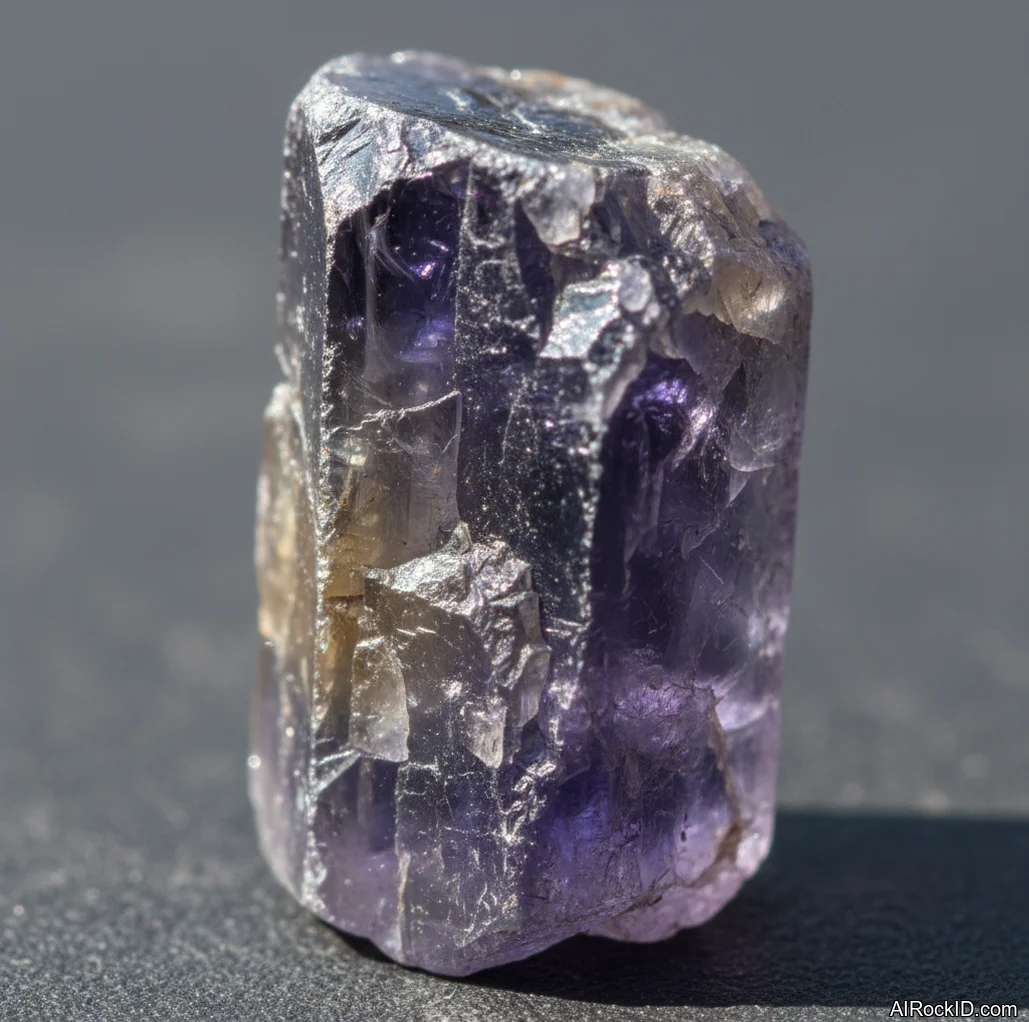
Color: Typical colors run denim blue, steel blue, and blue-violet, sometimes with gray, brown, or greenish tones. In quartz it often looks like blue wisps, streaks, or peppery clouds rather than a solid blue body color.
Luster: Luster is usually vitreous, but fibrous material can throw a slightly silky sheen on fresh surfaces.
If you scratch it with a steel nail and nothing happens, you’re in the right neighborhood. A lot of “blue quartz” on the market is just dyed or is blue chalcedony, and that stuff feels softer and won’t take a crisp scratch test the same way. The real test is a hand lens: dumortierite in quartz often shows tiny fiber bundles or streaks that look like little blue hairs trapped in glass.
Common Look-Alikes
Dumortierite is sometimes confused with these materials:
- Blue quartz (quartz with dumortierite inclusions, often sold as “dumortierite quartz” or just “blue quartz”)
- Sodalite (especially the gray-blue, low-contrast stuff without obvious white veining)
- Lapis lazuli (lower-grade, denim pieces without much pyrite can fool people fast)
- Kyanite (blue blades and fibrous chunks, but the habit is different when you get it in hand)
- Dyed quartzite or dyed agate sold as “blue quartz” (dye sits in cracks and along grain boundaries)
- Blue glass/slag marketed as “blue quartz” or “dumortierite” (too uniform, too bubbly, and too warm in the hand)
Market Cautions & Treatments
When AI Can Get This Wrong
At first glance in photos, AI mixes dumortierite up with sodalite, lapis, and anything marketed as “blue quartz” because the denim-to-steel blue range overlaps hard and cameras crush the texture. The real test is in-hand: dumortierite often shows a fibrous or silky grain when you roll it under light, and it’ll scratch glass cleanly while sodalite and lapis usually won’t. If the photo shows a super-uniform blue with no grain and a glossy, glassy look, AI will call it dumortierite anyway, but a quick bubble check with a flashlight would end that argument.
Properties of Dumortierite
Physical Properties
| Crystal System | Orthorhombic |
| Hardness (Mohs) | 7-8.5 (Very Hard (7.5-10)) |
| Density | 3.26-3.41 g/cm3 |
| Luster | Vitreous |
| Diaphaneity | Translucent to opaque |
| Fracture | Splintery |
| Streak | White |
| Magnetism | Non-magnetic |
| Colors | Denim blue, Blue-violet, Steel blue, Gray-blue, Brownish, Greenish blue |
Chemical Properties
| Classification | Silicates (borosilicate) |
| Formula | Al7BO3(SiO4)3O3 |
| Elements | Al, B, Si, O |
| Common Impurities | Fe, Mn, Ti |
Optical Properties
| Refractive Index | 1.678-1.689 |
| Birefringence | 0.010-0.012 |
| Pleochroism | Strong |
| Optical Character | Biaxial |
Dumortierite Health & Safety
Hand specimens are fine to pick up and handle, and a quick splash of water isn’t a problem. But if you’re cutting or sanding it like you would any silicate rock, don’t breathe the dust (that gritty stuff gets everywhere).
Safety Tips
If you’re shaping it, keep it wet, get some airflow going, and wear a real respirator that’s rated for fine particulates. Don’t trust a flimsy dust mask.
Dumortierite Value & Price
Price Range
Rough/Tumbled: $8 - $80 per piece
Cut/Polished: $5 - $30 per carat
Prices jump when the blue is really saturated, the surface takes a clean polish, and you can actually see that fibrous pattern running through the quartz (the kind that pops once it’s wet or freshly buffed). Big slabs that stay an even color edge to edge, plus rough that cuts into smooth cabs without a bunch of dead spots, will cost more than the usual gray-blue chunks.
Durability
Durable — Scratch resistance: Excellent, Toughness: Fair
It’s pretty stable day-to-day, but the fibrous habit means edges can chip if it’s banged around in a pocket.
How to Care for Dumortierite
Use & Storage
Store it like you would other hard silicates: wrapped or in a compartment so it doesn’t chip other stones or get its own edges bruised. If it’s a polished piece, keep it off gritty surfaces that can leave tiny scuffs.
Cleaning
1) Rinse with lukewarm water to remove dust. 2) Use a drop of mild soap and a soft toothbrush for crevices. 3) Rinse well and pat dry; don’t toss it wet back into a box with paper labels.
Cleanse & Charge
If you do the metaphysical routine, smoke cleansing and a quick rinse are the easiest options. I skip salt bowls for this one because salt grit gets into fibrous textures and drives me nuts to remove.
Placement
On a desk it reads as calm, steady blue, especially under warm indoor light. In a window it can look flatter, so I usually keep my best pieces a few feet back from direct sun.
Caution
Hardness-wise, it’s up there. But don’t kid yourself on toughness, it’s not bulletproof, so don’t drop it on tile (that sharp clack is usually the moment you regret it), and don’t toss it loose in a pouch with softer stones you actually care about because it’ll scuff them up. And if you’re shopping for “dumortierite quartz,” ask point-blank if it’s natural. Look, the real stuff usually shows those fiber-like inclusions when you tilt it under a light, not that perfectly even, flat dye color.
Works Well With
Dumortierite Meaning & Healing Properties
Most folks who walk in asking for dumortierite are chasing that “get it together” feeling. Focus. Steadier nerves. Less brain pinball. I get it. When I’m back from a show and sorting flats, I’ll leave a dumortierite palm stone right on the counter because it’s smooth, cool to the touch, and it kind of nudges me into finishing the boring stuff.
But here’s the honest part: a lot of what’s out there is dumortierite-in-quartz. And the way people describe that is often more “clear head” than “deep comfort,” which honestly tracks if you think in terms of symbolism. Blue plus quartz reads like calm plus clarity. Still, none of that is medical care. I don’t treat it as a replacement for sleep, therapy, or actual help.
Pick up a raw piece and you’ll notice the texture shift right away. The fibrous areas can feel a little grippy compared to plain quartz (almost like a tiny drag under your thumb), and that tactile part is probably half the reason people bond with it. It’s the kind of stone you end up handling while you’re thinking. Quiet. Practical.
Common mistakes
- Assuming every blue inclusion in quartz is dumortierite without additional evidence
- Confusing sodalite or lapis lazuli beads with dumortierite based only on color
- Overlooking dye concentrated in cracks, drill holes, or porous areas
- Expecting all dumortierite to be vivid blue; many pieces are gray-blue, violet-blue, or unevenly colored
- Using metaphysical trade names as proof of mineral identity
Identify Dumortierite from a photo
Compare Dumortierite traits, care tips, value clues, and common lookalikes with a clear photo.