Franklinite


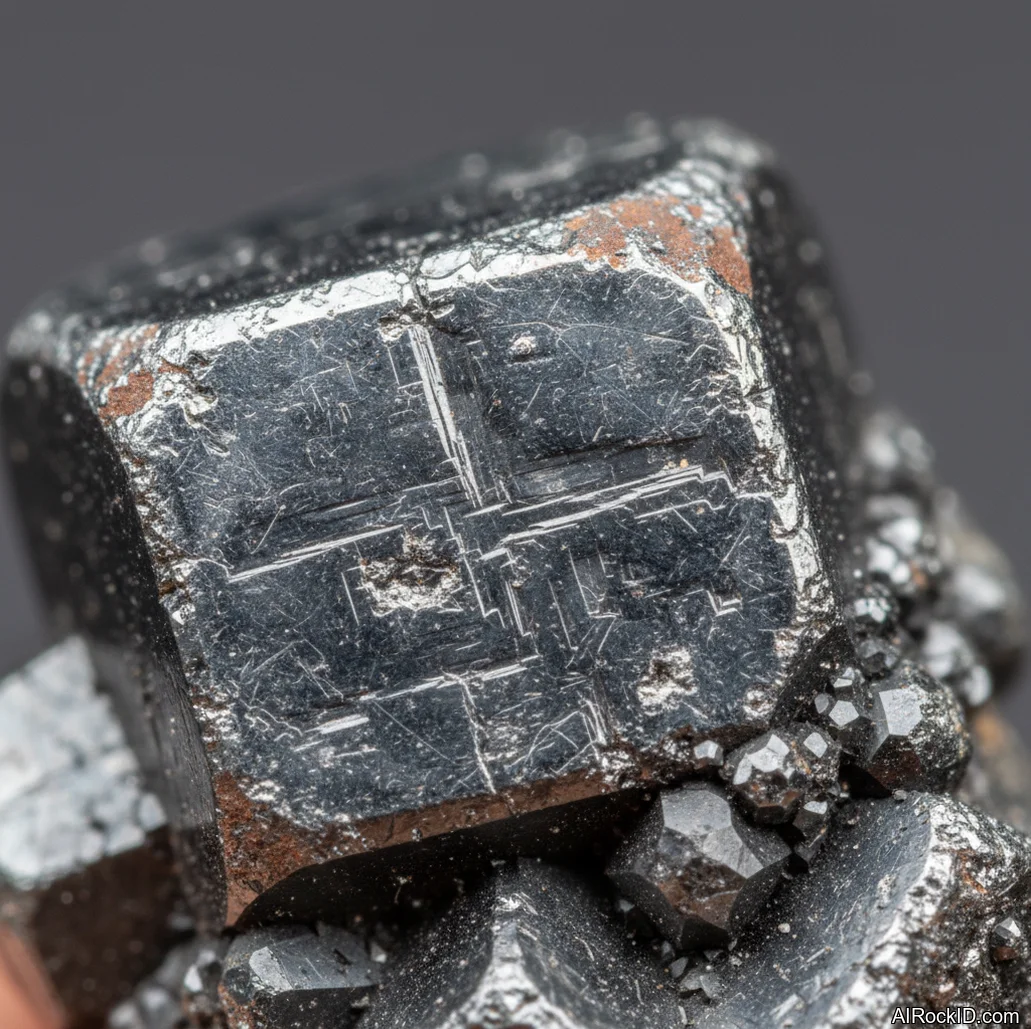
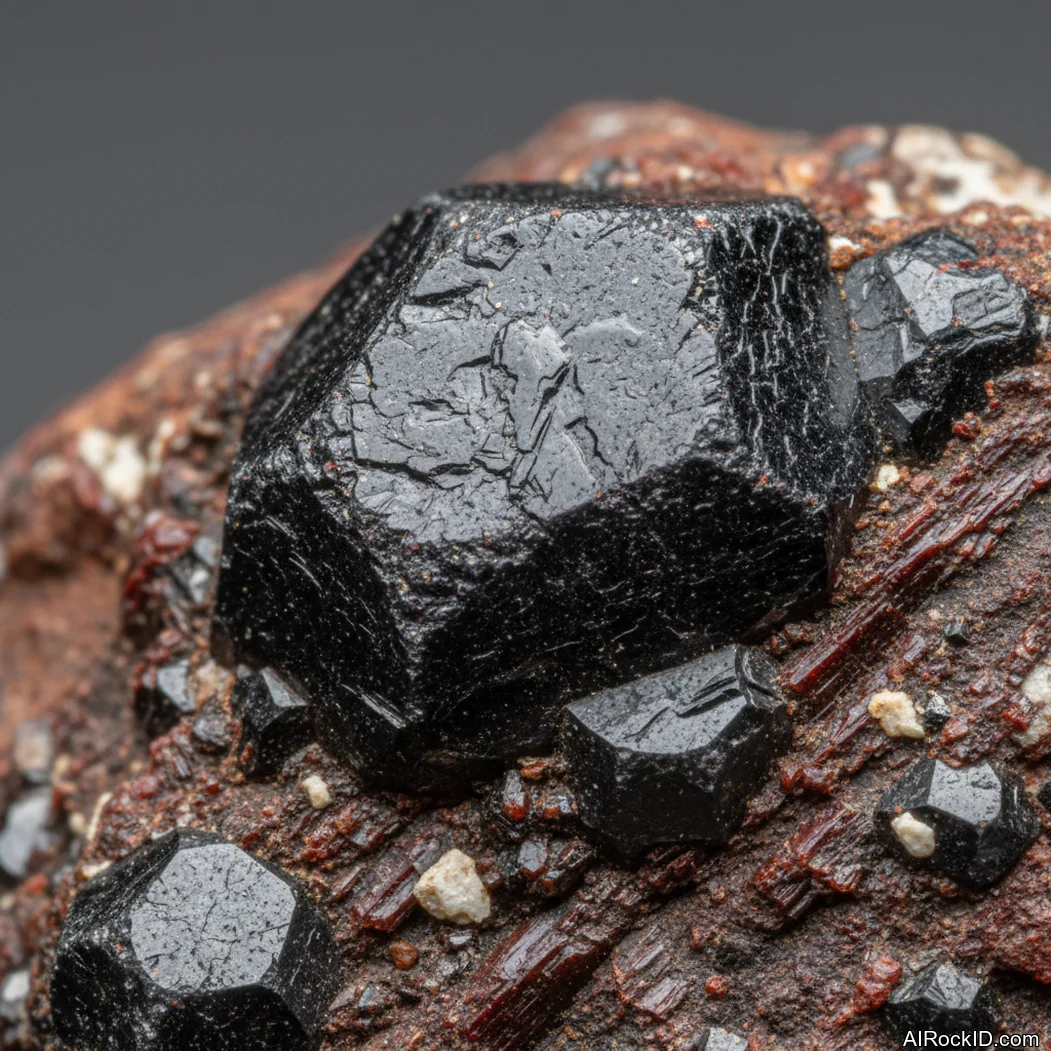
Quick answer: Franklinite is a black to dark brown zinc iron oxide mineral best known from Franklin and Sterling Hill, New Jersey. It commonly appears as metallic octahedral crystals or granular masses and may show magnetism, which helps separate it from many similar dark minerals.
AI Rock ID can help compare a Franklinite specimen with visually similar metallic minerals by checking luster, crystal form, streak, and magnetic response. RockIdentifier.io provides mineral information and identification support, but physical tests and locality details are still important for confident Franklinite identification.
Good fit
- Collectors interested in classic New Jersey minerals from Franklin or Sterling Hill
- Specimens showing black metallic octahedral crystals in white or mixed ore matrix
- Collections focused on zinc, iron, and manganese ore minerals
- Users who want a mineral that can be checked with simple observations such as streak and magnetism
Not a good fit
- Jewelry use, because Franklinite is typically opaque, dense, and not commonly cut as a gem
- Collectors wanting bright color, transparency, or fluorescence from the Franklin district
- Rough handling by children, because small chips and heavy ore pieces can be sharp or easily misplaced
Most commonly confused with
- Magnetite: Magnetite is usually more strongly magnetic and lacks the zinc-rich Franklin district association.
- Hematite: Hematite commonly gives a red-brown streak, while Franklinite typically has a dark brown to reddish-brown streak.
- Chromite: Chromite can look similar in massive black form but is a chromium ore and is not typically magnetic.
- Hausmannite: Hausmannite is a manganese oxide that can occur in dark crystals, but it has different chemistry and crystal habits.
Franklinite vs. Similar Black Metallic Minerals
| Feature | Franklinite | Magnetite | Hematite |
|---|---|---|---|
| Typical color | Black to dark brown | Black | Steel gray to black |
| Streak | Dark brown to reddish brown | Black | Red to reddish brown |
| Magnetism | Weak to moderate, variable | Usually strong | Usually weak or absent |
| Common crystal form | Octahedral crystals or granular masses | Octahedral crystals or massive | Tabular, botryoidal, or massive |
| Key clue | Classic Franklin/Sterling Hill locality | Strong pull to a magnet | Distinct red streak |
AI identification confidence
AI identification confidence for Franklinite is moderate when a clear photo shows black metallic octahedral crystals, a known Franklin or Sterling Hill label, and a reported magnetic response. Confidence is lower for massive black ore pieces because several iron and manganese oxides can look nearly identical in photos.
When AI gets it wrong
- The specimen is a massive black ore with no visible crystal faces.
- Lighting makes metallic luster look like glassy or dull black surfaces.
- The photo lacks scale, streak color, magnet response, or locality information.
- The specimen is from an unknown location and could be magnetite, hematite, chromite, or another oxide.
How to Identify Franklinite in Hand Sample
Look for black to dark brown metallic grains or octahedral crystals, especially in a pale calcite, willemite, or mixed ore matrix from Franklin or Sterling Hill, New Jersey. A streak test may show dark brown to reddish-brown powder, and a magnet may show a weak to moderate pull. Locality is especially useful because many dark oxide minerals overlap in color, luster, and density.
Buying Franklinite Specimens
Franklinite specimens are most credible when sold with a specific locality, especially Franklin Mine or Sterling Hill Mine in New Jersey. Well-formed octahedral crystals, attractive contrast with matrix minerals, and old collection labels can add collector interest. Be cautious with unlabeled black metallic ore pieces sold only by appearance, because visual identification alone is often uncertain.
Franklinite Locality Notes
The Franklin and Sterling Hill deposits are famous for zinc, manganese, and iron minerals, and Franklinite is one of their signature ore minerals. It may occur with minerals such as willemite, zincite, calcite, and tephroite, depending on the specimen. Some associated minerals from the district fluoresce strongly, but Franklinite itself is not known for fluorescence.
What Is Franklinite?
Franklinite is a zinc iron oxide mineral (ZnFe2O4) in the spinel group. Most of the time it turns up as black, metallic-looking grains or crystals, and it’s often magnetic.
Grab a solid chunk and the first thing that hits you is the heft. It feels weirdly heavy for how small it is, and if you’ve got one of those classic New Jersey granular pieces, the surface has this slightly gritty, sandpaper-ish feel (not sharp, just rough). A lot of specimens look like black metal peppered through pale calcite, green willemite, or that orange-red zincite you can spot from across the case. And when you tilt it under a bright light, the shine isn’t glassy. It’s more like a cold, steel-like flash, the kind you only get from a true metallic mineral.
From a distance, yeah, you could mistake it for plain magnetite. But franklinite usually comes with that Franklin-Sterling Hill “zinc district” vibe: mixed ores, busy matrices, and neighbors that really steal the show. It’s not something you cut for facets. It’s a collector’s mineral. The real fun is the association pieces and the locality story, honestly.
Origin & History
New Jersey is literally where the name comes from. Franklinite got its first proper description in 1819 from Henry John Brooke, and he named it after the town of Franklin, New Jersey (which, yeah, was named for Benjamin Franklin).
If you’ve ever walked a mineral show on the US East Coast, you’ve probably seen those flat display trays with little white sticker labels that just say “Franklin, NJ,” like it’s its own aisle. And there’s a reason for that. The Franklin and Sterling Hill ore bodies got famous not only for franklinite, but also for the weirdly varied mix of zinc minerals and the world-class fluorescent material that came out of those mines.
Where Is Franklinite Found?
Most classic specimens come from the Franklin and Sterling Hill deposits in northern New Jersey. Smaller occurrences exist elsewhere, but they rarely have the same classic matrix combinations.
Formation
Franklinite shows up in zinc-rich ore deposits that have been metamorphosed. Picture old sedimentary or hydrothermal zinc material that got heated up and squeezed hard, then re-formed into a chaotic (but still good-looking) mix of oxides, silicates, plus carbonates.
At Franklin and Sterling Hill, it sits in a layered ore body that went through high-grade metamorphism. So you get franklinite tangled up with zincite, willemite, calcite, and a whole bunch of other species. The feel can be granular or just solid and heavy, and if you’re lucky you’ll spot those crystal-ish octahedrons. But don’t count on perfect, museum-label crystals in every chunk. Most pieces you’ll actually pick up are “ore-style,” dark, dense, a little rough in the hand, and that’s the appeal, honestly.
How to Identify Franklinite
Color: Usually iron-black to brownish-black, sometimes with a faint reddish-brown cast on worn edges. Fresh breaks look pitch black and metallic.
Luster: Metallic to submetallic, like dark steel.
The real test is the magnet. Many pieces are weakly to clearly magnetic, but it’s not always as grabby as magnetite, especially if it’s mixed with calcite or willemite. If you scratch it on a streak plate, look for a dark brown streak, not the clean black you’d expect from magnetite. And in hand, franklinite from NJ often feels like it’s glued into a busy matrix, not sitting as a lone crystal in quartz like a lot of magnetite does.
Common Look-Alikes
Franklinite is sometimes confused with these materials:
- Magnetite (often sold as “lodestone”); similar black metallic look and strong magnet pull
- Hematite (specular hematite or tumbled hematite); same iron-black shine but usually not strongly magnetic
- Ilmenite; black heavy grains that can sit in calcite and look like franklinite pepper
- Chromite (spinel-group ore); black submetallic octahedra can mimic franklinite in photos
- Black spinel (natural or lab-grown, sometimes sold as “black diamond”); similar spinel habit but lacks the gritty NJ ore-mix context
- Dyed howlite or dyed quartz sold as “magnetic black stone”; dye collects in pits and it won’t have that dense, cool-in-the-hand ore feel
Market Cautions & Treatments
When AI Can Get This Wrong
At first glance, phone apps mix franklinite up with magnetite, hematite, and plain slag because all three photograph as featureless black with a metallic glare. The real test is in-hand: franklinite from the NJ ore tends to be very heavy for its size and grainy, and it’ll usually tug to a magnet but not always with the instant snap you get from magnetite. If you’ve got a streak plate, franklinite’s streak and the “pepper in calcite” context help a lot when photos don’t.
Properties of Franklinite
Physical Properties
| Crystal System | Cubic |
| Hardness (Mohs) | 5.5-6 (Medium (4-6)) |
| Density | 5.1-5.2 g/cm3 |
| Luster | Metallic |
| Diaphaneity | Opaque |
| Fracture | Uneven |
| Streak | dark brown |
| Magnetism | Magnetic |
| Colors | black, brownish-black, iron-black |
Chemical Properties
| Classification | Oxides |
| Formula | ZnFe2O4 |
| Elements | Zn, Fe, O |
| Common Impurities | Mn, Mg |
Optical Properties
| Refractive Index | 2.40 |
| Birefringence | None |
| Pleochroism | None |
| Optical Character | Isotropic |
Franklinite Health & Safety
Normal handling’s fine, and getting it wet is usually fine for the franklinite itself. But the real headache is those mixed pieces, where the softer calcite sits right alongside it. So if you soak it or really scrub at it, that calcite can etch or even start to crumble (you’ll sometimes see it go a little dull or chalky where the water sat).
Safety Tips
If you’re going to cut, grind, or sand any ore material, put on eye protection, keep the dust under control, and wash your hands afterward. Dust gets everywhere (you’ll feel it in your teeth), so don’t skip that part. And if it’s just a display piece, you don’t need to do anything fancy. Just don’t store it loose where it can rattle around and grind against other rocks.
Franklinite Value & Price
Price Range
Rough/Tumbled: $10 - $250 per specimen
Prices bounce around depending on where it’s tagged from, what the crystal actually looks like, and what else is stuck to it. A chunky franklinite sitting in calcite is one thing, but once you’ve got a sharp little octahedron and it’s sharing the same plate with bright willemite or that lipstick-red zincite, the number jumps in a hurry.
Durability
Moderate — Scratch resistance: Fair, Toughness: Fair
It’s generally stable on the shelf, but edges can chip and metallic surfaces can look duller if they rub against harder specimens.
How to Care for Franklinite
Use & Storage
Store it wrapped or in a perky box if it’s on calcite, because the matrix bruises easily. I keep my Franklin pieces in flats with little foam squares so the heavier chunks don’t clack together.
Cleaning
1) Start with a soft paintbrush to knock dust out of the pits. 2) Rinse quickly in lukewarm water if the matrix is sturdy, then pat dry. 3) Skip acids and harsh cleaners, especially if there’s calcite or other carbonate on the piece.
Cleanse & Charge
If you do energy-style cleansing, smoke, sound, or a quick pass under running water works without stressing the mineral. I wouldn’t bury a matrix specimen in salt because it can crust up in the cracks.
Placement
A shelf near a UV setup is fun if your specimen includes willemite, but keep it where it won’t get bumped. These pieces are dense, and a fall onto tile is how corners get sacrificed.
Caution
Don’t use acid to clean matrix pieces. And don’t toss franklinite in a tumbler with softer stuff like calcite or fluorite, because it’ll chew them up fast (you can feel how dense and grabby it is in your hand). Be careful with strong magnets too. Seriously, keep them away from electronics and credit cards, unless you want to find out the hard way what a wiped strip looks like.
Works Well With
Franklinite Meaning & Healing Properties
Most people who pick up franklinite for metaphysical stuff aren’t doing it because they read some grand description online. They’re reacting to the way it sits in your palm. Heavy. Grounded. Kind of stern, but in a way that feels reassuring.
When I’m sorting flats at a show, franklinite is one of the few minerals that makes me pause without thinking about it. The weight is immediate, like a little lump that drops into your hand and stays put. And the surface has that metallic “skin” that feels cool at first, then warms up slow, with a slightly gritty drag if there’s any rough spot or busted edge.
If you use stones as focus tools, franklinite tends to match up with grounding and practical follow-through. It’s not “soft” like rose quartz. It’s more like a paperweight for your attention. So you don’t drift. You stick.
But there’s a catch. A lot of franklinite shows up in mixed ore, and the vibe people swear they get can come from the whole blend, not just the franklinite itself, especially when there’s fluorescent willemite in there or a streak of zincite running through it. (Those combos can feel like their own thing.)
Keep this in the lane of personal practice, not health claims. I’ve had days where holding a dense, magnetic mineral keeps my hands busy and my head quieter. Is that real? Sure, in the “this helps me right now” sense. But it’s not treatment.
And if you like pairing intentions with physical objects, franklinite’s message is pretty blunt: stay here, do the work, don’t float off.
Common mistakes
- Assuming every black magnetic mineral is Franklinite.
- Identifying massive black ore from a photo without checking streak, magnetism, and locality.
- Confusing Franklinite with magnetite because both can form black octahedral crystals.
- Expecting Franklinite to fluoresce because many Franklin district minerals are fluorescent.
- Buying unlabeled specimens as Franklinite without asking for mine or district information.
Identify Franklinite from a photo
Compare Franklinite traits, care tips, value clues, and common lookalikes with a clear photo.