Grenatite


Quick answer: Grenatite is a garnet-rich metamorphic rock, typically recognized by abundant red, reddish-brown, or dark garnet grains set in a contrasting matrix. It is identified more reliably by its overall rock texture and mineral mix than by a single crystal habit.
AI Rock ID can help screen grenatite by comparing visible garnet abundance, matrix texture, and color patterns from a clear photo. RockIdentifier.io should be used as a visual identification aid, with hardness, streak, specific gravity, and local geology used to confirm uncertain specimens.
Good fit
- Collectors who want a garnet-bearing rock rather than a single garnet crystal
- Students studying metamorphic rocks and index minerals
- Lapidary users looking for dense, patterned material with garnet inclusions
- Collectors comparing garnet-rich rocks from different metamorphic regions
Not a good fit
- Buyers seeking transparent, faceted gemstone-grade garnet
- Anyone who needs a lightweight decorative stone
- Projects requiring consistent color or a uniform mineral pattern
Most commonly confused with
- Garnet: Garnet is a mineral, while grenatite is a rock made largely of garnet plus other minerals.
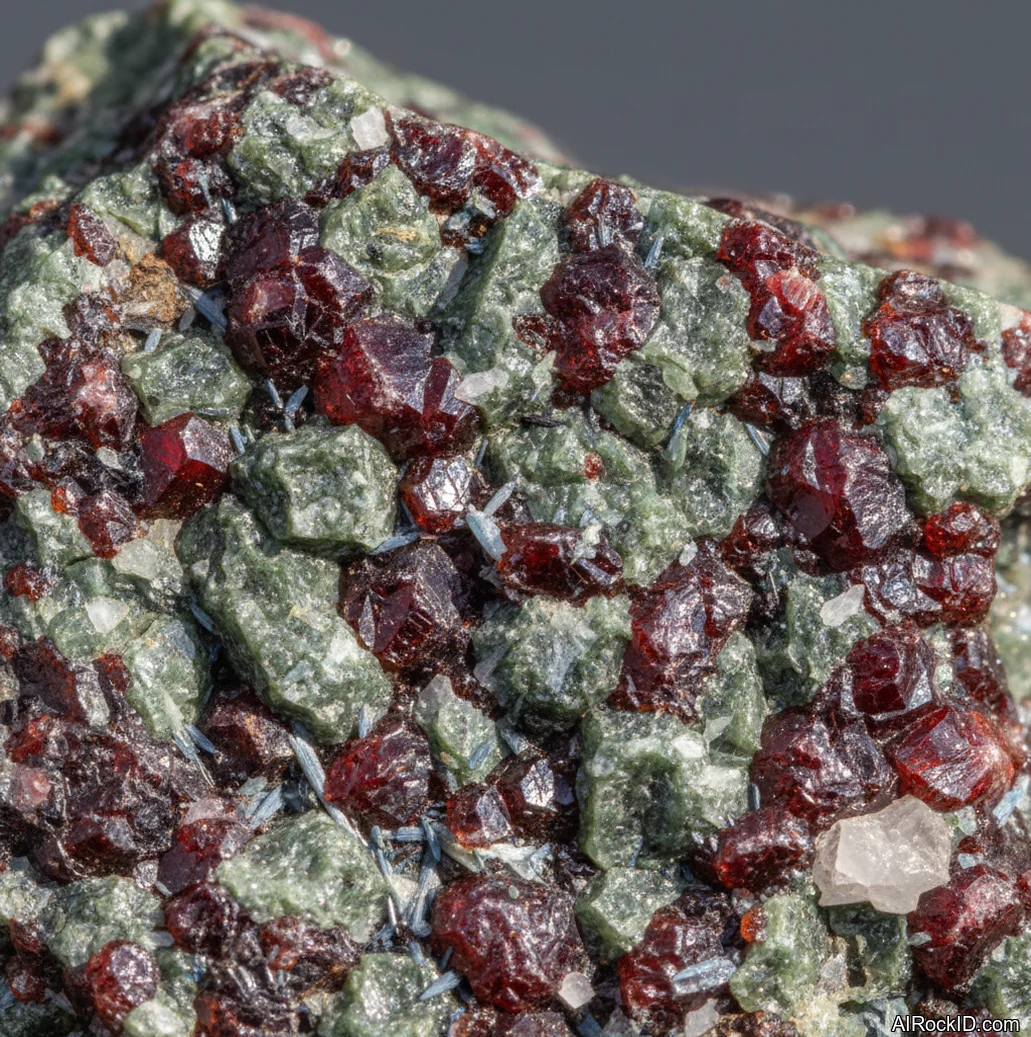
- Eclogite: Eclogite commonly has red garnet with green pyroxene; grenatite may lack the strong green omphacite-rich matrix.
- Garnet Schist: Garnet schist usually shows visible foliation or mica-rich layers, while grenatite is described mainly by high garnet content.
- Amphibolite: Amphibolite is typically dark and amphibole-rich; garnet-bearing varieties may resemble grenatite if garnets are abundant.
Grenatite vs. Similar Garnet-Bearing Rocks
| Specimen | Key visual clue | Main difference |
|---|---|---|
| Grenatite | Abundant garnet grains in a metamorphic matrix | Rock name emphasizes high garnet content |
| Garnet | Individual crystals or massive mineral pieces | Single mineral, not a mixed rock |
| Eclogite | Red garnet with green pyroxene | High-pressure metamorphic rock with diagnostic green omphacite |
| Garnet schist | Garnets in shiny, layered mica-rich rock | Foliation is usually obvious |
| Garnet amphibolite | Red garnet in dark hornblende-rich rock | Dark amphibole dominates the matrix |
AI identification confidence
AI identification of grenatite is usually moderate when the photo clearly shows many garnet grains and the surrounding matrix. Confidence drops when the specimen is polished, weathered, very dark, or shown without scale and close-up texture.
When AI gets it wrong
- A single garnet crystal is photographed without enough surrounding rock to show it is grenatite.
- Polished slabs make the matrix look more uniform than it is in natural texture.
- Red iron staining or dark mica is mistaken for garnet-rich material.
- Lighting hides foliation that would point to garnet schist instead.
Final recommendation
Choose grenatite when you want a garnet-rich metamorphic rock with visible mineral texture rather than a faceted garnet gemstone. For buying, ask for locality, natural or polished condition, and clear close-up photos that show garnet abundance and the host matrix.
How to Check Grenatite Authenticity
Authentic grenatite should show garnet grains as part of the rock fabric rather than red pieces glued or set into a surface. Look for consistent mineral boundaries, natural fractures, and garnets that continue into broken edges when visible. A seller should be able to describe it as a garnet-rich metamorphic rock, not as a transparent gemstone variety.
Photo Tips for Identifying Grenatite
Photograph grenatite in natural light with one close-up of the garnet grains and one wider image showing the full rock texture. Include a ruler, coin, or hand for scale. A wet and dry comparison can help show color and grain boundaries, but overly glossy wet photos may hide important texture.
What to Ask Before Buying Grenatite
Ask whether the specimen is natural, cut, polished, stabilized, or dyed. Request the locality if available, because garnet-rich metamorphic rocks can vary widely by region. For display pieces, check for chips, surface coatings, and whether the garnets are well exposed or mostly hidden in the matrix.
What Is Grenatite?
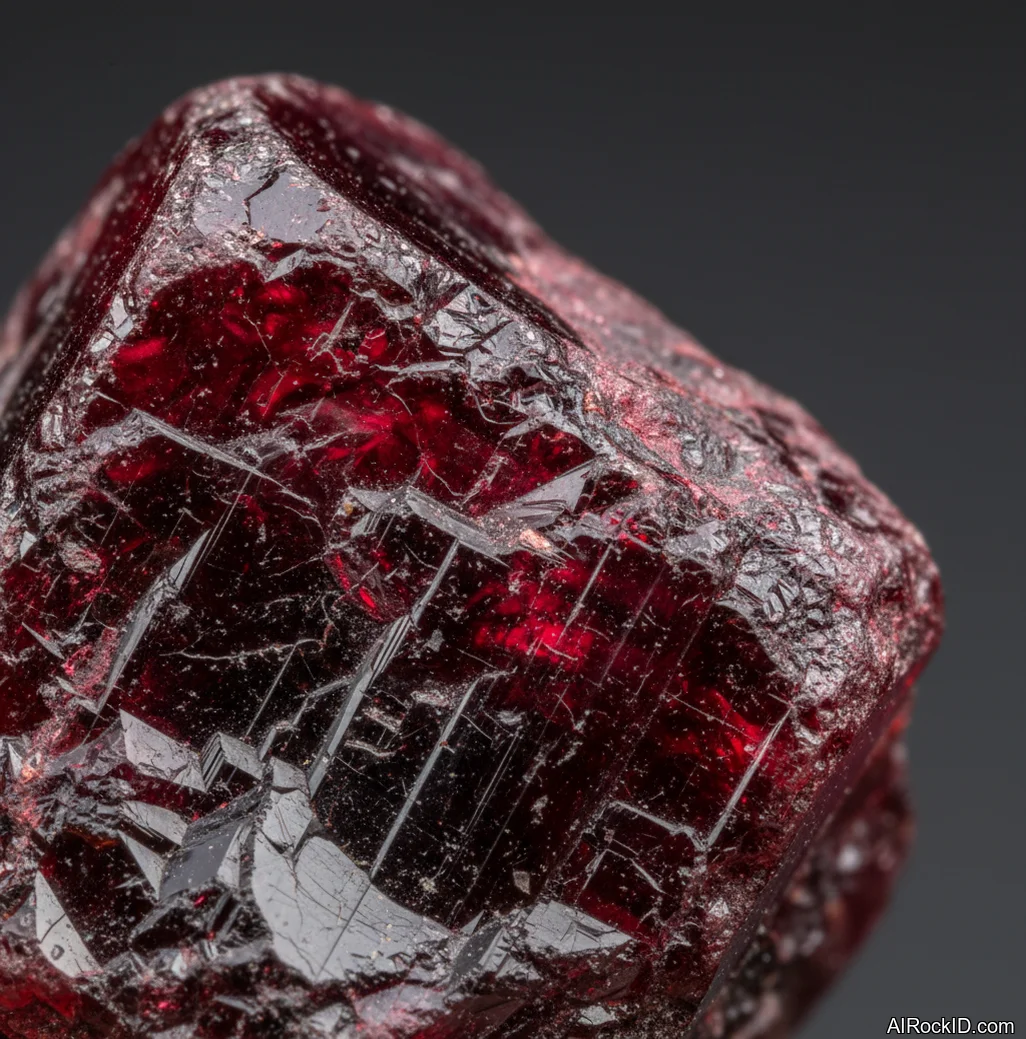
Grenatite is a metamorphic rock that’s mostly garnet, usually almandine-rich garnet, with smaller bits of mica, quartz, feldspar, or amphibole depending on what the host rock is.
Pick up a chunk and the weight hits you first. It feels oddly heavy in your palm compared to a plain mica schist, and if you rub your thumb across it you can feel the garnet grains as these tiny, stubborn hard knots even when the surface looks kind of dull.
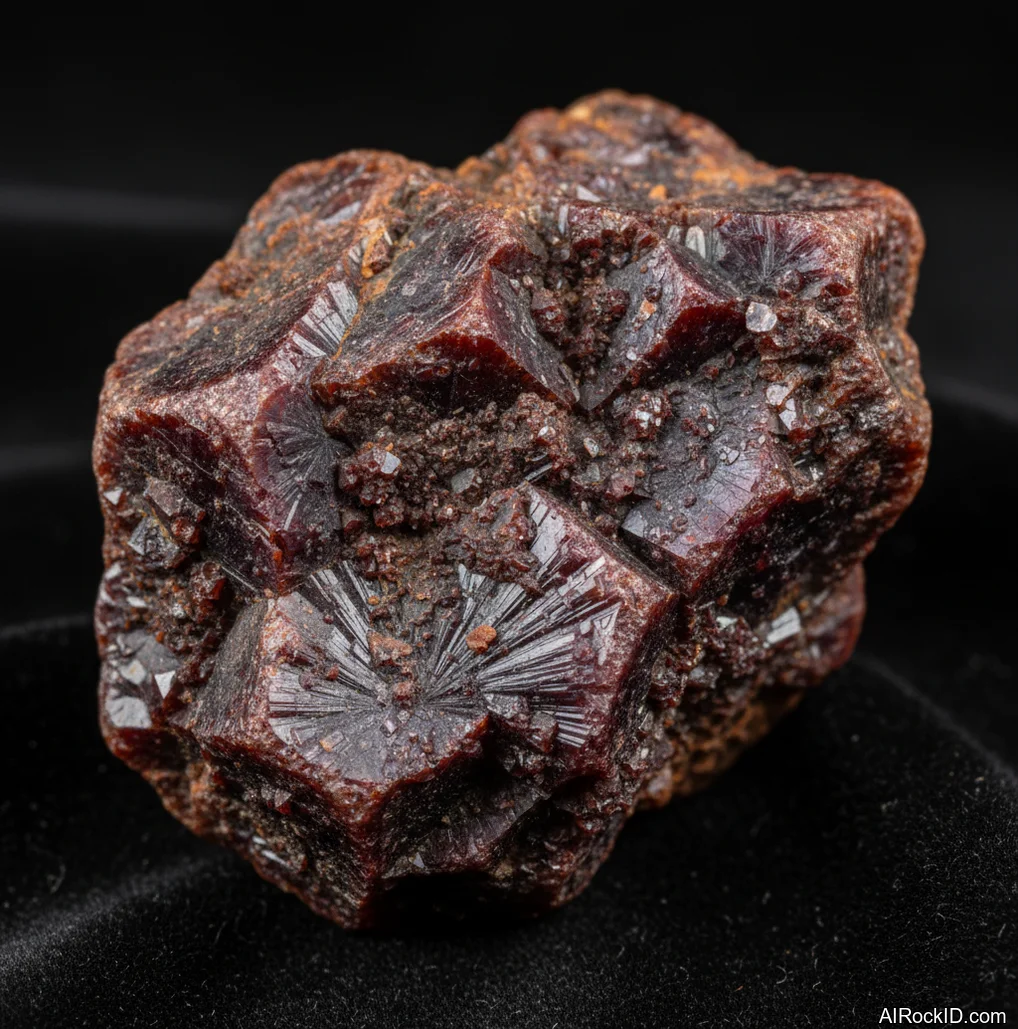
People see the name and expect big, crisp dodecahedrons like in the textbook shots. But out in the field most grenatite is more granular. So you get this peppered look, wine-red to brown-red dots set in a gray, tan, or black matrix, and if there’s enough garnet in it, it’ll take a pretty nice polish (surprisingly nice, honestly).
Origin & History
“Grenatite” pops up in metamorphic papers and scribbled field notebooks as a descriptive rock name, not as a formally approved single-mineral species. It basically means “garnet-rich rock,” used the same way people toss around terms like “eclogite” or “amphibolite” when one mineral is clearly running the show.
The word traces back to “grenat,” an old European term for garnet, a nod to how a lot of garnet crystals look like little seeds when you see them packed into the rock. And in dealer/shop talk, you’ll hear the same sort of material called “garnetite,” especially when it’s mostly garnet and there’s hardly anything else mixed in.
Where Is Grenatite Found?
You’ll run into garnet-rich metamorphic rocks anywhere regional metamorphism got intense, especially in old mountain belts and high-grade gneiss and schist terrains.
Formation
Raw chunks from high-grade schist and gneiss zones are the classic route. Garnet shows up during regional metamorphism, when heat and pressure shove iron, magnesium, and aluminum into the garnet structure and the rock basically has to reorganize itself around that new growth.
But the texture can swing all over the place depending on the conditions. With slow growth, you can end up with obvious crystals, real faces on them, the kind that flash when you tilt the rock under a lamp and catch that little glint off an edge. Faster growth, especially when space is tight, turns the whole thing into a tough, gritty, granular mass where garnet is everywhere, but it almost never looks “crystal pretty.” And if the host rock is mafic and the pressure gets high enough, you can even start seeing garnet-rich assemblages that edge toward eclogite territory.
How to Identify Grenatite
Color: Most grenatite reads as dark red-brown to wine-red garnet grains set in gray, black, or tan metamorphic matrix. Weathered surfaces can look rusty and hide the red until you wet the rock.
Luster: The garnet grains are usually vitreous to resinous, while the matrix can be dull or slightly silky if it’s micaceous.
Look closely with a hand lens and hunt for rounded to dodecahedral garnet grains that stay dark red even in shade. If you scratch it with a steel nail, the matrix might mark, but the garnet won’t, and those hard grains will skate right across glass. The real test is a fresh break: on a new surface, garnet grains pop with a glassy flash while the surrounding schist or gneiss stays matte.
Common Look-Alikes
Grenatite is sometimes confused with these materials:
- Garnet schist
- Almandine garnet in matrix
- Andradite-rich rocks
- Dyed jasper (dark reds)
- Brownish-red glass with mica flecks
- Banded hematite
Market Cautions & Treatments
When AI Can Get This Wrong
Photo ID apps get tripped up by garnet schist and even some dense jaspers, since surface color and grain size overlap. The real test is how it feels: grenatite is weighty, and you can feel those hard garnet grains with your thumb. Scratch it on glass and it'll leave a mark, but the matrix may shed fine grit.
Properties of Grenatite
Physical Properties
| Crystal System | Cubic |
| Hardness (Mohs) | 6.5-7.5 (Hard (6-7.5)) |
| Density | 3.6-4.3 |
| Luster | Vitreous |
| Diaphaneity | Opaque |
| Fracture | Uneven |
| Streak | White |
| Magnetism | Non-magnetic |
| Colors | dark red, brownish red, wine red, gray, black, tan |
Chemical Properties
| Classification | Silicates (nesosilicates) |
| Formula | Fe3Al2(SiO4)3–Mg3Al2(SiO4)3 (almandine–pyrope series common in grenatite) |
| Elements | Fe, Mg, Al, Si, O |
| Common Impurities | Mn, Ca, Cr, Ti |
Optical Properties
| Refractive Index | 1.740-1.830 |
| Birefringence | None |
| Pleochroism | None |
| Optical Character | Isotropic |
Grenatite Health & Safety
Grenatite’s usually safe to pick up and keep on a shelf. But it’s still a rock. If you’re cutting or grinding it, don’t breathe in the dust (that gritty, chalky stuff that hangs in the air for a second).
Safety Tips
If you’re shaping or polishing, keep a little water going, make sure you’ve got real ventilation (not just a cracked window), and wear a proper respirator that’s actually rated for fine mineral dust.
Grenatite Value & Price
Price Range
Rough/Tumbled: $5 - $60 per piece
Price mostly follows how much garnet is actually in it, how clean the surface looks up close, and if you can see obvious crystals instead of just that fine red peppery speckling. Polished slabs and spheres run higher because, thing is, the lapidary work is basically what you’re paying for.
Durability
Durable — Scratch resistance: Good, Toughness: Good
It’s generally stable in normal room conditions, but the softer matrix around the garnets can chip or undercut if it’s heavily micaceous.
How to Care for Grenatite
Use & Storage
Store it like you would most hard rocks: wrapped or separated so the garnet grains don’t scratch softer minerals in the same box. If it’s on a shelf, a little museum putty keeps heavy pieces from sliding.
Cleaning
1) Rinse with lukewarm water to float off grit. 2) Use a soft toothbrush with a drop of mild soap to clean around garnet grains and any micaceous seams. 3) Rinse well and pat dry; don’t bake it in direct sun to “speed things up.”
Cleanse & Charge
For a simple reset, I stick it on a windowsill overnight away from harsh midday sun or rest it on a piece of selenite. If you use smoke, keep it brief so soot doesn’t pack into rough textures.
Placement
Compared to a delicate crystal cluster, grenatite’s easygoing on a desk or by the front door. Just don’t put it where it can fall, because the matrix can spall even when the garnets are tough.
Caution
Don’t use an ultrasonic cleaner if the rock has a bunch of mica layers or those hairline fractures you only notice when you tilt it under a lamp, because the vibration can shake loose little grains. And if the piece is resin-stabilized (some polished decor pieces are, especially the ones that feel a bit plasticky-warm in your hand), keep it away from harsh solvents.
Works Well With
Grenatite Meaning & Healing Properties
Most dealers and collectors talk about grenatite kind of the way they talk about garnet, just… with more dirt-under-the-nails energy. You’re not holding one neat little gem. You’re holding a whole metamorphic story in your palm.
In my own use, it’s a “get moving” stone. Not jittery. More like that steady nudge you get when you finally park yourself in a chair and crank through the boring task you’ve been dodging all day.
Pick up a polished piece halfway through a long day and it feels anchored. It hits your skin cool, then it warms up slowly, and those garnet grains give your fingertips something real to lock onto when your brain won’t sit still. I use it like a tactile meditation thing, not medicine (big difference).
But here’s where people get tripped up: they buy it expecting it to behave like a bright red, faceted garnet. It doesn’t. Grenatite energy, if that’s your vocabulary, comes off heavier and quieter. And some pieces are so matrix-dominant they honestly feel more like schist with garnet freckles than a full-on garnet stone. Want a cleaner, more direct garnet feel? You’ll probably be happier with a solid garnet tumble, or a crystal specimen.
Common mistakes
- Calling every red garnet-bearing rock grenatite without checking whether garnet is abundant.
- Assuming grenatite is a gemstone variety rather than a metamorphic rock name.
- Using color alone for identification, since iron staining and dark mica can mimic garnet-rich areas.
- Ignoring foliation, which may indicate garnet schist instead.
- Expecting all garnet grains in grenatite to be transparent or jewelry-grade.
- Buying polished pieces without asking whether color has been enhanced or the surface has been coated.
Identify Grenatite from a photo
Compare Grenatite traits, care tips, value clues, and common lookalikes with a clear photo.