Isua


Quick answer: Isua is a very old metamorphosed rock associated with the Isua Greenstone Belt in southwestern Greenland. Collectors usually value it for its geologic age, banded appearance, and documented provenance rather than for gem clarity or traditional crystal form.
AI Rock ID can help compare a photographed Isua specimen with visually similar banded or dark metamorphic rocks, but provenance remains important for confident identification. RockIdentifier.io can be used as a visual reference tool when checking texture, banding, and likely rock family.
Good fit
- Collectors interested in ancient Earth materials and Archean geology
- People who prefer natural, rough, or slabbed specimens over polished gemstones
- Educational displays about metamorphism, greenstone belts, or early continental crust
- Buyers who can review provenance details from a reputable source
Not a good fit
- Anyone seeking a transparent faceted gemstone
- Buyers who want a specimen that can be authenticated by appearance alone
- Collections that require brightly colored mineral display pieces
- Use in jewelry that will receive frequent wear or impact
Most commonly confused with
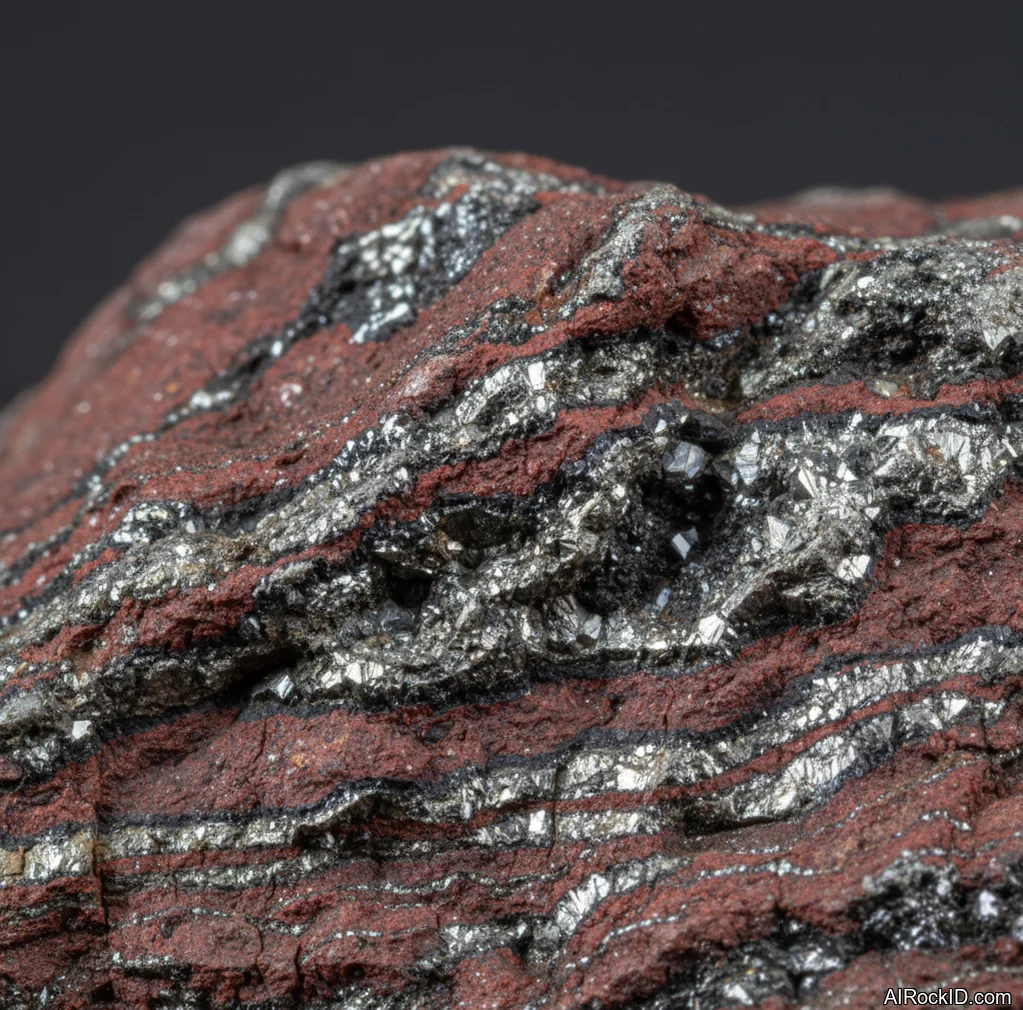
- Banded Iron Formation: Banded iron formation commonly shows iron-rich red, gray, or black layering, while Isua material may include varied metamorphosed volcanic and sedimentary textures from a specific Greenland locality.
- Gneiss: Gneiss can also show strong banding, but it is a broad metamorphic rock type and is not necessarily from the Isua Greenstone Belt.
- Amphibolite: Amphibolite is typically dark and hornblende-rich, while Isua specimens may include amphibolitic material but are identified mainly by geological source.
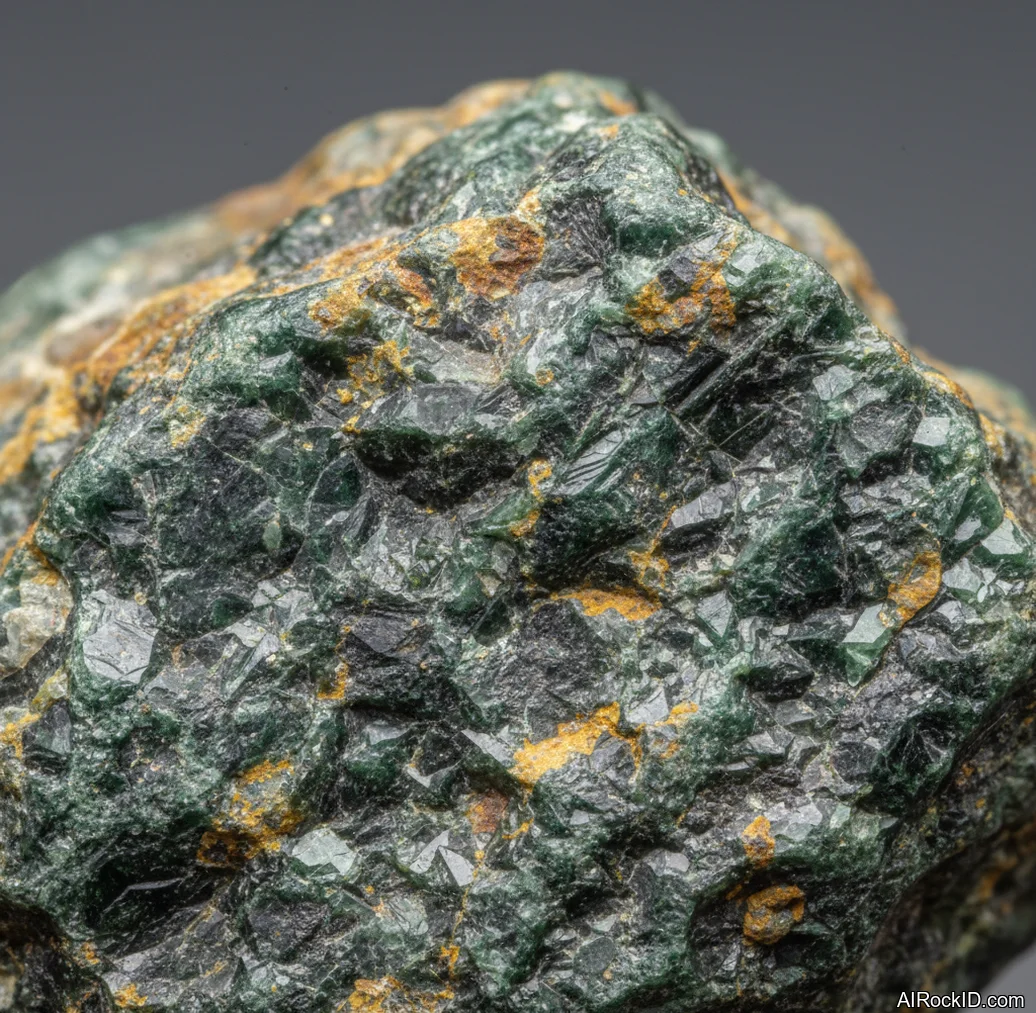
- Serpentine: Serpentine is often green and waxy to the touch, while many Isua pieces show harder, banded metamorphic textures.
Isua vs. Similar Banded Rocks
| Material | Typical appearance | Key identification clue | Main caution |
|---|---|---|---|
| Isua | Dark, gray, greenish, or banded metamorphic rock | Documented origin from Greenland's Isua Greenstone Belt | Visual ID alone is usually insufficient |
| Banded Iron Formation | Layered red, black, gray, or metallic bands | Iron-rich bands and strong color contrast | Can resemble ancient Greenland material in photos |
| Gneiss | Light and dark mineral banding | Coarse foliation and common feldspar-quartz layers | Not locality-specific without documentation |
| Amphibolite | Dark green to black, often massive or foliated | Hornblende-rich metamorphic texture | May be part of greenstone belt material |
| Jasper | Opaque red, yellow, brown, green, or patterned stone | Quartz-rich hardness and waxy to dull luster | Polished pieces may hide original rock context |
AI identification confidence
AI identification confidence for Isua should be treated as moderate to low when based only on a single photo, because many metamorphic rocks share similar banding and dark colors. Confidence improves when the image is paired with locality records, seller documentation, scale, fresh broken surfaces, and multiple angles.
When AI gets it wrong
- A specimen is labeled Isua only because it is banded or dark, without Greenland provenance.
- A polished surface makes ordinary gneiss, jasper, or banded iron formation look like ancient greenstone belt material.
- Lighting changes green, gray, and black tones enough to suggest the wrong rock family.
- The app identifies the rock type correctly but cannot verify the specific Isua Greenstone Belt source.
Final recommendation
Choose Isua when the main goal is a geologic specimen with documented ancient provenance. For confident buying, prioritize seller records, locality information, and clear photos over appearance alone.
How to Check Isua Authenticity
Authentic Isua specimens should be supported by credible locality information, preferably naming the Isua Greenstone Belt in Greenland and giving some detail about collection history or source. A visual match is not enough because gneiss, amphibolite, and banded iron formation can look similar. For higher-value pieces, ask for written provenance, previous collection labels, or a reputable dealer invoice.
What to Look for in Photos
Useful photos show the front, back, side profile, and a close view of the texture under neutral lighting. Look for natural banding, metamorphic fabric, and any cut or polished surfaces that reveal internal structure. A ruler or coin for scale helps separate small chips, display slabs, and larger hand specimens.
Ethical and Locality Considerations
Isua material is tied to a scientifically important geologic region, so responsible sourcing matters. Buyers should avoid vague listings that use the Isua name without a clear origin. Specimens with transparent collection history are easier to evaluate and preserve more useful geological context.
What Is Isua?
Collectors use “Isua” for metamorphosed Archean rock from the Isua Greenstone Belt in southwest Greenland, usually banded with iron-rich layers and greenish silicate zones.
Thing is, when you pick up a hand piece, it doesn’t feel like one mineral at all. Not even close. It comes across as a tough, compact rock made of mixed grains, and the face often has that slightly gritty drag you get with quartz-rich material when you run a thumb across it. I’ve handled a few slices where the dark bands are so crisp they honestly look inked on, then you tip it under the light and the paler layers flash with tiny quartz points (little pinprick sparkles).
At first glance, people expect “a crystal.” But yeah, sellers sometimes call it a crystal, and in your hand it behaves more like an old, beat-up geological record book. You’ll spot black magnetite or hematite bands, pale gray quartz or carbonate layers, and sometimes that green cast from amphibole or chlorite. Some pieces take a polish well. Some don’t, and the rough chunks just look like plain field rock until you wet the surface and the banding pops.
Origin & History
Isua material comes from the Isua Greenstone Belt, up by the settlement of Isukasia in southwest Greenland. Geologists use “Isua” both for the belt itself and for the well-known iron formations, plus the metamorphosed volcanic and sedimentary rocks you find in the same area.
The belt really hit the radar in modern geoscience in the 1960s and 1970s, when detailed mapping and geochemical work in Greenland started picking up speed. That wave of studies helped nail down Isua as some of Earth’s oldest accessible crustal rock. And in the collector world, the name stuck for a pretty simple reason: “Isua” rolls off the tongue, while “metamorphosed Archean supracrustals” is a mouthful. Also, when you slice and polish it (and you can feel that glassy-smooth finish under your fingertips), the banding can look seriously good.
Where Is Isua Found?
Authentic Isua is from the Isua Greenstone Belt in southwest Greenland. Most collector pieces are sold as rough chunks or cut slabs rather than natural crystal specimens.
Formation
Think of Isua as a pile of seriously old surface rocks that got heated up, squeezed hard, and basically reworked until they barely resemble what they started as. The originals were volcanic rocks plus sediments, including banded iron formation layers that settled out in ancient seas. Then metamorphism and deformation came along later and tightened the whole package up, recrystallized the grains, and folded or stretched the layers all over the place.
Look, if you get right up on the banding (the kind you can trace with your fingertip along a fresh break), you can usually tell it started life as real layers, not one big blob of magma. The iron-rich bands might be magnetite-heavy, which looks black and a little metallic when the light hits it. Or they’re hematite-rich, showing up as those brown-red thin streaks. The lighter bands are commonly quartz and carbonates. And the greenish zones usually come from metamorphic silicates like amphibole or chlorite. It’s a rock that’s been through a lot. And yeah, it looks like it.
How to Identify Isua
Color: Most pieces are gray to black with strong banding, often alternating dark iron-rich layers with lighter quartz-carbonate layers. Greenish streaks or patches can show up from amphibole or chlorite.
Luster: Mixed luster overall, with vitreous sparkle on quartz-rich areas and submetallic to metallic flashes on magnetite-rich bands.
Pick up a slice and run a fingernail over the light bands. If they feel slightly glassy and gritty, you’re probably on quartz-rich material. A small magnet is a real test on many pieces since magnetite bands can grab hard, but not every sample is strongly magnetic. And if someone’s selling “Isua crystal points,” be skeptical, because Isua is usually a rock you cut and polish, not a pocket full of clean terminations.
Common Look-Alikes
Isua is sometimes confused with these materials:
- Banded iron formation (BIF) slabs sold as “Isua” or “ancient Greenland rock”
- Greenstone / greenschist (chlorite-actinolite-epidote rock) from other localities, especially when it’s just green + black banding
- Serpentinized ultramafic rock (serpentinite) with magnetite streaks that mimic the dark Isua bands
- Jasper + magnetite / hematite banded material (sometimes marketed as jaspilite) cut into the same kind of flat slices
- Dyed quartzite or dyed “greenstone” souvenir rock where the green sits in cracks and saw marks
- Black-green glass or slag sold as “ancient meteorite rock” or “Isua” (too uniform, too glossy, often lighter than it looks)
Market Cautions & Treatments
When AI Can Get This Wrong
In photos, AI mixes Isua up with banded iron formation, jaspilite, and random greenstone because all it sees is black-gray banding plus a green cast. The real test is in-hand: Isua usually feels compact and gritty on a thumb rub, and hardness jumps around because you’re crossing quartz-rich bands and softer green silicate zones. A quick magnet check and a scratch test on the light bands (quartz should bite glass) help separate “real mixed Isua-ish rock” from pure ironstone slices or dyed stuff.
Properties of Isua
Physical Properties
| Crystal System | Amorphous |
| Hardness (Mohs) | 5.5-7 (Hard (6-7.5)) |
| Density | 2.8-4.2 g/cm3 |
| Luster | Vitreous |
| Diaphaneity | Opaque |
| Fracture | Uneven |
| Streak | varies (black to reddish-brown depending on iron oxide content) |
| Magnetism | Weakly Magnetic |
| Colors | gray, black, white, green, brown, reddish-brown |
Chemical Properties
| Classification | Rock (mixed; commonly Silicates + Oxides + Carbonates) |
| Formula | N/A (rock; common constituents include SiO2, Fe3O4, Fe2O3, CaCO3, and amphibole group silicates) |
| Elements | Si, O, Fe, Ca, Mg, C, H |
| Common Impurities | Mn, Al, Na, K |
Optical Properties
| Refractive Index | N/A (rock aggregate; quartz in it is ~1.544-1.553) |
| Birefringence | None |
| Pleochroism | None |
| Optical Character | Isotropic |
Isua Health & Safety
Handling it is pretty low risk. But if you cut it or grind it, you can kick up silica-bearing dust, and you really don’t want to be breathing that stuff. And if you’ve got pieces that are magnetite-rich, watch the surface. When it’s weathered, it can crumble a bit and shed this fine, dark grit (the kind that leaves a smudge on your fingertips).
Safety Tips
If you’re going to cut it, grind it, or hit it with sandpaper, don’t do it dry. Use water to keep the dust down, make sure you’ve got good ventilation, and wear a proper respirator that’s actually rated for silica dust (not just a flimsy mask). And once you’re done handling the dirty, rough stuff, wash your hands.
Isua Value & Price
Price Range
Rough/Tumbled: $20 - $200 per piece
Price follows the story and the look. If the banding’s crisp, the polish comes up clean (that glassy shine you can feel with a fingertip), and the Greenland sourcing is actually documented, the value jumps fast. Big slabs run higher mostly for a boring reason: cutting them and shipping a chunk of heavy rock isn’t cheap. Pick one up and you get it.
Durability
Durable — Scratch resistance: Good, Toughness: Good
It’s generally stable like most quartz and iron-oxide bearing rocks, but softer carbonate-rich layers can undercut or dull if you treat it like solid quartz.
How to Care for Isua
Use & Storage
Store it like you’d store any heavy slab: flat, padded, and not where it can tip onto softer crystals. If it’s a polished face, I keep a bit of felt between pieces so the polish doesn’t get hazed.
Cleaning
1) Rinse with lukewarm water to remove grit. 2) Use a soft brush with mild soap on rough surfaces and along bands. 3) Rinse again and dry fully, especially if there are tiny seams that can hold moisture.
Cleanse & Charge
For a non-mystical reset, I just rinse it and let it dry, or set it somewhere quiet out of direct sun. If you do energy-style cleansing, smoke or sound are gentle choices for mixed rocks.
Placement
It looks best under raking light so the banding throws contrast. On a desk, a small slab works great because you can flip it and compare layers without babying it.
Caution
Skip harsh acids and vinegar, because they can etch the carbonate layers. And don’t dry-sand it unless you’ve got real dust control in place.
Works Well With
Isua Meaning & Healing Properties
Most people who reach for Isua are really reaching for its age. That’s the whole pull. On a practical, in-the-body level, it’s a decent “slow down” stone because it isn’t flashy or sugary. It feels dense, literal, and a little uncompromising.
Grab a piece and notice what your hand does. Mine always clenches a touch tighter at first, like my brain clocks the weight and that slightly gritty, banded surface before it thinks about anything else. So I’ll set it on the table next to a notebook and use it while I’m doing breath work or journaling if I’m scattered. Not a cure. Just a physical anchor that’s right there when my attention skitters off.
But look, there’s a catch. A lot of the Isua being sold is just dark banded rock with big claims slapped on it, and without provenance it’s tough to prove which belt it actually came from. If you’re buying it for the story, get it from a dealer who can tell you exactly what it is, how it was sourced, and whether it’s truly an Isua belt slab or just “BIF-looking” material from somewhere else. And no, none of this replaces medical care, therapy, or plain common sense.
Common mistakes
- Assuming any old-looking banded rock is Isua
- Relying on color alone instead of provenance and texture
- Buying polished pieces without asking whether the original locality is documented
- Confusing a rock-type identification with confirmation of a Greenland source
- Ignoring scale, surface finish, and lighting when comparing online photos
Identify Isua from a photo
Compare Isua traits, care tips, value clues, and common lookalikes with a clear photo.