Maligano Jasper


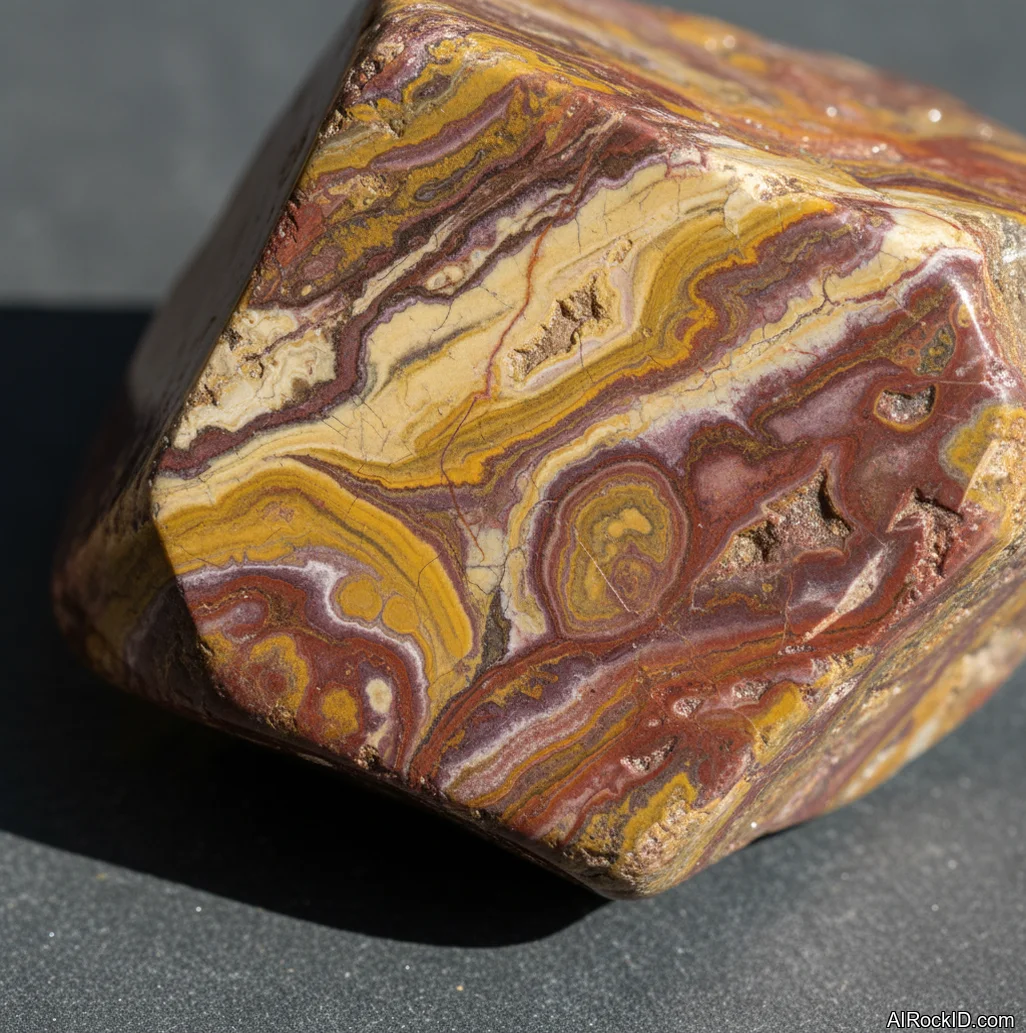
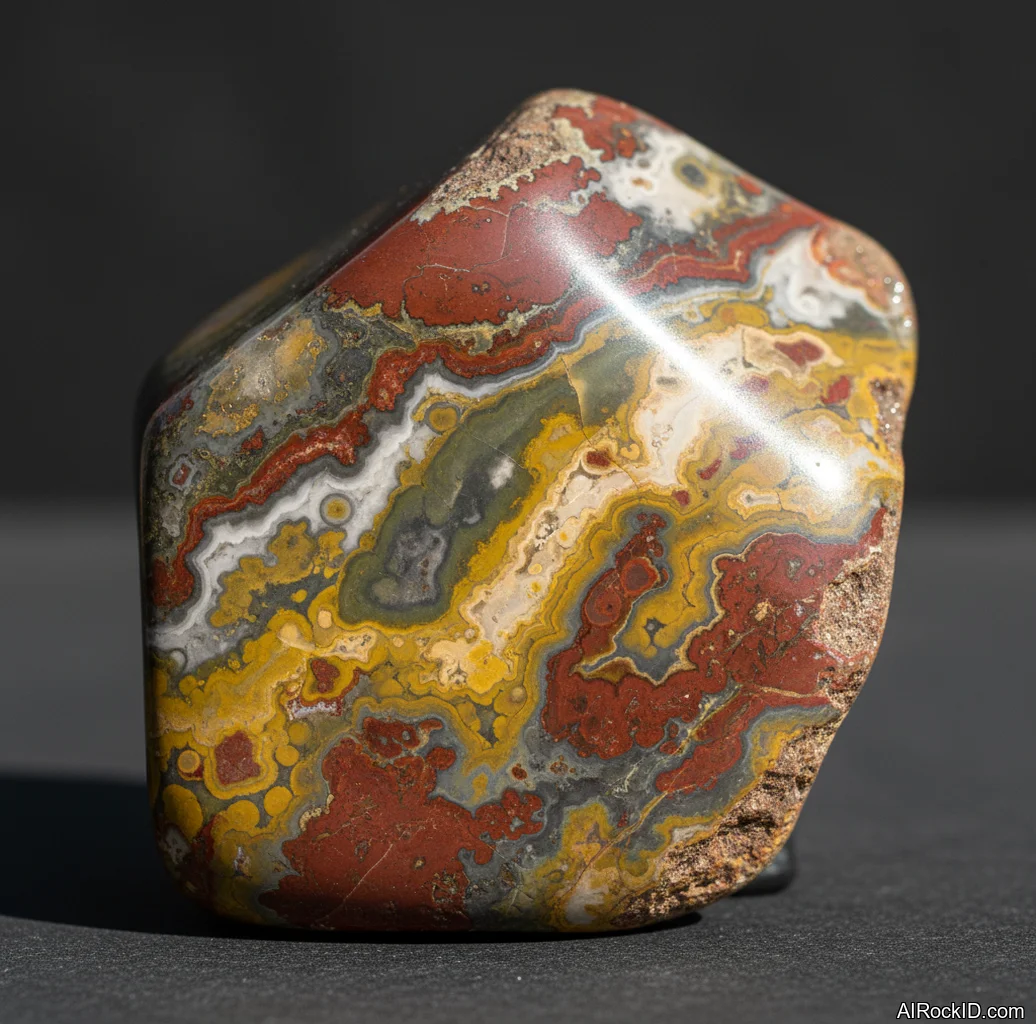
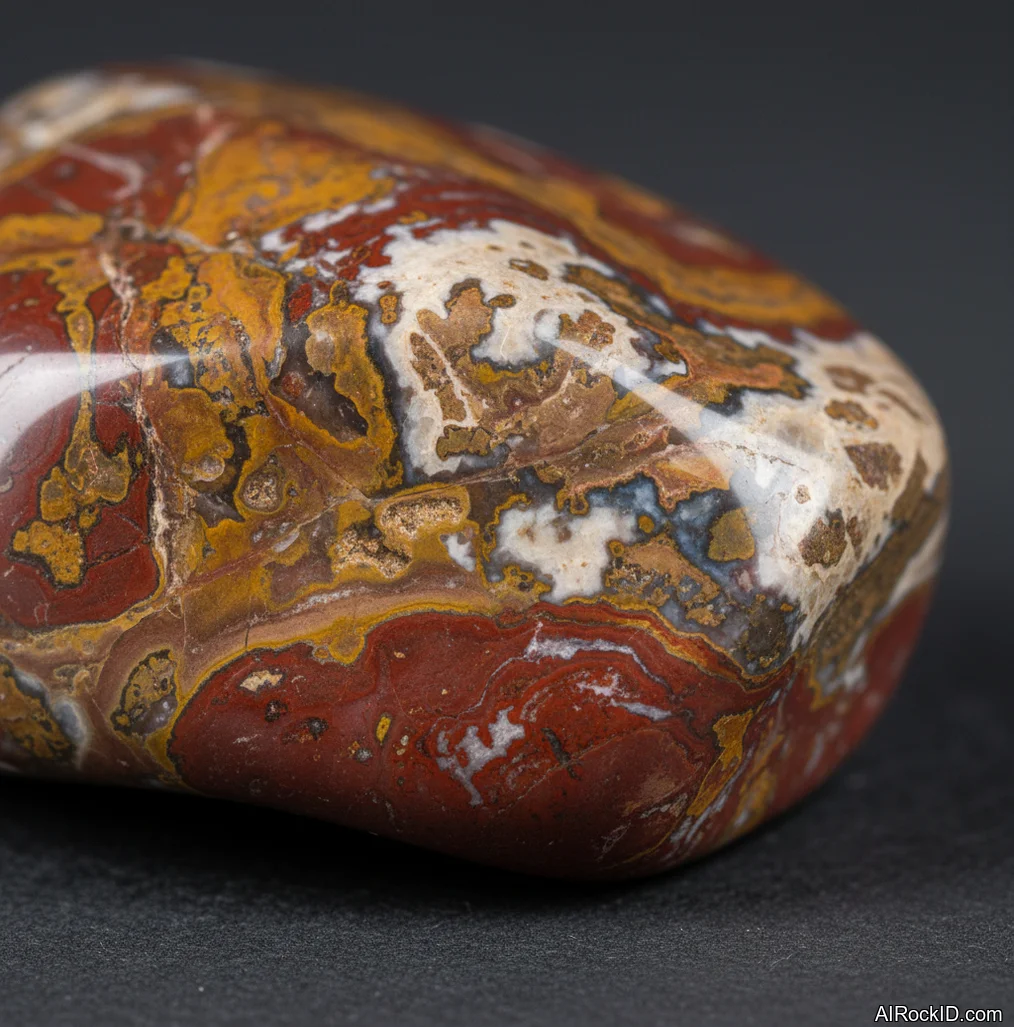
Quick answer: Maligano Jasper is usually identified by its opaque, polished surface and broken, mosaic-like patterning in gray, cream, tan, orange, red, and blue-gray tones. It is best evaluated by pattern, opacity, hardness range, and seller provenance because the trade name can overlap with other Indonesian jaspers.
AI Rock ID can help compare a Maligano Jasper photo against common jasper and chalcedony lookalikes using visible pattern, color, and texture cues. RockIdentifier.io provides crystal identification support, but final confirmation should consider hardness, opacity, polish quality, and the seller’s locality information.
Good fit
- Collectors who like brecciated, landscape-like, or orbicular-looking jasper patterns
- Cabochon and jewelry buyers who want an opaque stone that takes a smooth polish
- People comparing Indonesian jasper varieties before purchasing
- Beginners who want a visually distinctive jasper with clear pattern clues
Not a good fit
- Buyers seeking a transparent or faceted gemstone
- Anyone who needs a laboratory-certified mineral species rather than a trade variety
- Collectors who prefer uniform color with little pattern variation
- Projects requiring a stone softer than quartz-family material for easy carving
Most commonly confused with
- Ocean Jasper: Ocean Jasper commonly shows rounded orbicular patterns and is associated with Madagascar, while Maligano Jasper is an Indonesian trade variety with more brecciated mosaic patterning.
- Picture Jasper: Picture Jasper often has scenic, layered landscape-like bands, while Maligano Jasper more often appears fractured or patchworked.
- Brecciated Jasper: Brecciated Jasper is a broader descriptive term for broken-and-recemented jasper textures; Maligano Jasper is a specific trade name tied to Indonesian material.
- Polychrome Jasper: Polychrome Jasper usually has flowing, earthy color fields, while Maligano Jasper more often shows angular fragments and contrasting veins.
Maligano Jasper vs Common Lookalikes
| Stone | Typical Pattern | Key Difference | Common Origin Cue |
|---|---|---|---|
| Maligano Jasper | Brecciated mosaic, patchwork, orbicular-looking areas | Opaque Indonesian jasper-chalcedony trade material | Often sold as from Sulawesi, Indonesia |
| Ocean Jasper | Rounded orbs, eyes, and druzy pockets | More clearly orbicular; may include small cavities | Commonly sold as Madagascar material |
| Picture Jasper | Scenic bands and landscape-like layers | Less fragmented; more layered or sedimentary-looking | Origin varies by seller |
| Brecciated Jasper | Angular fragments with cement-like veins | Descriptive category, not necessarily Maligano | Origin varies widely |
| Polychrome Jasper | Flowing earthy color zones | Less angular and less mosaic-like | Often associated with Madagascar |
AI identification confidence
AI identification of Maligano Jasper is usually moderate when the photo shows a polished surface with clear brecciated patterning and natural color variation. Confidence is lower for tumbled stones, close-up crops, or listings that use broad trade names without origin details.
When AI gets it wrong
- The photo is overexposed, making cream, gray, and tan areas blend together.
- A close-up shows only one color patch instead of the broader mosaic pattern.
- The stone is dyed, heavily enhanced, or photographed under saturated lighting.
- The sample is labeled only as jasper without locality or seller provenance.
Final recommendation
Choose Maligano Jasper based on pattern clarity, polish quality, and credible Indonesian sourcing rather than color intensity alone. For higher-priced cabochons or slabs, ask for natural-light photos and confirm whether the seller is using Maligano as a locality-based trade name or a general pattern description.
How to Check Maligano Jasper Authenticity
Authentic Maligano Jasper should look opaque, take a glassy to waxy polish, and show natural variation rather than repeated printed-looking patterns. Ask sellers for untreated or natural-light photos, locality information, and whether any dye, resin filling, or stabilization has been used. A hardness check should be consistent with quartz-family material, but scratch testing should only be done on an inconspicuous area or spare piece.
Buying Tips for Maligano Jasper
Well-cut cabochons should have a smooth dome, even polish, and an attractive balance of contrasting pattern areas. Slabs are often valued for composition, so inspect both wet and dry photos to understand how the pattern will look after polishing. Avoid judging value by the name alone, because Maligano Jasper varies widely in color, fracture density, and lapidary quality.
Photo Tips for Identifying Maligano Jasper
Use diffuse daylight and photograph the whole stone, not just a close-up of one pattern area. Include the front, back, edge, and a scale reference so opacity, polish, and fracture-like patterning are easier to evaluate. Avoid colored backgrounds or strong filters because they can make ordinary jasper look more vivid than it is.
What Is Maligano Jasper?
Maligano Jasper is a patterned, brecciated chalcedony (microcrystalline quartz) that gets traded as jasper from Indonesia, usually showing up in gray-white tones with tan, brown, and black patches.
Pick up a polished palm stone and the first thing you feel is the heft. It’s got that solid, quartz-based weight, and it stays cool a beat longer than glass when you lift it off a dealer’s table (especially if it’s been sitting under a lamp). The better pieces have this storm-cloud gray chalcedony with sharp, inky outlines hugging the tan areas. And sure, from across the room it can pass for a weird agate. But there’s no clean banding like people expect. It looks more like shattered fragments that got locked in place.
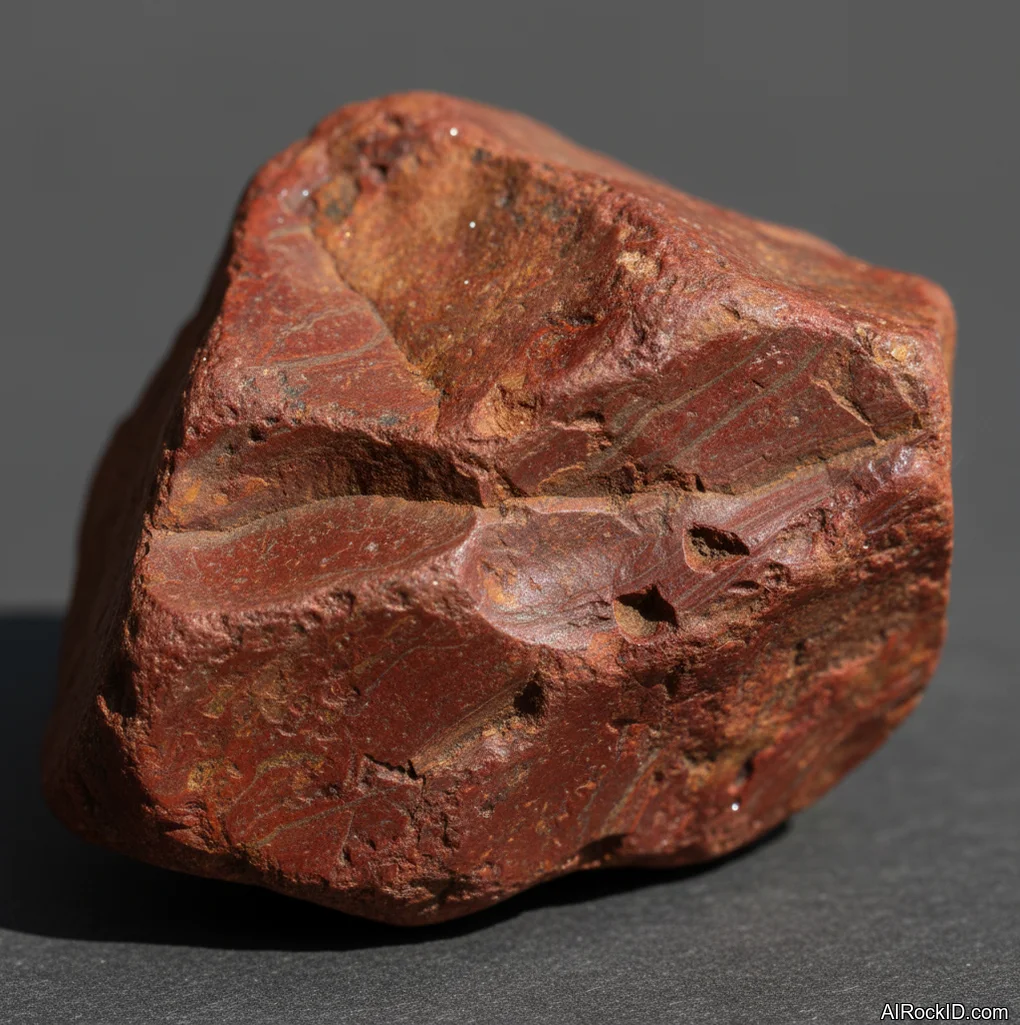
Most of what you’ll see for sale starts as nodules, then gets polished into slabs, cabs, freeforms, that kind of thing. Raw chunks are out there, but they’re usually kind of dull until you cut them open. Thing is, the name throws people. Plenty of sellers slap “jasper” on anything opaque that takes a shine, even when it’s really chalcedony with mixed textures.
Origin & History
You won’t find “Maligano Jasper” listed as a formal mineral species, because it isn’t one. It’s a trade name people use for patterned chalcedony and jasper-like silica that comes out of Indonesia. It really started popping up all over the lapidary and crystal market in the 2000s and 2010s, once Indonesian material got a lot easier to source and export.
Thing is, the “Maligano” name is basically tied to how Indonesian localities get labeled by exporters and lapidary suppliers, not the old-school Western style of first description like you’d see with smithsonite or rhodochrosite. In the shop world, it’s just quick shorthand: a gray base, that brecciated, broken-up look, tons of tiny orb and cell-like shapes you can actually see even before you polish it (especially when it’s wet), and it cuts like quartz.
Where Is Maligano Jasper Found?
Maligano Jasper on the market is sourced from Indonesia, with material commonly attributed to Sulawesi. It’s sold as nodules, rough blocks, slabs, and polished shapes.
Formation
Look at that pattern for a minute and it basically shouts, “Yeah, silica showed up here more than once.” The simplest read is silica-rich fluids moved through broken host rock, filled the gaps, and cemented it back together, then later pulses of silica came through again with iron oxides tagging along and staining parts of the mess. That’s how you end up with sharp, angular breccia chunks sitting right beside smooth, milky chalcedony like they’ve always belonged together.
Thing is, if you’ve ever cut jaspers that are genuinely uniform, Maligano doesn’t behave the same way on the saw. You’ll feel the blade hit little zones that are tougher and glassier, then it slides into areas that go a bit more dull and fine-grained (same overall hardness, different feel). And those black lines tracing the shapes? Most of the time that’s manganese- or iron oxide-rich material, not some separate “black crystal layer” like a few listings like to claim. Who even came up with that?
How to Identify Maligano Jasper
Color: Most Maligano Jasper shows a gray to gray-white chalcedony base with tan, beige, brown, and black patterning, often in brecciated or orb-like cells. Some pieces lean warmer overall, but the cooler gray background is the easy tell.
Luster: Polished pieces take a waxy to vitreous shine, like other chalcedony-based jaspers.
Pick up a piece and feel the temperature. Real silica stays cool in the hand longer than plastic or resin “imitation jasper.” If you scratch it with a steel nail, you usually won’t get a real gouge, but the nail may leave a faint metal streak that wipes off. The real test is a clean edge and a bright light: you might catch slight translucency at thin corners, which is common in chalcedony-heavy Maligano.
Common Look-Alikes
Maligano Jasper is sometimes confused with these materials:
- Ocean Jasper (orbicular jasper) and other Indonesian orbicular jaspers sold under mixed trade names
- Silver Leaf Jasper / Picasso Jasper (patterned gray-tan jasper/chert) that overlaps hard on color and webby breccia lines
- Brecciated Jasper (generic) and brecciated chert, especially the gray-tan stuff that gets labeled "Maligano" loosely
- Polychrome Jasper (Madagascar) when it’s in its muted gray-beige areas without the loud reds
- Dyed crackle agate/chalcedony sold as "Maligano" (dye sinks into the fracture network and makes the pattern look sharper than it should)
- Patterned resin or glass palm stones with printed-looking patches and a too-warm feel in the hand
Market Cautions & Treatments
When AI Can Get This Wrong
At first glance, phone apps mix Maligano Jasper up with Ocean Jasper, Picasso Jasper, or plain brecciated jasper because all they see is gray-white with tan webbing. Photos also lie when the polish is glossy and the pattern is high contrast from dye, since the camera boosts those fracture lines. The real test is a quick hardness and feel check: Maligano (chalcedony) should scratch glass cleanly and stay cool and heavy in the palm compared to resin or glass.
Properties of Maligano Jasper
Physical Properties
| Crystal System | Trigonal |
| Hardness (Mohs) | 6.5-7 (Hard (6-7.5)) |
| Density | 2.58-2.64 |
| Luster | Waxy |
| Diaphaneity | Opaque |
| Fracture | Conchoidal |
| Streak | White |
| Magnetism | Non-magnetic |
| Colors | Gray, White, Tan, Beige, Brown, Black |
Chemical Properties
| Classification | Silicates |
| Formula | SiO2 |
| Elements | Si, O |
| Common Impurities | Fe, Mn, Al, Ca |
Optical Properties
| Refractive Index | 1.53-1.54 |
| Birefringence | 0.004 |
| Pleochroism | None |
| Optical Character | Uniaxial |
Maligano Jasper Health & Safety
Maligano Jasper is non-toxic to handle, and it’s generally safe around water. Thing is, like any silica rock, the only real worry shows up when you’re cutting or shaping it. If you saw, grind, or sand it, you can kick up that super-fine dust that hangs in the air and coats everything (you’ll notice it on your fingers and even on the bench top).
Safety Tips
If you’re going to cut or shape it, keep water running, make sure there’s real ventilation (not just a fan pushing air around), and wear a proper respirator that’s actually rated for silica dust.
Maligano Jasper Value & Price
Price Range
Rough/Tumbled: $5 - $40 per palm stone or small slab
Cut/Polished: $1 - $6 per carat
Prices jump when the pattern has sharp black outlines, high contrast, and hardly any pits left after polishing. Big, clean slabs cost more, too, because the rough usually has fractures running through it that cap how large a usable piece you can actually get.
Durability
Very Durable — Scratch resistance: Good, Toughness: Good
It’s stable quartz-based material that handles normal wear well, but thin edges can chip if it gets knocked around in a pocket.
How to Care for Maligano Jasper
Use & Storage
Store it like you’d store any polished jasper: separated from softer stones so it doesn’t scratch them, and wrapped if you’re stacking slabs. If you toss it loose with other quartz, the corners can still get bruised.
Cleaning
1) Rinse with lukewarm water and a drop of mild soap. 2) Use a soft toothbrush to get into pits or seams, then rinse well. 3) Dry with a microfiber cloth to keep the polish looking sharp.
Cleanse & Charge
If you do energy-style cleansing, running water, smoke, or a night on a windowsill works fine. Just don’t bake it in harsh sun all day if the piece has any dyed-looking areas from the seller.
Placement
On a desk or shelf, it reads best under angled light that brings out the black outlines and the cloudy gray depth. I like it near a lamp, not flat under overhead lighting.
Caution
Skip harsh acids and strong bleach. And if the piece has visible fractures or those little natural pits you can feel with a fingernail, don’t toss it in an ultrasonic cleaner. Buying online? Ask the seller for tight, close-up photos, especially of the holes and edges, because some pieces have filler or a thick resin polish packed into voids.
Works Well With
Maligano Jasper Meaning & Healing Properties
Compared to the flashier stones, Maligano just feels… solid. Steady. Practical in your hand. The people who reach for it usually want that “okay, let me get my head straight” feeling, not something syrupy and dreamy. When I’m sorting a new flat of slabs, I’ll leave a Maligano palm stone right on the counter, and it honestly helps keep me from bouncing around when there are ten patterns all yelling for attention.
Most folks file jasper-type material under “grounding,” and Maligano sits squarely in that zone. The gray base looks calm in a way that’s hard to explain until you’ve seen it under shop lights, and that broken-then-cemented look makes it an easy fit for the whole “put the pieces back together” symbolism. But look, I’m blunt with customers: it’s not medical care. It’s not going to fix your sleep or your blood pressure. It’s a tactile tool. You hold it. You focus. You slow down. That’s the point.
And yeah, there’s a little market reality here too. Some listings go wild with the claims because it’s an “exotic Indonesian jasper.” In actual day-to-day use, it behaves like other chalcedony jaspers. If you want something gentler, pair it with a softer-feeling stone like rose quartz. If you want it to hit heavier, combine it with hematite or smoky quartz and you’ll get that more anchored mood people talk about.
Common mistakes
- Assuming every orbicular-looking jasper is Maligano Jasper.
- Confusing a brecciated texture with actual damage or poor durability.
- Buying from a listing that gives no locality, treatment, or natural-light photos.
- Expecting all Maligano Jasper to have the same color palette or pattern density.
- Using color alone for identification instead of pattern, opacity, hardness, and provenance.
Identify Maligano Jasper from a photo
Compare Maligano Jasper traits, care tips, value clues, and common lookalikes with a clear photo.