Mookaite


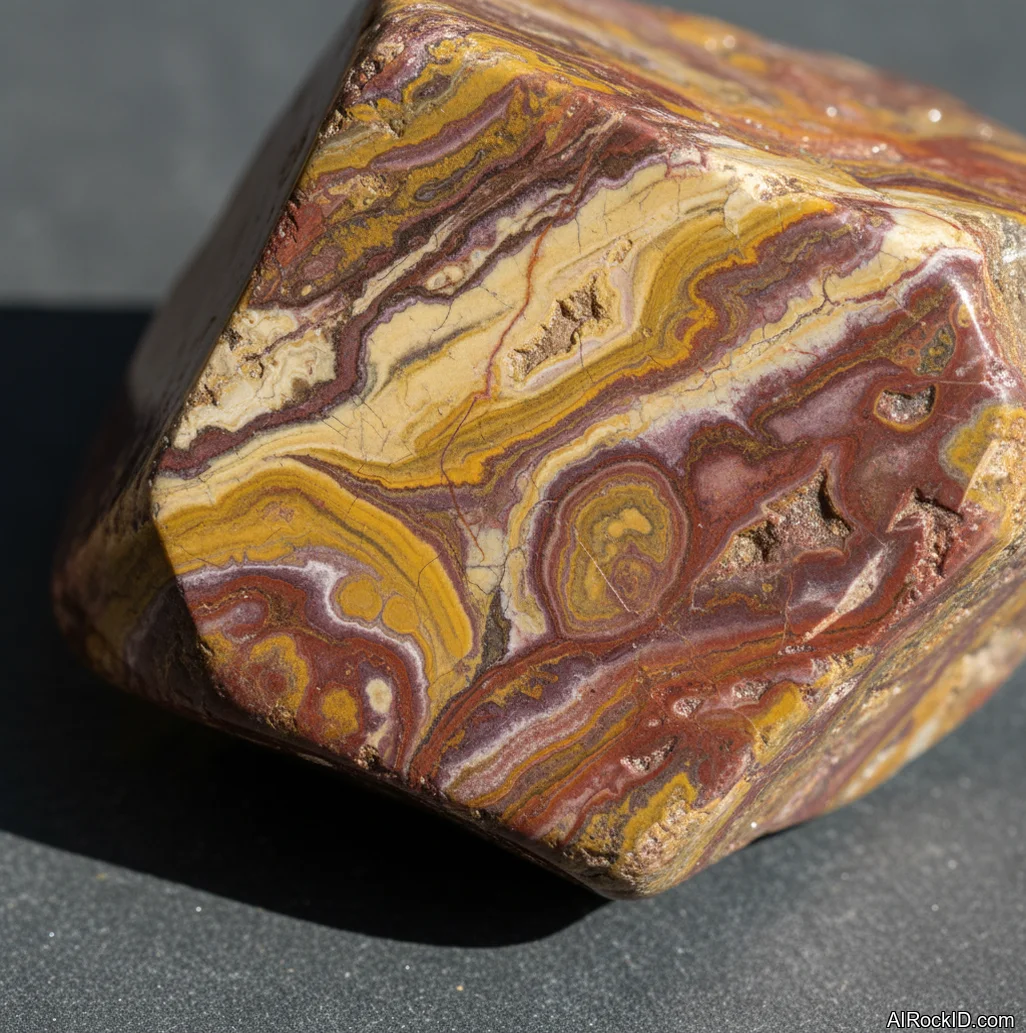
Quick answer: Mookaite is best recognized by its opaque, earthy color zones of mustard yellow, brick red, burgundy, cream, tan, and brown. It is commonly cut as cabochons, beads, palm stones, and decorative pieces, and its jasper-like look can overlap with other opaque chalcedony and patterned stones.
AI Rock ID can help compare a Mookaite specimen against visually similar stones by checking color zoning, opacity, texture, and surface pattern. RockIdentifier.io provides photo-based identification support, but results should be confirmed with basic physical observations such as hardness, luster, and whether the piece has been dyed or stabilized.
Good fit
- Collectors who like opaque stones with warm red, yellow, cream, and brown color blocks
- Jewelry buyers looking for a durable quartz-family material suitable for beads or cabochons
- Beginners who want a stone that is visually distinctive but still affordable in common sizes
- People comparing jasper-like stones and wanting an Australian material with recognizable color zoning
Not a good fit
- Anyone expecting transparency, sparkle, or crystal points
- Buyers who need a gem with a precise single color or uniform pattern
- People who want a rare faceted gemstone rather than a common lapidary material
- Specimens requiring laboratory-level origin proof without seller documentation
Most commonly confused with
- Jasper: Many jaspers are opaque and quartz-rich, but Mookaite usually has a recognizable Australian earthy palette with cream, mustard, red, and burgundy zones.
- Polychrome Jasper: Polychrome jasper often shows broader desert-like swirls, while Mookaite commonly has sharper patches or bands in red, yellow, cream, and brown.
- Petrified Wood: Petrified wood may show grain, bark-like texture, or growth-ring structure, which Mookaite normally lacks.
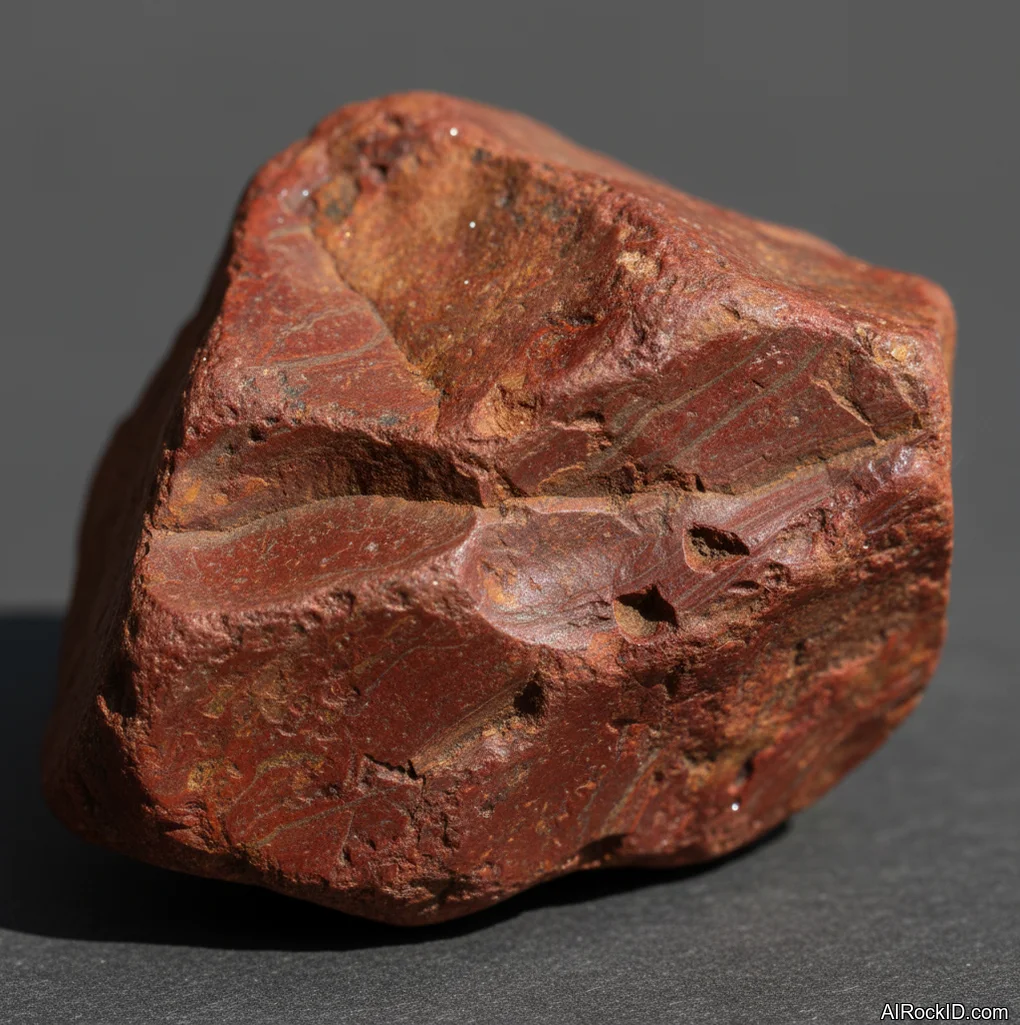
- Red Jasper: Red jasper is usually more uniformly red or brick-colored, while Mookaite commonly includes contrasting yellow, cream, burgundy, or brown areas.
Mookaite vs Similar Opaque Stones
| Stone | Typical Look | Key Difference |
|---|---|---|
| Mookaite | Opaque red, yellow, cream, tan, burgundy, or brown patches | Australian radiolarite with a jasper-like appearance |
| Red Jasper | Mostly red to brick-red and opaque | Usually less multicolored than Mookaite |
| Polychrome Jasper | Large swirls of tan, red, gray, or brown | Often has broader painterly patterns |
| Petrified Wood | Wood-grain or ring-like texture | May preserve visible organic structure |
| Agate | Banded and often partly translucent | Translucency is more common than in Mookaite |
AI identification confidence
AI identification confidence for Mookaite is usually moderate when photos show multiple natural color zones, opacity, and a polished jasper-like surface. Confidence decreases for single-color pieces, low-light images, close crops without scale, or stones that have been dyed to imitate natural earthy colors.
When AI gets it wrong
- The photo shows only a small red or yellow area without the broader color pattern.
- The stone is highly polished and reflective, hiding texture and opacity.
- Dyed jasper, dyed agate, or resin-treated material has colors that look similar in photos.
- The image lacks scale, natural lighting, or views of more than one side.
Final recommendation
Choose Mookaite when you want an opaque, durable lapidary stone with natural-looking warm color contrast rather than sparkle or transparency. For authenticity, favor sellers who describe it as Australian Mookaite or Mookaite jasper and provide clear, unfiltered photos of the full piece.
How to Check Mookaite Authenticity
Authentic Mookaite is opaque, fine-grained, and usually shows earthy color zones rather than neon colors or perfectly repeated patterns. Natural pieces may have small pits, color transitions, or irregular patches, while overly bright purple, blue, green, or uniformly saturated stones should be checked for dyeing. A steel knife should not easily scratch genuine quartz-rich material, but hardness testing should be done carefully on an inconspicuous area.
Buying Tips for Mookaite
Look for clear seller photos taken in natural light because filters can exaggerate reds and yellows. Cabochons and beads are typically valued by polish quality, pleasing color contrast, absence of cracks, and symmetry rather than carat weight alone. If origin matters, ask whether the seller can document Australian sourcing, since many listings use the name broadly for similar jasper-like stones.
Mookaite in Jewelry
Mookaite is commonly used in pendants, rings, bracelets, earrings, and bead strands because it takes a good polish and has suitable hardness for everyday decorative wear. Protective settings are useful for rings because opaque quartz-family stones can still chip if struck against hard surfaces. Avoid pairing it with very soft stones in storage, as Mookaite may scratch lower-hardness materials.
What Is Mookaite?
Mookaite is an opaque, jasper-like Australian radiolarite. It’s mostly microcrystalline silica (chalcedony and quartz) with iron-rich color zones.
At first glance, sure, it can look like “just jasper.” But the color blocks give it away. Mustard yellows, brick reds, cream, and sometimes that little purple-brown bit all sitting in the same piece.
Pick up a tumbled stone and it feels like quartz in your hand. Cool at first. Then it warms up fast. The polish usually lands in that glassy-waxy zone, not a perfect mirror the way some agates get, and the patterns lean chunky and painterly instead of those tight, lacy bands.
But here’s the catch: a lot of sellers slap the name “mookaite” on any jasper that looks vaguely Australian. And some real mookaite gets dyed or stabilized so the color comes out way too bright, too even. Real material tends to have slightly messy transitions between colors, tiny specks, and the occasional dull patch where the silica just didn’t take an even polish (it happens).
Origin & History
Mookaite takes its name from Mooka Creek in Western Australia, up near the Kennedy Range. “Mooka” comes from a local Aboriginal word for “running waters,” and yeah, that clicks the first time you’re out there after rain and you can see those creek beds carved hard into the ground (the kind with steep, sharp edges and pockets of damp sand that still cling in the shade).
In the gem trade, it popped up as a lapidary favorite in the mid to late 20th century, first sold as Australian jasper. Then it got marketed hard as “mookaite.” But if you ask geologists, a lot of them will tag it more tightly as radiolarite or just siliceous sediment, not a true jasper, because it started as tiny marine organisms (radiolaria) and the silica-rich sediments they left behind.
Where Is Mookaite Found?
Commercial mookaite is essentially an Australian stone, with the classic material coming from the Mooka Creek area in Western Australia.
Formation
Look at a fresh broken edge and you can usually see why people bicker over what to call this stuff. That “jasper” look comes from silica that replaced and cemented fine sediment, but the original deposit traces back to radiolarian ooze laid down in an ancient marine setting.
As time went on, that silica gel and microcrystalline quartz locked everything up tight (hard, almost glassy under your fingernail), while iron oxides and other trace minerals painted in the reds, yellows, browns, and all those in-between tones. Compared to banded agate, the texture is more massive and patchy. But compared to chert, it often takes a prettier polish and shows bigger blocks of color.
How to Identify Mookaite
Color: Earthy blocks and swirls of mustard yellow, burgundy red, tan, cream, and brown are typical, sometimes with a hint of mauve or purple. Color zoning is usually broad and bold rather than thin banding.
Luster: Waxy to vitreous when polished, dull to waxy on rough surfaces.
If you scratch it with a steel nail, it shouldn’t mark easily, and it should scratch common glass with a firm drag. The real test is the feel plus the pattern: mookaite tends to look like thick paint strokes, not the crisp parallel bands you see in many agates. And when you’ve handled a bunch, you’ll notice the best pieces take a smooth, almost buttery polish, while dyed material often has color sitting in tiny pits and cracks.
Common Look-Alikes
Mookaite is sometimes confused with these materials:
- Banded jasper (especially Australian varieties)
- Brecciated jasper
- Polychrome jasper
- Dyed agate
- Glass fakes (opaque, colored glass)
- Petrified wood (Australian sources)
Market Cautions & Treatments
When AI Can Get This Wrong
Photo IDs mix up Mookaite with polychrome jasper and brecciated jasper all the time, especially when colors are muted. AI struggles most with tumbled stones, where the color zoning gets smoothed out. The real test is texture: Mookaite feels dense, with a glassy-waxy polish and no gritty drag like some jaspers.
Properties of Mookaite
Physical Properties
| Crystal System | Trigonal |
| Hardness (Mohs) | 6.5-7 (Hard (6-7.5)) |
| Density | 2.58-2.64 g/cm3 |
| Luster | Waxy |
| Diaphaneity | Opaque |
| Fracture | Conchoidal |
| Streak | white |
| Magnetism | Non-magnetic |
| Colors | mustard yellow, red, burgundy, cream, tan, brown, purple-brown |
Chemical Properties
| Classification | Silicates |
| Formula | SiO2 |
| Elements | Si, O |
| Common Impurities | Fe, Al, Mn |
Optical Properties
| Refractive Index | 1.530-1.540 |
| Birefringence | 0.009 |
| Pleochroism | None |
| Optical Character | Uniaxial |
Mookaite Health & Safety
Mookaite isn’t toxic. But if you cut it or sand it, you can kick up respirable silica dust, the kind that hangs in the air and gets into your lungs (you’ll see that fine powder settling on the bench). Normal handling is fine, and getting it wet or rinsing it under water is fine too.
Safety Tips
Wet-cut or wet-sand. If you’re going to make dust, put on a proper respirator, not just a flimsy mask. And when you’re done, wipe the slurry off your tools while it’s still wet (it’s way easier) instead of letting it dry into powder.
Mookaite Value & Price
Price Range
Rough/Tumbled: $3 - $25 per tumbled stone; $20 - $120 per kg rough
Cut/Polished: $2 - $10 per carat
Thing is, price swings mostly come down to color contrast, how clean the polish finishes (you can feel it when it’s truly slick), and whether the rough is solid or full of pits and fractures.
Durability
Durable — Scratch resistance: Good, Toughness: Good
It’s generally stable like most chalcedony, but thin edges can chip if it’s cut into sharp-point jewelry.
How to Care for Mookaite
Use & Storage
Keep it in a pouch or a divided box if it’s polished, because quartz-level hardness means it’ll scratch softer stones and can still get scuffed by harder stuff. If you’ve got a slab with a crisp edge, store it flat so it doesn’t take a corner hit.
Cleaning
1) Rinse with lukewarm water and a drop of mild soap. 2) Use a soft toothbrush to lift dirt from pits or seams. 3) Rinse well and dry with a soft cloth.
Cleanse & Charge
If you do energetic cleansing, running water, smoke, or a quick rest on dry salt nearby (not buried) are common methods. I avoid long, harsh sun on display just because it can bake the look of some polished stones over time.
Placement
Looks best where you get side light across the surface, like a shelf near a lamp, because the waxy polish picks up warm highlights. For a desk stone, grab one with a flatter face so it doesn’t roll and smack into your keyboard.
Caution
Skip ultrasonic cleaners and harsh chemicals, and don’t inhale the dust you kick up when you’re cutting or drilling silica-based rocks (that fine, gritty powder that hangs in the air for a second).
Works Well With
Mookaite Meaning & Healing Properties
Next to the flashier stones, mookaite feels… practical. You grab it when you want something steady in your pocket, not something “floaty” and airy. And honestly, that tracks with what it’s like as a rock: dense, opaque, kind of squat-looking, with those desert reds and mustardy yellows that read like iron and clay.
Pick up a palm stone and run your thumb over the polish. It’s slick, sure, but it’s not glass-slick like obsidian where your finger almost skates. There’s a tiny bit of drag (the kind you notice when you’re absentmindedly rubbing the same spot). So I’m not surprised people use it for fidgeting or staying focused during meetings. If you’re using crystals as a personal reminder system, mookaite fits nicely with routines, travel days, and decision-heavy weeks, because it’s hard, durable, and you don’t have to baby it.
But keep your feet on the ground with the claims. Any “healing” angle here is personal or traditional, not medical care. If someone tells you mookaite will fix your blood pressure or replace therapy, that’s sales talk. What it can do is act like a physical anchor: a bit of weight in your pocket, a warm color sitting in your line of sight, and a small nudge to slow down and choose on purpose.
Common mistakes
- Assuming every red-and-yellow jasper is Mookaite without checking pattern, opacity, and seller origin information.
- Expecting Mookaite to be translucent like agate; most pieces are opaque.
- Judging authenticity only by color, since dyed stones can imitate earthy reds and yellows.
- Using harsh household chemicals or ultrasonic cleaning without considering fractures, fillers, or jewelry settings.
- Confusing trade names such as “Mookaite jasper” with a strict mineral species name.
Identify Mookaite from a photo
Compare Mookaite traits, care tips, value clues, and common lookalikes with a clear photo.