Pietersite


Quick answer: Pietersite is a brecciated, chatoyant quartz material with blue, gray, gold, brown, or reddish fiber-like flashes. It is most often compared with tiger's eye, hawk's eye, and boulder opal, but its broken, stormy pattern is a key visual clue.
AI Rock ID can help screen pietersite by checking for chatoyancy, brecciated structure, and color zoning from a clear photo. RockIdentifier.io should be used as an identification aid, not as a substitute for gemological testing when value, treatment, or origin matters.
Good fit
- Collectors who like chatoyant stones with irregular, storm-like patterns
- Jewelry buyers looking for a quartz-family material with good everyday hardness
- People comparing blue-gold stones such as hawk's eye, tiger's eye, and pietersite
- Buyers who want a gemstone where pattern and polish quality strongly affect appearance
Not a good fit
- Anyone who needs a transparent faceted gemstone
- Buyers who want a uniform color or symmetrical banding
- Situations where untreated origin must be guaranteed without lab documentation
- People expecting metaphysical effects to replace medical care
Most commonly confused with
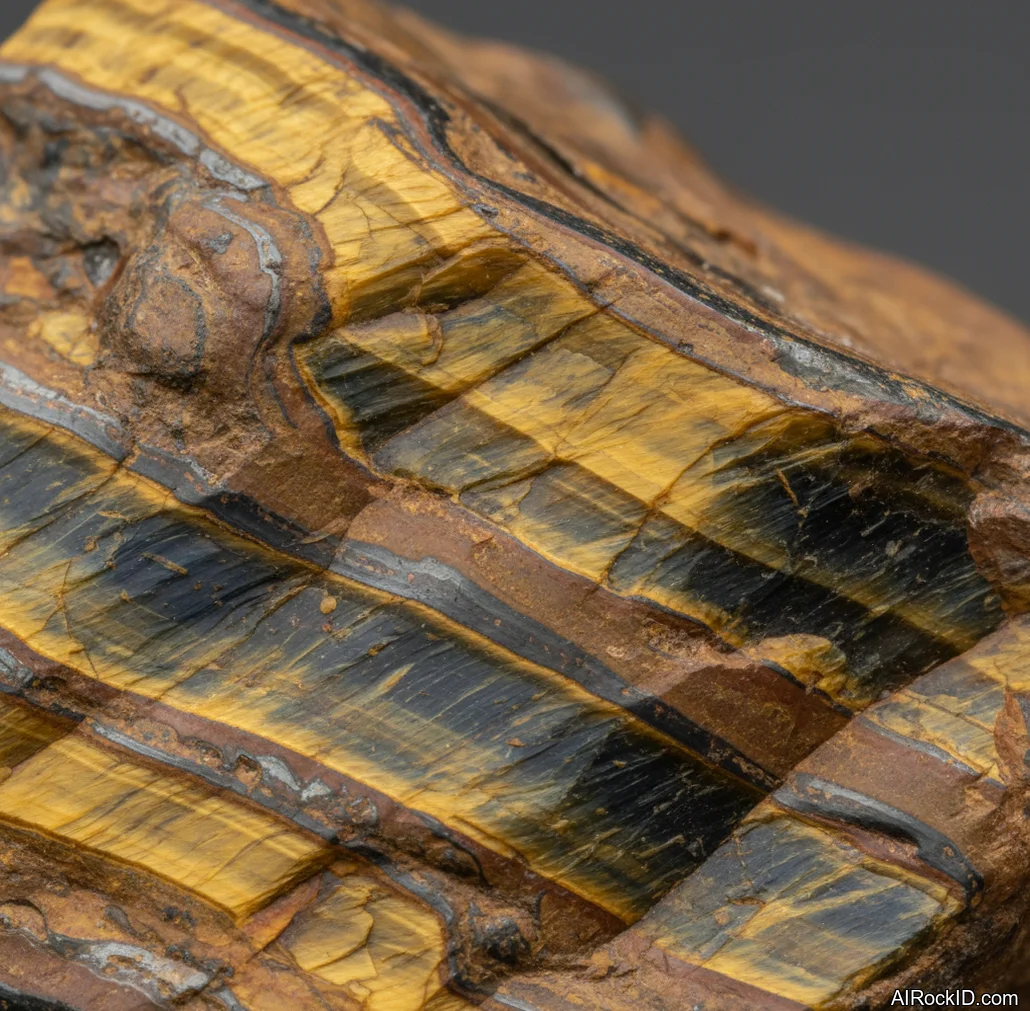
- Tiger's Eye: Tiger's eye usually has more continuous golden-brown bands, while pietersite has a broken brecciated pattern.
- Hawk's Eye: Hawk's eye is typically blue-gray with straighter silky bands, while pietersite often mixes blue, gold, brown, and red in fragmented patches.
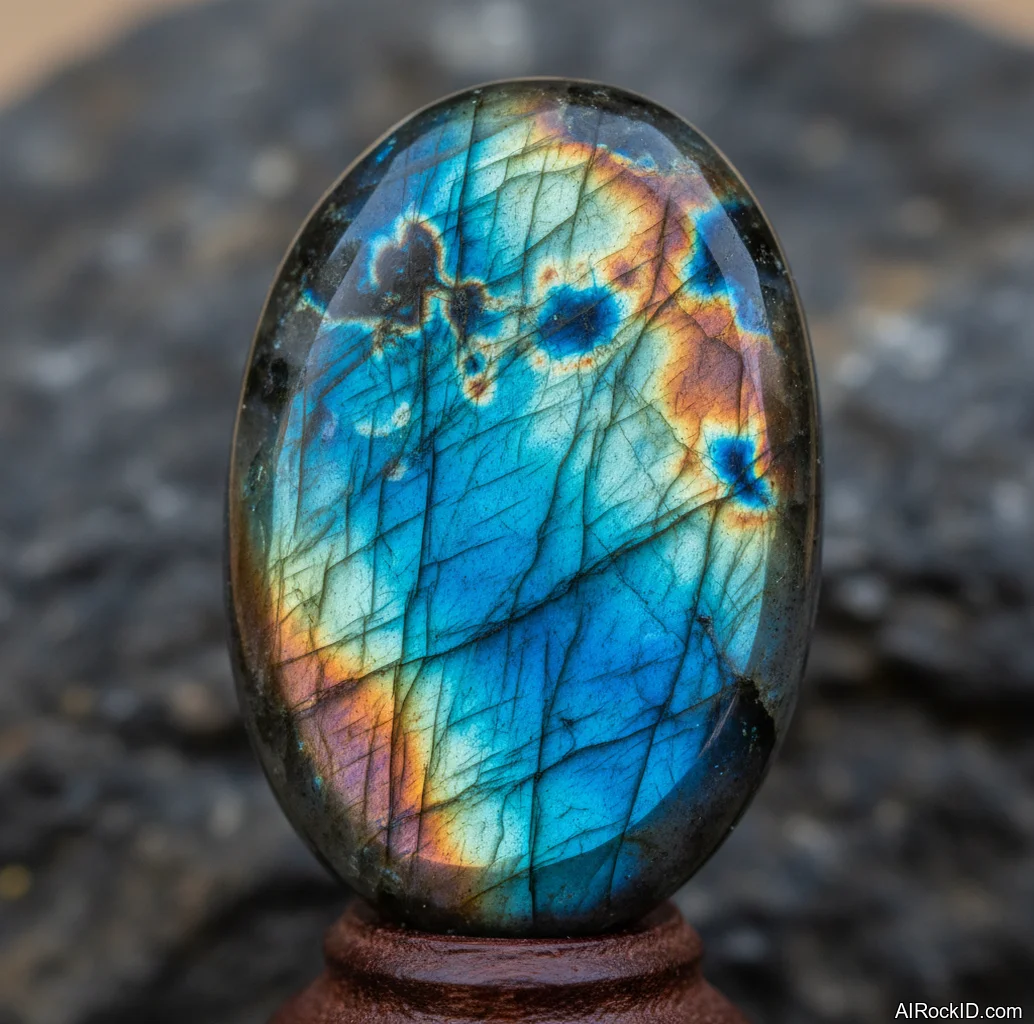
- Boulder Opal: Boulder opal can show spectral play-of-color, while pietersite shows chatoyant reflection rather than true opal fire.
- Sodalite: Sodalite is usually opaque blue with white veining and lacks the silky moving flash of pietersite.
Pietersite vs. Similar Stones
| Stone | Typical look | Key difference |
|---|---|---|
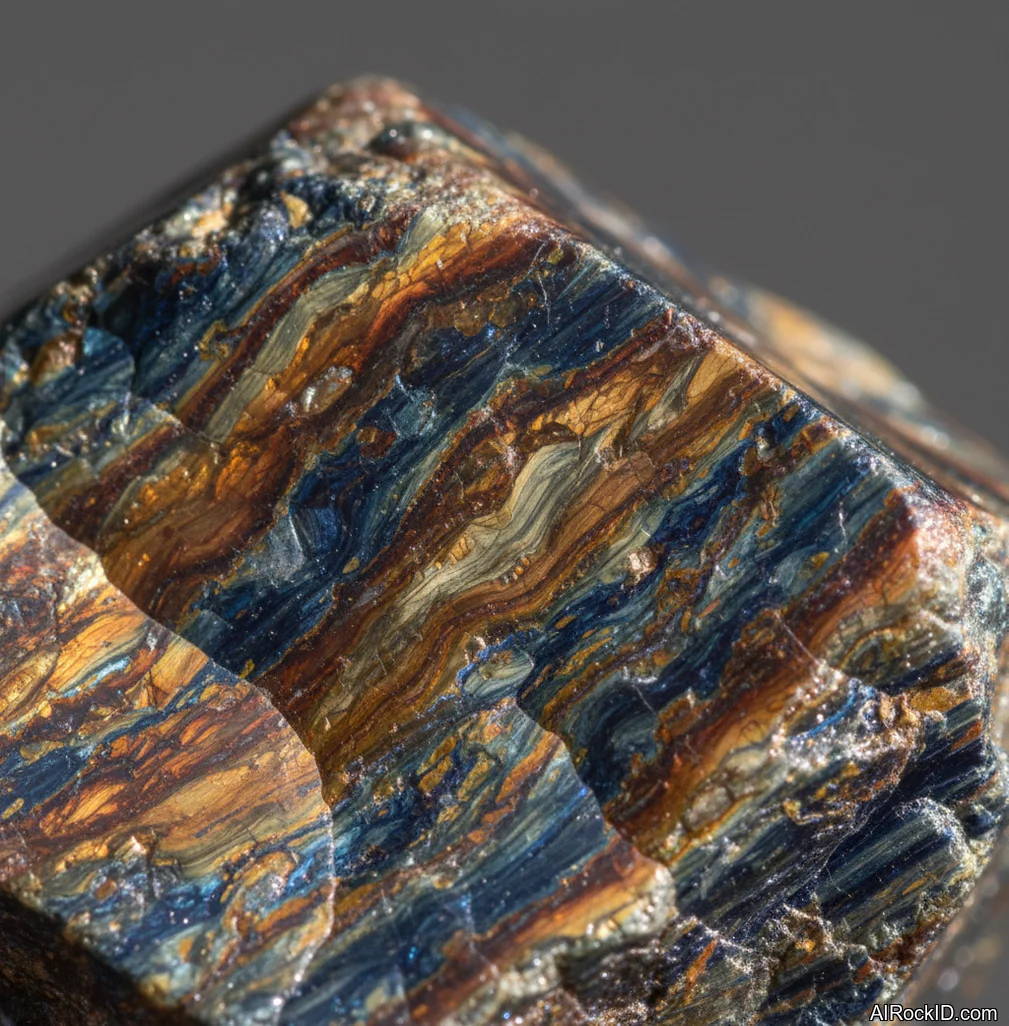
| Pietersite | Broken blue, gold, brown, or red chatoyant patches | Brecciated, stormy pattern with shifting silky flash |
| Tiger's Eye | Golden to brown parallel bands | More orderly banding and usually warmer color |
| Hawk's Eye | Blue-gray silky bands | Less brecciated and often more linear |
| Boulder Opal | Opal seams in ironstone matrix | May show play-of-color instead of chatoyancy |
| Lapis Lazuli | Deep blue with white calcite or pyrite specks | No moving fiber-like flash |
AI identification confidence
AI identification confidence for pietersite is usually higher when the photo clearly shows a polished surface, directional flash, and brecciated blue-gold pattern. Confidence drops when the stone is rough, poorly lit, dyed, or photographed without showing the chatoyant effect.
When AI gets it wrong
- A still photo may miss the moving flash that separates pietersite from non-chatoyant blue stones.
- Dyed quartz, dyed jasper, or resin composites can imitate the color contrast of pietersite.
- Close-up images without scale can make tiger's eye, hawk's eye, and pietersite look similar.
- Strong reflections from a glossy cabochon may be mistaken for natural chatoyancy.
Final recommendation
For buying pietersite, prioritize natural-looking chatoyancy, a clean polish, and a pattern you can verify under moving light. Ask for clear photos or video from multiple angles, especially when a seller claims rare color, high grade, or a specific origin.
How to Check Pietersite Authenticity
Real pietersite should show a fiber-like flash that shifts as the stone or light source moves. The pattern is usually irregular and brecciated rather than perfectly straight or printed-looking. Be cautious with pieces that have unusually bright uniform color, surface-only sheen, or seller photos that avoid angled lighting.
Pietersite Buying Checklist
Look for strong chatoyancy, balanced color contrast, a smooth cabochon polish, and minimal pits or open fractures. Blue-dominant material is often sought after, but pattern quality and flash can matter more than color name alone. For higher-priced pieces, request origin information, return options, and close-up images in natural and angled light.
Photo Tips for Identifying Pietersite
Photograph pietersite under a single directional light and tilt the stone through several angles to capture the moving sheen. Include one close-up, one image in normal room light, and one image beside a common object for scale. Avoid heavy filters because they can hide whether the color and chatoyancy are natural.
What Is Pietersite?
Pietersite is a brecciated, chatoyant kind of quartz. It’s made from silicified amphibole fibers (often crocidolite) that got snapped up, jumbled around, then glued back together by more silica. If you’ve ever seen tiger’s eye, pietersite is like that… except it didn’t feel like lining up. The shine shows up in swirls and blotches instead of tidy bands, and one cab can flip between blue, gold, rust, and sometimes a smoky gray.
Grab a palm stone and it looks “busy” right away, even before you move it. Then you tilt it. And the light skates over the dome in these little stormy flashes, because the fibers are pointing every which way. I’ve had pieces in my hand that seem kind of flat under soft room lighting, then you walk under a harsh spotlight at a show and, wow, they snap to life fast.
Most of what’s for sale is polished. Raw pietersite is out there, sure, but it’s usually not the sort of thing with clean crystal faces. It’s more like a tough, fibrous chunk that doesn’t really click until it’s been cut and domed.
Origin & History
Namibia is basically where pietersite first got on collectors’ radar. It was first described in 1962 by Dr. Sid Pieters, a Namibian geologist and mineral dealer, and the name stuck because he was the one who clocked it as its own mineral, not just some “weird tiger’s eye” lookalike.
But the trade really grabbed onto it later, once the Chinese material started coming in with real volume. You’ll still hear people in metaphysical shops call it “tempest stone,” sure. And at gem shows or out in the field, most sellers just say pietersite, then tag it as Namibia or China if they’re actually being straight with you.
Where Is Pietersite Found?
Most pietersite on the market comes from Namibia and China, with Namibia often showing stronger blue and China often leaning warmer and redder.
Formation
Pietersite shows up when fibrous amphiboles, usually crocidolite (same family situation as tiger’s eye), get swapped out for silica and then smashed up by brecciation. Instead of settling into neat, orderly layers, those fiber bundles crack, twist around, and get glued back together inside quartz. So the chatoyancy doesn’t run in one tidy line, it kind of swirls and breaks up in patches.
If you’ve got a polished cab in your hand and you hit it with a loupe, you can sometimes spot that “shattered then healed” look. You’ll notice it right away. The fibers don’t all point one way. It’s more like a bunch of small neighborhoods (little zones), each one catching the light from a different angle. And in the end, it’s still quartz doing quartz things, just with a rough, messy backstory.
How to Identify Pietersite
Color: Typical colors run blue to blue-gray, golden brown, reddish brown, and black, often mixed in one piece with abrupt transitions. Some pieces show a stormy, mottled look rather than straight bands.
Luster: Polished pietersite has a silky to vitreous sheen with strong chatoyant flash.
Pick up the stone and rock it under a single bright light. Real pietersite gives you moving bands and patches of light that shift fast with the angle, not a flat printed-looking shimmer. The real test is the fiber look: with a loupe you’ll see fine, hair-like structure and a brecciated pattern, not glittery flakes like aventurine or dyed crackle lines. And if the color is screaming neon-blue and totally uniform, I get suspicious, because natural blue tends to have gray and depth to it.
Common Look-Alikes
Pietersite is sometimes confused with these materials:
- Tiger's Eye
- Hawk's Eye
- Blue Tiger's Eye (dyed quartz)
- Dyed Agate
- Fiber-optic glass (cat's eye glass)
- Synthetic Pietersite
Market Cautions & Treatments
When AI Can Get This Wrong
AI image tools confuse pietersite with tiger's eye and hawk's eye because the chatoyancy can look similar, especially in polished cabs. Dyed agate and blue glass fakes also trip up photo ID, since they can mimic the swirls. The real test is holding it: only pietersite has that wild, torn-fiber look under a loupe and a heavy, cold feel in the palm.
Properties of Pietersite
Physical Properties
| Crystal System | Trigonal |
| Hardness (Mohs) | 6.5-7 (Hard (6-7.5)) |
| Density | 2.60-2.70 |
| Luster | Silky |
| Diaphaneity | Opaque |
| Fracture | Conchoidal |
| Streak | White |
| Magnetism | Non-magnetic |
| Colors | Blue, Blue-gray, Golden brown, Reddish brown, Black, Gray |
Chemical Properties
| Classification | Silicates |
| Formula | SiO2 |
| Elements | Si, O |
| Common Impurities | Fe |
Optical Properties
| Refractive Index | 1.544-1.553 |
| Birefringence | 0.009 |
| Pleochroism | None |
| Optical Character | Uniaxial |
Pietersite Health & Safety
Handling it and giving it a quick rinse are pretty low risk. But once you start doing lapidary work, that’s when things change, because you can kick up respirable silica dust, plus (depending on how it breaks down) dust that could be fiber-related from the original amphibole structure.
Safety Tips
If you have to cut it or sand it, do it wet and wear the right respirator. And when you’re done, wipe up the slurry while it’s still damp, don’t let it dry out and turn into dust you can breathe in.
Pietersite Value & Price
Price Range
Rough/Tumbled: $15 - $250 per piece
Cut/Polished: $3 - $25 per carat
Thing is, price usually follows the flash first. Then it’s the color mix. Then you look at how clean the polish is when you tilt it under a light. Big Namibia cabs with that electric blue pop and those tight, swirly chatoyancy bands that snap as you move them? They climb in price fast. But if it’s mostly dull brown and the flash just kind of sits there, it stays cheap.
Durability
Durable — Scratch resistance: Good, Toughness: Good
It’s basically quartz, so it holds up well in normal wear, but a high dome can still chip if you smack it on a counter.
How to Care for Pietersite
Use & Storage
Store it in a pouch or a divided box so it doesn’t rub softer stones. I’ve seen pietersite haze up the polish on fluorite just from riding in the same pocket.
Cleaning
1) Rinse with lukewarm water and a drop of mild soap. 2) Use a soft toothbrush to get skin oils out of the dome and around drill holes. 3) Rinse well and dry with a microfiber cloth.
Cleanse & Charge
If you do energy-style cleansing, smoke, sound, or a quick rinse work fine. I avoid salt soaks just because they’re messy and don’t really do anything for the stone itself.
Placement
Keep it out of harsh window sun if you’re displaying it, mostly to protect the polish and any glued jewelry settings. A shelf with angled light is the move, because pietersite looks best when the flash can travel.
Caution
Skip ultrasonic cleaners and anything too chemically aggressive, especially if the jewelry has glue holding parts in place or it’s a composite setting. And don’t dry-sand or dry-grind it either, because quartz dust is still quartz dust (nasty stuff). Treat it the same way you’d handle any quartz when dust comes into the picture.
Works Well With
Pietersite Meaning & Healing Properties
Most people grab pietersite when they want that “clear the mental clutter” feeling but don’t want to get drowsy. I keep a piece in my own box, and it’s the one I reach for when I’m packing for a show or tearing into a fresh flat of rough. It keeps me awake. Locked in. Not calm like blue lace agate, which feels softer. Pietersite is steadier, like it’s holding your shoulders level.
Look, you’ve got to watch how it flashes in your hand. The light doesn’t slide across it in one neat stripe. It kind of snaps, disappears, then pops back up somewhere else when you tilt it (especially under those harsh overhead booth lights that show every fingerprint). That’s the energy people read into it: change, stress, those ugly in-between stages where nothing feels tidy. But I’m going to say it straight, because it matters: none of this is medical. If you’re dealing with anxiety or sleep issues, crystals are a side tool at best. Not the plan.
Thing is, pietersite does have a practical “healing” side, in the collector sense. It makes you slow down and actually use your eyes. I’ve watched people at my table turn the same cabochon back and forth for a full minute, chasing one last ribbon of blue they swear they saw a second ago. That pause is real. And sometimes, honestly, that’s enough to reset your head for a moment, right?
Common mistakes
- Assuming every blue-gold chatoyant stone is pietersite instead of hawk's eye or tiger's eye.
- Judging authenticity from color alone without checking for moving chatoyancy.
- Overpaying for vague labels such as “rare storm stone” without photos, dimensions, or origin details.
- Confusing surface glare from polish with true internal fibrous flash.
- Using vinegar, bleach, or harsh ultrasonic cleaning on jewelry settings that may contain pietersite.
Identify Pietersite from a photo
Compare Pietersite traits, care tips, value clues, and common lookalikes with a clear photo.