Pyromorphite


Quick answer: Pyromorphite is a lead chlorophosphate mineral best known for bright green, yellow-green, orange, or brown barrel-shaped crystals. Because it contains lead, it is mainly a collector specimen rather than a handling stone for children, pets, or elixir use.
AI Rock ID can help compare a suspected pyromorphite specimen against visual features such as color, crystal habit, luster, and matrix association. RockIdentifier.io supports photo-based mineral identification, but suspected lead minerals should still be handled cautiously and verified by a qualified lab or mineral expert when accuracy matters.
Good fit
- Collectors who want colorful secondary lead minerals from oxidized ore zones
- Specimen displays where bright green or yellow crystal clusters are desired
- Students comparing apatite-group minerals and lead-bearing mineral habits
- Buyers comfortable with labeled, display-only mineral specimens
Not a good fit
- Crystal water, elixirs, or any use involving ingestion or prolonged skin contact
- Children’s collections without sealed display storage and adult supervision
- Jewelry that may be worn often or abraded
- Buyers who cannot safely store or label lead-bearing minerals
Most commonly confused with
- Mimetite: Mimetite is a lead chloroarsenate and can look very similar, but it contains arsenate instead of phosphate.
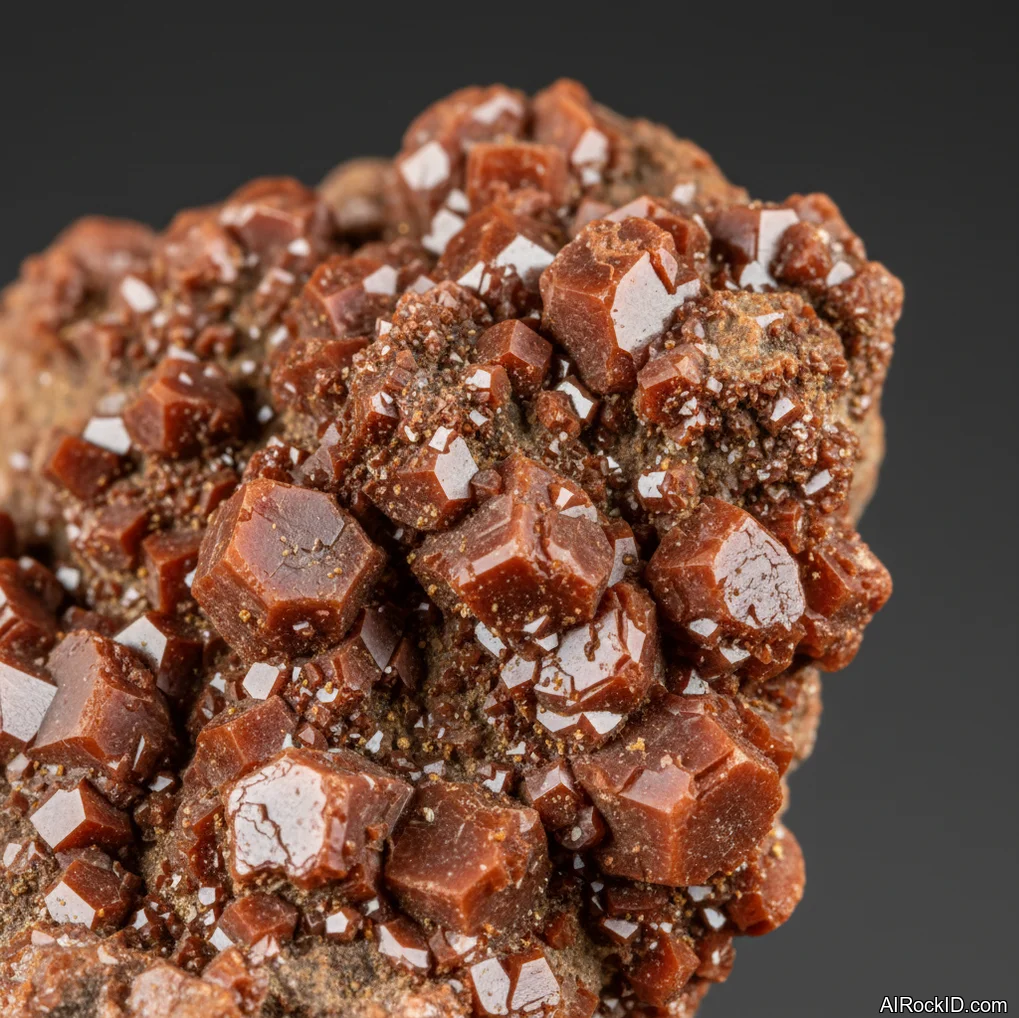
- Vanadinite: Vanadinite is typically red to orange-brown and forms hexagonal crystals, but it is a lead vanadate rather than a phosphate.
- Apatite: Apatite may share green color and hexagonal form, but it is much lighter in density and does not contain lead.
- Wulfenite: Wulfenite is also a lead mineral, but it commonly forms thin square to tabular crystals instead of barrel-shaped pyromorphite crystals.
Pyromorphite vs Similar Green or Lead Minerals
| Mineral | Typical clue | Key difference | Handling note |
|---|---|---|---|
| Pyromorphite | Green to yellow-green barrel or hexagonal crystals | Lead chlorophosphate; very high density | Display-only caution due to lead |
| Mimetite | Yellow, orange, brown, or green crystals | Lead chloroarsenate; may require testing to separate | Caution due to lead and arsenic |
| Vanadinite | Red, orange, or brown hexagonal crystals | Lead vanadate with stronger red-orange colors | Caution due to lead and vanadium |
| Apatite | Green, blue, yellow, or purple hexagonal crystals | Much lower density and no lead content | Lower toxicity concern than lead minerals |
| Wulfenite | Orange to yellow thin tabular crystals | Lead molybdate with square, plate-like habit | Display-only caution due to lead |
AI identification confidence
AI identification of pyromorphite is often moderate when the specimen shows bright green barrel-shaped crystals on matrix with good lighting and scale. Confidence drops when pyromorphite is massive, weathered, unusually colored, or visually close to mimetite or vanadinite.
When AI gets it wrong
- Green apatite or dyed quartz may be mistaken for pyromorphite if density and hardness are not checked.
- Mimetite and pyromorphite can overlap in color and crystal habit, making chemistry-based confirmation necessary for certainty.
- Orange or brown pyromorphite may be confused with vanadinite or wulfenite in photos.
- Poor lighting can make yellow-green pyromorphite appear like common green secondary minerals.
Final recommendation
Choose pyromorphite as a labeled collector mineral when its origin, identity, and safe handling requirements are clear. For jewelry, children’s collections, or frequent handling, a non-lead lookalike such as apatite or quartz is usually a more practical choice.
How to Check Pyromorphite Authenticity
Authentic pyromorphite is unusually heavy for its size because of its lead content and often forms short hexagonal or barrel-shaped crystals with a resinous to adamantine luster. A reliable label should include the mineral name and ideally the locality, since famous sources such as China, Germany, France, the United Kingdom, and the United States can produce distinctive habits. Avoid destructive home tests on collectible specimens, and use professional analysis such as XRF, Raman spectroscopy, or expert examination when pyromorphite must be separated from mimetite.
Buying Pyromorphite Specimens
When buying pyromorphite, check for intact crystal tips, strong but natural-looking color, stable matrix, and clear seller disclosure that it is a lead-bearing mineral. Very bright green clusters can be valuable, but price depends heavily on crystal quality, size, locality, aesthetics, and damage. Be cautious with unlabeled green mineral clusters sold only as decorative crystals, especially if no safety information or locality is provided.
Pyromorphite Locality Clues
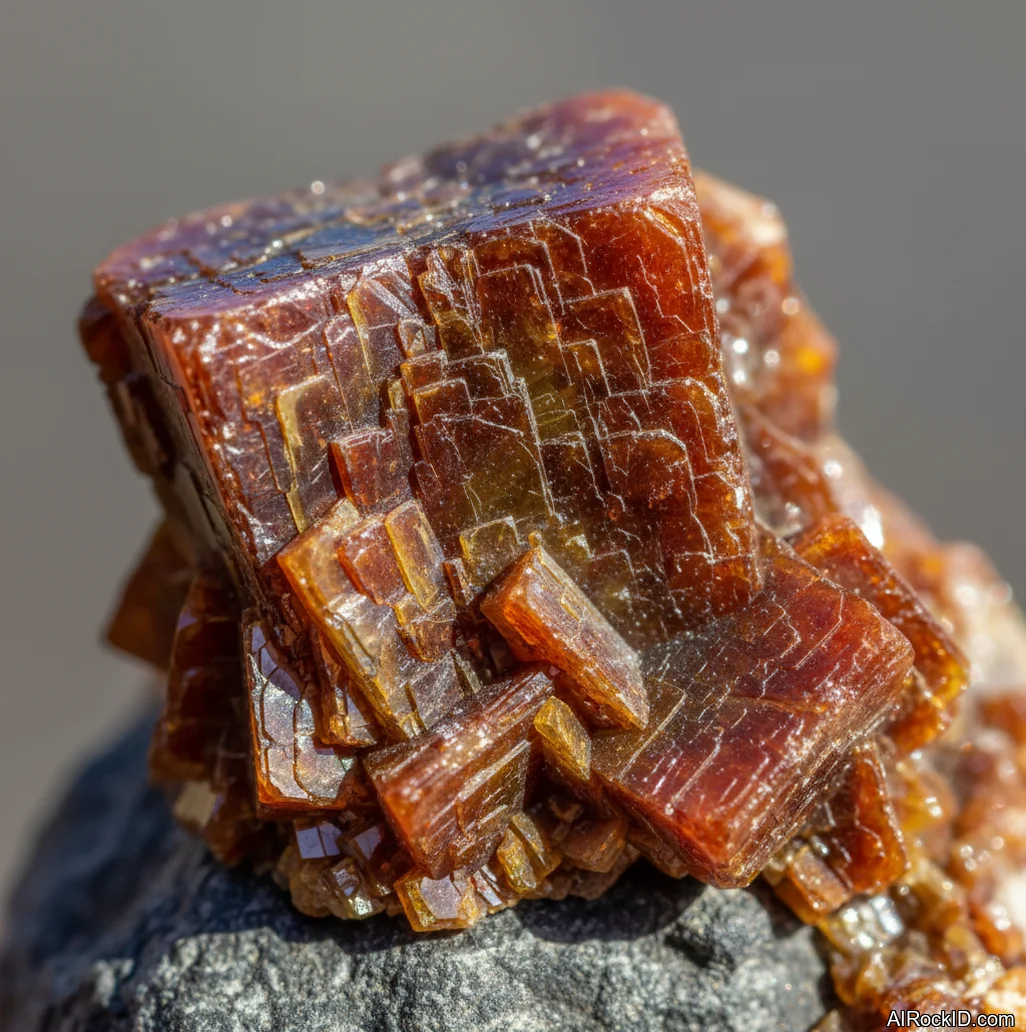
Locality can influence pyromorphite appearance, with some specimens showing vivid apple-green crystals, others yellow-green, brown, orange, or hopper-like growth. Chinese pyromorphite is often seen in bright green clusters, while classic European and American localities may show varied habits and colors. Locality alone does not prove identity, but it helps evaluate whether the specimen’s habit and color are plausible.
What Is Pyromorphite?
Pyromorphite is a lead chlorophosphate mineral with the formula Pb5(PO4)3Cl, and it forms down in the oxidation zone of lead ore deposits.
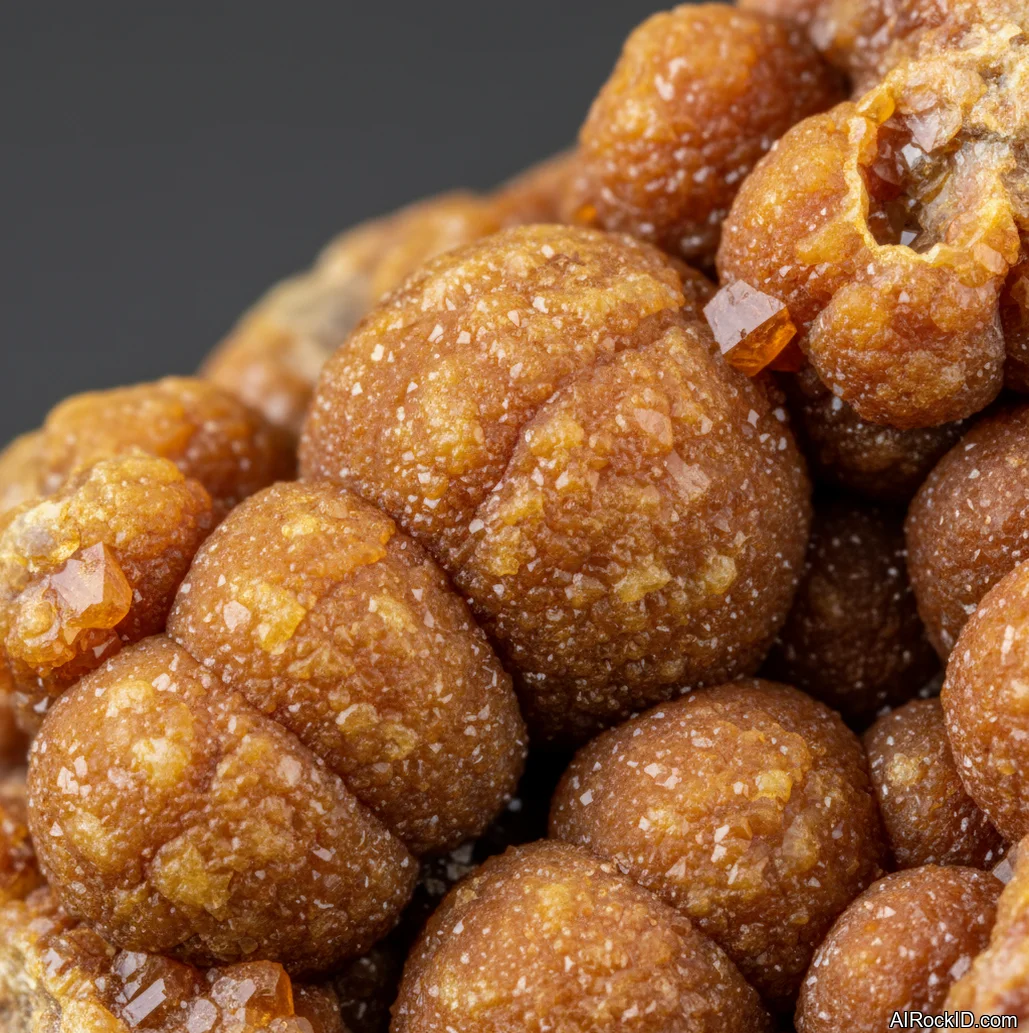
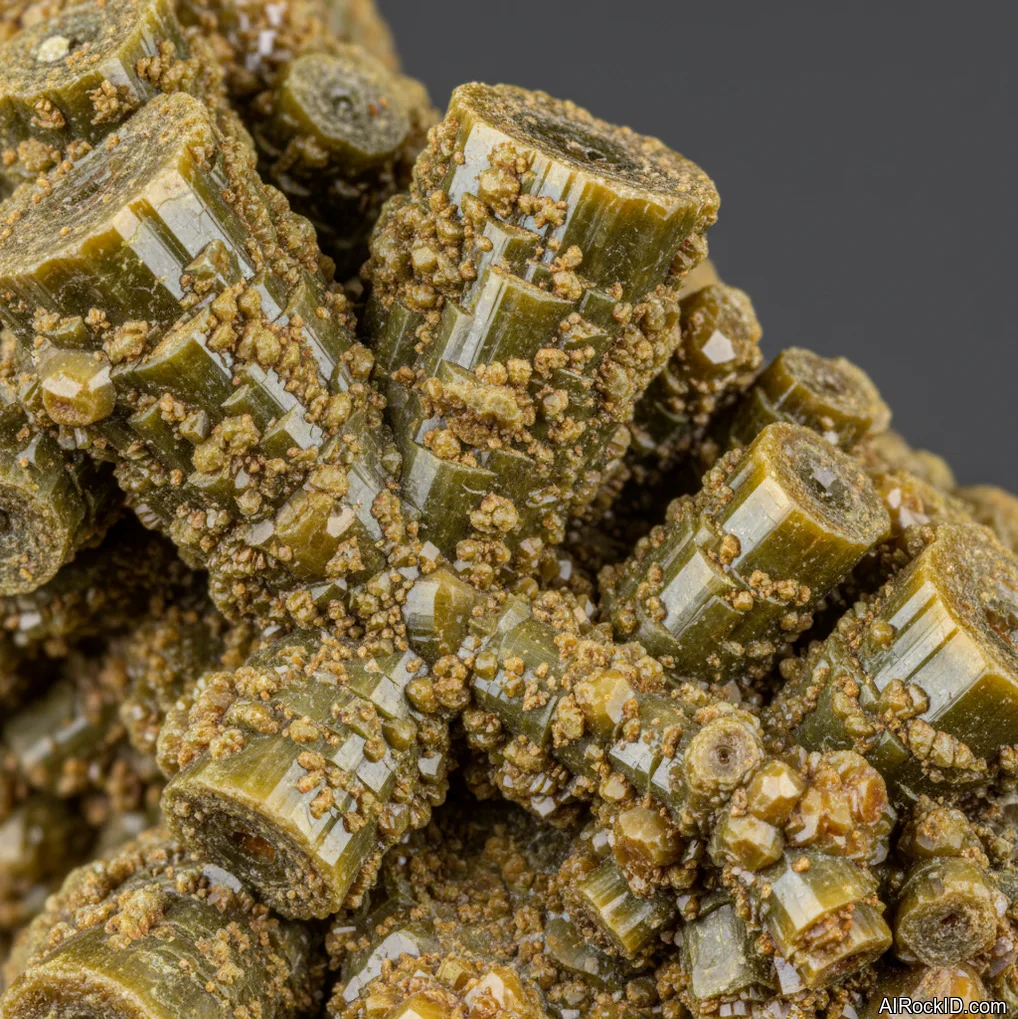
Grab a decent cabinet piece and the first thing that hits you is the weight. It’s got that dead, heavy feel in your hand that quartz just doesn’t have, and yeah, that heft is one of the fastest giveaways that you’re dealing with a lead mineral. But the color is what pulls you in. Most folks run into pyromorphite as that loud leaf green, but I’ve also handled honey-yellow, brown, and this odd olive shade that looks kind of dusty until you sweep a flashlight across it.
And if you get your nose right up to the crystals, you’ll see why people chase it. The usual crystal habit is those little barrel shapes and hexagonal prisms, sometimes stubby like pencil erasers, other times longer and stacked like tiny columns. On matrix it can look glassy and clean. But it can also have this slightly “greasy” look when the faces are micro-pitted (you can feel it a bit if you drag a fingernail across a rough spot). That doesn’t mean it’s fake. It just means it grew in rough conditions and got etched later.
Origin & History
1784 is the date that matters. That’s when the German mineralogist Abraham Gottlob Werner put pyromorphite on the record, right in the middle of that messy stretch when lead minerals were being sorted, re-sorted, and renamed as chemistry finally got more precise.
The word itself is built from Greek for “fire” and “form.” Why? Because early workers noticed the stuff could crystallize after you heated it up and then let it cool, like it was literally getting its shape after firing. And look, if you’ve handled old mineral labels, you’ve probably seen pyromorphite tossed in with “green lead ore,” or written as “mimetite/pyromorphite” back before anyone had quick tests or decent reference books to lean on.
Where Is Pyromorphite Found?
It turns up wherever lead deposits weather near the surface, especially in old mining districts with plenty of oxygen and groundwater moving through fractures.
Formation
Most pyromorphite shows up late in the story, not way down deep. It’s usually sitting in the oxidation zone above primary lead sulfides like galena, where acidic water and oxygen basically gnaw through the old ore and then re-precipitate new minerals in little pockets and fractures.
And phosphate is the other piece people tend to blank on. It can come from nearby apatite, phosphate-rich rocks, guano (yeah, really), or groundwater that’s hauling dissolved phosphate along. When that phosphate runs into lead under the right chemistry window, pyromorphite drops out, often right there with cerussite, anglesite, and limonite. I’ve split open iron-stained gossan chunks at shows, the kind that leave a rusty smear on your fingers, and found that green lining inside like somebody took a brush and painted the cavity. But it’s not always that neat. Sometimes it’s just a thin crust of tiny barrel shapes that looks almost sugary until you put it under a loupe.
How to Identify Pyromorphite
Color: Most specimens are bright to yellowish green, but pyromorphite can also be brown, orange, yellow, or even gray-green depending on impurities and mix with related species.
Luster: Luster is usually vitreous, with a slicker look on tightly packed microcrystals.
Pick up the piece and judge the heft. Pyromorphite feels surprisingly heavy for its size, and that’s a big clue compared to green calcite or green quartz lookalikes. Look for hexagonal barrel or prism crystals under a loupe, often with flat terminations and faint growth zoning. The real test is hardness: it’s around Mohs 3.5 to 4, so a steel needle can scratch it, but it won’t crumble like chalky malachite.
Common Look-Alikes
Pyromorphite is sometimes confused with these materials:
- Mimetite
- Vanadinite
- Apatite (especially green or yellow-green)
- Adamite
- Dyed quartz (especially when cut en cabochon)
- Green lead glass
Market Cautions & Treatments
When AI Can Get This Wrong
AI photo tools often mix up pyromorphite with mimetite and vanadinite, since all three make those short hexagonal barrel crystals. The color overlap adds to the problem, especially in green and yellow tones. Weight is the fastest check—real pyromorphite feels unexpectedly heavy. If in doubt, the simple streak test (white for pyromorphite) helps separate it from mimetite and vanadinite.
Properties of Pyromorphite
Physical Properties
| Crystal System | Hexagonal |
| Hardness (Mohs) | 3.5-4 (Soft (2-4)) |
| Density | 6.5-7.1 g/cm3 |
| Luster | Vitreous |
| Diaphaneity | Transparent to translucent |
| Fracture | Uneven |
| Streak | white |
| Magnetism | Non-magnetic |
| Colors | green, yellow-green, yellow, brown, orange, gray-green |
Chemical Properties
| Classification | Phosphates |
| Formula | Pb5(PO4)3Cl |
| Elements | Pb, P, O, Cl |
| Common Impurities | As, V, Ca, Fe |
Optical Properties
| Refractive Index | 2.050-2.070 |
| Birefringence | 0.020 |
| Pleochroism | Weak |
| Optical Character | Uniaxial |
Pyromorphite Health & Safety
Thing is, it’s a lead mineral, so handle it the same way you’d handle lead fishing weights you’ve actually had in your tackle box, the kind that leave that dull gray rub-off on your fingers. Don’t grind it. Don’t lick it (why would you?). And don’t let kids mess with it unless you’re right there watching.
Safety Tips
Wash your hands after you touch it. Don’t do anything that kicks up dust. And stash it somewhere it won’t rub off and sprinkle gritty crumbs onto whatever else is in the bin or on the shelf. If you absolutely have to cut or shape a piece, keep it wet while you work and wear a proper respirator rated for particulates (not just a flimsy mask). Why risk breathing that stuff?
Pyromorphite Value & Price
Price Range
Rough/Tumbled: $20 - $600 per specimen
Cut/Polished: $30 - $200 per carat
Prices jump fast once the crystals get bigger, the terminations are sharp, and the color stays clean while they’re still sitting on matrix. And damage is a huge deal because these crystals are soft. One little chip on the barrel and, boom, it gets knocked down into “study specimen” pricing.
Durability
Fragile — Scratch resistance: Poor, Toughness: Fair
It’s fairly stable on a shelf, but it scratches easily and the crystal edges bruise if it rattles around in a box.
How to Care for Pyromorphite
Use & Storage
Store it in a perky box or a padded flat, not loose in a bowl. I keep my better pieces in individual specimen boxes because the crystals bruise if they tap each other.
Cleaning
1) Skip soaking and just start with a soft, dry brush to lift dust. 2) If it needs more, use a barely damp cotton swab with a drop of mild soap and dab only the matrix, not the crystal faces. 3) Rinse the swab, wipe again with clean water, then pat dry and let it air out completely.
Cleanse & Charge
For a metaphysical-style cleanse, use smoke, sound, or a quick pass under cool running water without soaking, then dry right away. Don’t use salt water.
Placement
Give it a stable shelf spot where it won’t get bumped, and keep it out of direct sun if the color looks a little delicate. A small acrylic stand works well because you can tilt it to catch the luster without touching the crystals.
Caution
Lead mineral. Don’t use it in elixirs. Don’t put it in aquariums. And seriously, skip any cleaning method that makes dust or a wet slurry, because that stuff gets everywhere (on your hands, in the air, on the table) before you even notice.
Works Well With
Pyromorphite Meaning & Healing Properties
Compared to a lot of those “feel-good” stones, pyromorphite feels grounded and kind of heavy in your palm, and people either love that or go, nope, too much. When I’m holding a chunky cluster, the whole vibe shifts and my focus tightens up fast. It’s less floaty than fluorite. And it’s less buzzy than moldavite. Just steady.
If you’re using crystals as a personal focus tool, pyromorphite is one people reach for when they’re thinking about getting organized, actually following through, or clearing out mental clutter. Thing is, it’s still a lead mineral. So I keep it simple and practical: handle it for a bit, wash your hands, and don’t make it the one you’re absentmindedly rubbing all day while you’re on calls.
And here’s the straight collector note. Some sellers will say it’s “safe in water” because pyromorphite is relatively insoluble compared to other lead minerals. But water plus time plus whatever else is in that water is still a gamble, and you really don’t need to take that gamble for a meditation routine. Use it like a desk mineral, not a bath mineral. Metaphysical use is personal belief and personal experience, not medical care.
Common mistakes
- Assuming every bright green crystal cluster is pyromorphite without checking density, habit, or source.
- Handling loose or damaged pyromorphite frequently without washing hands afterward.
- Using pyromorphite in crystal-infused water or any practice that may cause ingestion of lead-bearing material.
- Confusing pyromorphite with mimetite when no chemical or expert verification has been done.
- Buying unlabeled specimens without asking for locality, mineral name, and safety information.
- Cleaning pyromorphite with harsh chemicals, abrasives, or ultrasonic cleaners that may damage crystals.
Identify Pyromorphite from a photo
Compare Pyromorphite traits, care tips, value clues, and common lookalikes with a clear photo.