Wulfenite


Quick answer: Wulfenite is a colorful lead molybdate mineral often recognized by thin tabular crystals in orange, red-orange, yellow, or brown tones. It is best suited for display and collecting rather than jewelry or handling because it is soft, brittle, and contains lead.
AI Rock ID can help compare a suspected wulfenite specimen with visually similar minerals by analyzing color, crystal habit, luster, and matrix clues. RockIdentifier.io provides mineral information that can support photo-based identification, but laboratory testing or expert review may be needed for valuable specimens.
Good fit
- Collectors who want a distinctive display specimen with bright tabular crystals
- Mineral enthusiasts interested in lead molybdate and oxidized lead deposits
- People comparing orange crystal specimens found on limestone, dolomite, or gossan matrix
- Collectors who can store fragile minerals safely in a case
Not a good fit
- Jewelry use, daily carrying, or frequent handling
- Households where small children or pets may touch or mouth specimens
- Cleaning methods involving acids, soaking, ultrasonic cleaners, or abrasion
- Buyers seeking a durable beginner mineral for rough handling
Most commonly confused with
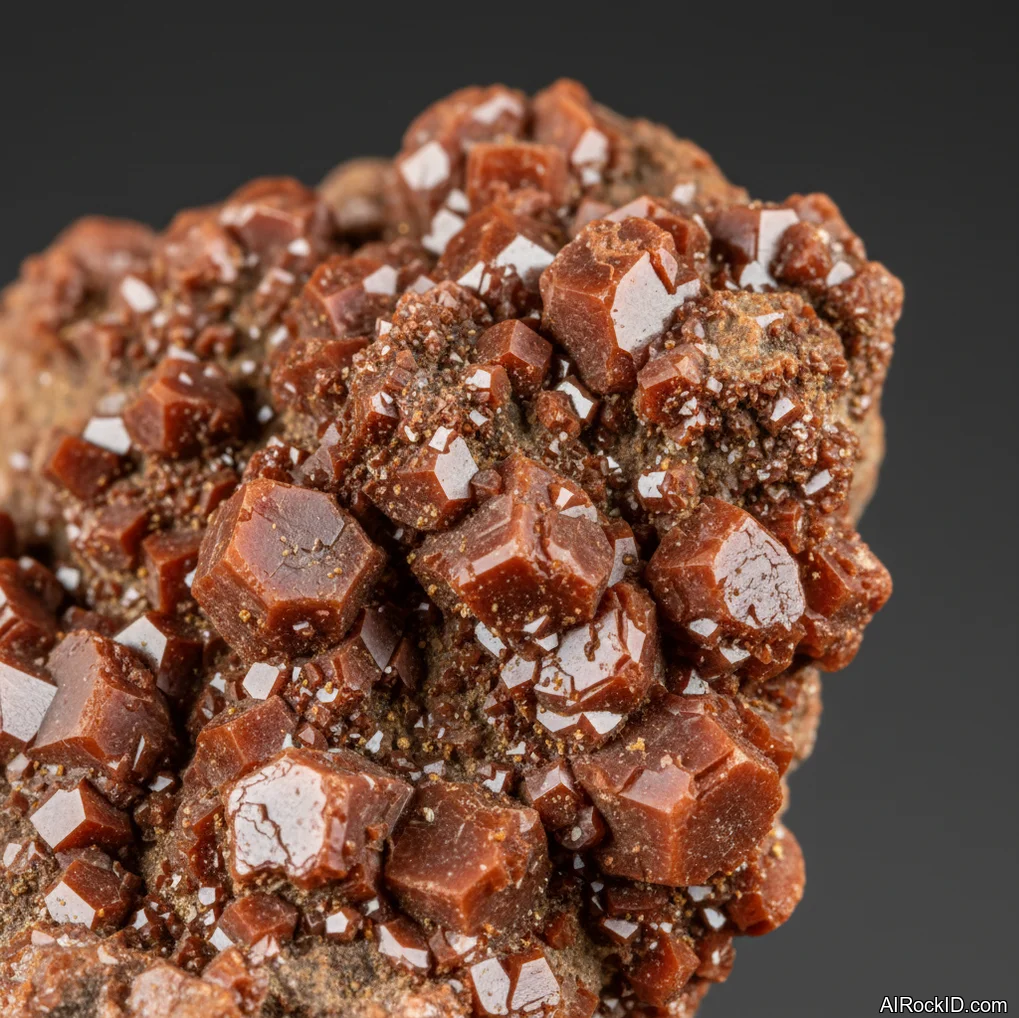
- Vanadinite: Vanadinite usually forms hexagonal barrel-shaped crystals, while wulfenite more often forms square to thin tabular crystals.
- Crocoite: Crocoite commonly forms elongated red-orange prismatic crystals and is lead chromate, not lead molybdate.
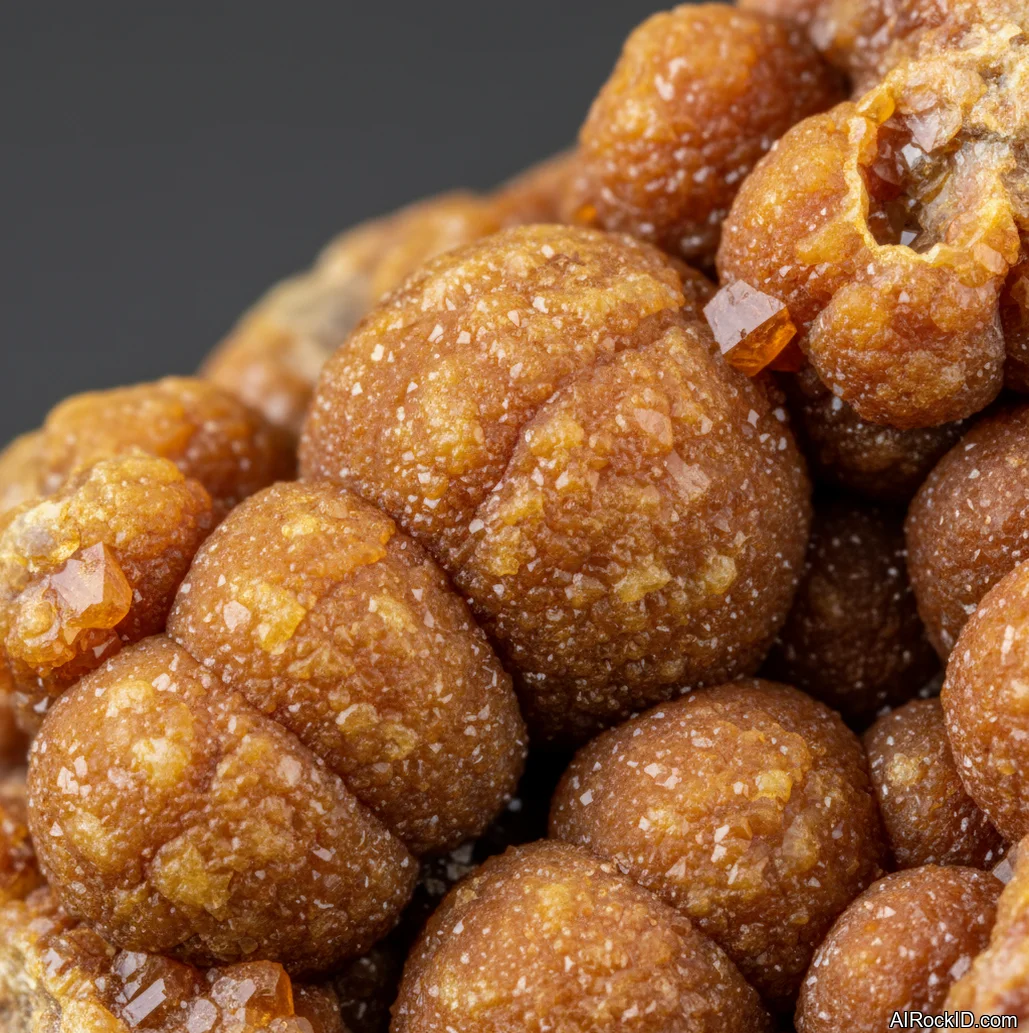
- Mimetite: Mimetite is commonly yellow to orange with hexagonal or botryoidal habits, unlike wulfenite’s typical square tabular habit.
- Calcite: Orange calcite is softer-looking, has different cleavage, and reacts with dilute acid, while wulfenite does not show calcite’s acid reaction.
Wulfenite vs. Similar Orange Minerals
| Mineral | Typical Habit | Key Difference | Common Color |
|---|---|---|---|
| Wulfenite | Thin square or tabular crystals | Lead molybdate; very fragile plates | Orange, red-orange, yellow |
| Vanadinite | Hexagonal barrels or prisms | Lead vanadate; usually blockier crystals | Red, orange-red, brown |
| Crocoite | Long slender prisms | Lead chromate; more needlelike to prismatic | Red-orange to scarlet |
| Mimetite | Hexagonal prisms or rounded masses | Lead arsenate chloride; often more rounded or botryoidal | Yellow, orange, brown |
| Orange Calcite | Cleavable masses or rhombs | Calcium carbonate; reacts with dilute acid | Orange, honey, cream |
AI identification confidence
AI identification confidence for wulfenite is often moderate to high when photos show flat, square tabular crystals on matrix with good lighting and scale. Confidence drops when the specimen is massive, damaged, coated, unusually colored, or photographed without close-up crystal detail.
When AI gets it wrong
- Hexagonal vanadinite crystals can be mistaken for square wulfenite plates in angled photos.
- Orange calcite on matrix may appear similar when crystal faces are unclear.
- Crocoite or mimetite may be confused with wulfenite if only color is visible.
- Dyed or coated specimens can reduce photo-based identification accuracy.
Final recommendation
Choose wulfenite as a display mineral if the specimen has clear crystal form, stable matrix, and accurate locality information. Avoid loose, crumbly, heavily repaired, or suspiciously coated pieces unless the seller provides clear disclosure.
How to Check Wulfenite Authenticity
Authentic wulfenite is most often recognized by its thin tabular crystal habit, high luster, orange to red-orange color range, and association with oxidized lead deposits. Ask for multiple photos, specimen dimensions, locality, and disclosure of repairs or coatings before buying. A very bright specimen with no matrix context, unclear crystal shape, or unusually uniform surface color should be examined carefully.
Buying Wulfenite Specimens
Condition is important because wulfenite crystals chip and detach easily. Well-formed crystals, strong color, good transparency, aesthetic placement on matrix, and documented classic localities can increase collector interest. Packaging should immobilize the specimen without pressure on crystal faces or edges.
Notable Wulfenite Localities
Important wulfenite specimens are known from Arizona, Mexico, Slovenia, Morocco, and several other oxidized lead-mining districts. Locality can influence crystal habit, color, matrix, and collector value. Labels from established dealers or older collections are useful because they help preserve provenance.
What Is Wulfenite?
Wulfenite is a lead molybdate mineral with the formula PbMoO4, and you usually find it as thin, tabular crystals in the oxidation zones of lead deposits.
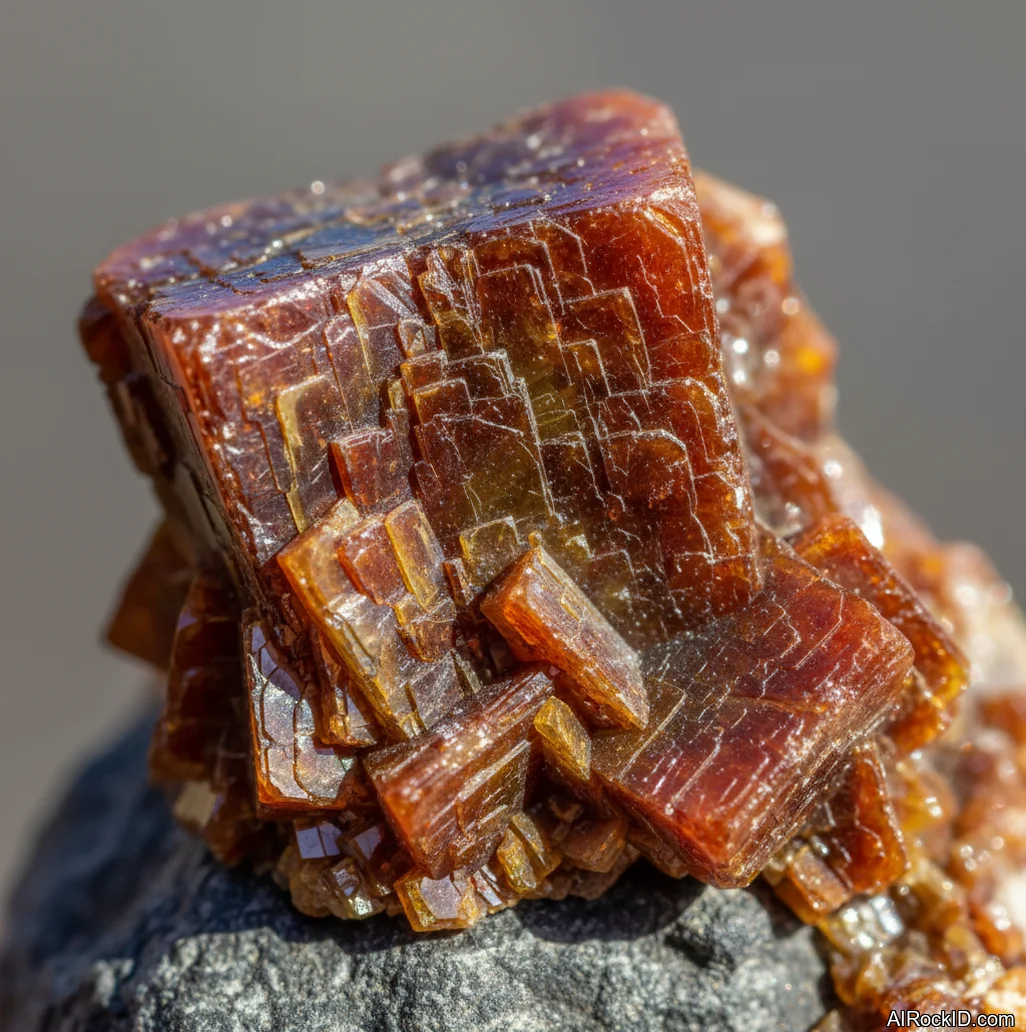
Thing is, when you’ve got a decent cabinet specimen in your hands, the first thing you notice is the plates. Little square windowpanes, stacked and slightly cockeyed. And if you tilt it under a lamp, the faces snap back a hard flash, almost like tiny mirrors.
The color can be traffic-cone orange, honey yellow, or that deep red-brown that looks almost smoked around the edges, and it’s not subtle. I’ve picked up pieces that look pretty tame in photos, then you see them in person and that glassy sheen hits and you get it. Why people chase them.
But don’t treat it like a “throw it in your pocket” mineral. Those thin plates chip stupid-easy, and a lot of specimens have little edge nicks you only catch when you roll the piece and the light skims across the corners (annoying, but common). So if you’re buying online, ask for side views. A straight-on shot can hide busted corners way too well, can’t it?
Origin & History
Austria is where the name comes from. Wulfenite got its formal description in 1841, and it was named after Franz Xaver von Wulfen, an Austrian Jesuit and naturalist who was writing up mineral descriptions back in the late 1700s.
Thing is, older books will sometimes shove it in with other lead ores, because people cared about the lead value first and the crystal species second. But once chemical work got more precise, PbMoO4 was recognized as its own thing, and wulfenite turned into the classic “oxidation zone trophy” mineral, especially after those famous Arizona finds made waves with collectors.
Where Is Wulfenite Found?
Wulfenite turns up in oxidized lead deposits worldwide, but the showy plate crystals collectors want are strongly tied to a handful of mines in the USA, Mexico, and Morocco.
Formation
Most of the time, wulfenite is a weathering product, not something that grows deep underground where it’s hot. Think about a lead deposit that’s been cracked open to oxygen-rich groundwater. Primary sulfides like galena start to fall apart, lead gets moved around, and if there’s molybdenum in those fluids, PbMoO4 can drop out as wulfenite.
Look, if you stare at a mixed specimen long enough, it basically tells that oxidation-zone story on its own. You’ll see wulfenite plates hanging out with cerussite, mimetite, vanadinite, plus iron oxides, sometimes sitting on crumbly limonite that’ll stain your fingertips if you rub it (and yeah, it leaves that rusty smear). I’ve had pieces where the wulfenite looked pristine, but the matrix underneath was soft and dusty. Kind of a giveaway, right? That’s exactly what you’d expect from a near-surface, altered setting.
How to Identify Wulfenite
Color: Most collector wulfenite runs yellow to orange to red-orange, sometimes brownish red. Color can shift a lot under different bulbs, so check it in daylight if you can.
Luster: Luster is typically vitreous to resinous, with bright reflective faces on clean crystals.
Pick up a specimen and tilt it slowly: the flat tabular faces should give sharp, clean flashes instead of a waxy glow. If you scratch it with a copper penny, it’ll mark easily because it’s only about Mohs 2.5 to 3, but don’t do that on a display crystal unless you want a permanent scar. The real test is crystal habit: those thin square or rectangular plates are a dead giveaway, even when the color is more yellow than orange.
Common Look-Alikes
Wulfenite is sometimes confused with these materials:
- Orange calcite
- Vanadinite
- Mimetite
- Dyed glass (window glass or bottle glass cut into plates)
- Scheelite
- Cerussite (especially coated or altered specimens)
Market Cautions & Treatments
When AI Can Get This Wrong
AI image tools mix up wulfenite with vanadinite all the time, especially if it's a cluster. Flat windowpane crystals get flagged as orange calcite or even painted glass. The real test is the luster—wulfenite flashes like a mirror and has a stubborn weight. Scratch with a copper coin: wulfenite gives in, but glass won't.
Properties of Wulfenite
Physical Properties
| Crystal System | Tetragonal |
| Hardness (Mohs) | 2.5-3 (Soft (2-4)) |
| Density | 6.5-7.0 g/cm3 |
| Luster | Resinous |
| Diaphaneity | Transparent to translucent |
| Fracture | Uneven |
| Streak | white to pale yellow |
| Magnetism | Non-magnetic |
| Colors | yellow, orange, red-orange, brownish red, honey |
Chemical Properties
| Classification | Molybdates |
| Formula | PbMoO4 |
| Elements | Pb, Mo, O |
| Common Impurities | Ca, W, V, Cr, Fe |
Optical Properties
| Refractive Index | 2.17-2.30 |
| Birefringence | 0.07 |
| Pleochroism | Weak |
| Optical Character | Uniaxial |
Wulfenite Health & Safety
It’s okay to handle it as long as you’re careful, but try not to kick up any dust, and wash your hands when you’re done touching the specimens (seriously, just do it). And don’t soak it in water, and don’t use it for elixirs since it contains lead.
Safety Tips
Don’t grind, cut, or sand it unless you’ve got proper PPE on and real ventilation going, not just a cracked window. And if the matrix is crumbly or the crystals feel even a little loose when you tap it, keep it in a closed display case so you’re not finding grit on the shelf later.
Wulfenite Value & Price
Price Range
Rough/Tumbled: $40 - $2,500 per specimen
Cut/Polished: $25 - $200 per carat
Prices shoot up fast when the corners are still crisp, the orange-red is really saturated, and the plates are big with no chips along the edges (especially those tiny little nicks you only see when you tilt it under a light). And yeah, locality matters. Clean, classic Arizona or Sonora pieces usually go for more than the more common smaller plates.
Durability
Fragile — Scratch resistance: Poor, Toughness: Poor
Wulfenite is soft and brittle, and thin crystals can chip from minor knocks or vibration in transit.
How to Care for Wulfenite
Use & Storage
Store wulfenite in a perky box or a lined drawer so the plates can’t rattle against anything. If it’s on a soft limonite matrix, keep it somewhere it won’t get bumped or shaken.
Cleaning
1) Skip water and chemicals. 2) Use a soft artist brush or a hand blower to remove dust without touching crystal faces. 3) If you must, dab the matrix only with a barely damp cotton swab and keep it away from the crystals.
Cleanse & Charge
For metaphysical folks, stick to dry methods like sound, smoke, or leaving it near (not on) a selenite slab. Avoid salt and water cleanses.
Placement
A stable shelf with low traffic is best, ideally inside a case so it doesn’t get knocked by a sleeve or a curious finger. Keep it out of direct sun if you’re worried about the matrix drying and shedding grit.
Caution
Lead mineral: keep it away from drinking water, no elixirs, and wash your hands after you handle it (especially before you eat or touch your face). And yeah, even the dust you can’t see counts. Fragile crystals: don’t toss it in a pocket or let it rattle around loose in a bag. It’ll chip. So skip ultrasonic cleaners and steam cleaning too.
Works Well With
Wulfenite Meaning & Healing Properties
In crystal shop circles, wulfenite gets pitched as a “spark” stone, the one you park on your desk when you’re stalled out and need a little push. I get it. That color hits like sunrise, and when a lamp catches those thin plates, it’s hard not to snap a bit more alert.
Thing is, the first time you actually pick one up, there’s this surprise: it’s heavier than it looks. The lead content gives it a dense, no-joke weight in your palm, even when the crystal plates are skinny and delicate. And for some people, that literal heft lines up with ideas like follow-through and practicality. But it’s also fragile. So I end up thinking of it as a reminder to move carefully, not muscle through.
This isn’t medical advice, and I don’t treat it like that. If you’re using it in a personal practice, keep it dry, keep it clean, and let it sit there as a visual anchor instead of something you’re constantly fiddling with (tempting, I know). Because wulfenite’s kind of unforgiving: the more you fuss with it, the more likely you’ll nick an edge or chip a corner, and once those corners are gone… what are you going to do, glue the sparkle back on? You can’t un-chip them.
Common mistakes
- Identifying any bright orange crystal as wulfenite without checking crystal habit
- Handling loose crystals frequently despite wulfenite’s softness and brittleness
- Using water, acid, or ultrasonic cleaning on delicate specimens
- Ignoring lead-content precautions when storing or handling broken material
- Buying high-priced specimens without locality, repair, or treatment disclosure
- Assuming all tabular orange specimens are natural and untreated
Identify Wulfenite from a photo
Compare Wulfenite traits, care tips, value clues, and common lookalikes with a clear photo.