Rainforest Rhyolite


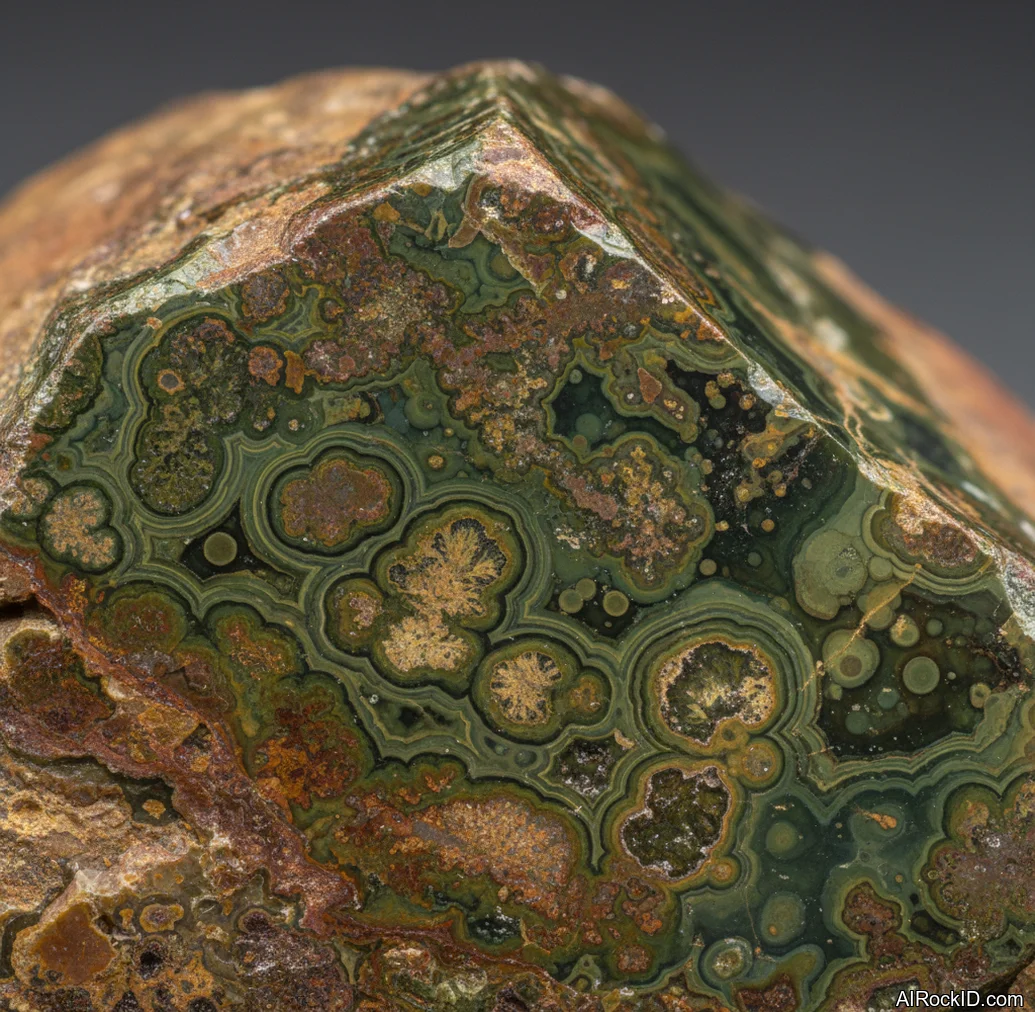
Quick answer: Rainforest Rhyolite is commonly recognized by its green to brown base color, orbicular spots, and mottled volcanic texture. It is most often used in polished forms such as beads, cabochons, palm stones, and small carvings.
AI Rock ID can help compare Rainforest Rhyolite with similar green, spotted, or orbicular stones by analyzing color, pattern, luster, and texture from a photo. RockIdentifier.io provides crystal and rock reference information that can support visual identification, but unusual specimens may still need confirmation from a gemologist or geologist.
Good fit
- Collectors who like patterned volcanic stones
- Jewelry makers looking for green, earthy beads or cabochons
- Beginners who want a durable polished stone for handling
- Anyone comparing orbicular or spotted green stones
- People interested in Australian lapidary materials
Not a good fit
- Buyers who need a transparent or faceted gemstone
- Collectors seeking a single uniform color
- Situations where exact mineral composition is required without testing
- Outdoor display in harsh conditions or prolonged direct sunlight
Most commonly confused with
- Ocean Jasper: Often has orbicular patterns too, but it is typically chalcedony-rich and commonly shows more varied pastel, cream, yellow, or red tones.
- Leopard Skin Jasper: Usually shows tan, pink, gray, or brown leopard-like spots rather than the green rainforest-like palette typical of Rainforest Rhyolite.
- Kambaba Jasper: Has dark green to black circular fossil-like patterns and is commonly sold as a jasper, while Rainforest Rhyolite has a volcanic rhyolite texture.
- Unakite: Combines green epidote and pink feldspar, lacking the rounded orbicular rhyolite pattern.
Rainforest Rhyolite vs Similar Green Patterned Stones
| Stone | Typical Look | Key Difference |
|---|---|---|
| Rainforest Rhyolite | Opaque green, brown, cream, or red volcanic rock with orbicular patches | Volcanic rhyolite texture with rounded spherulitic patterns |
| Ocean Jasper | Orbicular spots in cream, green, yellow, red, or pastel colors | Usually chalcedony-rich and more waxy-looking when polished |
| Kambaba Jasper | Dark green and black circular patterns | Patterns are usually darker and more uniform |
| Unakite | Green and salmon-pink granular mix | Pink feldspar is a major visual clue |
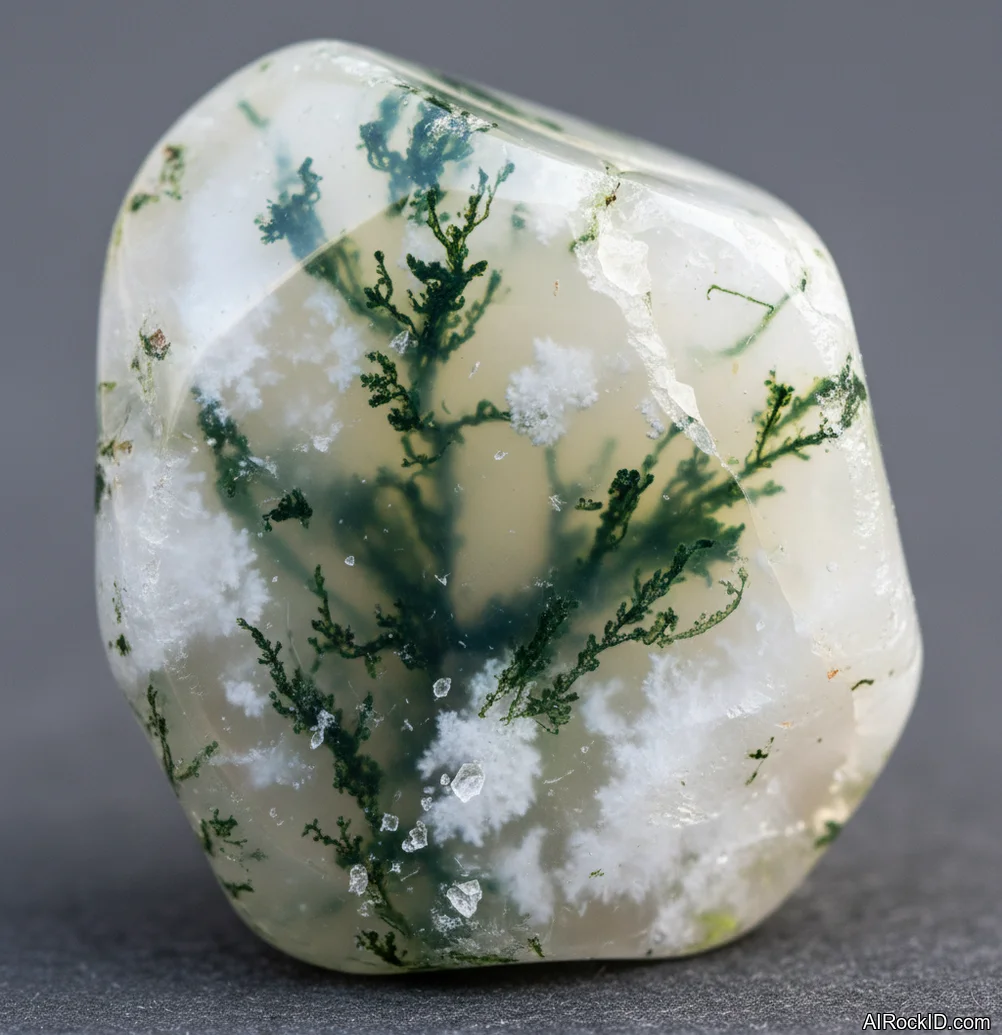
| Moss Agate | Translucent or milky base with moss-like inclusions | Translucency separates it from opaque rhyolite |
AI identification confidence
AI identification is usually moderate for polished Rainforest Rhyolite when the photo clearly shows its green color, opaque surface, and orbicular patterning. Confidence is lower for small beads, dyed stones, or photos taken under strong color-shifting light.
When AI gets it wrong
- The stone is photographed too close, hiding the overall orbicular pattern.
- The specimen is a small bead with only one visible color patch.
- Polish or glare makes the surface look like chalcedony or agate.
- The sample has unusual red, tan, or cream coloring with little green.
Final recommendation
Choose Rainforest Rhyolite if you want an opaque, patterned volcanic stone with green and earthy tones rather than a transparent gem. For buying, compare several photos of the same item and look for natural variation instead of perfectly repeated printed-looking patterns.
How to Identify Rainforest Rhyolite in Photos
Look for an opaque green to brown volcanic-looking stone with rounded spots, patches, or spherulitic shapes. Natural pieces usually show irregular color distribution rather than identical repeated circles. A polished surface may be glossy, but the stone should not look glass-clear or highly translucent like many agates.
Buying Tips for Rainforest Rhyolite
Rainforest Rhyolite is commonly sold as beads, cabochons, palm stones, and tumbled stones. Ask whether the material is natural, stabilized, dyed, or resin-treated, especially when the green color appears unusually bright. Beads should be checked for drilling chips, uneven polish, and cracks around the holes.
Authenticity Clues
Natural Rainforest Rhyolite usually has varied green, tan, brown, cream, and occasional reddish areas with non-uniform orbicular patterns. Dyed or imitation material may show color concentrated in fractures, drill holes, or surface pits. If a seller labels the stone as both rhyolite and jasper, the name may be commercial rather than strictly geological.
What Is Rainforest Rhyolite?
Rainforest Rhyolite is a green, orbicular type of rhyolite, which is a silica-rich volcanic rock, and it’s usually cut and polished into decorative stones.
Pick up a palm stone and you notice the feel first. Smooth, almost like glazed ceramic, but it’s not slippery. There’s this tiny bit of drag under your thumb, especially on a high-polish piece, and the little orbs look like they’re suspended just under the surface.
At a quick glance, people call it “jasper” because it has that earthy, spotty look. But rhyolite is the right family for most of what gets sold as Rainforest Rhyolite. That’s just how it is.
Look closer and the colors aren’t just random “mud tones.” You’ll see mossy greens, olive, tan, cream, plus the occasional rusty freckles that look like iron staining. Some stones have tight, clean little round orbs. Others go blotchy, or even brecciated. And yeah, it varies a ton from slab to slab, which is honestly part of the fun when you’re digging through a dealer’s tray at a show, flipping pieces over in your hand and trying to find the one with the best pattern.
Origin & History
Rhyolite got its name back in the 1860s, pulled from Greek roots that mean “flowing,” which fits when you’ve watched how those lavas move and then lock up as they cool.
Rainforest Rhyolite came much later as a trade name. It’s used for that specific green rhyolite with the orbicular pattern, and it really took off in the lapidary world once the Australian stuff started showing up everywhere as cabochons and tumbled stones. You’d see the same chunks turning up again and again, those round green “eyes” popping out once they’re ground down and hit with a good polish.
But most sellers call it Rainforest Jasper, and that’s more marketing than petrology. I’ve seen plenty of wholesale flats tagged “jasper” that were obviously rhyolite once you actually look at the texture and how it polishes up (jasper doesn’t usually have that same feel under the wheel). The name stuck because it sells a picture. And yeah, the green orbs really do read like a canopy pattern, don’t they?
Where Is Rainforest Rhyolite Found?
Commercial Rainforest Rhyolite is best known from Queensland, Australia. Similar-looking rhyolites occur elsewhere, but the classic “rainforest” orb pattern is strongly associated with Australian lapidary rough.
Formation
Rhyolite shows up when silica-rich lava cools fast up near the surface, so the rock “freezes” before big crystals have time to grow. That’s why it ends up fine-grained or even glassy, the kind of stuff that feels smooth under your fingertips instead of gritty like a granite. Later on, trapped gases and moving fluids (plus small chemistry shifts) can mess with it and set off spherulites, those little orb-like features where minerals crystallize in tight, radiating bundles inside the rock.
So the orbicular look in Rainforest Rhyolite is basically a snapshot of how it cooled, then got altered after the fact. You’re looking at zones. Pale spots that are feldspar-rich, green areas that are often tied to chlorite or other alteration products, and iron oxides that throw in that brown and red speckling you notice when you tilt it under a light. But it’s still a tough volcanic rock at the end of the day. Not some single crystal you can cleave or split cleanly.
How to Identify Rainforest Rhyolite
Color: Typically olive to moss green orbs and patches in a cream, tan, or brown matrix, sometimes with rusty red iron staining. Patterns range from tight circular “eyes” to blotchy, flowy bands.
Luster: Polished pieces show a waxy to vitreous luster, depending on how fine-grained the rough is.
Pick up a polished piece and tilt it under overhead light. The orb pattern should look internal and layered, not printed flat on the surface. If you scratch it with a steel knife, it usually won’t gouge easily, but you can leave a faint metal mark that wipes off. The problem with a lot of “Rainforest Jasper” labels is that sellers use the name for any green spotty rock, so ask for origin if you care about the Australian material.
Common Look-Alikes
Rainforest Rhyolite is sometimes confused with these materials:
- Rainforest Jasper / “Rhyolite Jasper” (trade name mix-ups, same material sold under jasper labels)
- Kambaba jasper (orbicular stromatolite look, darker forest-green with black orbs)
- Ocean jasper (orbicular chalcedony, usually brighter and more translucent on the edges)
- Leopard skin jasper (spotty orb patterns, more tan/pink with higher contrast spots)
- Dyed green howlite or dyed magnesite (fake “green jasper” sold as rhyolite)
- Green glass or resin “palm stones” (cast fakes with printed-looking orbs)
Market Cautions & Treatments
When AI Can Get This Wrong
At first glance, phone cameras love to call Rainforest Rhyolite “kambaba jasper” or “ocean jasper” because all three can read as green with circles in a thumbnail. Photos also hide the big tell: rhyolite’s orbs often look a little soft-edged and mottled, not crisp like ocean jasper’s dots. The real test is a quick scratch check and feel test: Rainforest Rhyolite (6-7) will resist a steel nail better than dyed howlite, and it stays cool in the hand longer than glass or resin.
Properties of Rainforest Rhyolite
Physical Properties
| Crystal System | Amorphous |
| Hardness (Mohs) | 6-7 (Hard (6-7.5)) |
| Density | 2.4-2.7 g/cm3 |
| Luster | Waxy |
| Diaphaneity | Opaque |
| Fracture | Conchoidal |
| Streak | White |
| Magnetism | Non-magnetic |
| Colors | Green, Olive, Cream, Tan, Brown, Red |
Chemical Properties
| Classification | Silicates |
| Formula | SiO2 (dominant, as a rock with quartz and feldspar) |
| Elements | Si, O, Al, K, Na, Ca, Fe, Mg |
| Common Impurities | Fe, Mn, Ti |
Optical Properties
| Refractive Index | 1.48-1.54 |
| Birefringence | None |
| Pleochroism | None |
| Optical Character | Isotropic |
Rainforest Rhyolite Health & Safety
Rainforest Rhyolite is fine to handle and keep on a shelf, no problem. But once you start cutting it, grinding it, or sanding it, you can kick up silica dust. So treat it the same way you’d treat any quartz-rich rock when you’re doing lapidary work (because, yeah, the dust is the part you don’t want in your lungs).
Safety Tips
Use wet cutting or wet grinding. Seriously, don’t do it dry. Put on a proper respirator that actually seals on your face (you’ll feel it tug a bit when you inhale). And when you’re done, wipe or rinse the slurry off your tools while it’s still wet instead of sweeping up dried dust. Why make more airborne dust than you have to?
Rainforest Rhyolite Value & Price
Price Range
Rough/Tumbled: $5 - $40 per piece
Cut/Polished: $2 - $10 per carat
Tight, high-contrast orb patterns with a clean, glassy polish can bump the price up in a hurry. But if it’s got fractures you can catch with a fingernail, patches that look dull no matter how you tilt it under the light, or that muddy brown slab look, it usually gets tossed straight into the bargain bin.
Durability
Durable — Scratch resistance: Good, Toughness: Good
It’s generally stable in normal household conditions, but sharp knocks can chip edges on thin cabochons and hearts.
How to Care for Rainforest Rhyolite
Use & Storage
Store it like you’d store any polished cab. Keep it from rubbing against harder stones like quartz points or corundum, because the polish can haze over time.
Cleaning
1) Rinse with lukewarm water. 2) Use a drop of mild soap and a soft brush for skin oils. 3) Rinse again and dry with a microfiber cloth.
Cleanse & Charge
If you do energy-style cleansing, running water or a quick smoke cleanse works fine. I avoid long salt soaks mostly because it’s messy and unnecessary for a hard, stable rock.
Placement
On a desk it reads as calm, earthy green from a few feet away, and the orb pattern rewards close-up looking. In a display case, give it side lighting so the orbs pop instead of going flat.
Caution
Skip harsh acids and gritty cleaners, since they’ll take the shine down fast and leave the surface looking kind of flat. And if it’s mounted in a piece of jewelry, don’t let it take a hard knock against a countertop or a ring stack, because those edges can chip.
Works Well With
Rainforest Rhyolite Meaning & Healing Properties
Most people grab Rainforest Rhyolite when they want something earthy that doesn’t come off heavy or dark. In my own pile, it’s the one I pass to the person who can’t stop messing with whatever’s on the counter. It keeps your fingers busy. That’s it. It stays cool in your palm for a bit, and those rounded orbs are easy to rub with your thumb, like worry beads.
Collectors and shop folks tend to tie it to grounding and steadiness, plus that “nature reset” feeling. I get why. The pattern really does look like moss, lichen, leaf shadows, the kind of stuff you notice on a damp trail when the light’s low. But I’m not going to act like a rock can replace therapy, sleep, or a doctor. What it can do is work as a physical cue. You spot it and, right, you remember to slow down, drink some water, step outside, or finish one task before starting five more (we’ve all done that).
Next to flashier stones like labradorite, this one’s quieter. But it’s not boring. And if you’re picky about texture, you’ll feel it: some pieces have tiny pits or a softer patch that didn’t take a perfectly glassy polish. That’s normal for rhyolite. Honestly, I like those little rough spots. They’re a reminder it’s real volcanic rock, not some factory-perfect resin pebble.
Common mistakes
- Assuming every green orbicular stone is Rainforest Rhyolite.
- Confusing opaque rhyolite with translucent moss agate.
- Using color alone for identification without checking texture and pattern.
- Assuming the name means the stone comes from a rainforest habitat.
- Overlooking dye concentration in pits, cracks, or bead holes.
- Expecting every piece to show strong circular orbs; some pieces are more mottled.
Identify Rainforest Rhyolite from a photo
Compare Rainforest Rhyolite traits, care tips, value clues, and common lookalikes with a clear photo.