Red Quartz Identification


Quick answer: Red Quartz is quartz whose red, orange-red, or rusty color usually comes from hematite or other iron-oxide inclusions or coatings. It keeps the typical quartz properties, including Mohs hardness 7, but its appearance can overlap with carnelian, red jasper, and iron-stained quartz.
How to identify red quartz
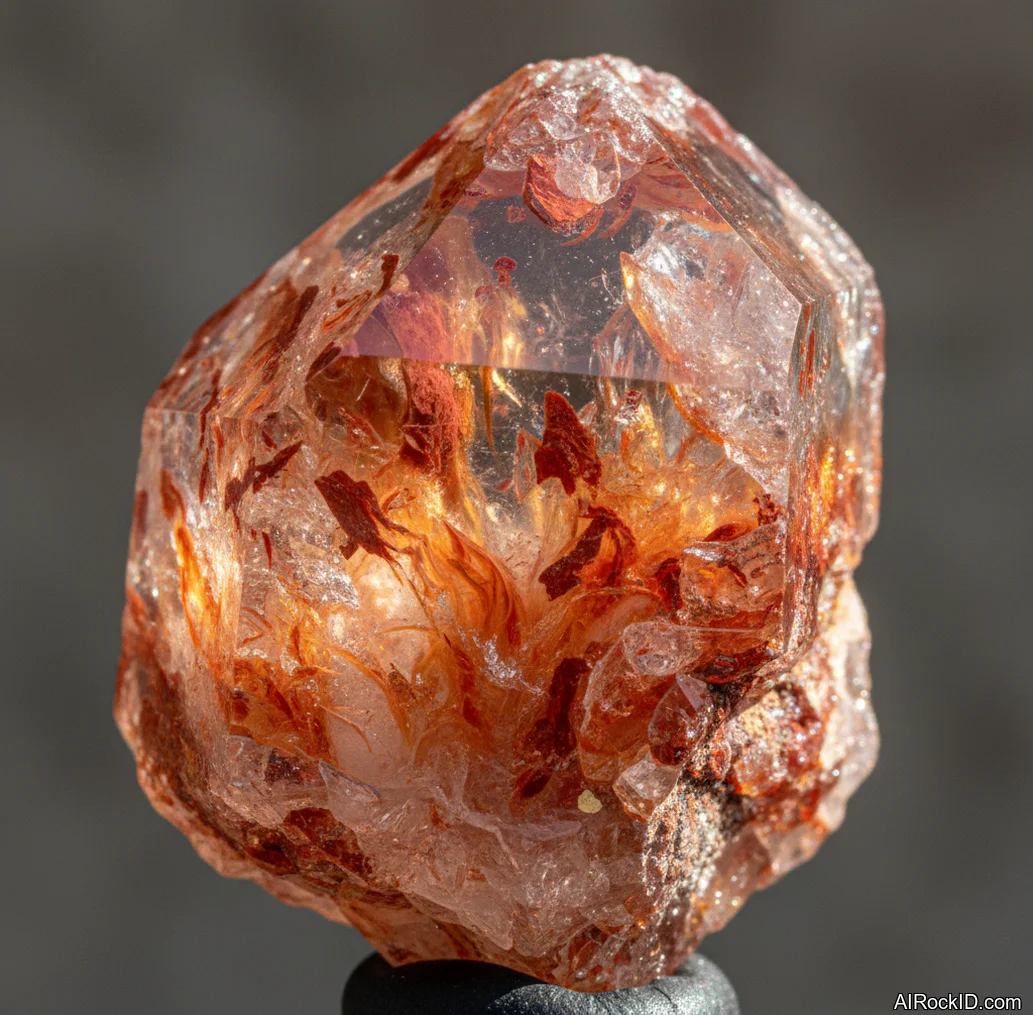
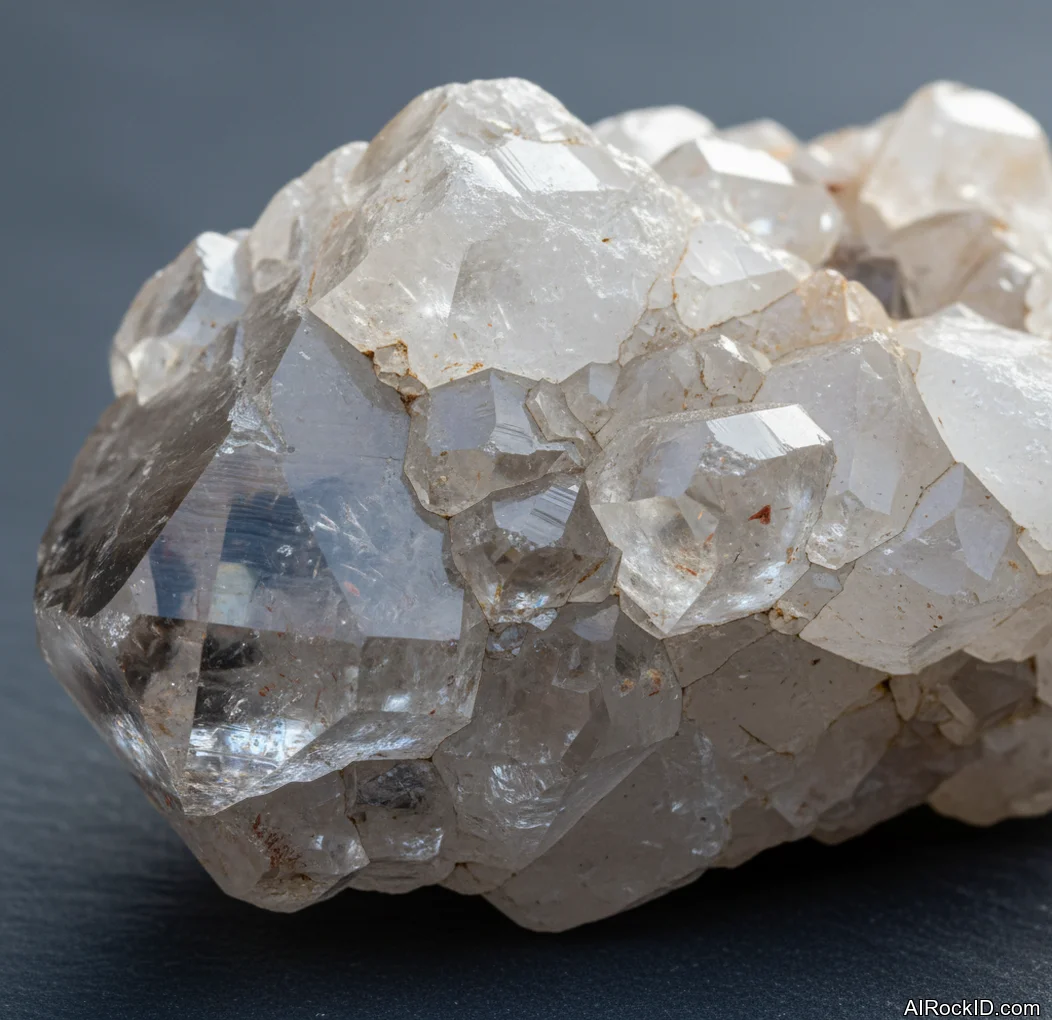
Red quartz is quartz colored by inclusions or coatings of hematite and other iron oxides rather than a separate mineral species. It should retain quartz's glassy luster, conchoidal fracture and Mohs hardness of 7. Transparent or translucent material with internal red inclusions is often sold as hematoid or fire quartz, while opaque, fine-grained red silica may be jasper. Dye concentrated in fractures, drill holes or surface pits can indicate treated material.
AI Rock ID can help compare Red Quartz with visually similar quartz and chalcedony varieties using color, texture, translucency, and surface pattern clues. RockIdentifier.io provides crystal identification support, but close lookalikes may still require hardness testing, magnification, or gemological confirmation.
Good fit
- Collectors who like quartz with natural iron-oxide coloration
- Beginners who want a durable crystal for display or handling
- Buyers comparing rusty-red quartz points, clusters, or tumbled stones
- Anyone learning the difference between quartz, jasper, and carnelian
Not a good fit
- Anyone needing a guaranteed untreated specimen without seller documentation
- Buyers expecting every red stone labeled quartz to be transparent or gem-grade
- People seeking medical benefits from a crystal
Most commonly confused with
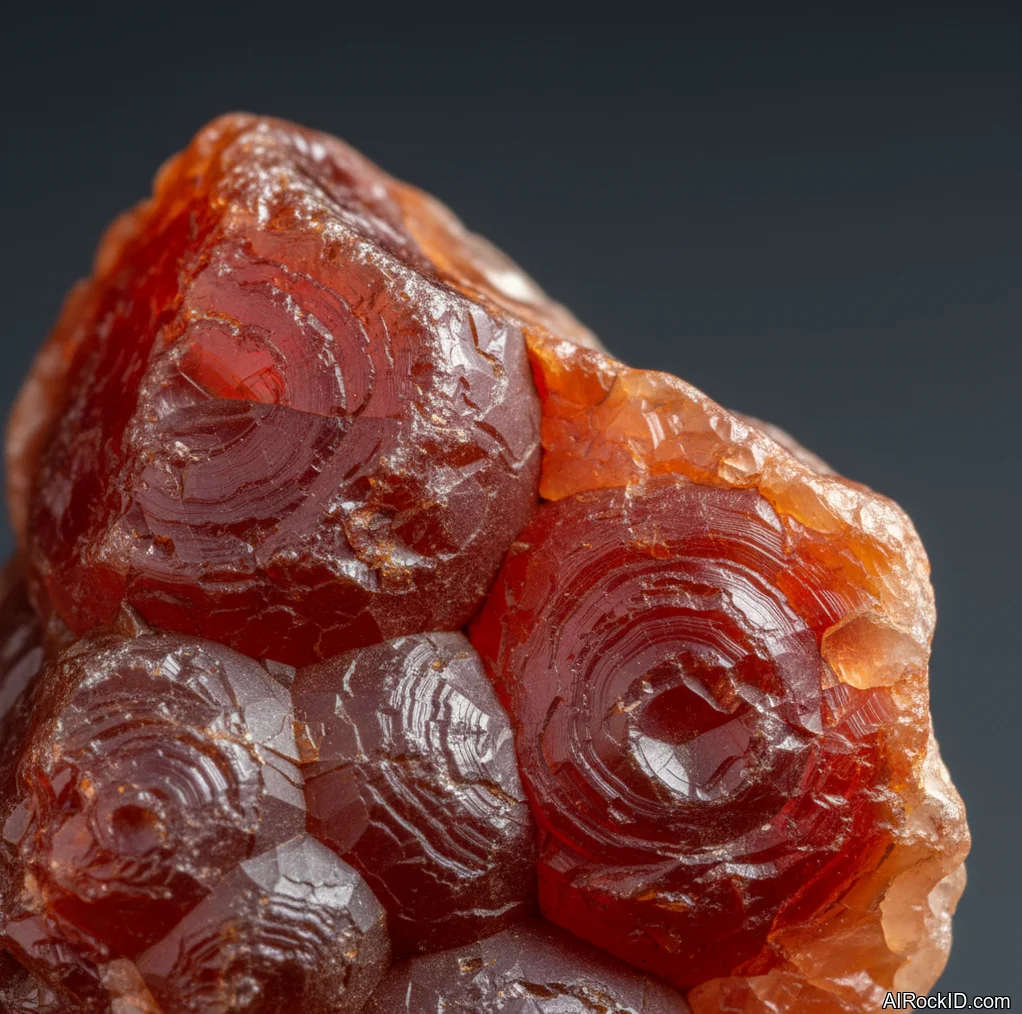
- Carnelian: Carnelian is a translucent orange to red chalcedony, usually waxier looking and less visibly crystalline than Red Quartz.
- Red Jasper: Red Jasper is opaque microcrystalline quartz with a dense, earthy look, while Red Quartz may show clearer quartz zones or visible inclusions.
- Hematoid Quartz: Hematoid Quartz is a closely related term often used for quartz with hematite inclusions, and the names may overlap in the trade.
- Fire Quartz: Fire Quartz is a trade name commonly applied to quartz with red, orange, or flame-like hematite inclusions.
Red Quartz vs. Common Lookalikes
| Stone | Typical appearance | Key difference |
|---|---|---|
| Red Quartz | Clear to milky quartz with red, rusty, or hematite-rich areas | May show quartz crystal faces or internal iron-oxide inclusions |
| Carnelian | Orange-red to reddish brown, translucent, waxy luster | Usually more uniform chalcedony with no quartz crystal points |
| Red Jasper | Opaque brick-red to earthy red, often massive | No transparency and typically a duller, denser look |
| Hematoid Quartz | Quartz with red, orange, or brown hematite inclusions | Often used interchangeably with Red Quartz in retail listings |
| Dyed Quartz | Bright or patchy red color, often in cracks or porous zones | Color may look artificial or concentrate along fractures |
AI identification confidence
AI identification is usually moderate for Red Quartz because the quartz structure and iron-oxide coloration are visible in many photos. Confidence drops when the stone is tumbled, opaque, heavily polished, or photographed under warm lighting that hides translucency and surface texture.
When AI gets it wrong
- A tumbled stone is opaque and could be red jasper, carnelian, or dyed quartz.
- The photo lighting makes orange, red, and brown tones look more saturated than they are.
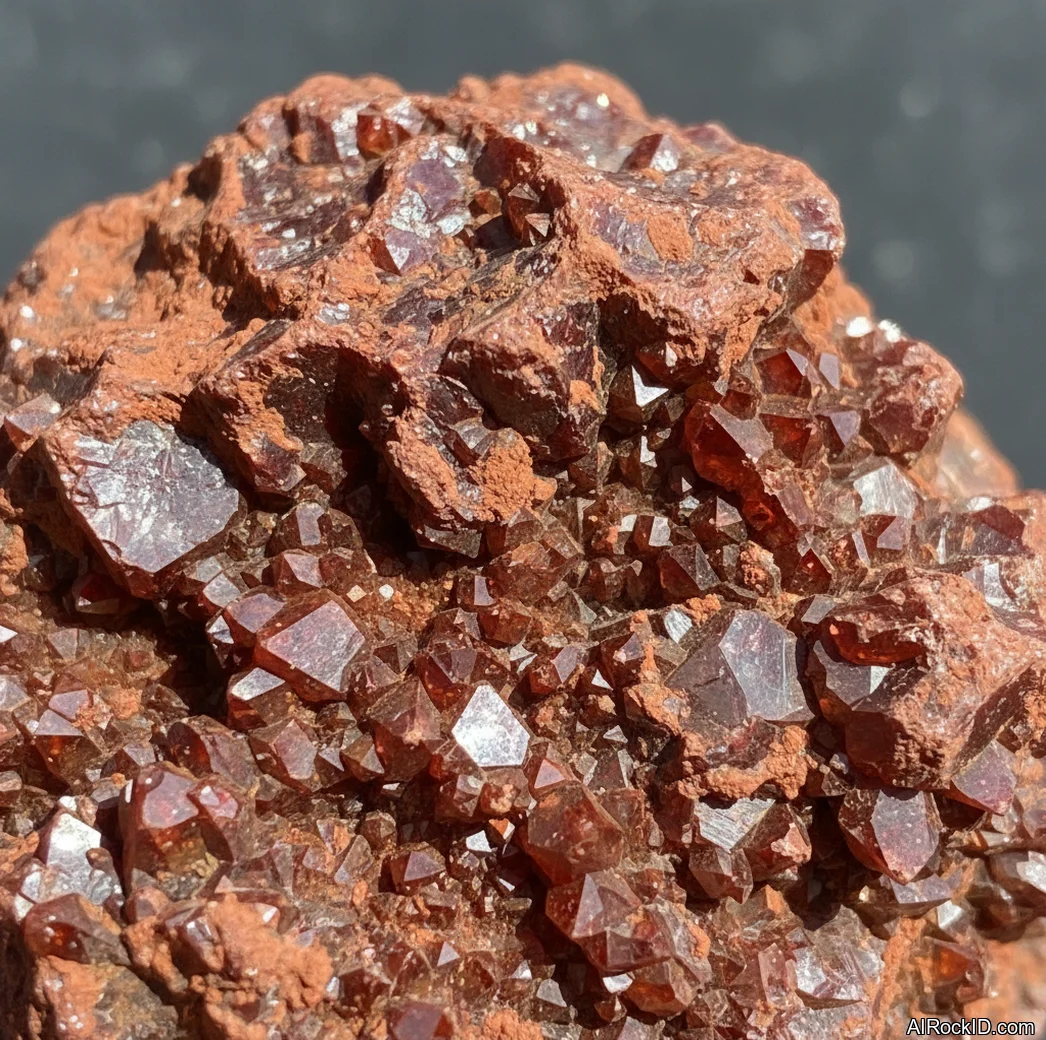
- The specimen is coated with iron oxide on the surface rather than included inside the quartz.
- A trade name such as Fire Quartz or Hematoid Quartz is used inconsistently by the seller.
Final recommendation
Choose Red Quartz if you want a durable quartz variety with natural-looking rusty red or hematite-rich inclusions. For higher-confidence buying, look for clear photos in daylight, visible quartz texture, and seller disclosure about dyeing, coating, or heat treatment.
How to Check Red Quartz Authenticity
Authentic Red Quartz usually shows iron-oxide color as inclusions, veils, patches, or coatings rather than a perfectly uniform red body color. Under magnification, natural hematite-related color may appear along internal fractures, growth zones, or surface iron staining. Be cautious with very bright red stones, stones with dye concentrated in cracks, or items that leave color on a damp cotton swab.
Best Photos for Identifying Red Quartz
Use daylight or neutral lighting and photograph the stone on a plain white or gray background. Include one close-up of the red areas, one photo showing translucency against light, and one image of the whole specimen. For crystal points or clusters, capture any natural faces and terminations because they help separate quartz from massive jasper or chalcedony.
Red Quartz Trade Names
Red Quartz may be sold under names such as Hematoid Quartz, Fire Quartz, Ferruginous Quartz, or iron-stained quartz. These names can describe similar material, but they are not always used consistently by sellers. A listing should ideally describe whether the red color is from internal inclusions, surface coating, or treatment.
What Is Red Quartz?
Red Quartz is just quartz (silicon dioxide) that’s picked up a red to rusty tone from iron-oxide staining or inclusions, usually hematite and, now and then, goethite. Hold a piece and it feels like plain quartz in your palm, that cool, steady heft you notice right away, but the color isn’t smeared on like paint. Tip it under a light and you can actually see the red hanging inside the stone, like smoke or fine specks, sometimes laid out in bands that look like somebody dragged a brush through it and didn’t bother to clean up.
Look, at first glance a lot of it really does resemble clear quartz that got roughed up by red clay. And honestly, plenty of what’s sold is exactly that: quartz with iron staining along fractures. The nicer material has suspended plates or dust-like hematite inside, so the red has real depth instead of just sitting in cracks. I’ve handled chunks where one face is glassy and clean, and then you roll it over and there’s this milky center with red freckles that line up like a little storm front. Weirdly satisfying to stare at.
Compared to carnelian, Red Quartz is usually less even. Carnelian’s color tends to be more uniform and kind of waxy; Red Quartz keeps that quartz “window” look, even when it’s cloudy. But don’t count on every piece being gemmy. Most are translucent at best, and the red can slide into brown fast if the lighting is bad.
Origin & History
Quartz has been described and collected forever, but “Red Quartz” is really a shop label, not a strict mineral species name. Quartz itself is simple. The red color comes from iron oxides that mineralogists have known about in quartz for a long time, especially after microscopes and inclusions started getting serious attention in the 1800s.
So if you want the name backstory, “quartz” comes through German (Quarz) and even older European mining terms. “Hematoid quartz” is a modern dealer and collector term people use to point out hematite-related inclusions (you can usually spot those tiny rusty-looking flecks inside when you tilt the piece under a light). And in the retail world you’ll also hear “fire quartz,” which can mean anything from genuine hematite-included quartz to orange-stained material that’s been polished up to look extra punchy.
Where Is Red Quartz Found?
Iron-stained and hematite-included quartz shows up in a lot of quartz districts worldwide, especially where iron-rich fluids moved through cracks and pockets.
Formation
Raw chunks out of pegmatites and hydrothermal veins are where I run into it most.
Quartz grows out of silica rich fluids. If those fluids are carrying dissolved iron, or if the pocket already has hematite or goethite sitting around, that’s when the red shows up, either as coatings, little flakes, or that fine dust that gets trapped while the crystal’s still growing. Sometimes it shows up early. Sometimes it comes in late and sneaks along healed fractures.
Look, if you’ve got a good specimen in your hand, you can kind of read the timeline in it. You’ll see crisp clear growth zones, then this red veil, then it goes clear again. That’s the pocket chemistry shifting while the crystal was still building faces. And the headache with “Red Quartz” online is sellers don’t always tell you what you’re actually buying. Inclusion red and surface stain red are both real, but they’re totally different once you’ve handled a couple side by side (the stain can look like it’s sitting on the skin, while inclusions feel like they’re living inside the crystal).
How to Identify Red Quartz
Color: Red Quartz ranges from pale pinkish-red to brick red and rusty brown, usually as internal veils, specks, or bands rather than perfectly even body color. Many pieces show red concentrated along cracks or in cloudy zones.
Luster: It has a vitreous luster on fresh faces and polished surfaces.
If you scratch it with a steel knife, you won’t get far; quartz should resist and will still scratch glass easily. The real test is a loupe: hematite inclusions look like tiny plates, dust, or threadlike veils inside, while simple iron staining tends to sit on fractures and surface pits. And in the hand, polished quartz stays cool longer than glass or resin fakes, especially if you set it down and pick it back up after a minute.
Common Look-Alikes
Red Quartz is sometimes confused with these materials:
- Hematoid quartz (quartz with obvious hematite plates or red phantoms, often sold as “fire quartz”)
- Dyed crackle quartz (heat-cracked quartz that’s been dyed red, with color sitting in the fracture network)
- Red aventurine (iron-stained quartzite with sparkly mica flecks, sold as “red quartz” in bead strands)
- Carnelian / red chalcedony (waxy luster, more even color, no “smoky” iron haze inside)
- Red glass (including “cherry quartz” manmade glass with swirls and bubbles)
Market Cautions & Treatments
When AI Can Get This Wrong
At first glance, phone pics make Red Quartz look like carnelian or red jasper because the camera flattens the depth and turns internal iron haze into a solid red patch. AI also mixes it up with hematoid quartz and even manmade “cherry quartz” glass when the photo’s heavily backlit. The real test is a quick loupe check for dye in cracks and bubbles in glass, plus a steel blade scratch test: quartz shrugs it off, but a lot of softer red look-alikes won’t.
Properties of Red Quartz
Physical Properties
| Crystal System | Trigonal |
| Hardness (Mohs) | 7 (Hard (6-7.5)) |
| Density | 2.65 g/cm3 |
| Luster | Vitreous |
| Diaphaneity | Transparent to translucent |
| Fracture | Conchoidal |
| Streak | White |
| Magnetism | Non-magnetic |
| Colors | Red, Reddish-brown, Pinkish-red, Rust, Clear, White |
Chemical Properties
| Classification | Silicates |
| Formula | SiO2 |
| Elements | Si, O |
| Common Impurities | Fe, Al, Ti |
Optical Properties
| Refractive Index | 1.544-1.553 |
| Birefringence | 0.009 |
| Pleochroism | None |
| Optical Character | Uniaxial |
Red Quartz Health & Safety
Touching it and getting it wet is usually fine as long as it’s a solid piece. The real day-to-day concern is the super-fine silica dust you can kick up if you’re cutting, grinding, or sanding it (that powder that hangs in the air and gets on everything).
Safety Tips
If you’re going to cut or shape it for lapidary work, keep the saw wet and wear proper respiratory protection. And don’t dry-grind quartz.
Red Quartz Value & Price
Price Range
Rough/Tumbled: $5 - $60 per piece
Cut/Polished: $1 - $20 per carat
Price shoots up when the clarity’s good, the internal hematite veils look sharp, and the crystal actually has a solid shape instead of being a wonky lump. Plain iron-stained chunks? Those are usually cheap. But if it’s a clean, terminated crystal and you can see red phantoms in it, the cost can climb fast.
Durability
Durable — Scratch resistance: Excellent, Toughness: Good
Quartz is stable for everyday handling, but surface iron staining can look dull if it gets abraded or scrubbed too hard.
How to Care for Red Quartz
Use & Storage
Store it like you would any quartz: separate from softer stones so it doesn’t scratch them, and keep sharp points from knocking together. A small box with padding keeps terminations from getting bruised.
Cleaning
Rinse with lukewarm water. Use a drop of mild dish soap and a soft toothbrush to get grime out of pits and along fractures. Rinse again and air-dry on a towel.
Cleanse & Charge
If you do energetic cleansing, running water, smoke, or a night on a selenite plate are common options. Avoid anything that’s basically sandpaper, because it can haze a good polish.
Placement
Looks best where light can pass through, like a windowside shelf that doesn’t get harsh midday sun. If the piece is mostly surface-stained, keep it away from dusty spots since the red can lose contrast when it gets grimy.
Caution
If that red is mostly an iron-oxide coating, don’t hit it with strong acids or go at it hard with a scratchy scrubber. You can end up bleaching it in weird spots or leaving little patchy areas that don’t match. And don’t treat every “strawberry quartz” listing like it’s the exact same stuff. A lot of what’s sold under that name is dyed or straight-up mislabeled (it happens more than people admit).
Works Well With
Red Quartz Meaning & Healing Properties
Grab Red Quartz on a rough day and it comes off as a practical stone, not some floaty, head-in-the-clouds thing. The whole point people seem to want from it is getting moving again. Showing up. Finishing the thing. Staying in your body. I’ve seen customers reach for it when they want something “grounding,” but they don’t want a stone that looks muddy, dull, or like it’s been sitting in a garden bed.
But look, I’ll be straight with you. That red color might be doing a lot of the psychological heavy lifting. Red hits our brains as energy and heat, right? That doesn’t mean what you’re feeling is fake, it just means you should treat it like a personal tool, not a medical treatment. So if you’re using crystals around mood or motivation, keep it in the habit-support lane: a reminder object, a meditation focus, a little anchor you can touch when you’re about to drift.
Compared to plain clear quartz, Red Quartz usually feels less sterile in the hand. Clear quartz can feel icy and sharp, like it’s got edges even when it’s polished (you know what I mean). Red-included pieces look warmer, even though the stone itself still stays cool to the touch. I like it for simple routines. Hold it for a minute. Set an intention. Then park it somewhere you’ll actually see it, like by your keys, on your desk, or next to your coffee mug.
Common mistakes
- Assuming every red-orange quartz-like stone is Red Quartz without checking translucency and texture.
- Confusing opaque Red Jasper with Red Quartz because both can have iron-rich red color.
- Treating trade names such as Fire Quartz and Hematoid Quartz as strict gemological categories.
- Ignoring possible dye when the color is very bright, uniform, or concentrated in cracks.
- Using color alone for identification instead of combining hardness, luster, fracture, and magnification clues.
Identify Red Quartz from a photo
Compare Red Quartz traits, care tips, value clues, and common lookalikes with a clear photo.