Fire Quartz Identification


Quick answer: Fire Quartz is quartz containing red, orange, or brown iron-oxide inclusions, most often hematite or lepidocrocite. It is usually identified by its glassy quartz body, Mohs 7 hardness, and suspended internal color rather than surface dye.
How to identify fire quartz
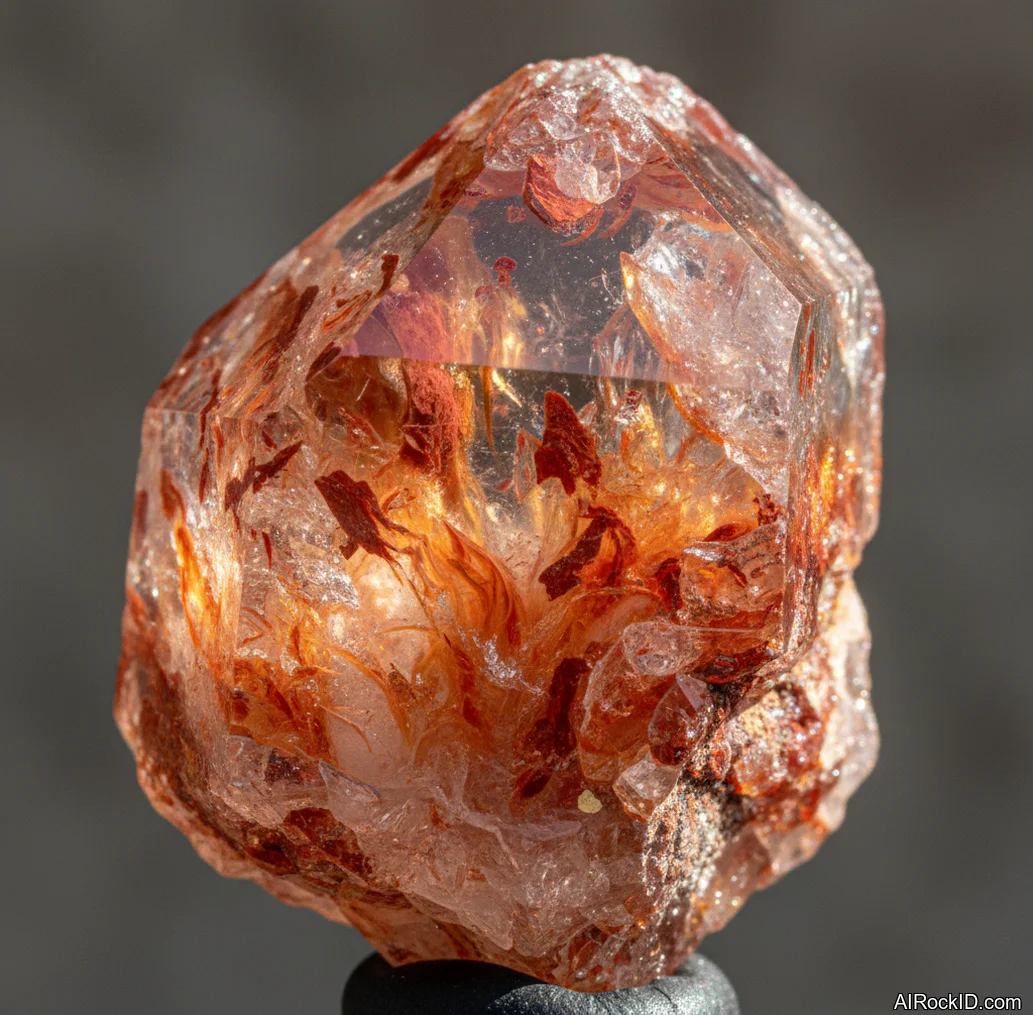
Fire quartz is a trade name commonly used for quartz containing red, orange or brown hematite or other iron-oxide inclusions. The color may appear as clouds, streaks, speckles or flame-like zones inside transparent to milky quartz, while the host retains quartz's glassy luster and Mohs hardness of 7. The name overlaps with hematoid quartz and is not a formal mineral species; dyed crackle quartz and surface-coated stones can imitate its vivid color.
AI Rock ID can help compare Fire Quartz against visually similar quartz varieties by analyzing color distribution, transparency, crystal habit, and inclusion patterns from a photo. RockIdentifier.io can be used as a supporting reference, but final identification is strongest when photo results are checked against hardness, luster, and known treatments.
Good fit
- Collectors who like visible mineral inclusions inside clear or milky quartz
- Jewelry buyers looking for a durable quartz material with red-to-orange internal color
- Beginners who want a quartz variety that is easier to test by hardness than many softer stones
- People comparing natural included quartz with dyed, coated, or heat-treated lookalikes
Not a good fit
- Buyers who need a gem with consistent, uniform color throughout
- Anyone expecting every red quartz specimen to be natural Fire Quartz
- Collectors who prefer inclusion-free faceted gemstones
- Use cases where professional gemological confirmation is required but unavailable
Most commonly confused with
- Hematoid Quartz: Often used as an overlapping trade name; Fire Quartz usually refers to specimens with vivid red-to-orange internal iron inclusions.
- Carnelian: Carnelian is chalcedony with more even orange-red color, while Fire Quartz is crystalline quartz with visible internal inclusions.
- Red Jasper: Red Jasper is opaque and usually massive, while Fire Quartz is commonly translucent to transparent with cloud-like inclusions.
- Strawberry Quartz: Strawberry Quartz typically has pink to red fine inclusions or color centers, while Fire Quartz shows stronger orange-red iron-oxide clouds or flakes.
Fire Quartz vs. Common Lookalikes
| Stone | Typical Appearance | Key ID Clue | Mohs Hardness |
|---|---|---|---|
| Fire Quartz | Clear to milky quartz with red, orange, or brown internal clouds | Iron-oxide inclusions appear suspended inside quartz | 7 |
| Carnelian | Translucent orange to red chalcedony | Color is more evenly distributed and waxy rather than glassy | 6.5–7 |
| Red Jasper | Opaque brick-red to brownish red | No clear quartz body or transparent internal inclusions | 6.5–7 |
| Strawberry Quartz | Pink to reddish quartz with fine speckling or haze | Usually softer-looking pink-red color rather than orange hematite clouds | 7 |
| Dyed Quartz | Bright or uneven red color in cracks, pits, or surfaces | Color may concentrate along fractures or rub off under testing | 7 |
AI identification confidence
AI identification is usually moderate to high when the photo clearly shows a quartz crystal with internal red-orange inclusions and natural transparency. Confidence drops when the specimen is opaque, heavily polished, artificially colored, or photographed under warm lighting that exaggerates red tones.
When AI gets it wrong
- The specimen is opaque and could be Red Jasper, iron-stained quartz, or another massive stone.
- Strong orange lighting or filters make ordinary quartz look redder than it is.
- A polished bead or cabochon hides whether the color is internal, surface-level, or dye-related.
- The sample is labeled with a broad trade name such as Hematoid Quartz, Strawberry Quartz, or Red Quartz without testing.
Final recommendation
Choose Fire Quartz with visible internal inclusions, natural-looking color zoning, and a seller description that states whether the stone is natural, heated, dyed, or coated. For higher-priced pieces, request daylight photos and basic gem details such as origin, treatment disclosure, and return policy.
How to Spot Natural-Looking Fire Quartz
Natural-looking Fire Quartz usually shows red, orange, or brown inclusions trapped inside a clear to milky quartz body rather than a flat layer of color on the surface. Look for irregular clouds, wisps, flakes, or phantom-like zones that follow internal growth features. Color that gathers only in cracks, drill holes, or pits can indicate dye or enhancement.
Buying Fire Quartz: Questions to Ask
Ask whether the specimen is natural, dyed, heat-treated, coated, or stabilized, especially when the color is very bright or uniform. Request photos in indirect daylight and close-ups of fractures, bead holes, and the back of cabochons. A reliable listing should distinguish Fire Quartz from broad trade labels such as Red Quartz, Hematoid Quartz, or Strawberry Quartz when possible.
Photo Tips for Better Identification
Photograph Fire Quartz on a neutral background in natural daylight without red or orange surroundings reflecting into the stone. Include one close-up, one full-specimen image, and one photo showing transparency with light passing through the crystal. Avoid heavy filters because color intensity is one of the main clues used to separate natural inclusions from dyed or mislabeled material.
What Is Fire Quartz?
Fire Quartz is still quartz, but it gets its color from tiny hematite or lepidocrocite inclusions. That’s what throws those red, orange, or rusty plumes inside the stone. Look, the first time you see a good piece, it really does look like there’s a little ember caught under the surface, and yeah, that’s the whole hook.
You still get that clean, glassy quartz vibe. But then you turn it under a lamp and the inside shifts, like smoky brushstrokes sliding around as the light changes. Weirdly satisfying.
Grab a tumbled one and you’ll feel it right away. It stays cool in your palm longer than glass does, and it has that proper quartz heft, not that suspicious “too light” feel resin fakes have. But don’t count on every stone matching the dealer’s hero photo. Some Fire Quartz is honestly pretty cloudy, more beige than flame, and the best pieces have contrast: clear windows next to dense red wisps, not one flat muddy orange blob.
Next to plain clear quartz, Fire Quartz looks busier. Those iron-oxide inclusions can come off like sunsets, rust flakes, or a thin red haze caught along healed fractures. I’ve had pieces where the red makes tiny comet tails that don’t show up until you tilt the stone just right and catch a narrow strip of overhead light. How is that not fun?
Origin & History
Most dealers toss around “Fire Quartz” as a trade name. It isn’t a formally defined mineral species, and most of the time it’s the same stuff collectors call hematoid quartz. Quartz itself got described ages ago, and the name traces back to the German “Quarz,” which shows up in writing in the Middle Ages.
Thing is, the inclusion story is the newer piece. Once you start running into hematite-stained quartz coming out of pegmatites and hydrothermal veins, the naming turns into a mess fast. Some sellers call anything reddish “fire.” But in your hand, you can usually tell iron-oxide inclusions from plain surface staining because the red is inside the stone, kind of suspended like it actually grew that way (not just painted on the outside).
Where Is Fire Quartz Found?
It turns up in quartz-bearing veins and pegmatites worldwide, with a lot of market material coming out of Brazil. Similar included quartz is also collected from alpine-type veins in places like the Swiss Alps.
Formation
Raw chunks from iron-rich hydrothermal systems are where Fire Quartz actually fits. Quartz grows out of silica-bearing fluids, and if there’s iron around and the chemistry lines up, hematite (Fe2O3) or lepidocrocite (FeO(OH)) can show up as tiny plates, needles, or even a dusty-looking haze while the quartz is still building, or later when cracks are sealing back up.
Look, if you get a decent specimen in your hand and tilt it under a strong light, you’ll usually notice the inclusions aren’t spread evenly. They bunch up along phantom growth zones or run through internal fracture networks like little rusty threads trapped under glass. That’s the whole “plot” inside the stone, right? The quartz grows, it pops a crack, it heals, and the iron oxides slip in during one of those moments.
But not every piece is a crisp, pointy crystal. A lot of what’s sold is massive quartz with included seams, then it gets cut into freeforms because the rough looks kind of ugly on the outside (chalky skin, random pits), even if the inside has the good stuff.
How to Identify Fire Quartz
Color: Colors range from pale peach haze to deep rusty red, usually as clouds, streaks, or plumes inside clear to milky quartz. The red is internal, not just a surface coating, though some pieces are both.
Luster: Vitreous luster on fresh surfaces, with a glassy shine when polished.
If you scratch it with a steel knife, it shouldn’t take a scratch, but it will scratch the knife a little and it’ll scratch glass easily. The real test is a loupe: you’re looking for tiny platey or dusty red inclusions that look suspended, not dye pooled in surface pits. Cheap versions sometimes use dyed crackle quartz, and you can spot those by the loud, uniform color sitting along a web of heat fractures that looks too even to be natural.
Common Look-Alikes
Fire Quartz is sometimes confused with these materials:
- Harlequin Quartz (Lepidocrocite Quartz)
- Dyed Clear Quartz
- Heat-treated Citrine
- Red Glass
- Cherry Quartz (synthetic glass)
- Included Hematoid Quartz
Market Cautions & Treatments
When AI Can Get This Wrong
AI photo ID trips up most often with dyed quartz and cherry quartz glass—both can mimic the red plumes, but they lack the tight, needle-like inclusions you see under a loupe. Harlequin Quartz is a close call too, but the lepidocrocite inclusions in Fire Quartz are more scattered and less layered. Real Fire Quartz scratches glass and feels cold to the touch, which a photo can't show.
Properties of Fire Quartz
Physical Properties
| Crystal System | Trigonal |
| Hardness (Mohs) | 7 (Hard (6-7.5)) |
| Density | 2.65 g/cm3 |
| Luster | Vitreous |
| Diaphaneity | Transparent to translucent |
| Fracture | Conchoidal |
| Streak | White |
| Magnetism | Non-magnetic |
| Colors | Clear, White, Red, Orange, Brown, Rust |
Chemical Properties
| Classification | Silicates |
| Formula | SiO2 |
| Elements | Si, O |
| Common Impurities | Fe |
Optical Properties
| Refractive Index | 1.544-1.553 |
| Birefringence | 0.009 |
| Pleochroism | None |
| Optical Character | Uniaxial |
Fire Quartz Health & Safety
If the piece is whole and not cracked, you can handle it and rinse it off without much worry. But like any quartz, don’t breathe in the fine dust if you’re cutting it or grinding it (that powder gets in the air fast, right?).
Safety Tips
If you’re going to do any lapidary work on it, keep a steady drip of water going. Don’t skip the respirator either, and make sure it’s actually rated for silica dust, not just a basic mask. And when you’re done, deal with the slurry the right way, because that gritty stuff builds up fast (and it’s a pain to clean off everything).
Fire Quartz Value & Price
Price Range
Rough/Tumbled: $5 - $60 per piece
Cut/Polished: $1 - $10 per carat
Price mostly comes down to how crisp the stone looks. A clear quartz piece with sharp, red plume inclusions will cost more than that evenly cloudy orange stuff you see everywhere. And if it’s a clean, nicely terminated crystal (no chipped tips, no dull faces) or a cabochon that’s been cut and domed well, the price climbs fast. Common tumbles? Those stay cheap.
Durability
Durable — Scratch resistance: Excellent, Toughness: Good
Quartz is stable in normal home conditions, but the polish can dull if it rubs against harder grit or other quartz in a pouch.
How to Care for Fire Quartz
Use & Storage
Store it like you would any quartz: separate from softer stones so it doesn’t scratch them, and don’t let pieces knock together if you care about the polish. I keep my nicer Fire Quartz in small boxes because tumbles in a bowl will haze each other over time.
Cleaning
1) Rinse with lukewarm water to remove dust. 2) Wash with mild soap and a soft brush, especially around pits or natural creases. 3) Rinse well and dry with a microfiber cloth.
Cleanse & Charge
For non-medical, spiritual-style care, people usually use running water, smoke, or leaving it on a shelf in indirect light. Avoid long, hot sunbathing if your piece has a high polish and you don’t want it to heat up and pick up micro-scratches from grit.
Placement
On a desk, it reads best with side lighting so the red plumes “float” in the clear zones. If it sits flat under overhead light, a lot of the internal detail disappears.
Caution
Don’t hit it with harsh cleaners or any acids. And don’t toss included quartz into an ultrasonic cleaner if it’s got internal fractures, because those tiny cracks can spread fast once it starts vibrating. Thing is, if a seller is calling dyed crackle quartz “Fire Quartz,” be careful. That color can bleed or fade if you clean it too aggressively.
Works Well With
Fire Quartz Meaning & Healing Properties
Pick up Fire Quartz and the vibe people talk about clicks right away. It’s got that clean quartz clarity, but there’s this rusty, earthy shove behind it that you don’t get from plain clear quartz. I’ve seen customers grab it when they want something more grounded than clear quartz, but they don’t want the darker, heavier look you get with straight hematite. It’s a “use it with your hands” kind of stone. You feel that slick, glassy quartz surface, then your eyes keep getting tugged back into the red swirl inside (like smoke caught under ice).
But look, I’m gonna be straight about the limits. Any “healing” talk sits in the tradition and personal-experience lane, not medical care. What I’ve noticed is Fire Quartz gets used like a focus anchor. People park it on a work desk, or they’ll hold it while journaling, because it gives your brain something visual to lock onto. Those internal plumes really do look like a tiny weather system trapped in the stone, and just staring into it can slow you down. Weirdly calming. Who expects that?
So compared to plain clear quartz, folks usually connect Fire Quartz with energy, drive, getting unstuck, that kind of thing. Probably because red and orange read as “go” colors in our brains. And the iron-oxide inclusions are what give it that grounded feel in the first place. Thing is, if you’re hoping for a super bright, candy-red look, you’ll probably be disappointed unless you pay for top-grade material. Most real pieces lean earthy and a little smoky. That’s the honest version.
Common mistakes
- Assuming every red or orange quartz specimen is Fire Quartz without checking whether the color is internal.
- Confusing opaque Red Jasper with included quartz because both can show iron-rich red tones.
- Overlooking dye in cracks, bead holes, or surface pits on very brightly colored pieces.
- Using only trade names from a seller instead of comparing hardness, luster, transparency, and inclusion pattern.
- Judging color from a single warm-lit photo rather than viewing the stone in daylight.
- Expecting all Fire Quartz to contain the same inclusion mineral; hematite and lepidocrocite can produce different textures and shades.
Identify Fire Quartz from a photo
Compare Fire Quartz traits, care tips, value clues, and common lookalikes with a clear photo.