Ruby In Kyanite


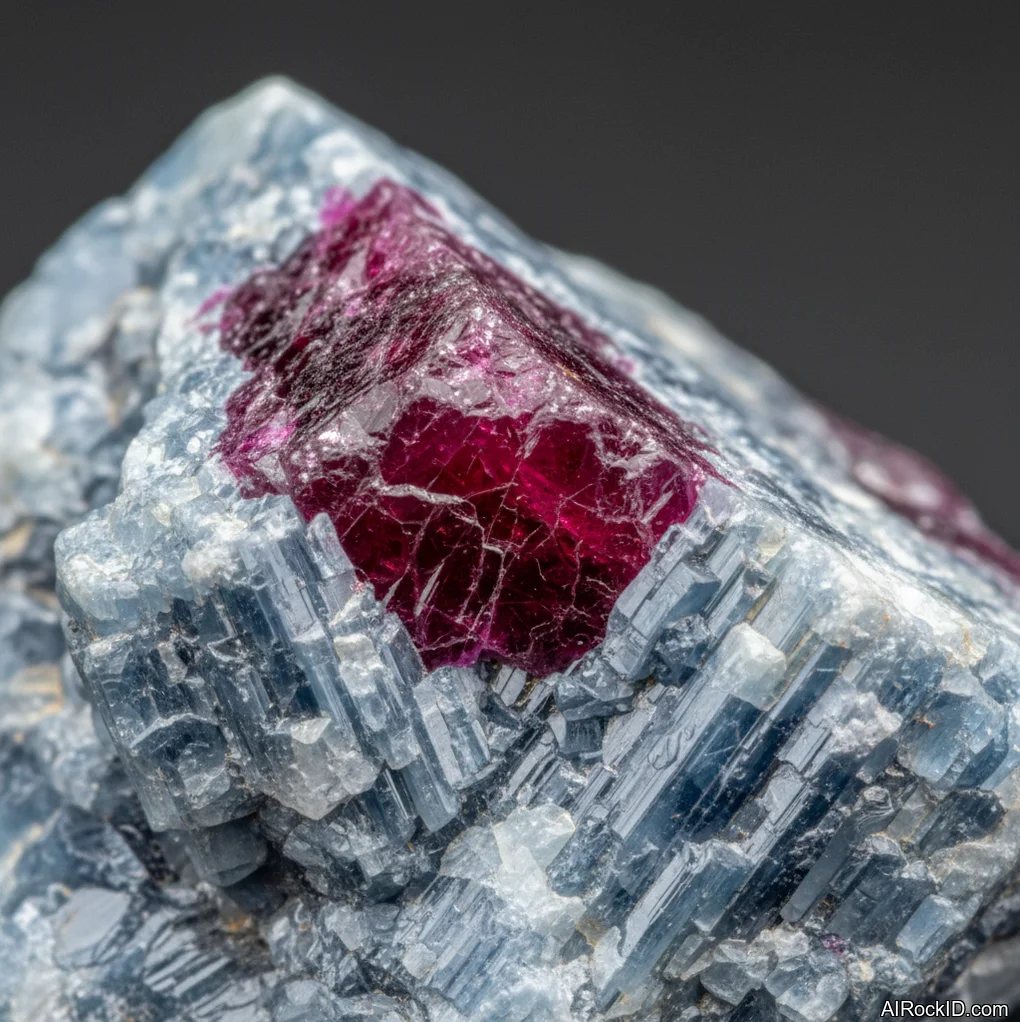
Quick answer: Ruby in kyanite is a composite rock or mineral specimen with pink to red corundum crystals included in blue to blue-gray kyanite. It is usually identified by its contrasting colors, uneven hardness, and granular to bladed texture rather than by a single crystal habit.
AI Rock ID can help screen ruby in kyanite by comparing visible color zones, texture, and crystal associations from a clear photo. RockIdentifier.io provides crystal identification references that can support visual checks, but hardness and source information are still important for confirmation.
Good fit
- Collectors who like naturally contrasting mineral combinations
- Beginners learning to compare mixed-mineral hardness and texture
- Jewelry buyers considering cabochons or beads with visible red and blue zones
- Specimen owners who want a material that is recognizable without specialized equipment
Not a good fit
- Anyone needing a uniformly hard stone for daily-wear rings
- Buyers expecting transparent gem-grade ruby
- People who dislike surface pits, fractures, or mixed textures
- Situations where a single-mineral identification is required
Most commonly confused with
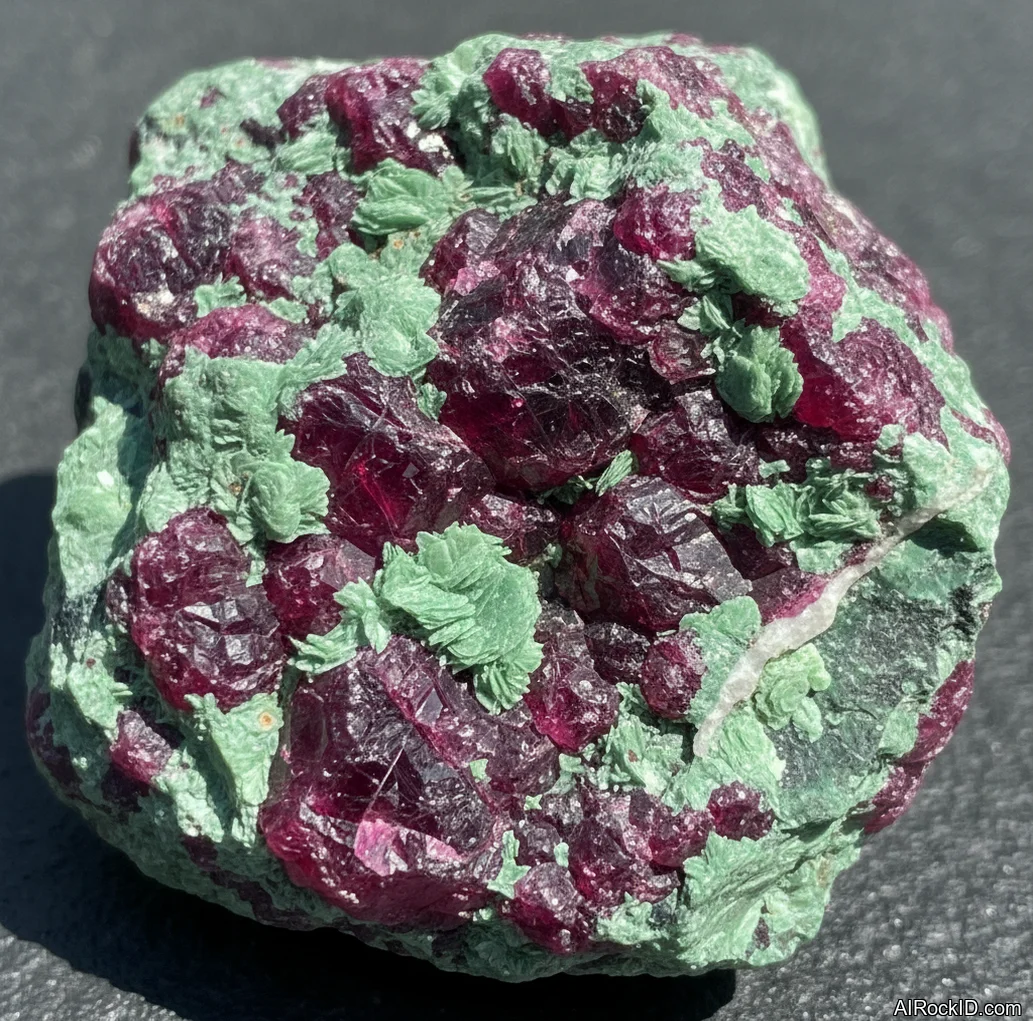
- Ruby in Fuchsite: Ruby in fuchsite has a green mica host, while ruby in kyanite has a blue to blue-gray kyanite host.
- Ruby in Zoisite: Ruby in zoisite usually shows green zoisite with black hornblende, not the bladed blue texture of kyanite.
- Sapphire in Kyanite: Blue corundum in kyanite may resemble the host color, while ruby zones are red to pink corundum.
- Blue Kyanite: Plain kyanite lacks the distinct red corundum areas that define ruby in kyanite.
Ruby in Kyanite Lookalikes
| Material | Typical Host Color | Key Difference |
|---|---|---|
| Ruby in kyanite | Blue to blue-gray | Red corundum occurs with bladed or fibrous-looking kyanite |
| Ruby in fuchsite | Green | Soft mica host often has sparkly cleavage surfaces |
| Ruby in zoisite | Green with black areas | Commonly includes black hornblende with ruby spots |
| Plain kyanite | Blue to gray-blue | No red corundum crystals or patches |
| Dyed stone composite | Variable | Color may collect in cracks, pits, or drill holes |
AI identification confidence
AI photo identification is usually moderate when ruby in kyanite shows clear red corundum areas against a blue kyanite matrix. Confidence drops when the specimen is polished, heavily included, poorly lit, or photographed so closely that the host texture is not visible.
When AI gets it wrong
- The red areas are iron staining, dye, or another red mineral rather than ruby.
- The blue host is lapis lazuli, sodalite, or dyed quartz instead of kyanite.
- A polished bead hides the natural crystal texture and makes the material look more uniform.
- Lighting oversaturates the red and blue colors, causing false visual matches.
Final recommendation
For buying, look for natural-looking red corundum zones set in a blue kyanite matrix, with seller disclosure about treatments and origin when available. For practical use, choose cabochons, beads, or display pieces rather than designs that rely on sharp edges or impact resistance.
How to Check Authenticity When Buying Ruby In Kyanite
Authentic ruby in kyanite should show a natural boundary between red corundum and the blue kyanite host, not a painted surface or color only sitting in cracks. Ask whether the material is natural, dyed, stabilized, or reconstructed, especially for beads and low-cost carvings. A simple hardness check should not be done on finished jewelry, but the ruby areas should be much harder than the kyanite host if tested on a rough specimen.
Photo Tips for Identifying Ruby In Kyanite
Use indirect daylight or a neutral lamp to avoid oversaturating the red and blue colors. Photograph the entire specimen plus one close-up of the boundary between the ruby and kyanite. Include an in-focus view of any blade-like kyanite texture, fractures, or drill holes because these details help separate natural material from dyed or composite substitutes.
Jewelry Use and Durability Notes
Ruby in kyanite has mixed durability because ruby is very hard, while kyanite has variable hardness and strong cleavage. Pendants, earrings, beads, and protected cabochons are usually safer choices than exposed ring settings. Avoid ultrasonic cleaners and sudden impacts because the kyanite portion may split or chip even when the ruby areas remain intact.
What Is Ruby In Kyanite?
Ruby in Kyanite is a natural combo rock: red ruby (corundum) crystals set right into blue kyanite.
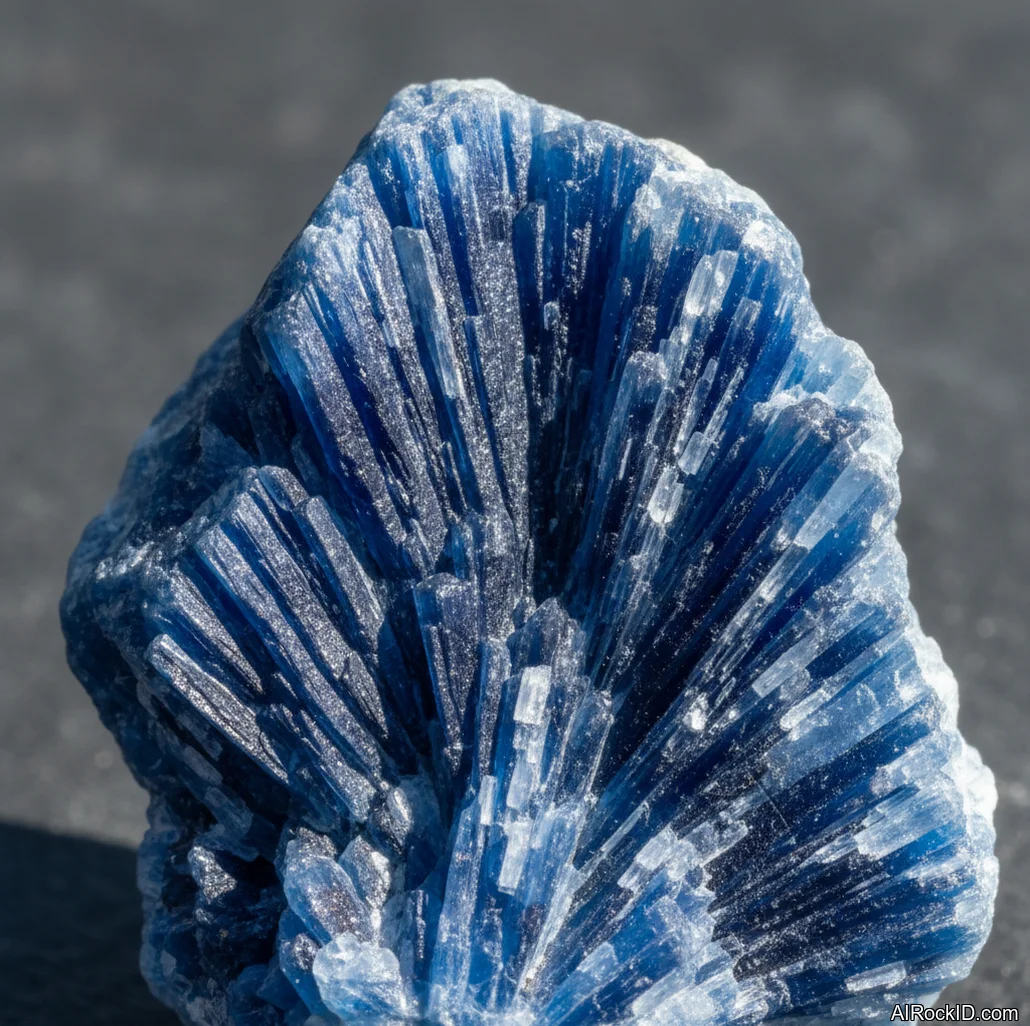
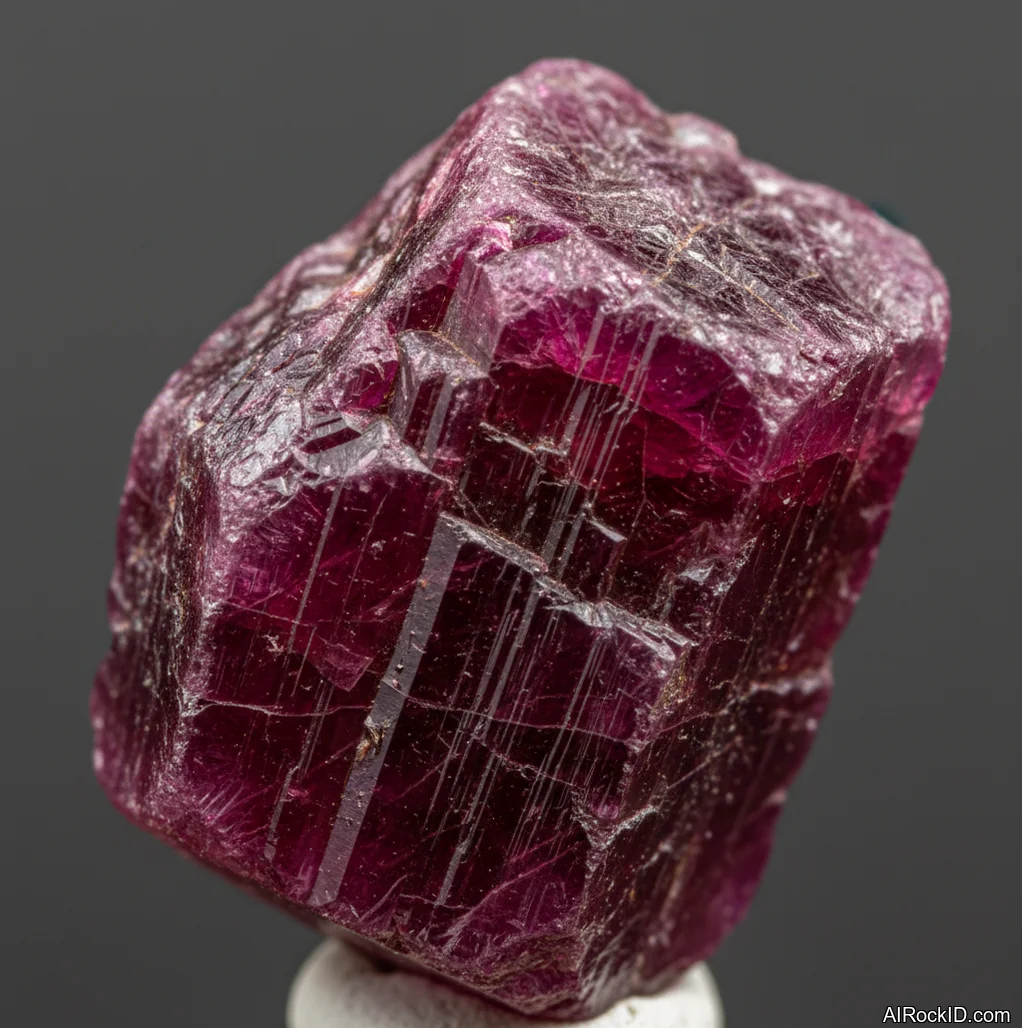
Hold a piece in your hand and you feel it fast. The kyanite has that boardy, bladed thing going on, almost like thin ridges, and the ruby spots stick up harder and knobbier, like tiny pebbly islands sitting in the blue. Some pieces show clean, obvious red dots. But others read more like wine-colored freckles until you tip them under a lamp and they finally pop.
People usually expect the ruby to look gemstone-bright at first glance. Most of the time it doesn’t. The ruby is generally opaque to translucent and more “crystal-in-matrix” than jewelry-grade, but it still looks great on a shelf because that blue-and-red contrast kind of sells itself (no effort required).
Origin & History
Ruby, the red gem form of the mineral corundum, got formally described as corundum back in the 18th century. The species name is credited to Johan Gottlieb Lehmann in 1760. “Ruby,” though, has been the go-to gem name for red corundum for a long time, well before anyone was being that formal about it.
Kyanite came later. It was described in 1789 by Abraham Gottlob Werner.
The word kyanite traces back to the Greek kyanos, meaning blue. And “ruby in kyanite”? That’s not a separate mineral name at all. It’s a trade label collectors use when you’ve got both minerals sitting together in one piece, like little red ruby blobs embedded in that bladed, denim-blue kyanite you can actually feel as ridges when you run a fingertip across it. Dealers have been leaning on the name more in the last couple decades because the stuff tumbles into really striking stones, and it photographs absurdly well. Why wouldn’t they push it?
Where Is Ruby In Kyanite Found?
Ruby and kyanite both form in metamorphic settings, and the combo shows up where aluminum-rich rocks get cooked and squeezed. In the market, most pieces are sold by country of export rather than a tight mine name.
Formation
Look at the overlap between these two minerals and it clicks. Ruby (Al2O3) and kyanite (Al2SiO5) both gravitate toward aluminum-rich source rocks. Think clay-heavy sediments that got hauled down deep, then cooked and squeezed into schists and gneisses, the kind that split along shiny mica planes and leave a little gritty dust on your fingers.
Kyanite is one of those pressure-indicator minerals. When the pressure and temperature line up, it shoots up as long, flat blades, sometimes fanning out in sprays or locking together in cross-hatched bundles you can feel as ridges if you run a fingernail across the rock. Ruby can grow right in that same setting, but only if there’s enough aluminum and the chemistry stays low in silica so corundum can actually stabilize. So you end up with ruby crystals sitting in or right up against kyanite blades, sometimes with mica, quartz, or darker amphibole in the mix. And yeah, the contact zones can be a bit of a jumble. Nature doesn’t hand you clean museum labels, does it?
How to Identify Ruby In Kyanite
Color: Most pieces show denim to slate blue kyanite with scattered red to purplish-red ruby crystals. The ruby color can look darker indoors and pop more under direct sunlight.
Luster: Kyanite is typically vitreous to pearly on cleavage faces, while ruby is vitreous and glassier on fresh surfaces.
If you scratch it with a steel nail, the kyanite will often take a mark along one direction but resist more across the blade. That directional hardness is a dead giveaway for kyanite. The ruby spots usually won’t scratch easily at all, and on a broken edge they stay shiny and crisp compared to the softer blue around them.
Common Look-Alikes
Ruby In Kyanite is sometimes confused with these materials:
- Ruby in Fuchsite
- Dyed Quartz with red and blue pigments
- Glass composites with embedded red chips
- Synthetic corundum set in blue resin
- Ruby in Zoisite
- Dyed blue kyanite with glass "ruby" bits
Market Cautions & Treatments
When AI Can Get This Wrong
AI photo ID apps mix up ruby in kyanite with ruby in fuchsite all the time because both show red dots in a blue-green matrix. In pictures, it's tough to spot the bladed kyanite texture; physical tests like scratching glass or checking for kyanite's splintery cleavage help confirm. If the red is glassy and flush, not pebbly, it's probably a fake.
Properties of Ruby In Kyanite
Physical Properties
| Crystal System | Triclinic |
| Hardness (Mohs) | 4.5-7 (kyanite is anisotropic; ruby is 9) (Hard (6-7.5)) |
| Density | 3.53-3.67 g/cm3 |
| Luster | Vitreous |
| Diaphaneity | Opaque to translucent |
| Fracture | Uneven |
| Streak | White |
| Magnetism | Non-magnetic |
| Colors | Blue, Red, Purple-red, Gray, Black |
Chemical Properties
| Classification | Silicates (kyanite) with oxide inclusion (corundum) |
| Formula | Al2SiO5 + Al2O3 |
| Elements | Al, Si, O |
| Common Impurities | Fe, Ti, Cr, V |
Optical Properties
| Refractive Index | 1.712-1.734 (kyanite); 1.762-1.770 (ruby) |
| Birefringence | 0.012-0.018 (kyanite); 0.008 (ruby) |
| Pleochroism | Strong |
| Optical Character | Biaxial |
Ruby In Kyanite Health & Safety
It’s usually fine to handle and keep at home. The bigger concern isn’t chemicals or anything like that, it’s physical: kyanite can splinter along its cleavage if you drop it, so you don’t want to learn that lesson the hard way.
Safety Tips
If you’ve gotta cut or grind it, put on a real respirator (not just a paper mask) and keep the surface wet the whole time so the dust doesn’t go flying everywhere.
Ruby In Kyanite Value & Price
Price Range
Rough/Tumbled: $8 - $80 per piece
Cut/Polished: $2 - $20 per carat
Price jumps around depending on how deep that blue looks in real light, how many ruby crystals you can spot with your own eyes, and if the piece is solid and clean or riddled with those crumbly seams that flake a bit when you rub a thumb over them. And yeah, big slabs with strong contrast, or those round spheres, run higher because cutting them eats up more rough and the pattern shows up way clearer.
Durability
Moderate — Scratch resistance: Fair, Toughness: Fair
It’s stable in normal room conditions, but kyanite’s perfect cleavage means it can chip or flake if it takes a hit.
How to Care for Ruby In Kyanite
Use & Storage
Store it where it won’t bang into harder stones. I keep mine in a tray with a little padding because the kyanite edges love to catch and chip.
Cleaning
1) Rinse quickly in lukewarm water. 2) Use a soft toothbrush with a drop of mild soap to get dust out of blade grooves. 3) Pat dry and let it air dry fully before putting it back in a box or bag.
Cleanse & Charge
For a gentle reset, I use smoke, sound, or a quick pass on selenite. If you’re a sunlight charger, keep it brief so you don’t bake the surface or fade the overall look over time.
Placement
It looks best under angled light, not flat overhead, because the kyanite cleavage flashes when you tilt it. Put it somewhere it won’t get knocked off, since a fall onto tile can turn a crisp edge into a chip.
Caution
Skip ultrasonic cleaners and steam. And don’t just drop it loose in a pocket or pouch with quartz points or any other hard stones. Kyanite’s the one that’ll get scratched up (you’ll see those little scuffs right along the edges first), so it ends up taking the hit.
Works Well With
Ruby In Kyanite Meaning & Healing Properties
Next to plain kyanite, ruby-in-matrix just feels more alive in your hand. Like there’s this little tug-of-war going on between calm and go. That’s why people chase it.
Blue kyanite gets framed as cool-headed and good for clean communication. Ruby, on the other hand, gets talked about as heat, drive, and stamina. Put them together and you end up with a combo a lot of folks reach for when they need to show up to a hard conversation and not mentally bail halfway through.
But here’s the bit people glide right past: the stone won’t do the work for you. What it can do, in my experience (and from a ton of customer chats at shows), is act like a physical cue. You look down at the red spots sitting in that blue and it snaps you back to the point. Keep your edge. Keep your heart in it. Say the thing anyway. I’ve carried a palm stone on long vendor days when I’m wiped out and starting to get short, and honestly it’s just a pocket reminder to stay steady.
None of this is medical advice. If you’re dealing with anxiety, burnout, or anything serious, treat the rock like support, not a fix. And if you’re sensitive to texture, choose carefully. Some tumbled pieces come out slick and easy to rub with your thumb, but raw kyanite can be splintery (like those tiny flaky edges you notice the second you squeeze it), and that can pull you right out of meditation.
Common mistakes
- Assuming the whole stone has ruby-level hardness because it contains corundum.
- Identifying any red-and-blue polished bead as ruby in kyanite without checking texture or treatment signs.
- Confusing ruby fluorescence or bright color with proof of natural origin.
- Using acid, scratch, or heat tests on finished jewelry and damaging the kyanite host.
- Overlooking filled pits, surface dye, or color concentration around drill holes in beads.
Identify Ruby In Kyanite from a photo
Compare Ruby In Kyanite traits, care tips, value clues, and common lookalikes with a clear photo.