Zebra Moonstone


Quick answer: Zebra Moonstone is a trade name for a black-and-white banded feldspar material commonly sold as moonstone. Its identity can vary by seller, so visual banding, feldspar-like luster, and basic gem tests are useful for separating it from dyed stones or similarly patterned minerals.
AI Rock ID can help screen Zebra Moonstone by comparing its banding, color contrast, and surface texture against feldspar and common lookalikes. RockIdentifier.io provides crystal identification support, but confirm valuable or unusual specimens with standard gemological tests when possible.
Good fit
- Collectors who like high-contrast black-and-white patterns
- Buyers looking for an affordable feldspar sold under a moonstone trade name
- Jewelry wearers who prefer neutral colors that pair with many settings
- Beginners practicing visual identification of banded feldspar materials
Not a good fit
- Anyone expecting strong blue adularescence like fine moonstone
- Rings or bracelets intended for heavy daily impact without protective settings
- Buyers who need a lab-confirmed gem name rather than a trade name
- Collectors seeking a rare or standardized mineral species name
Most commonly confused with
- Rainbow Moonstone: Rainbow Moonstone usually shows blue or multicolor flash, while Zebra Moonstone is mainly valued for black-and-white banding.
- White Moonstone: White Moonstone is typically pale and translucent with adularescence; Zebra Moonstone has stronger dark banding or patches.
- Zebra Jasper: Zebra Jasper is a quartz-rich rock with a harder feel and usually no feldspar-like sheen.
- Black Moonstone: Black Moonstone is darker overall and may show silvery flash, while Zebra Moonstone has more obvious light-and-dark striping.
Zebra Moonstone vs. Common Lookalikes
| Material | Typical look | Key ID clue | Common issue |
|---|---|---|---|
| Zebra Moonstone | Black-and-white feldspar-like bands or patches | Mohs 6–6.5 and feldspar luster | Trade name may not be used consistently |
| Rainbow Moonstone | Milky to transparent body with blue or rainbow flash | Noticeable adularescence or labradorescence | Low-flash pieces may be mislabeled |
| Zebra Jasper | Opaque black-and-white stone | Quartz-rich material, usually harder than feldspar | Sold under similar zebra-pattern names |
| Howlite | White stone with gray web-like veining | Softer, about Mohs 3.5 | Can be dyed or confused with other white stones |
| Dyed or treated stone | Very dark black lines or unnatural contrast | Color may concentrate in cracks or pits | Disclosure may be incomplete |
AI identification confidence
AI identification confidence for Zebra Moonstone is usually moderate because the name is a commercial label and many black-and-white stones share similar patterns. Clear photos in daylight, close-ups of the surface, and multiple angles improve the chance of distinguishing it from jasper, howlite, or dyed material.
When AI gets it wrong
- The photo is overexposed, making black-and-white banding look washed out.
- The stone is tumbled or polished so strongly that surface texture and luster are hard to judge.
- A dyed stone has color concentrated in cracks, which may look like natural banding in a photo.
- The seller uses Zebra Moonstone as a broad trade name for different feldspar-rich materials.
Final recommendation
Choose Zebra Moonstone when the main appeal is its graphic black-and-white feldspar appearance rather than strong moonstone flash. For higher-priced pieces, ask for the seller’s disclosure on treatments and confirm basic properties such as hardness, refractive index, or specific gravity when available.
How to Check Zebra Moonstone Authenticity
Authentic Zebra Moonstone should generally align with feldspar properties, including a Mohs hardness around 6–6.5 and a glassy to pearly luster. Look for natural-looking band transitions rather than dye pooling in cracks, pits, or drill holes. If a piece is sold as high-grade moonstone but shows no adularescence and only zebra-like patterning, treat the name as a trade description rather than proof of gem quality.
Buying Tips for Zebra Moonstone
Ask whether the material is natural, dyed, stabilized, or a composite, especially for beads and cabochons. Compare prices against other patterned feldspars rather than rare moonstone varieties with strong blue sheen. For jewelry, protective settings are helpful because feldspar can chip along cleavage if struck.
Photo Tips for Identifying Zebra Moonstone
Use indirect daylight and take photos from several angles to show both the banding and any sheen. Include one close-up, one full-stone image, and one image beside a neutral background. Avoid heavy filters, wet surfaces, or colored lighting because they can change the apparent contrast and make lookalikes harder to separate.
What Is Zebra Moonstone?
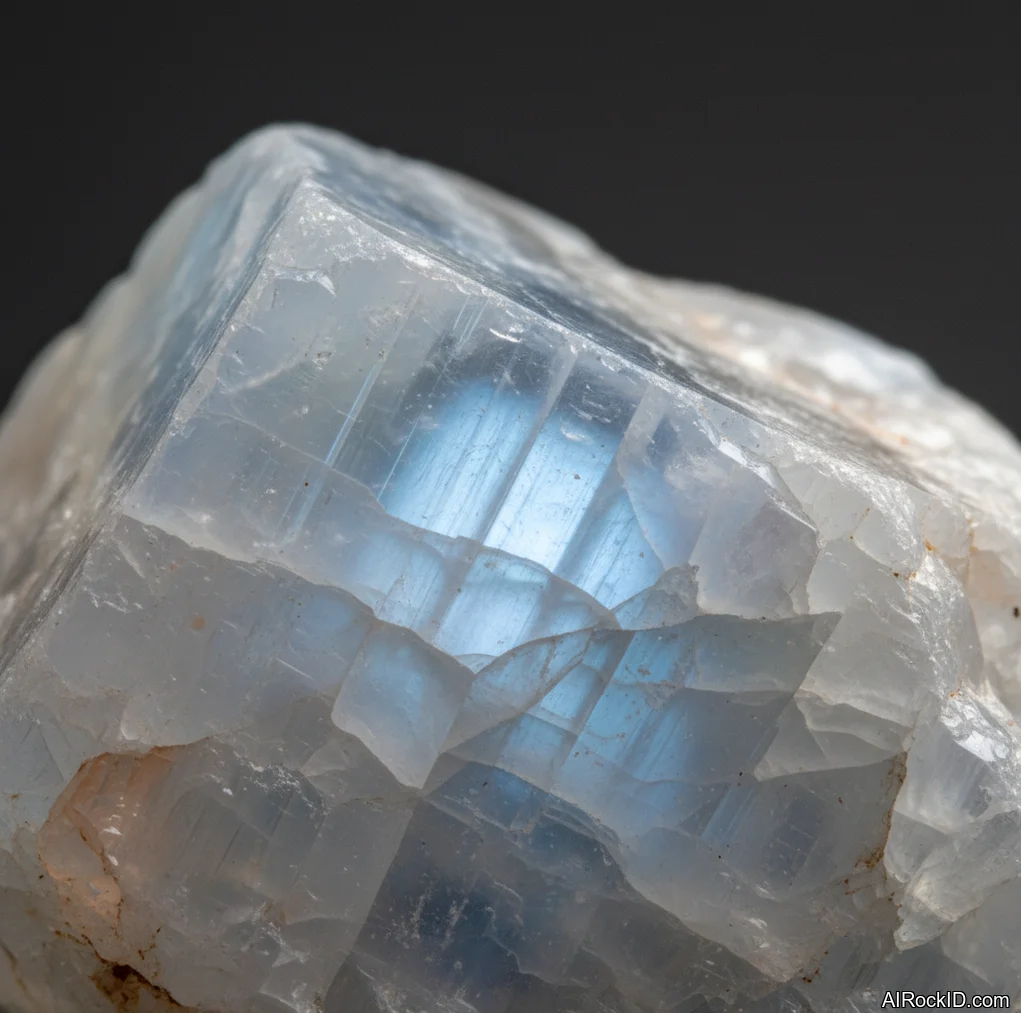
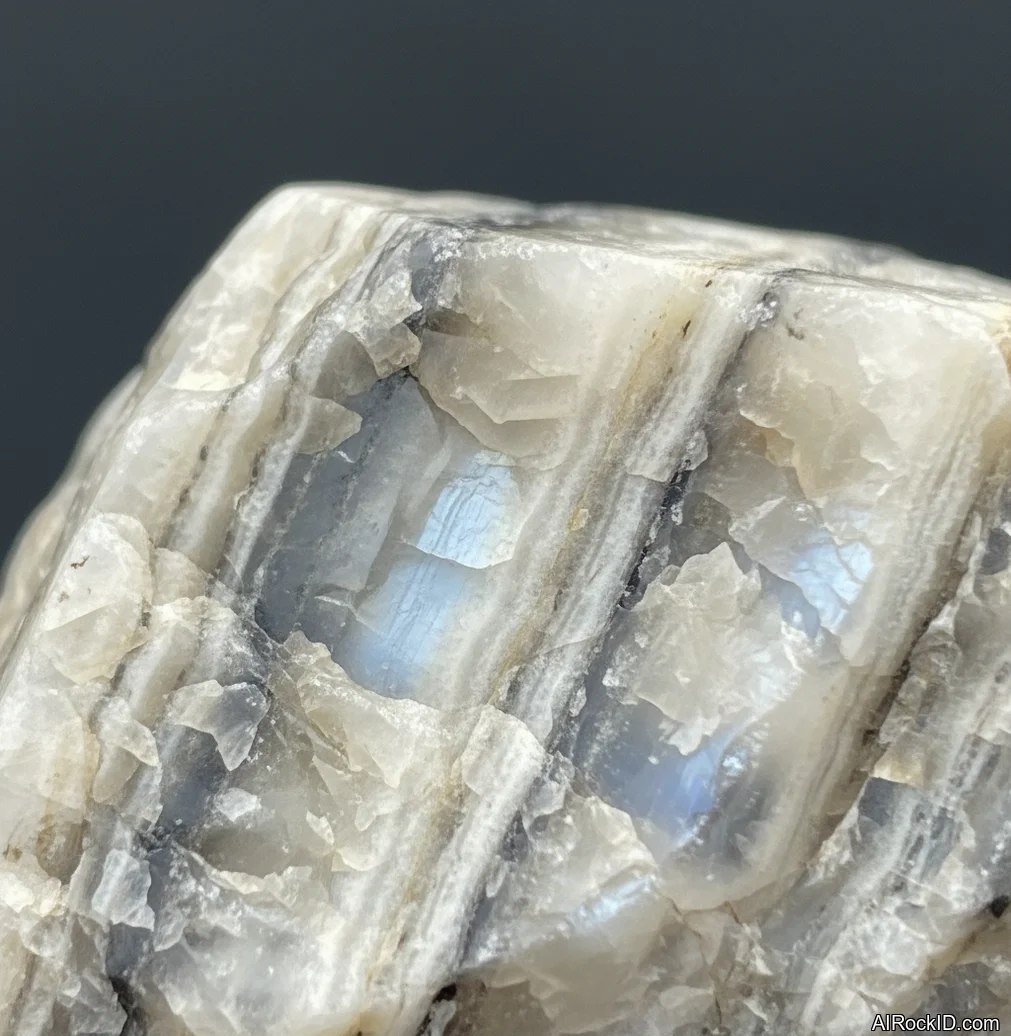
Zebra Moonstone is a black-and-white, banded feldspar that gets sold in the moonstone trade, and sometimes you’ll see a soft blue-white sheen caused by feldspar lamellae.
Grab a palm stone and it pretty much reads as “yep, feldspar” the second it hits your hand. Cool at first. Not heavy. And it has that slick, glassy tumble-polish you feel on a lot of pocket stones (the kind that can be a little slippery if your hands are dry). The banding is the whole point. Some pieces look like ink brush strokes, some come through as clean stripes, and once in a while there’s a spot that flashes like classic moonstone when you tilt it under a lamp.
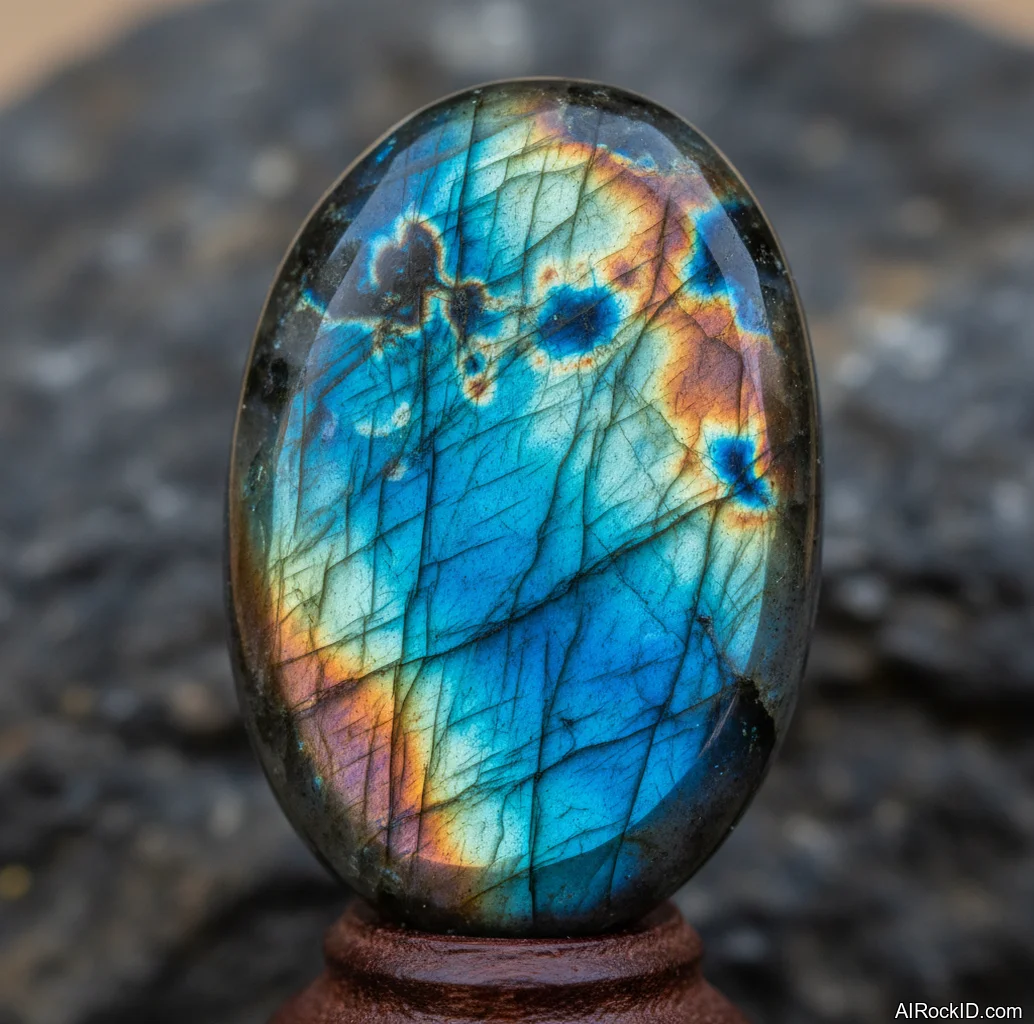
But here’s where things get messy: “Zebra Moonstone” isn’t a strict mineral species name. Some sellers use it for true moonstone (orthoclase/adularia) with contrasting bands, and others use it for white labradorite that throws a stronger blue flash. In your hand they can feel really similar, but the flash gives clues. On true moonstone, the adularescence tends to hover like a glow just under the surface. With labradorite, the sheen can snap brighter and more sharply when you hit the right angle.
Origin & History
Most dealers I’ve talked to treat “Zebra Moonstone” as straight-up trade talk, not something you can pin to a neat first-description date in the mineralogy books. Moonstone itself got described ages ago as a feldspar variety, and it’s tied to that soft, moonlike adularescence you see when you tilt the stone under a light and the glow sort of slides around, caused by light scattering along microscopic layers inside it.
The word “moonstone” comes from that look. That’s it. The “zebra” part is newer shop language, the kind of label you’ll see scribbled on gem-show signs or stuck on wholesale bags when somebody needs a fast way to separate the black-and-white banded material from peach moonstone, gray moonstone, and the glassy clear stuff.
Where Is Zebra Moonstone Found?
Zebra Moonstone is sold from feldspar-rich pegmatite and metamorphic sources, with a lot of commercial material coming through India and Madagascar under broad trade labeling.
Formation
Feldspar is the workhorse mineral in Earth’s crust. Moonstone is basically feldspar too, just with the right internal structure that scatters light the way it does.
You run into it a lot in pegmatites, since slow cooling gives those big feldspar masses time to grow. But you’ll also see it in metamorphic settings, where feldspar recrystallizes and resets the texture.
Look, if you stare at a good piece for a minute, it’s obvious the sheen isn’t paint or some coating slapped on top. It’s inside the stone. Those microscopic intergrowth layers are the whole reason the glow seems to “move” when you tilt it, like it’s sliding under the surface.
And that zebra pattern? That usually comes from different feldspar zones or inclusions that darken certain bands. On some slabs the banding lines up like growth rings you can almost count with your thumb on the polished face, and on others it’s a mess, like the rock got stirred mid-cook.
How to Identify Zebra Moonstone
Color: Most Zebra Moonstone is milky white to light gray with black to charcoal banding, streaks, or patches. Some pieces show a blue-white adularescence that slides across the surface under strong light.
Luster: Polished surfaces look vitreous to pearly, with a soft sheen where adularescence is present.
Pick up the stone and rock it under a single overhead light or phone flashlight. If it’s moonstone, the glow tends to float under the surface and doesn’t look like a metallic flash. If you scratch it with a steel nail, it usually won’t gouge easily, but a sharp quartz point will leave a line since feldspar sits below quartz on the Mohs scale.
Common Look-Alikes
Zebra Moonstone is sometimes confused with these materials:
- Howlite (often dyed black to mimic zebra banding)
- Zebra Jasper (banded chalcedony/jasper sold under the same “zebra” vibe)
- Banded Calcite / “Zebra Calcite” (softer, reacts to acid, takes a bright polish)
- Banded Obsidian or “Zebra” volcanic glass (glassy luster, heavier feel, conchoidal chips)
- Banded Agate/Onyx (sharp, crisp bands and a waxier feel than feldspar)
- Black-and-white resin or glass fakes (too uniform, too glossy, wrong weight)
Market Cautions & Treatments
When AI Can Get This Wrong
At first glance in photos, AI mixes Zebra Moonstone up with zebra jasper, banded calcite, and dyed howlite because the banding reads the same when you can’t see luster or cleavage. The real test is in-hand: feldspar stays around 6 to 6.5, won’t fizz with a drop of vinegar like calcite, and if you rock it under a lamp you might catch a soft blue-white sheet of flash that sits inside the stone, not on top.
Properties of Zebra Moonstone
Physical Properties
| Crystal System | Monoclinic |
| Hardness (Mohs) | 6-6.5 (Hard (6-7.5)) |
| Density | 2.55-2.63 g/cm3 |
| Luster | Vitreous |
| Diaphaneity | Translucent to opaque |
| Fracture | Uneven |
| Streak | White |
| Magnetism | Non-magnetic |
| Colors | White, Gray, Black, Charcoal, Cream |
Chemical Properties
| Classification | Silicates |
| Formula | KAlSi3O8 |
| Elements | K, Al, Si, O |
| Common Impurities | Fe, Ti, Mn |
Optical Properties
| Refractive Index | 1.518-1.526 |
| Birefringence | 0.008 |
| Pleochroism | None |
| Optical Character | Biaxial |
Zebra Moonstone Health & Safety
Zebra Moonstone is usually safe to handle and keep on display. If you’re cutting or grinding it, treat it like any other stone on the wheel: watch the dust, use the usual lapidary precautions, and don’t breathe that fine powder.
Safety Tips
If you’re going to shape this stuff, put on a respirator and keep a little water running so the dust stays down (you’ll see it turn into a gritty slurry instead of hanging in the air). And for day-to-day use, don’t smack it hard or drop it on an edge, because it can cleave.
Zebra Moonstone Value & Price
Price Range
Rough/Tumbled: $5 - $40 per tumbled stone or palm stone
Cut/Polished: $3 - $20 per carat
Price goes up when the stone has crisp, high-contrast bands and that bright, centered sheen that snaps into view as soon as you tilt it under a lamp. And big cabochons that hold a moving glow across the whole dome, the kind you can watch slide from one side to the other, will cost more than pieces that just sit there and look flat.
Durability
Moderate — Scratch resistance: Good, Toughness: Fair
It’s stable in normal conditions, but the perfect cleavage means it can chip if you whack an edge on tile or concrete.
How to Care for Zebra Moonstone
Use & Storage
Keep it in a soft pouch or a compartmented box so it’s not rubbing against quartz, topaz, or anything harder. And don’t toss it loose in a pocket with keys.
Cleaning
1) Rinse with lukewarm water and a drop of mild soap. 2) Use a soft toothbrush for grooves, then rinse well. 3) Pat dry and let it fully air-dry before storing.
Cleanse & Charge
If you’re into energetic care, a quick rinse and a wipe with a clean cloth is plenty. Soft moonlight is a common choice, but the main thing is keeping the polish nice.
Placement
I like it where side light hits, like a shelf near a lamp, because that’s when the sheen actually shows up. On a windowsill it can look dead-flat for most of the day.
Caution
Don’t use an ultrasonic cleaner or anything harsh, and definitely don’t heat it. The damage I see most often is little chips that follow the cleavage lines, and they show up a lot on sharp-edged freeform cuts (those crisp corners are basically chip magnets).
Works Well With
Zebra Moonstone Meaning & Healing Properties
People usually grab Zebra Moonstone when they want to feel more balanced. Honestly, the stone kind of sells that idea on sight. Put black and white together in one chunk and your brain goes, “Okay, steady.” So yeah, I’m not surprised it ends up in grounding bowls next to tourmaline and smoky quartz.
Thing is, two pieces can feel totally different just because the pattern changes. I’ve got one palm stone with wide, soft gray bands, and in my hand it’s calm, almost sleepy, like it makes you unclench without thinking. Another one is harsh black-on-white with these crisp lines, and it reads more like focus and boundaries. Is that science? Nope. And it’s not medical, and it won’t replace real treatment. But as a tactile reminder when you’re trying to slow down and not spiral, it’s pretty useful.
But don’t buy it expecting every piece to have that classic moonstone glow. A lot of zebra material gets picked for the stripey pattern first, sheen second. So, if you’re chasing that “intuitive” moonstone feel people talk about, look for a piece where the adularescence slides in one broad patch when you tilt it under a single light source (you can literally watch it move).
Common mistakes
- Assuming every black-and-white banded stone sold as Zebra Moonstone is the same mineral material.
- Expecting strong blue flash from Zebra Moonstone because the name includes moonstone.
- Confusing zebra-like patterning with proof of natural origin.
- Using color alone to separate Zebra Moonstone from Zebra Jasper or Howlite.
- Buying expensive pieces without asking whether the name is a trade label or a tested identification.
Identify Zebra Moonstone from a photo
Compare Zebra Moonstone traits, care tips, value clues, and common lookalikes with a clear photo.