Angel Aura Quartz


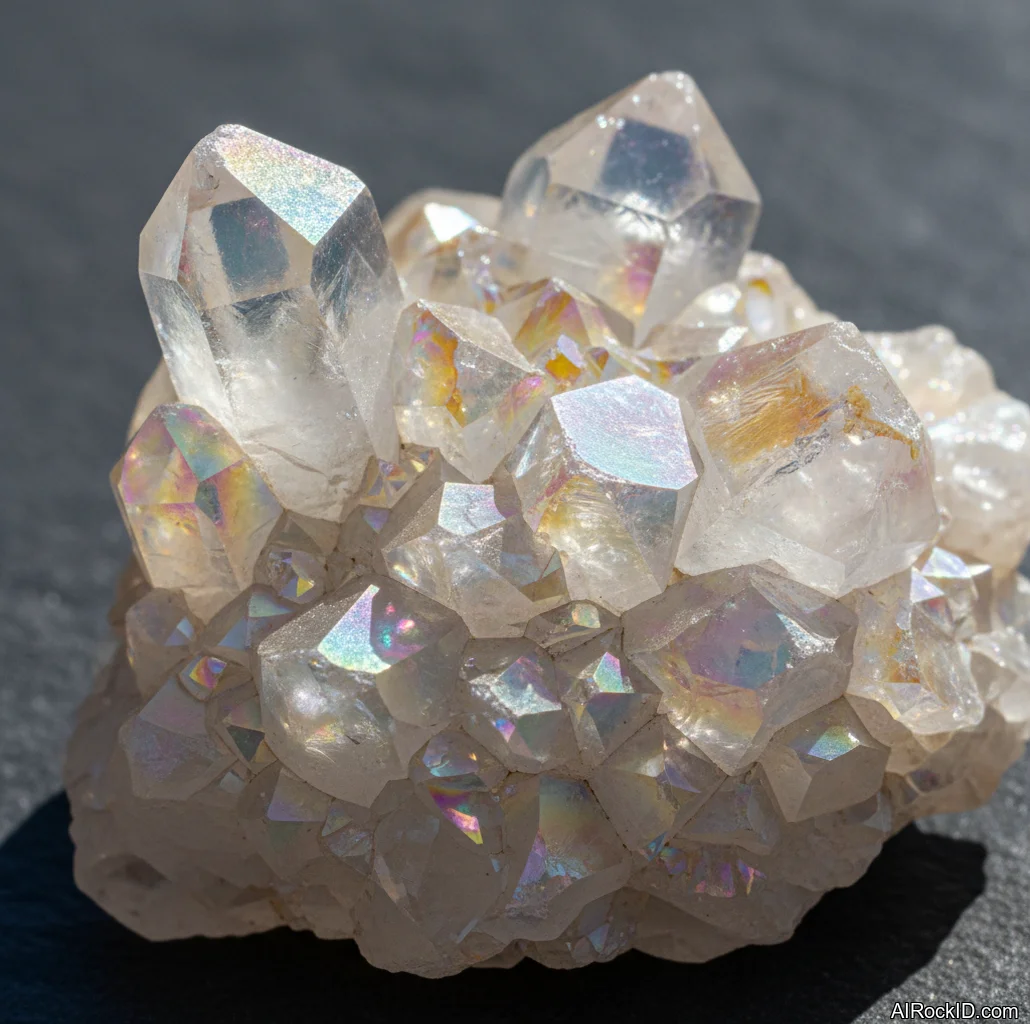
Quick answer: Angel Aura Quartz is natural quartz that has been permanently bonded with a thin metallic coating, usually through vapor deposition. Its rainbow sheen is manufactured, so identification should consider both the quartz base and the artificial surface treatment.
AI Rock ID can help compare Angel Aura Quartz against visually similar coated, dyed, or naturally iridescent stones from a photo. RockIdentifier.io treats Angel Aura Quartz as a treated quartz variety rather than a naturally occurring quartz color.
Good fit
- Collectors who want a clearly labeled treated quartz specimen
- Buyers comparing coated quartz with natural iridescent minerals
- People who prefer bright rainbow surface color over subtle natural inclusions
- Beginners learning to recognize enhancement treatments in crystals
Not a good fit
- Collectors seeking only untreated or fully natural quartz varieties
- Buyers who need a stone suitable for abrasive daily wear
- Anyone expecting the rainbow coating to be a natural quartz color
Most commonly confused with
- Opal Aura Quartz: Also coated quartz, but often shows a softer milky or pastel iridescence rather than the bright rainbow look of Angel Aura Quartz.
- Titanium Aura Quartz: Typically has stronger blue, purple, and metallic rainbow colors from a different coating recipe.
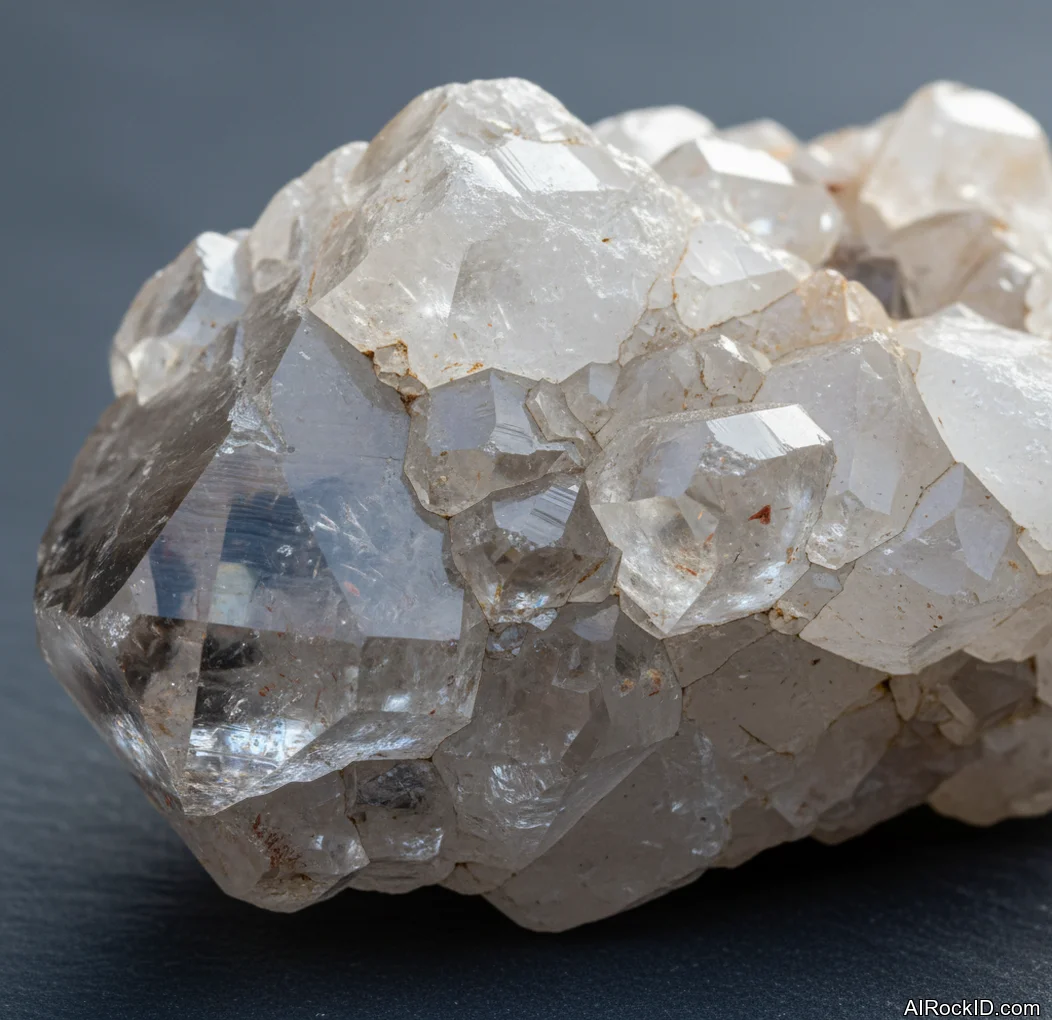
- Clear Quartz: Natural clear quartz lacks the permanent rainbow metallic surface film.
- Rainbow Quartz: Natural rainbow effects usually come from internal fractures or inclusions, not a uniform exterior coating.
Angel Aura Quartz Lookalike Comparison
| Material | Main visual clue | Treatment status | Typical distinction |
|---|---|---|---|
| Angel Aura Quartz | Clear quartz form with rainbow metallic sheen | Coated quartz | Iridescence sits on the outer surface |
| Clear Quartz | Transparent to milky without metallic colors | Usually untreated | No vapor-deposited surface film |
| Titanium Aura Quartz | Bold blue, purple, or multicolor metallic flash | Coated quartz | Often darker and more saturated |
| Rainbow Quartz | Color flashes from internal cracks | Natural or heated/fractured quartz | Color appears inside the stone, not as an exterior layer |
| Dichroic Glass | Smooth glassy body with artificial color layers | Manufactured glass | No natural quartz crystal faces or growth lines |
AI identification confidence
AI identification is usually moderate when a clear photo shows crystal shape, transparency, and the rainbow surface sheen. Confidence drops when the image is overexposed, heavily filtered, or shows only a close-up of iridescent color without crystal structure.
When AI gets it wrong
- The photo shows only the rainbow coating and not the quartz crystal form
- Lighting creates artificial rainbow glare on plain clear quartz or glass
- A different aura coating, such as titanium aura, has a similar multicolor finish
- The specimen is tumbled or carved, making quartz growth features hard to see
Final recommendation
Choose Angel Aura Quartz when the listing clearly states that it is coated quartz and provides photos in natural light. For untreated quartz collecting, select clear quartz or another natural quartz variety instead.
How to Check Angel Aura Quartz Authenticity
Authentic Angel Aura Quartz should be described as treated or coated quartz, not as a naturally rainbow-colored quartz species. Look for quartz-like crystal shape, a glassy luster, and a thin iridescent surface film that follows the exterior of the specimen. Be cautious of listings that avoid naming the coating process or imply the rainbow color formed naturally underground.
What the Coating Means for Identification
The iridescent layer on Angel Aura Quartz is a surface enhancement, so identification includes both the base mineral and the treatment. A scratch or chip may reveal ordinary clear or milky quartz beneath the coating. Surface color alone is not enough to separate Angel Aura Quartz from other aura-coated quartz varieties.
Buying Tips for Angel Aura Quartz
Reliable sellers usually label Angel Aura Quartz as clear quartz with a vapor-deposited metal coating. Photos taken under neutral lighting are more useful than highly saturated images because the coating can look much stronger under studio lights. For jewelry, inspect exposed edges and points, since coatings may show wear first in high-contact areas.
What Is Angel Aura Quartz?
Angel Aura Quartz starts out as natural clear quartz. Then it gets heat-treated and vacuum-coated with a microscopic layer of metals, usually titanium, and sometimes silver or platinum, which is what gives it that iridescent skin.
Look, the first time you see it, it honestly looks like somebody trapped an oil-slick rainbow on a quartz point. Hold it under a single lamp and tilt it a little. The colors skate from icy blue to pink to gold, then they disappear on one face and hit hard on another. Weird, right? That shift is the coating causing thin-film interference. It’s not the quartz itself changing color.
And when you pick one up, it still reads as quartz in your hand. Cool, glassy, and about the same weight as any other clear point from Brazil. But if you run a fingernail along the ridges, you can sometimes feel the tiniest bit of drag where that coating sits on the surface (especially on sharper edges). On worn tumbles, the rainbow layer usually goes thin along the edges first. That’s normal.
Origin & History
Most “aura quartz” you see out there basically goes back to late 20th-century lab work, when people started using vacuum deposition and sputtering on decorative glass, and then moved on to quartz points. There’s no single classic “first describer” like you get with an actual new mineral species, because Angel Aura Quartz isn’t a new mineral at all. It’s treated quartz.
And the name? Pure marketing. Dealers wanted something gentler than “titanium-coated quartz,” so “Angel Aura” ended up sticking, especially for that pale, opalescent coating that skews icy-blue instead of the louder peacock colors you’ll see on other aura styles.
Where Is Angel Aura Quartz Found?
The quartz base material commonly comes from Brazil, Madagascar, Arkansas (USA), China, and Russia, then it’s coated in a lab afterward.
Formation
Clear quartz starts out pretty simple: silica-rich fluids snake through tiny cracks in the rock. Then the pressure, temperature, or chemistry shifts, and quartz begins growing right there, building points that line pockets and veins. That’s where you get those classic terminations, the faint striations you can catch when you tilt the crystal in the light, plus the occasional phantom. All of it. It’s basically the crystal’s growth history locked in place, which is why collectors obsess over it.
Angel Aura comes later. And this is the part people mix up: that rainbow shine didn’t “grow” in the earth. The quartz gets put into a vacuum chamber, and vaporized metal is bonded onto the outside at high heat, leaving a coating so thin it’s measured in nanometers. The quartz underneath is still quartz. The outer skin is the special effect (pretty, sure, but it’s a coating).
How to Identify Angel Aura Quartz
Color: Iridescent rainbow sheen over a clear or milky quartz base, often with a soft blue-white cast on the main faces. Color is strongest on flat faces and weaker on chipped edges.
Luster: Vitreous with a slick, iridescent surface flash from the coating.
Look closely at chips and dings. On real coated quartz, the rainbow sits on the surface and you can see plain quartz in tiny bruises or at fresh fractures. If you scratch it with a steel pin, the quartz won’t budge much, but the coating can get a faint scuff line. And if a seller claims the rainbow is “natural,” that’s your red flag.
Common Look-Alikes
Angel Aura Quartz is sometimes confused with these materials:
- Angel Aura glass (lab-made glass with a similar rainbow finish)
- Iridescent titanium-coated quartz (other 'aura' treatments with different metals)
- Opalite glass (milky, blue glow, often sold as 'moonstone')
- Rainbow aura quartz (sometimes labeled differently but made the same way)
- Mystic quartz (colorless quartz coated with a different metallic film)
- Dyed quartz with iridescent paint or film
Market Cautions & Treatments
When AI Can Get This Wrong
AI photo tools confuse Angel Aura Quartz with opalite glass and other aura-coated stones, especially under mixed lighting. Pictures flatten the rainbow flash, so it can look like plain quartz or even plastic. The real test is scratching glass (quartz does, glass fakes don't) and checking for cold weight and conchoidal fractures.
Properties of Angel Aura Quartz
Physical Properties
| Crystal System | Trigonal |
| Hardness (Mohs) | 7 (Hard (6-7.5)) |
| Density | 2.65 g/cm3 |
| Luster | Vitreous |
| Diaphaneity | Transparent to translucent |
| Fracture | Conchoidal |
| Streak | White |
| Magnetism | Non-magnetic |
| Colors | Clear, White, Iridescent rainbow, Blue, Pink, Gold |
Chemical Properties
| Classification | Silicates |
| Formula | SiO2 |
| Elements | Si, O |
| Common Impurities | Al, Fe, Li, Na, K, Ti |
Optical Properties
| Refractive Index | 1.544-1.553 |
| Birefringence | 0.009 |
| Pleochroism | None |
| Optical Character | Uniaxial |
Angel Aura Quartz Health & Safety
Handling is pretty low-risk. But if you’re cutting or grinding quartz, don’t breathe in the dust, it gets everywhere and you’ll feel it in your throat. The coating? It’ll scratch if you’ve got grit rubbing on it (think sandy bits stuck on a rag), but plain water won’t do anything to it.
Safety Tips
If you’re polishing or drilling, keep a little water running, make sure you’ve got decent ventilation, and wear a proper respirator that’s actually rated for silica dust. It matters.
Angel Aura Quartz Value & Price
Price Range
Rough/Tumbled: $5 - $60 per piece (typical small points and tumbles); $80 - $250+ for large, clean clusters
Price mostly comes down to the quartz quality underneath, like how clear it is, whether the termination is clean, and how big the piece actually is when you’ve got it in your hand. And then there’s the coating. If it lays on evenly with no bare patches and none of those cloudy, slightly scorched-looking spots, it’ll usually cost more.
Durability
Durable — Scratch resistance: Excellent, Toughness: Good
Quartz holds up well, but the thin aura coating can scuff, wear on edges, or get dulled by abrasives and harsh cleaners.
How to Care for Angel Aura Quartz
Use & Storage
Store it like you’d store any coated jewelry. Wrap it or keep it in a soft pouch so the surface doesn’t rub against harder stones or sand in a drawer.
Cleaning
1) Rinse briefly in lukewarm water with a drop of mild soap. 2) Use your fingers or a very soft cloth, no scrub pads. 3) Rinse and pat dry, then air-dry fully before putting it away.
Cleanse & Charge
If you do energetic cleansing, stick to gentle methods like smoke, sound, or moonlight. Salt scrubs and rough tumbling are what chew up the sheen.
Placement
Put it where it gets angled light, like a shelf near a lamp, not in direct sun all day. The rainbow reads best when you can tilt it and catch a single bright source.
Caution
Skip ultrasonic cleaners. Don’t use abrasive polishing compounds either, and definitely don’t go at it with gritty salt. Also, don’t just toss it loose in your pocket with your keys. The coating will pick up those tiny scuff tracks, the kind you can feel with a fingernail when you tilt it under a light.
Works Well With
Angel Aura Quartz Meaning & Healing Properties
Most dealers lump Angel Aura in with “high vibration,” but here’s the plain, feet-on-the-floor take. It’s still quartz underneath, so if you already use clear quartz as a focus stone, Angel Aura feels pretty similar in your hand. Clean. Bright. And that rainbow coating gives your eyes something obvious to grab onto when you’re trying to settle your attention (and your brain’s bouncing around).
Pick up a point on a busy shop day and, honestly, the shimmer does most of the heavy lifting. Your gaze catches that oily little flash on the facets, you stop doom-scrolling in your head for a second, and you remember to breathe. Is that medicine? Nope. I’m not treating anything with it. It’s just a small, shiny cue to slow down.
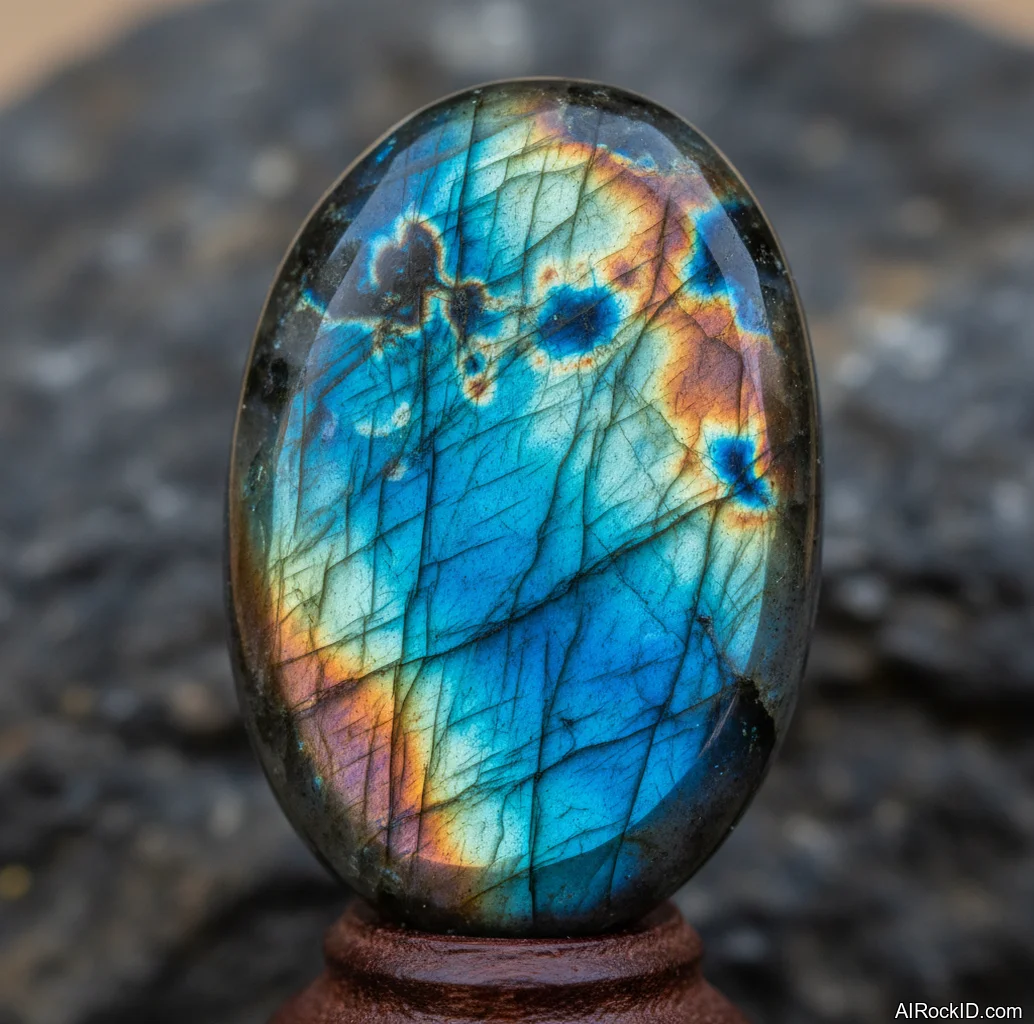
But there’s a catch people skip. Because it’s coated, some folks end up bummed when the surface starts to dull over time, especially with tumbles that ride in a pocket with keys and loose change. If you want a “forever finish,” grab a coated point that mostly lives on a shelf, or go with natural rainbow makers like labradorite if wear is going to bug you.
Common mistakes
- Calling Angel Aura Quartz a naturally occurring quartz color
- Assuming all rainbow quartz is Angel Aura Quartz
- Identifying the stone from color alone without checking crystal form
- Confusing coated quartz with dichroic glass or metallic-coated glass
- Expecting every Angel Aura Quartz piece to show the same intensity of rainbow sheen
Identify Angel Aura Quartz from a photo
Compare Angel Aura Quartz traits, care tips, value clues, and common lookalikes with a clear photo.