Arizona Pietersite


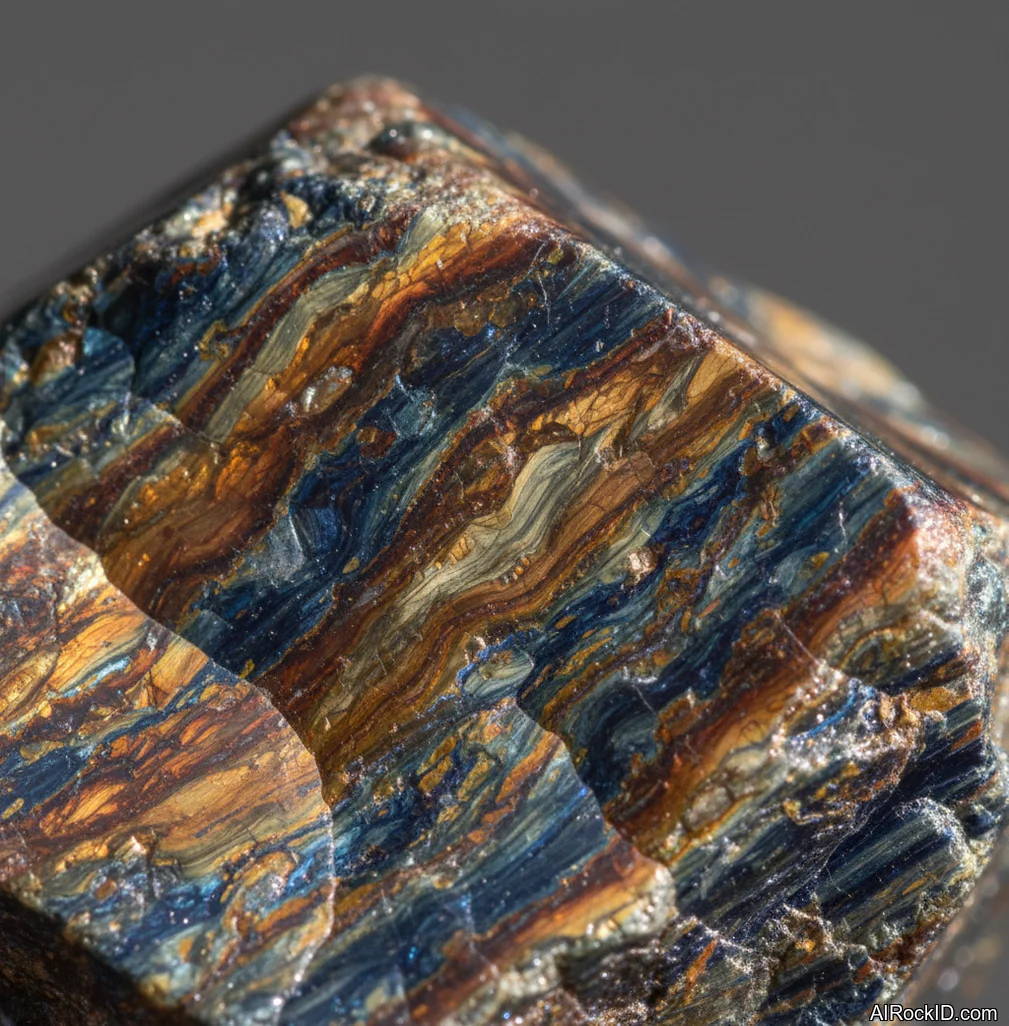
Quick answer: Arizona pietersite is a brecciated, chatoyant quartz-rich rock known for streaky gold, brown, blue-gray, or reddish fibers in a swirled pattern. It is most useful to identify by its broken, stormy texture, silky flashes, and quartz-like hardness rather than by color alone.
AI Rock ID can help compare Arizona pietersite with visually similar chatoyant stones by analyzing pattern, luster, and color distribution from a clear photo. RockIdentifier.io provides reference information that can support identification, but uncertain or high-value specimens should still be checked by a qualified gemologist or mineral laboratory.
Good fit
- Collectors who like chatoyant stones with irregular, brecciated patterns
- Buyers comparing tiger’s eye, hawk’s eye, and pietersite-type material
- Jewelry use where a polished cabochon or bead is preferred over a faceted gem
- People who want a quartz-based stone with a distinctive stormy appearance
Not a good fit
- Anyone needing a transparent faceted gemstone
- Buyers who require a verified locality without seller documentation
- Rough handling in rings or bracelets without protective settings
- Identification based only on color, since similar stones can overlap visually
Most commonly confused with
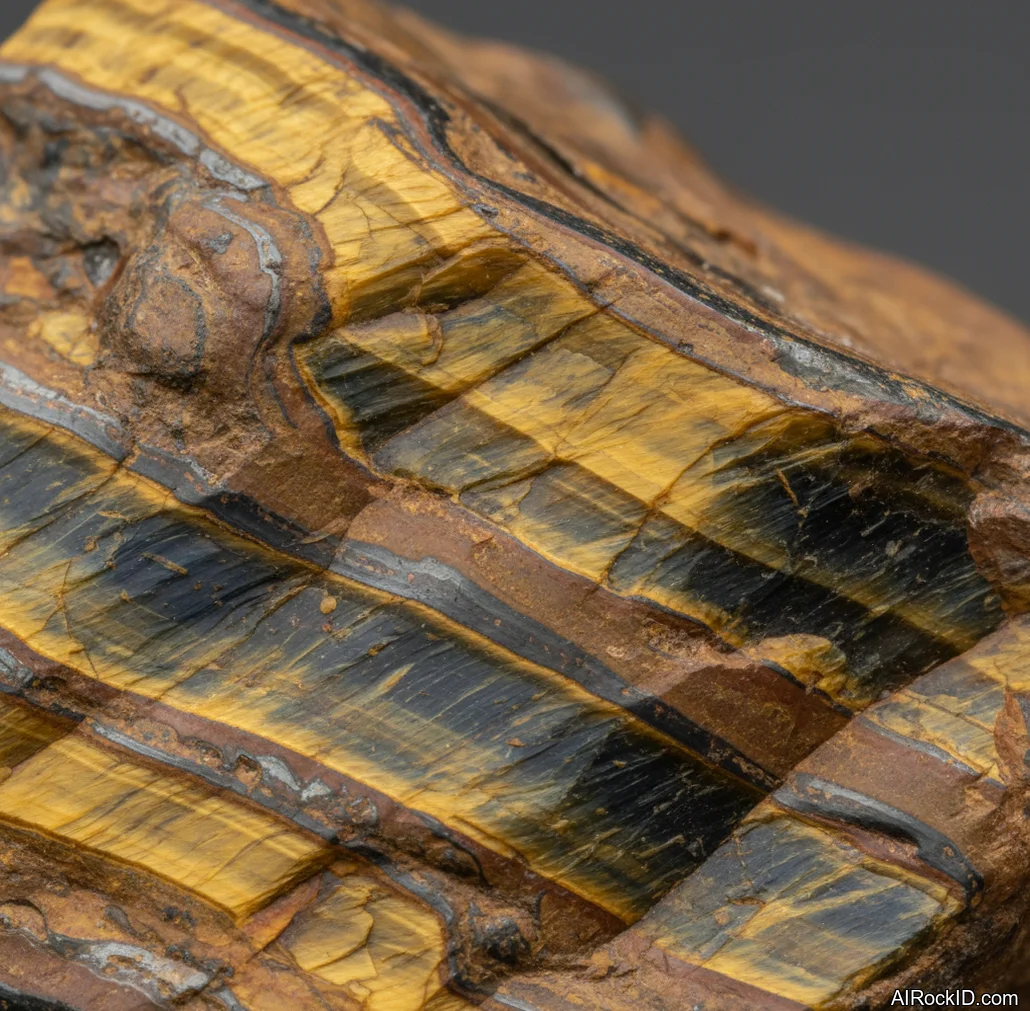
- Tiger's Eye: Tiger's eye usually has straighter, more parallel golden bands instead of the broken, swirled breccia pattern typical of pietersite.
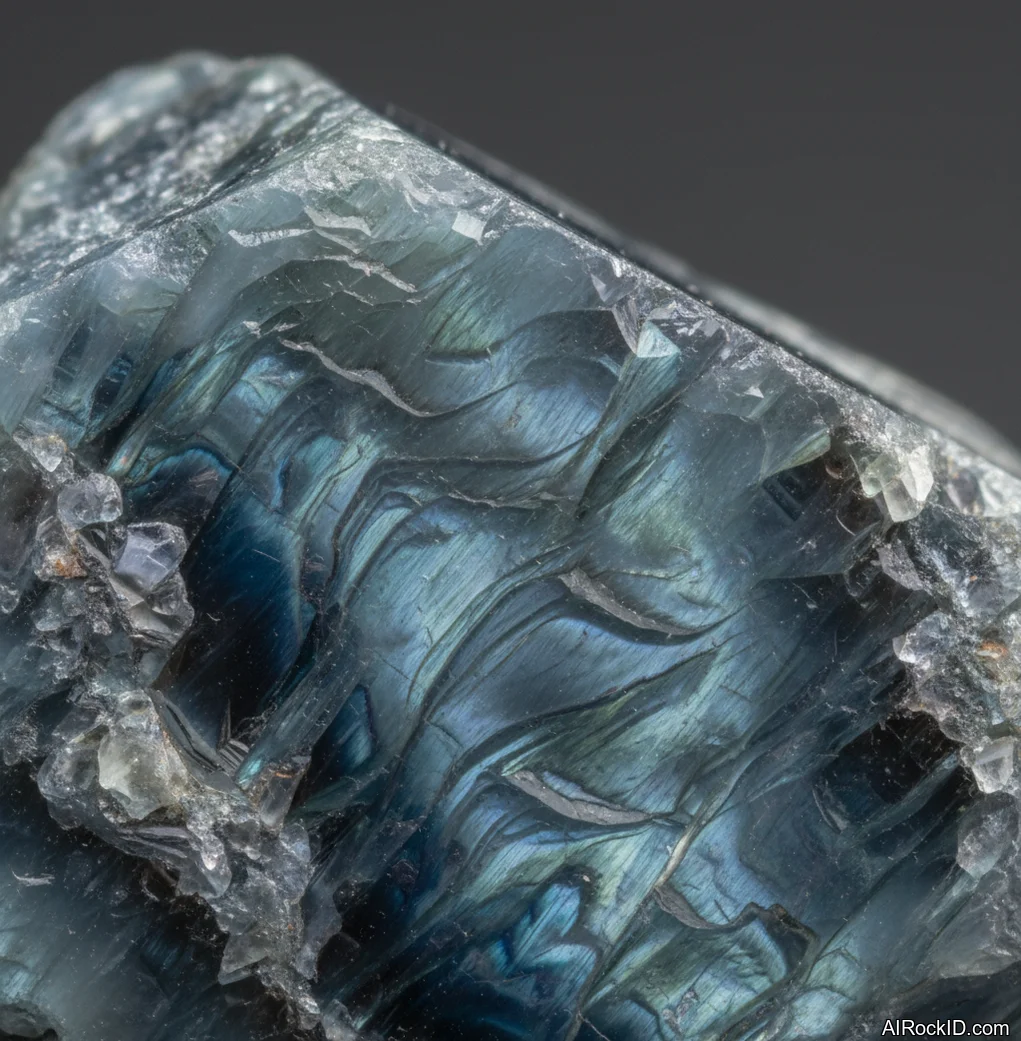
- Hawk's Eye: Hawk's eye is commonly blue-gray and fibrous with more continuous banding, while Arizona pietersite tends to show more chaotic patches and mixed colors.
- Binghamite: Binghamite can show chatoyancy and mottled color, but it is an iron-rich jasper-like material rather than a classic pietersite-style brecciated quartz with amphibole fibers.
- Seraphinite: Seraphinite has feathery silver-green clinochlore patterns and is much softer than quartz-based Arizona pietersite.
Arizona Pietersite vs. Common Lookalikes
| Stone | Typical Look | Key Difference |
|---|---|---|
| Arizona pietersite | Swirled, brecciated patches with silky chatoyancy | Broken storm-like texture with mixed fiber directions |
| Tiger's eye | Golden to brown parallel bands | Straighter banding and more uniform fiber direction |
| Hawk's eye | Blue-gray fibrous bands | Usually less brecciated and more linearly banded |
| Binghamite | Mottled red, gold, and brown with chatoyant areas | Different iron-rich jasper-like composition and locality association |
| Dyed quartz | Bright or uneven artificial color | Color may concentrate in cracks; natural chatoyancy is often absent |
AI identification confidence
AI identification is usually moderate for polished Arizona pietersite when the photo clearly shows chatoyancy, brecciation, and color zoning. Confidence drops when the stone is photographed under flat lighting, is highly polished with glare, or resembles tiger's eye or hawk's eye in a small cropped image.
When AI gets it wrong
- The photo shows only color and not the moving silky flash caused by fibrous inclusions.
- A cabochon has straight golden bands that make it look like tiger's eye from one angle.
- The specimen is dyed, resin-treated, or sold under a trade name without locality proof.
- The image is too dark, overexposed, or taken through plastic packaging.
Final recommendation
Choose Arizona pietersite when the specimen shows natural-looking fibrous chatoyancy, irregular brecciation, and a polish that reveals depth rather than flat surface color. For higher-priced pieces, ask for locality information, treatment disclosure, and clear photos taken from multiple angles.
How to Photograph Arizona Pietersite for Identification
Use a single bright light source and tilt the stone slowly to show any moving silky flash. Take one photo straight on, one at an angle, and one close-up of the surface pattern. Avoid heavy filters because boosted contrast can make tiger's eye, hawk's eye, and pietersite appear more similar than they are.
Buying and Authenticity Checks
Authentic Arizona pietersite should show natural-looking fiber bundles, irregular brecciated structure, and chatoyancy that shifts with light. Be cautious of listings that rely only on the word “pietersite” without locality, treatment, or material details. Very bright colors, color pooling in cracks, or a uniform painted appearance can indicate dye or surface enhancement.
Locality and Trade Name Notes
The name Arizona pietersite is used in the trade for Arizona-sourced or Arizona-associated pietersite-like chatoyant quartz material. Because pietersite names are sometimes applied broadly to brecciated tiger's eye or hawk's eye material, locality claims should be supported by seller documentation when provenance matters.
What Is Arizona Pietersite?
Arizona Pietersite is a pietersite-style, brecciated quartz rock with chatoyant fibrous inclusions, sold as “pietersite” from Arizona.
Grab a palm stone and you feel it instantly. It’s cooler than glass, heavier than it looks, and the polish has that slick, almost oily slide when you run your thumb over it. From across the table it can come off like tiger’s eye with a mean streak, all busted ribbons and swirls, but tip it under a lamp and the flash doesn’t behave in tidy bands. It kind of drifts. Patches light up, then go dark.
Most of the Arizona material I’ve had in hand leans more blue-gray, smoky, and bronze than the classic Namibia stuff. You’ll still see gold chatoyancy, but it’s usually chunkier, like little storm-cloud clumps of shimmer caught inside the quartz. And yeah, the name turns into a whole thing at shows. Some dealers will call any brecciated, chatoyant quartz “pietersite,” while the stricter crowd keeps “pietersite” for the original material and treats “Arizona pietersite” as a trade label for similar-looking rock.
Origin & History
Pietersite got its first proper write-up in 1962, over in Namibia. Sid Pieters, a Namibian mineral dealer and prospector, is the one tied to that description, and the name is literally just his last name. Simple. Documented. No drama.
“Arizona Pietersite,” though? That’s a whole different situation. It’s a trade label that showed up once lapidaries and sellers started cutting chatoyant, brecciated quartz from Arizona that has that pietersite-ish look when you tilt it under a light and the sheen slides across the surface. There’s no separate, approved mineral species for it. And you won’t see “Arizona pietersite” listed as a formal mineral entry the way you would for quartz or crocidolite.
So in the shop and show world, it’s basically shorthand for “pietersite vibe, but from Arizona.” And depending on who’s behind the table (and what sign they printed that morning), the exact same rough might be sitting there labeled “brecciated tiger eye” instead.
Where Is Arizona Pietersite Found?
Arizona material is sold out of the U.S. lapidary market, with rough attributed to Arizona localities rather than a single famous mine.
Formation
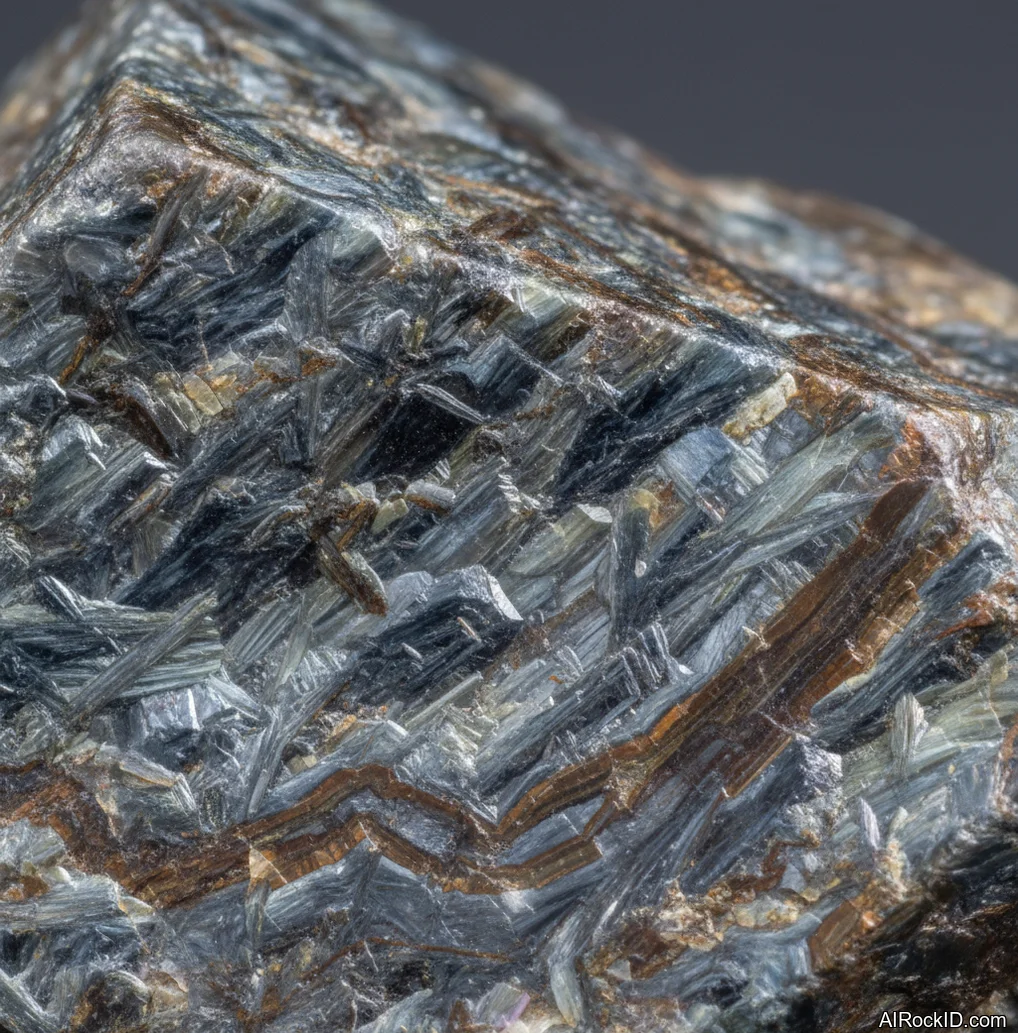
Look at the structure for a second and the story clicks. Pietersite-style material starts out as fibrous amphibole (usually crocidolite), then it gets silicified, and later the whole thing gets broken up and re-cemented by silica. That’s why the shimmer shows up in ragged, torn-looking patches, not those neat, parallel bands.
But compared to regular tiger’s eye, the breccia part is the point. You’re not just looking at fibers getting replaced by quartz. You’re seeing fibers first, then stress, then fracture, then quartz moving in and basically gluing it all back together. In hand samples, you can sometimes catch those healed crack lines as slightly dull seams, and they won’t flash the same way when you tilt the stone under a light (you know that little “dead strip” that stays flat while everything else lights up?).
How to Identify Arizona Pietersite
Color: Usually blue-gray, smoky gray, brown, and bronze-gold with patchy chatoyancy; some pieces lean more iron-stained red-brown depending on the rough.
Luster: Polished pieces show a silky to vitreous luster, with a moving cat’s-eye sheen in fibrous zones.
Pick up a piece and rotate it under a single point light like your phone flashlight. Real chatoyancy moves as a band or patch that slides across, not a glittery sparkle that stays put. The problem with photos is they freeze the flash, so ask for a quick video if you’re buying online. If the surface feels warm fast and the pattern looks printed or too uniform, you’re probably looking at resin or a composite.
Common Look-Alikes
Arizona Pietersite is sometimes confused with these materials:
- Namibian pietersite (the classic blue-gold material)
- Tiger’s eye / hawk’s eye quartz (banded chatoyancy that reads similar in photos)
- Brecciated jasper or brecciated chert sold as “pietersite”
- Bronzite or hypersthene (silky bronze flash, especially in palm stones)
- Dyed quartzite/chalcedony sold as “blue pietersite” (dye grabs the crackle)
- Man-made fiber-optic glass (cat’s eye glass) cut as cabochons
Market Cautions & Treatments
When AI Can Get This Wrong
At first glance, phone pics make Arizona pietersite read like tiger’s eye/hawk’s eye or even bronzite because the flash gets flattened into simple bands by the camera. AI struggles most when the stone’s mostly smoky gray with only small gold streaks, or when the breccia pattern looks like jasper. Pick up a piece and rotate it under a single point light: real Arizona material tends to have broken, drifting chatoyancy that pops in patches, while fiber-optic glass throws one clean, uniform stripe every time.
Properties of Arizona Pietersite
Physical Properties
| Crystal System | Trigonal |
| Hardness (Mohs) | 6.5-7 (Hard (6-7.5)) |
| Density | 2.60-2.70 g/cm3 |
| Luster | Vitreous |
| Diaphaneity | Opaque |
| Fracture | Conchoidal |
| Streak | White |
| Magnetism | Non-magnetic |
| Colors | Blue-gray, Smoky gray, Brown, Gold, Bronze, Red-brown |
Chemical Properties
| Classification | Silicates |
| Formula | SiO2 |
| Elements | Si, O |
| Common Impurities | Fe |
Optical Properties
| Refractive Index | 1.544-1.553 |
| Birefringence | 0.009 |
| Pleochroism | None |
| Optical Character | Uniaxial |
Arizona Pietersite Health & Safety
Handling it is pretty low-risk. But the moment you start cutting it, things change fast, because sawing, sanding, or drilling can kick up respirable silica dust that’s actually hazardous. Don’t breathe any of that dust. Seriously.
Safety Tips
Use wet cutting for lapidary work, and don’t cheap out on a proper respirator that’s actually rated for fine particulates. That mist and grit gets everywhere, even on your sleeves and the damp ring it leaves around the saw pan. And when you’re done, deal with the slurry the safe way. Scoop it up or wipe it out while it’s still wet (yeah, it’s gross), instead of letting it dry out and turn into dust you can kick up later. Why make more airborne junk for yourself?
Arizona Pietersite Value & Price
Price Range
Rough/Tumbled: $15 - $120 per piece
Cut/Polished: $3 - $18 per carat
Price jumps fast when the slab has a strong moving flash, a tight breccia pattern, and a clean polish with zero undercutting. But if you’ve got those gray, dead zones or crumbly seams, value drops quick because cutters end up losing material.
Durability
Durable — Scratch resistance: Good, Toughness: Good
It’s generally stable like quartz, but fractured breccia seams can chip if the cab is thin at the edges.
How to Care for Arizona Pietersite
Use & Storage
Store it like you would any polished quartz cab or palm stone: separate from softer stones so it doesn’t scratch them, and keep it from banging into harder stuff like topaz or corundum.
Cleaning
1) Rinse with lukewarm water. 2) Use a drop of mild soap and your fingers or a soft cloth to wipe. 3) Rinse again and dry fully before putting it away.
Cleanse & Charge
If you do energetic cleansing, I’d stick to simple stuff like smoke, sound, or a quick rinse and dry. Long salt soaks aren’t needed and can creep into fractures on brecciated pieces.
Placement
A desk or shelf spot with angled light is where it looks best because the flash needs direction. Keep it out of direct sun if you’re worried about heat on glued settings or jewelry findings.
Caution
Don’t toss jewelry with this material into an ultrasonic cleaner if the cab has any visible fractures or seams. That buzzing vibration can worm its way into the weak spots and make them spread. And if you’re shaping it or doing a re-polish, don’t breathe in the dust. It’s the kind that hangs in the air for a second (you’ll see it in the light) before it settles. Why risk it?
Works Well With
Arizona Pietersite Meaning & Healing Properties
Most people grab pietersite-style stones when they’re chasing that “clear the fog” feeling. In my own little pile, it’s the one I reach for when my attention’s all over the place and I need to stop doom-scrolling, sit up, and actually finish the thing in front of me. The stone looks like that mood, too. All swirly and stormy, kind of busy, and then you tilt it and the light hits just right, and there’s this clean ribbon of flash that slides across.
But look, I’m not going to pretend it’s a magic reset button. A lot of listings talk like it fixes your life in one go, and… come on. What it can do (if you’re into crystal work) is act like a physical anchor for mindfulness. You hold it, roll it between your fingers, turn it slowly, watch the sheen move as the angle changes, and your brain settles a bit because there’s something real to lock onto.
And if you’re wearing it, I’ve noticed cabs with tighter, more continuous chatoyancy feel “louder” in that meditative way than the blotchy ones. Not science. Just what I’ve seen after picking them up over and over and getting a feel for the pattern. But if you’re dealing with real anxiety or panic, treat crystals like a comfort object at best, not a replacement for a professional who actually knows what they’re doing. Who wants to gamble with that?
Common mistakes
- Assuming every swirled brown-and-gold chatoyant stone is Arizona pietersite.
- Using color alone instead of checking for brecciation, fiber direction, and moving chatoyancy.
- Confusing straight-banded tiger's eye with pietersite because both can be golden and silky.
- Accepting an Arizona locality claim without documentation for collectible or resale purposes.
- Overlooking dye signs such as unusually vivid color concentrated along fractures.
- Judging hardness from a polished surface without considering coatings, backing, or composite settings.
Identify Arizona Pietersite from a photo
Compare Arizona Pietersite traits, care tips, value clues, and common lookalikes with a clear photo.