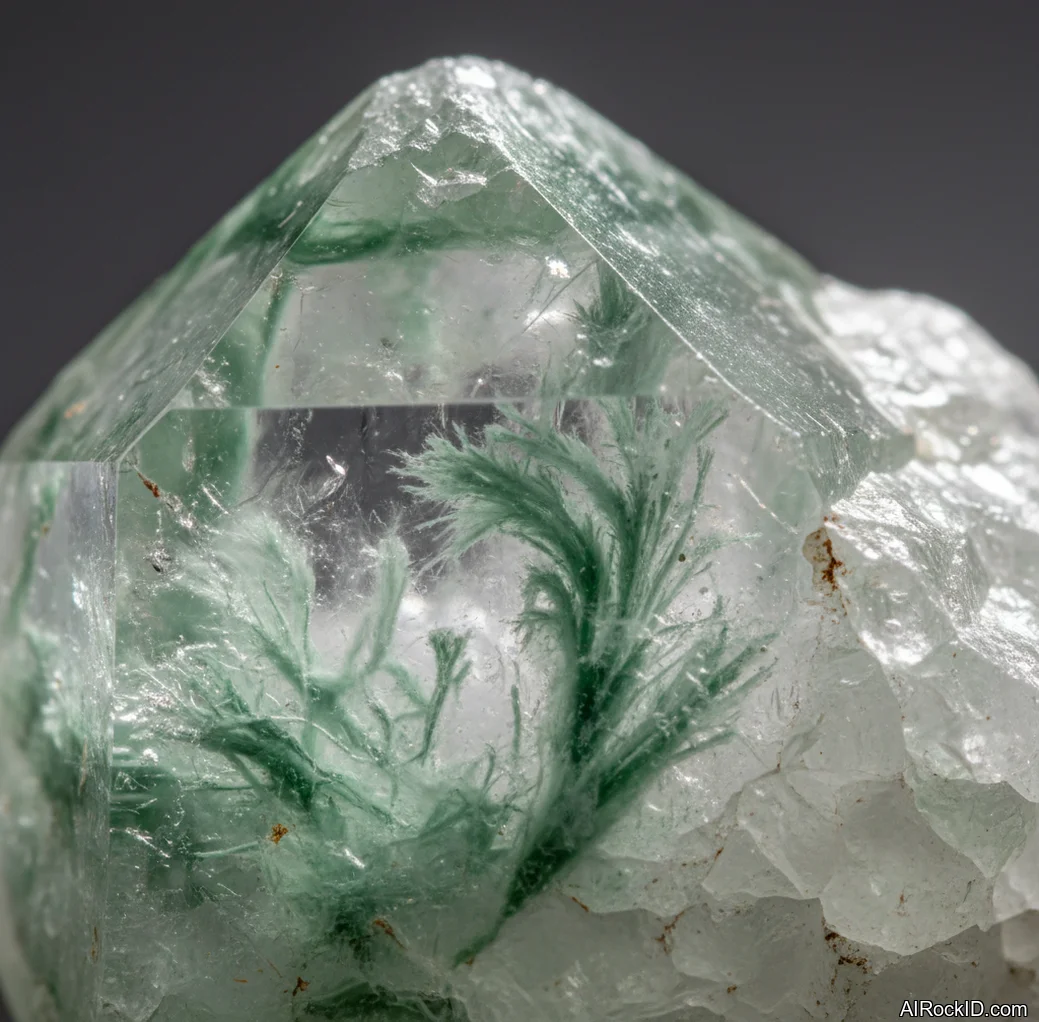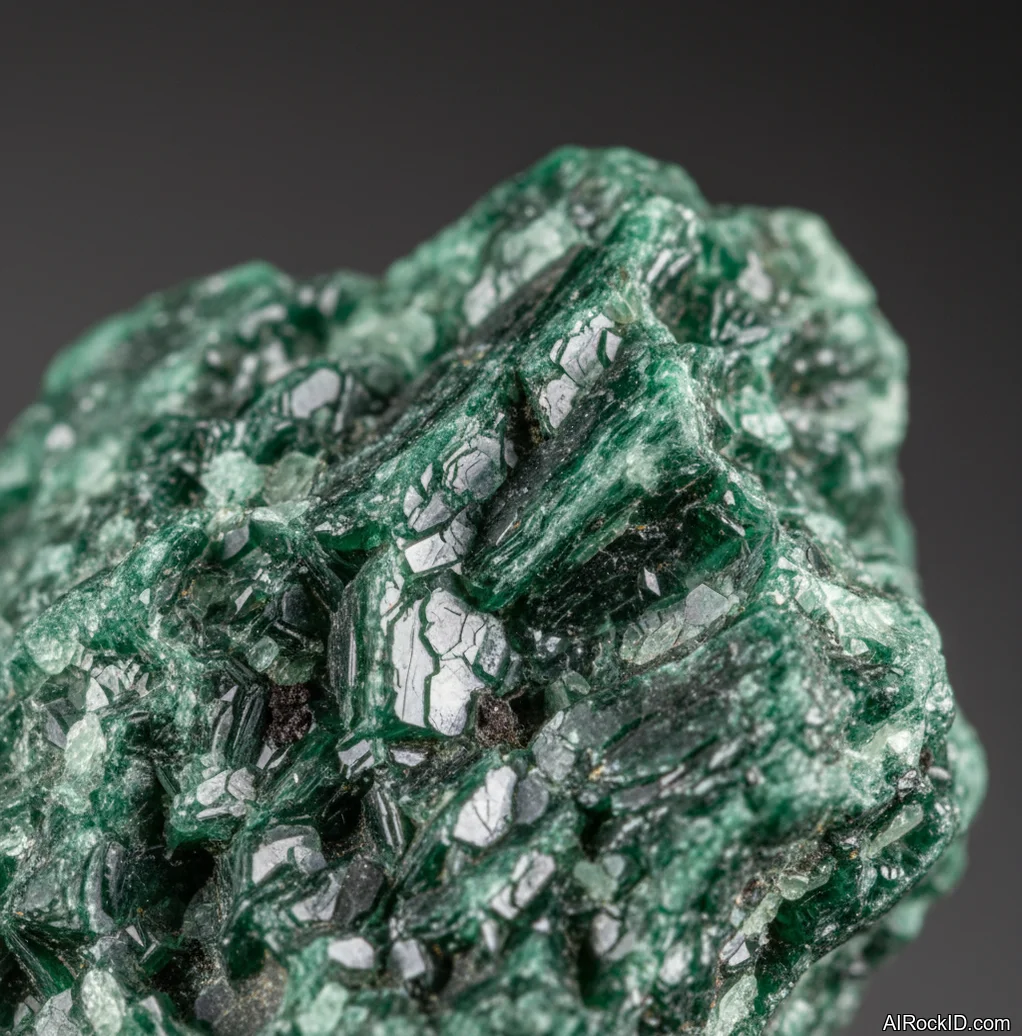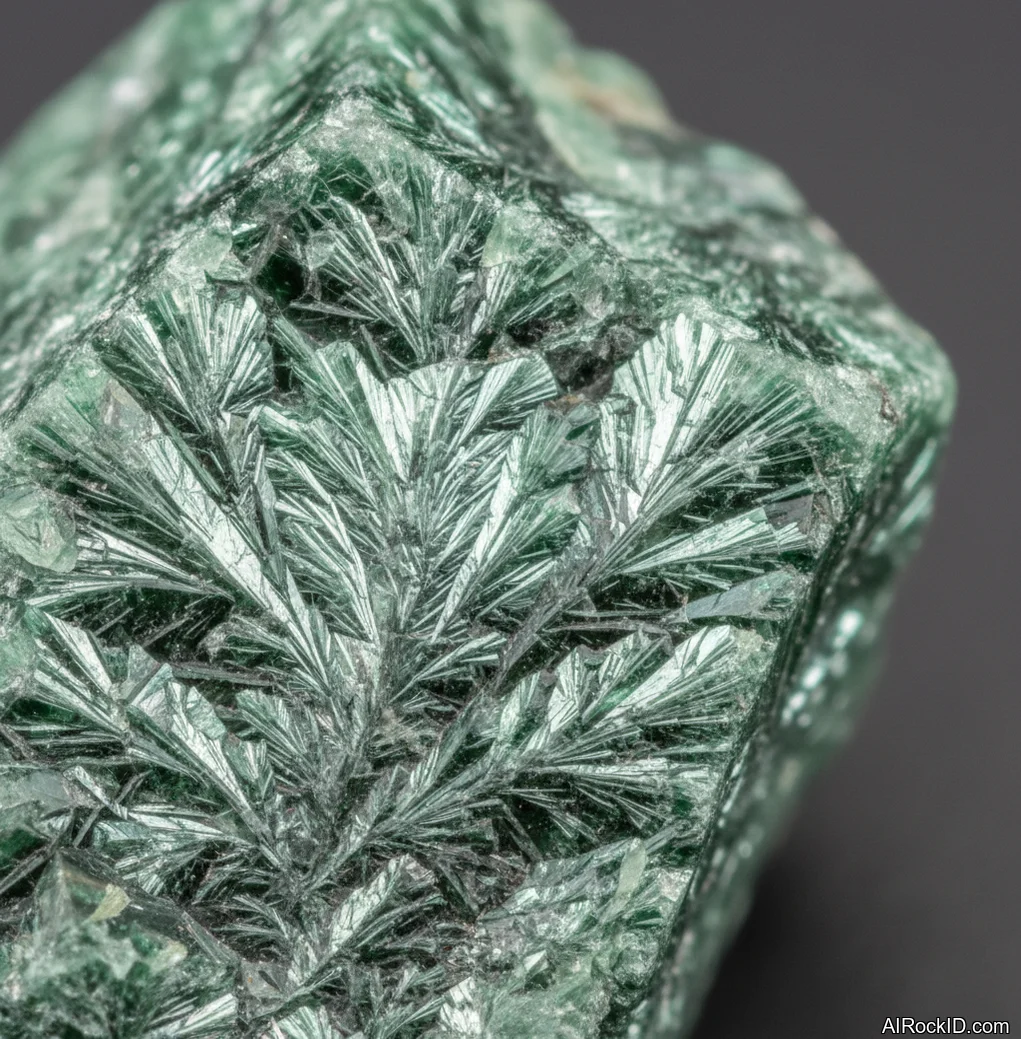
Seraphinite


Quick answer: Seraphinite is a green variety of clinochlore known for silvery, feather-like chatoyancy that often resembles layered leaves or wings. Its softness makes it better for display, pendants, and careful handling than for rings or daily-wear jewelry.
AI Rock ID can help screen a suspected seraphinite by comparing color, pattern, luster, and visible texture from a photo. RockIdentifier.io should be used as an identification aid rather than a substitute for gemological testing when value, treatment, or species confirmation matters.
Good fit
- Collectors who like green stones with silvery feather-like patterns
- Pendant, cabochon, palm stone, or display-piece use where abrasion is limited
- Buyers who want a distinctive chlorite-group material rather than a hard gemstone
- People comparing soft green stones before purchasing online
Not a good fit
- Rings, bracelets, or daily-wear jewelry exposed to bumps and scratches
- Buyers who need a hard, durable gemstone for frequent handling
- Projects requiring ultrasonic cleaning, steam cleaning, or harsh chemical exposure
Most commonly confused with
- Chrysotile Serpentine: May show silky fibers or green banding, but it typically lacks seraphinite’s silver feather-like clinochlore pattern.
- Malachite: Has stronger green banding and a higher specific visual contrast, without the same silvery chatoyant feather effect.
- Green Jasper: Usually appears opaque and waxy or matte with earthy patterns rather than reflective silver plumes.
- Moss Agate: Contains moss-like inclusions in translucent chalcedony and is much harder than seraphinite.
Seraphinite vs. Similar Green Stones
| Stone | Typical Look | Key Difference | Relative Durability |
|---|---|---|---|
| Seraphinite | Dark to medium green with silvery feather-like chatoyancy | Soft clinochlore with reflective plume patterns | Low |
| Malachite | Bright to dark green curved bands | Copper mineral with strong banding, not silvery feathers | Low to moderate |
| Moss Agate | Translucent chalcedony with green dendritic inclusions | Harder quartz-family material with moss-like inclusions | Moderate to high |
| Nephrite Jade | Green, creamy, or fibrous-looking masses | Tougher amphibole jade without seraphinite’s chatoyant plumes | High toughness |
| Green Jasper | Opaque green with earthy or mottled patterns | Harder microcrystalline quartz without reflective feathering | Moderate to high |
AI identification confidence
Photo-based identification of seraphinite is often moderately reliable when the stone clearly shows green color plus silvery feather-like chatoyancy. Confidence drops for polished pieces with weak patterning, poor lighting, dyed material, or stones photographed without scale and multiple angles.
When AI gets it wrong
- The image shows only a uniform green surface with no visible feather-like chatoyancy.
- Lighting creates artificial glare that looks like silver plumes.
- The specimen is a dyed or composite stone sold under a trade name.
- The photo lacks close-up detail, natural-light views, or information about hardness.
Final recommendation
Choose seraphinite when the main goal is a distinctive green display stone or protected jewelry piece with silvery feather-like patterning. For rings, bracelets, or frequent wear, a harder green material such as moss agate, nephrite, or jasper is usually more practical.
How to Check Seraphinite Authenticity
Authentic seraphinite usually shows a natural-looking green body color with silvery, feather-like chatoyancy that changes with the viewing angle. Be cautious of pieces with overly uniform color, painted-looking silver streaks, resin-filled surfaces, or vague listings that do not mention clinochlore or chlorite. Because seraphinite is soft, a seller’s claim that it is highly scratch-resistant should be treated as a warning sign.
Buying Seraphinite Online
Clear photos in daylight, close-up views, and angled shots are useful because the reflective feather pattern is a major identification clue. Cabochons and polished slabs should be checked for cracks, filled pits, dull patches, and uneven polishing. For higher-priced pieces, request the weight, dimensions, origin if known, and any disclosure of stabilization or treatment.
Seraphinite in Jewelry Settings
Seraphinite is best suited to protective settings such as bezels, pendants, earrings, and brooches. Prong-set rings and exposed bracelet stones are more likely to chip or abrade because the mineral is very soft. A smooth cabochon with a secure backing is generally safer than a sharp-edged or thinly cut piece.
What Is Seraphinite?
Seraphinite is a trade name for gemmy, chatoyant clinochlore from the chlorite group, and you’ll spot it by those feathery silver-green patterns.
Hold a polished palm stone for a minute and it hits you fast: that “soapy” feel. Not greasy, just slick, like satin that’s warmed up from your hand. Tip it under a desk lamp and the silvery fibers flare into bright streaks, then they kind of snap off again when you roll it a couple degrees. That blink is the whole trick. Some pieces honestly look like angel wings mid-swish, so yeah, sellers really ran with the name.
But it’s not a tough stone. I tossed one loose in my pocket with my keys once, and it came out with tiny scuffs plus a dull spot where the shine used to pop. If you want it to stay glossy, you’ve gotta baby it like a soft cab, not treat it like quartz.
Origin & History
Russia is really where the seraphinite story kicks off, even though clinochlore itself got described way earlier. Clinochlore was named in the 1800s (the whole chlorite family was getting named, renamed, argued over, you name it), and “seraphinite” showed up later as a trade label for that feathery, shimmery green stuff.
Most dealers connect the name to “seraphim” because the pattern honestly can look like stacked feathers. And yeah, I’ve seen it happen at shows: someone catches that wing-like chatoyancy from two tables away, then they’re weaving through people like they’ve got somewhere to be. Thing is, once you tilt a piece under the booth lights and it flashes, it pretty much sells itself.
Where Is Seraphinite Found?
Most commercial gem-grade seraphinite on the market comes from Siberia (Irkutsk area). Clinochlore itself shows up in Alpine metamorphic zones and serpentinized terrains in a bunch of countries.
Formation
Think metamorphic “wet heat” chemistry. Clinochlore shows up when magnesium and aluminum rich rocks get altered during metamorphism, usually hanging out with serpentine, talc, tremolite, plus other sheet silicates. It’s a chlorite, which means it’s literally stacked in layers. And those layers are why it can feel kind of slick under your fingers and why it doesn’t really love abrasion.
That feathery look in seraphinite comes from fibrous or platy aggregates that kick light back at you in a very directional way. In a hand sample, you’ll sometimes catch zones that look brush-stroked, like somebody dragged a silver paintbrush across dark green (especially when you tilt it under a lamp). That’s the chatoyancy doing its thing, not some separate mineral pasted in there.
How to Identify Seraphinite
Color: Usually deep forest green to gray-green with silver to pale green feathery streaks or “wings.” The best pieces have strong contrast between the dark base and the bright flash.
Luster: Silky to pearly in the flashy areas, often more waxy on duller patches.
Look closely under a single point light. Real seraphinite gives a moving sheen that slides in bands when you tilt it, not a static glitter. The real test is the feel: it stays cool at first touch and has that slightly greasy, micaceous slip that glass or resin fakes don’t quite copy. And if you scratch it with a copper coin in an inconspicuous spot, it’ll mark easier than most “everyday” stones because it’s down around Mohs 2 to 2.5.
Common Look-Alikes
Seraphinite is sometimes confused with these materials:
- Nephrite jade (dark green cabochons and palm stones sold as "seraphinite")
- Chrome diopside (deep bottle-green stones, sometimes mislabeled when the chatoyance is weak)
- Fuchsite quartz / aventurine (green with sparkly mica that can read as "feathery" in photos)
- Kambaba jasper (green-black orbicular rhyolite often swapped in for dark seraphinite pieces)
- Dyed magnesite or dyed howlite (sold as green "seraphinite" when the patterning is faked)
- Green glass cabochons (used to imitate the silver flash, but the weight and bubbles give it away)
Market Cautions & Treatments
When AI Can Get This Wrong
At first glance, phone pics of seraphinite get miscalled as jade, aventurine, or kambaba jasper because cameras flatten the silver-green feathering into a generic dark green. The real test is movement: seraphinite’s chatoyance snaps on and off in narrow streaks when you tilt it under a single point light, while jade stays more even and aventurine just twinkles. If you can do a quick reality check in hand, a copper coin or fingernail will mark softer seraphinite edges way easier than it will jade, and that usually settles the ID.
Properties of Seraphinite
Physical Properties
| Crystal System | Monoclinic |
| Hardness (Mohs) | 2-2.5 (Very Soft (1-2)) |
| Density | 2.60-2.75 |
| Luster | Pearly |
| Diaphaneity | Opaque |
| Fracture | Uneven |
| Streak | White to pale greenish white |
| Magnetism | Non-magnetic |
| Colors | dark green, gray-green, silver-green, blackish green |
Chemical Properties
| Classification | Silicates |
| Formula | Mg5Al(AlSi3O10)(OH)8 |
| Elements | Mg, Al, Si, O, H |
| Common Impurities | Fe, Mn, Cr |
Optical Properties
| Refractive Index | 1.57-1.59 |
| Birefringence | 0.02 |
| Pleochroism | Moderate |
| Optical Character | Biaxial |
Seraphinite Health & Safety
Safe to pick up and put on a shelf. Thing is, the only real “risk” here is cosmetic, because it’s soft and you can ding it up pretty easily. But if you ever grind or reshape it, don’t breathe the dust.
Safety Tips
Don’t just shove it in your pocket next to harder stones (you’ll hear that gritty little scrape). If you’re going to cut or sand it, keep it wet with water, make sure there’s good ventilation, and wear a real respirator, not one of those flimsy dust masks.
Seraphinite Value & Price
Price Range
Rough/Tumbled: $10 - $120 per piece
Cut/Polished: $3 - $15 per carat
Prices jump when the chatoyancy is stronger, the “feathering” has higher contrast, and the polish is clean with zero pits you can feel if you drag a fingernail across it. Big cabochons are common. But the ones with truly crisp, bright flash across the whole face? Those cost more.
Durability
Fragile — Scratch resistance: Poor, Toughness: Fair
It’s stable in normal room conditions, but the surface scuffs easily and edges can chip if it gets knocked around.
How to Care for Seraphinite
Use & Storage
Store it in a soft pouch or a lined box, separated from quartz and anything harder. I keep mine face-up so the polish doesn’t rub on foam grit.
Cleaning
1) Rinse quickly with lukewarm water and a drop of mild soap. 2) Use your fingers or a very soft cloth, no stiff brush. 3) Pat dry and let it air-dry fully before putting it away.
Cleanse & Charge
If you do the metaphysical routine, stick to smoke, sound, or moonlight. I wouldn’t use salt bowls because grains can scratch the polish.
Placement
Put it where it catches angled light, like a shelf near a lamp, not in direct sun on a windowsill. On a desk, a small stand helps keep it from getting dragged around.
Caution
Skip ultrasonic cleaners, steam cleaners, plus any abrasive polishing cloths. And don’t treat a seraphinite ring like an everyday piece you never take off. Bracelets need a little extra caution too, because one hard knock on a table edge (you can feel that sharp tap through the metal) can do real damage.
Works Well With
Seraphinite Meaning & Healing Properties
A lot of people who pick up seraphinite are chasing that “heart plus higher mind” feeling, and honestly, I get it. When you’ve got a good piece in your hand, the silvery feathering shifts as you tilt it, like it’s sliding under the surface, and your eyes naturally snag on it. So breathwork gets easier. Same with a plain sit-and-stare meditation. It’s just a very visual stone.
In the shop, people link it with compassion, an emotional reset, that “my chest finally unclenched” feeling after a rough week. But look, that’s personal practice territory, not medicine. If you’re dealing with real anxiety or depression, crystals can sit alongside a routine, but they don’t replace a professional. At all.
One practical thing I’ve noticed: seraphinite feels calmer (or at least reads calmer) when it’s cool and clean. Once a palm stone picks up skin oil, that flash can go kind of dull, like someone turned the dimmer down. Wipe it off and the shimmer snaps back. And, weirdly enough, that tiny cleaning ritual can become its own cue to slow down and check in with yourself, you know?
Common mistakes
- Assuming all green stones with silver-colored reflections are seraphinite.
- Buying seraphinite for an everyday ring without considering its low hardness.
- Confusing surface glare in photos with true chatoyancy.
- Cleaning seraphinite with ultrasonic cleaners, steam, acids, or abrasive cloths.
- Judging authenticity from color alone instead of checking pattern, texture, and seller disclosure.
Identify Seraphinite from a photo
Compare Seraphinite traits, care tips, value clues, and common lookalikes with a clear photo.