Black Tourmaline
What Is Black Tourmaline?
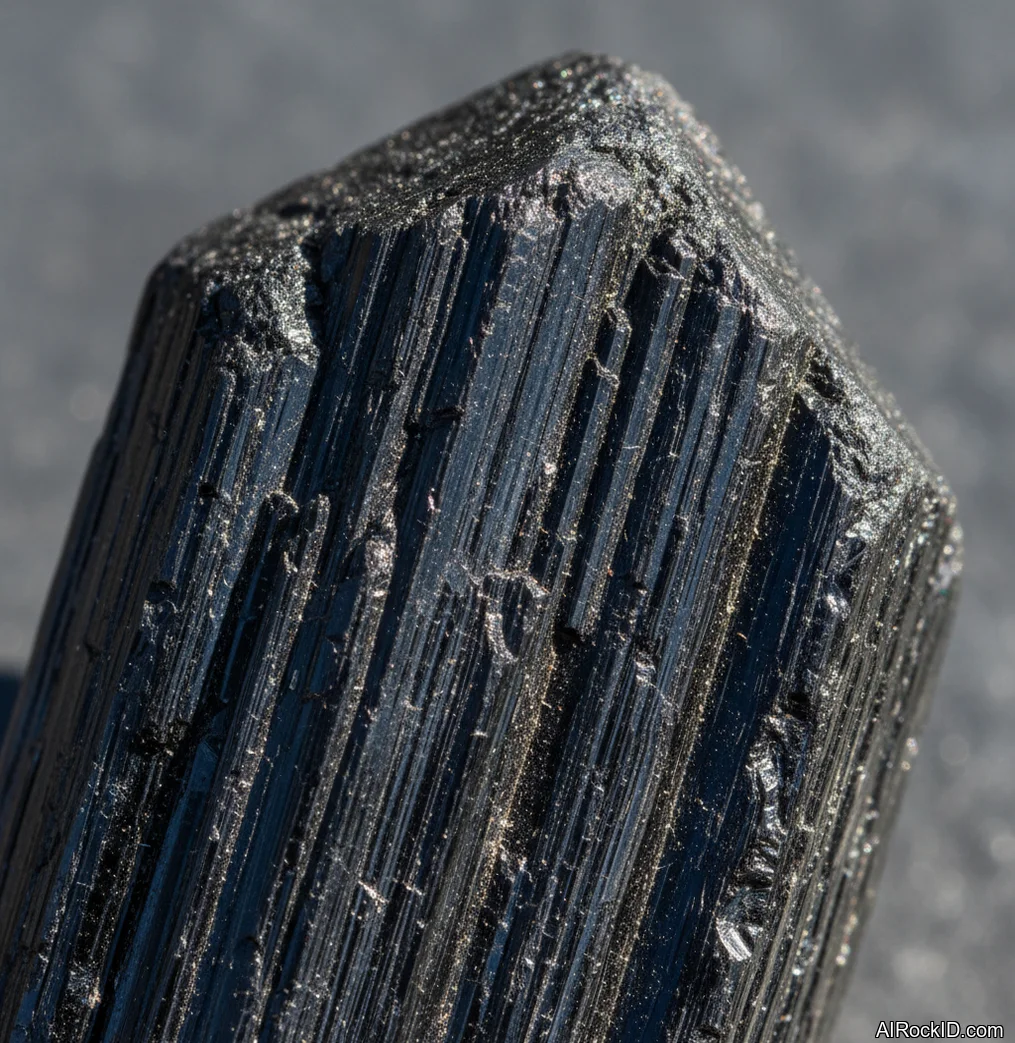
Black tourmaline is the black, iron-rich type of tourmaline known as schorl. In your hand, it often feels like a tight bundle of black rods, and those long, lengthwise grooves are hard to miss. Run your thumb down one and it can snag at your skin or even catch on fabric. Some chunks look dead matte because they’ve been weathered, but snap a fresh edge or find a cleaner crystal and it throws off that dark, glassy shine when you tilt it under a lamp.
Grab a chunky piece of schorl out of a pegmatite pocket and you notice a couple things right away. It’s tougher than it looks. And it’s almost never “perfect,” either. The ends are usually broken, the faces can be a little pitted, and even the best-looking crystals still have that faintly gritty feel from all the striations. But when you do get one with a nice termination, the top can look like a tiny black pencil point, and you’ll keep turning it in your fingers without even thinking about it (I always do).
Compared to obsidian or shungite, black tourmaline doesn’t feel waxy or soft. It scratches glass easily. And thing is, once you’ve handled enough of it, you start to recognize the sound, too. Tap two pieces together and you get a sharper, more glassy click than most black rocks people sell as protection stones. Who expects that from something that looks so dull at first glance?
Origin & History
Schorl got pinned down as its own mineral species in the 1700s, but the name “schorl” is way older than modern mineralogy. It traces back to a mining district in Saxony, Germany, near the village of Zschorlau, where black tourmaline turned up all the time in tin mines and in pegmatites.
“Tourmaline,” on the other hand, comes from the Sinhalese word “turamali,” which people used for those mixed-color stones coming out of Sri Lanka. And tourmaline has been both a headache and a treat for collectors ever since, because the colors can fool you into thinking you’re looking at some other gem. But black schorl is the blunt, no-drama end of the group: it’s common, it’s useful, and once you’ve actually handled a few crystals, the feel and look are hard to confuse (that slick, striated prism thing gives it away).
Where Is Black Tourmaline Found?
It shows up worldwide in granite pegmatites and some metamorphic rocks. Big, cabinet-size schorl crystals are common from Brazil, and classic European material comes from alpine and Saxon localities.
Formation
Raw pegmatite chunks are what most folks picture first: black tourmaline crystals stuck in coarse granite, sitting right next to quartz and feldspar, and sometimes you’ll spot mica plates kind of tucked in around them. Pegmatites come from that last, water-rich bit of a cooling granite melt. So boron and a bunch of other elements get shoved into little pockets, and that’s where tourmaline can shoot up fast and long.
But you’ll find schorl in metamorphic rocks too, especially in places where boron-rich fluids pushed through while the rock was getting heated and squeezed. In those settings, it’s not really about nice single crystals. It’s more like sprays, skinny needles, or chunky masses. Different shape, same vibe in your hand: it’s hard, it’s striated, and if you whack it the wrong way it tends to break unevenly, sometimes with those splintery edges that feel a little nasty if you drag a finger across them (ask me how I know).
How to Identify Black Tourmaline
Color: Usually jet black to very dark brown-black; thin edges can look smoky brown in strong light. In slender crystals, a bright flashlight sometimes shows a faint translucence at the rim.
Luster: Vitreous on fresh crystal faces, dull to sub-vitreous on weathered surfaces.
Look closely for the lengthwise striations that run like corduroy down the crystal. The real test is hardness: a clean corner will scratch glass, while a lot of fake “black tourmaline” carvings are softer stuff that won’t. And in your hand, schorl stays cool and has a crisp, almost sharp feel along the grooves, unlike obsidian which feels smoother and more uniform.
Properties of Black Tourmaline
Physical Properties
| Crystal System | Trigonal |
| Hardness (Mohs) | 7-7.5 (Hard (6-7.5)) |
| Density | 3.0-3.3 g/cm3 |
| Luster | Vitreous |
| Diaphaneity | Opaque |
| Fracture | Uneven |
| Streak | White |
| Magnetism | Non-magnetic |
| Colors | Black, Brownish black |
Chemical Properties
| Classification | Silicates |
| Formula | NaFe3Al6Si6O18(BO3)3(OH)4 |
| Elements | Na, Fe, Al, Si, O, B, H |
| Common Impurities | Mg, Mn, Ca, K, Ti |
Optical Properties
| Refractive Index | 1.62-1.64 |
| Birefringence | 0.018-0.020 |
| Pleochroism | Strong |
| Optical Character | Uniaxial |
Black Tourmaline Health & Safety
Black tourmaline is usually safe to pick up and keep on a shelf. But if you’re cutting or grinding any mineral, treat it like shop work: dust gets everywhere, and those sharp little grit bits can nick your fingers fast.
Safety Tips
If you’re going to lap it, carve it, or grind it, don’t do it dry. Use water to keep the dust down, keep the area well ventilated (a window fan helps), and wear a proper respirator so you’re not breathing in that fine mineral dust.
Black Tourmaline Value & Price
Price Range
Rough/Tumbled: $3 - $60 per piece
Cut/Polished: $10 - $80 per carat
Terminated crystals with some size to them and that clean, glassy luster will jack the price up fast, especially when the whole thing is perched nicely on matrix and doesn’t look like it was glued there yesterday. But the cheaper pieces? Usually just busted chunks with bruised edges, or material that’s been beat up by weather and then sold as tumbled.
Durability
Durable — Scratch resistance: Excellent, Toughness: Fair
It holds up well day to day, but it can chip or splinter if dropped because tourmaline doesn’t like hard impacts along its length.
How to Care for Black Tourmaline
Use & Storage
Store it so points and edges don’t bang into harder stones, because the crystal tips can chip. I keep nicer terminated schorls in a small box with foam, not loose in a bowl.
Cleaning
1) Rinse with lukewarm water to remove grit. 2) Use a soft toothbrush with a drop of mild soap to get dust out of the striations. 3) Rinse well and pat dry; avoid high heat and harsh cleaners.
Cleanse & Charge
If you do energetic cleansing, smoke, sound, or a quick rinse are the low-drama options. I avoid salt baths just because salt crust gets stuck in the grooves and looks terrible.
Placement
On a desk or by a front door is where people tend to put it, mostly because it’s sturdy and doesn’t fade in normal indoor light. A dark shelf can swallow it visually, so a pale background helps.
Caution
Don’t run fractured pieces through an ultrasonic cleaner. And don’t toss a terminated crystal you actually care about into a tumbler unless you’re genuinely okay with it coming out with the sharp edges knocked off.
Works Well With
Black Tourmaline Meaning & Healing Properties
At first glance, black tourmaline gets boxed into one job: “protection.” I get it. It’s heavy, jet black, and it honestly looks like it could stare down a problem.
In my own stash, it’s the piece I reach for when my head feels loud, not because I think it’s doing anything supernatural, but because it’s just… grounding in a physical way. The long ridges give your fingertips something to trace. You can feel the little grooves catch under a nail. That tiny sensory thing matters more than people like to admit.
Most dealers will pitch it as a blocker for bad vibes or EMFs. Here’s the straight collector take: it’s a good ritual object, and rituals can help you hold boundaries and stay focused. I’ve had customers park a chunky piece next to their keyboard, and what they describe as the “benefit” is basically a cue to drop their shoulders, unclench their jaw, and quit doom-scrolling for a second. That’s real. It’s just not medical.
Thing is, the market’s messy. “Black tourmaline” gets slapped on anything that’s black and sort of column-shaped. Actual schorl has a specific feel: cool in the hand, kind of glassy in spots, with those lengthwise striations you cannot miss once you’ve handled the real stuff. So if you’re using it for meditation or grounding practices, you want the real thing, because the texture and the weight are half the whole experience. And look, if you’re dealing with anxiety or sleep problems, treat crystals like support tools, not treatment. Talk to a professional when you need one.
Identify Any Crystal Instantly
Snap a photo and get properties, value, care instructions, and healing meanings in seconds.