Obsidian
What Is Obsidian?
Obsidian’s basically nature’s glass: silica-rich lava cools so fast it never gets the chance to crystallize. And if you’ve ever actually held a good black piece, you recognize it instantly. It’s cold, slick, almost weirdly smooth, like it’s trying to skate right out of your fingers.
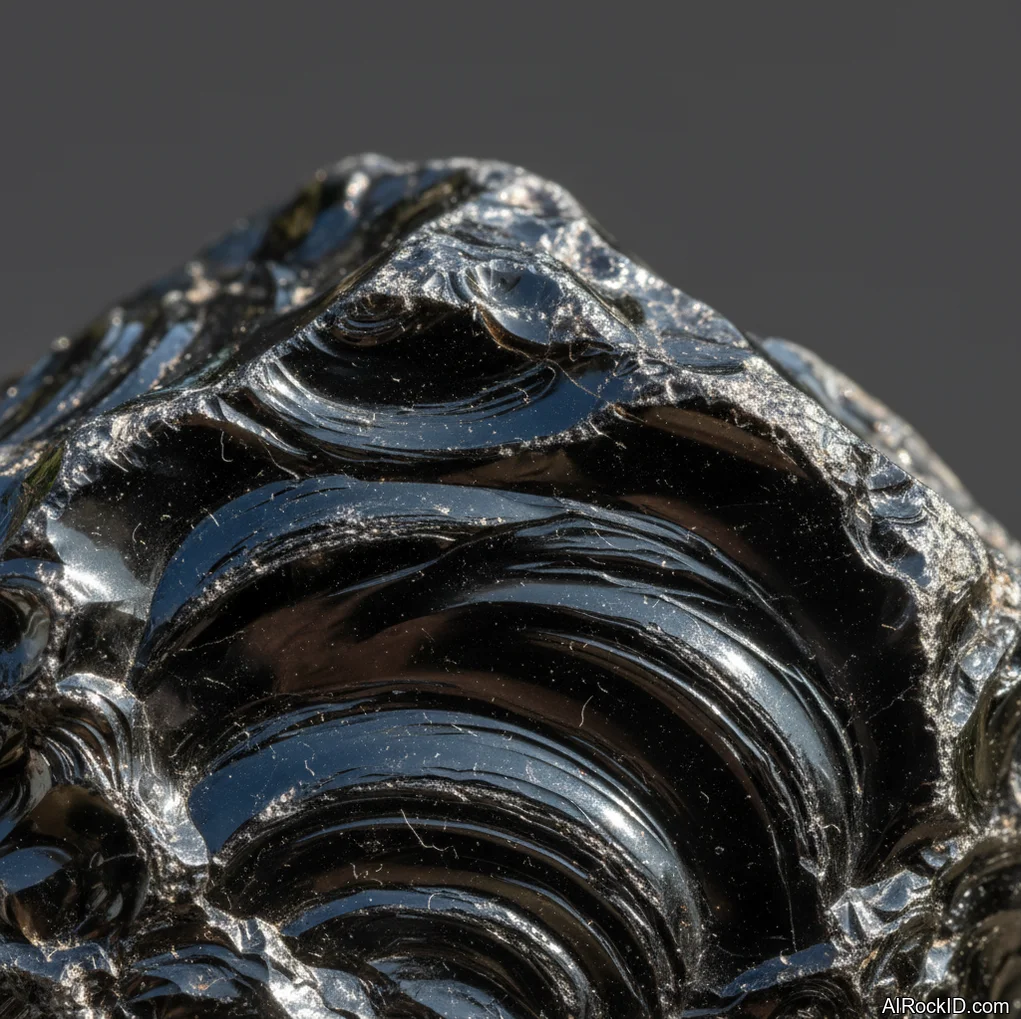
It reads as “just black” from across the room, sure. But tip a polished face under a shop light and, boom, you might catch a green sheen, a bronze sheen, or that rainbow flash some pieces throw back when you roll them just right. Rough chunks are a whole different deal. They can look kind of dull and dusty until you find a fresh break (or make one), and then you see it: that sharp, glassy conchoidal curve that basically yells volcanic glass.
Grab a fist-sized chunk and the weight can surprise you. It’s not crazy heavy like hematite, but it has this solid, honest heft in your palm. But the edges, though. Real obsidian can be wicked sharp where it’s broken, so I don’t toss rough pieces loose in a pocket unless I’m in the mood for a random little cut. Who needs that?
Origin & History
The word “obsidian” goes way back to Roman writing. Pliny the Elder talked about a stone he called “obsianus,” which he said a guy named Obsidius brought back from Ethiopia, and the description fits that inky, dark volcanic glass.
People have been working obsidian for ages for one simple reason: when it snaps, it leaves a razor edge. Really razor. That’s why it shows up in ancient tools and trade routes, and later on in those surgical scalpel experiments, since a fresh flake can come out sharper than steel. But today it’s also a lapidary staple. It’ll take a mirror polish fast, and you don’t need fancy equipment to make it look good (a basic setup gets you there).
Where Is Obsidian Found?
Obsidian turns up anywhere you’ve had silica-rich volcanism and rapid cooling, especially around rhyolitic lava flows and domes. The best-known collecting localities are in the western USA and Mexico, but it’s worldwide in volcanic belts.
Formation
Fast cooling is basically the trick. If you’ve got a silica-rich melt (usually rhyolite or dacite) and it gets quenched so fast the atoms can’t line themselves up into mineral crystals, it freezes as glass instead of that normal, grainy igneous texture.
Look at a rough nodule up close and you’ll usually catch flow banding, those little swirly streaks, plus faint layering from the lava still moving while it was stiffening. Some pieces have tiny gas bubbles (pinprick stuff you only notice when the light hits at an angle), and some show devitrified patches where it started to crystallize later. Thing is, when people see really uniform jet-black material, they jump to “plastic” or “slag.” But natural glass really can be that clean if it formed under the right conditions.
How to Identify Obsidian
Color: Most obsidian is black to very dark brown, but it can show gray, green, mahogany brown, or iridescent rainbow sheen depending on inclusions and flow layers. Snowflake obsidian has gray-white spherulites that look like little flowers in the black glass.
Luster: Vitreous, like broken bottle glass, especially on fresh fractures or polished faces.
Pick up a rough piece and look for conchoidal fracture arcs, those shell-like curves you also see in broken glass. If you scratch it with a steel nail, it usually won’t gouge easily, but the real test is flipping it around and checking for sharp edges and a glassy shine on a fresh chip. And watch for man-made slag: it often has lots of bubbles, an oily rainbow skin, and a weird “melted” texture that doesn’t look like natural flow banding.
Properties of Obsidian
Physical Properties
| Crystal System | Amorphous |
| Hardness (Mohs) | 5.0-5.5 (Medium (4-6)) |
| Density | 2.35-2.60 g/cm3 |
| Luster | Vitreous |
| Diaphaneity | Opaque |
| Fracture | Conchoidal |
| Streak | white |
| Magnetism | Non-magnetic |
| Colors | black, dark brown, gray, greenish-black, mahogany brown, iridescent |
Chemical Properties
| Classification | Silicates |
| Formula | SiO2 (variable, glassy mixture) |
| Elements | Si, O |
| Common Impurities | Fe, Mg, Ca, Na, K, Al, Ti, Mn |
Optical Properties
| Refractive Index | 1.48-1.51 |
| Birefringence | None |
| Pleochroism | None |
| Optical Character | Isotropic |
Obsidian Health & Safety
Obsidian’s usually fine to pick up and handle, but the edges can be razor-sharp and will slice skin if you’re not careful. Breathing risks are pretty low as long as the piece is intact, but if you grind it and kick up any silica dust, don’t breathe that in (seriously, avoid it).
Safety Tips
If you’re going to cut or sand it, keep a little water running, make sure there’s real ventilation (like a fan you can feel on your face), and wear a proper respirator that’s rated for fine particulates. And if the specimen’s rough, stash it so the sharp edges aren’t sitting right where your fingers land when you reach in. Why risk a surprise slice?
Obsidian Value & Price
Price Range
Rough/Tumbled: $2 - $25 per piece
Cut/Polished: $1 - $10 per carat
Price mostly comes down to the finish and whatever special effects it’s got going on. Plain black tumble is usually cheap. But once you get that clean rainbow sheen, those big snowflake spheres (the kind that feel cool and a little slick in your palm), or a nicely knapped display piece with crisp edges, the price shoots up fast.
Durability
Moderate — Scratch resistance: Fair, Toughness: Poor
It’s chemically stable for everyday use, but it chips easily because it’s glass with conchoidal fracture.
How to Care for Obsidian
Use & Storage
Keep it in a soft pouch or a compartmented box so it doesn’t chip or scratch softer stones. If it’s rough, don’t let it rattle against other glassy pieces unless you like fresh flakes.
Cleaning
1) Rinse with lukewarm water to remove grit. 2) Wash with mild soap and your fingers or a soft cloth. 3) Dry completely and buff with a clean microfiber to bring back the glassy shine.
Cleanse & Charge
If you do ritual cleansing, running water, smoke, or a quick sound cleanse all work without stressing the stone. I skip salt jars for obsidian jewelry because salt grit can haze a polish.
Placement
On a desk it reads like a little pool of black glass, especially under a lamp. For a shelf piece, angle it so the sheen or flow banding catches light instead of facing it straight on.
Caution
Raw obsidian and knapped points are razor-sharp at the edges, so handle them like you would a fresh utility blade. And don’t drop it on tile or concrete. It can chip, or just straight-up shatter (I’ve seen little crescent flakes pop off the edge when it hits hard). Also skip ultrasonic cleaners if it’s set in jewelry. The vibration can work a setting loose, and obsidian really doesn’t take impacts well. Why risk it?
Works Well With
Obsidian Meaning & Healing Properties
People usually pick up obsidian because it feels like it cuts through the noise. No fluff. Just this blunt, get-to-the-point energy.
And some of that is probably in your head, sure. You’re literally holding volcanic glass. It chips with those razor-like edges, the kind you can catch on a fingertip if you’re not paying attention, so your brain files it under sharp, protective, serious.
In my own routine, I use it when my thoughts are bouncing everywhere and I need something to pull me back down. A palm stone works well because you can feel how cool it is right away, and the weight sits heavy in your hand (especially if you’re turning it over and over with your thumb). It keeps your attention in your palm instead of letting your mind spiral. But I won’t grab obsidian when I’m already emotionally raw. It can feel intense. Lots of people end up switching to something gentler after a few days. Happens.
This isn’t medical care, and it’s not a replacement for therapy or actual treatment. So what is it good for? For me, it’s a physical anchor for intentions: boundaries, focus, and, honestly, calling yourself out when you’re avoiding something. If you want that same grounded feeling without the knife-edge mood, smoky quartz is usually a softer landing.
Identify Any Crystal Instantly
Snap a photo and get properties, value, care instructions, and healing meanings in seconds.