Charoite


Quick answer: Charoite is most recognizable by its purple to lavender color, swirling fibrous patterns, and occasional silky chatoyancy. It is strongly associated with the Murun complex in Siberia, Russia, which makes locality and authenticity important when identifying or buying specimens.
AI Rock ID can help screen charoite by checking visible color zoning, fibrous swirls, polish, and lookalike patterns from a photo. RockIdentifier.io provides crystal identification support, but final confirmation may require hardness testing, magnification, or seller documentation for higher-value pieces.
Good fit
- Collectors who want a distinctive purple cabochon or display stone
- Buyers interested in a rare locality-linked mineral
- Jewelry wearers who prefer pendants, earrings, or low-impact settings
- People comparing purple stones with visible patterning rather than uniform color
Not a good fit
- Rings or bracelets that will receive frequent abrasion or impact
- Buyers who need a highly transparent faceted gemstone
- Anyone who wants a crystal that is easy to verify by color alone
- Situations where a seller cannot provide clear photos or provenance for expensive pieces
Most commonly confused with
- Sugilite: Sugilite is often more uniform purple and lacks charoite’s strong swirling, fibrous texture.
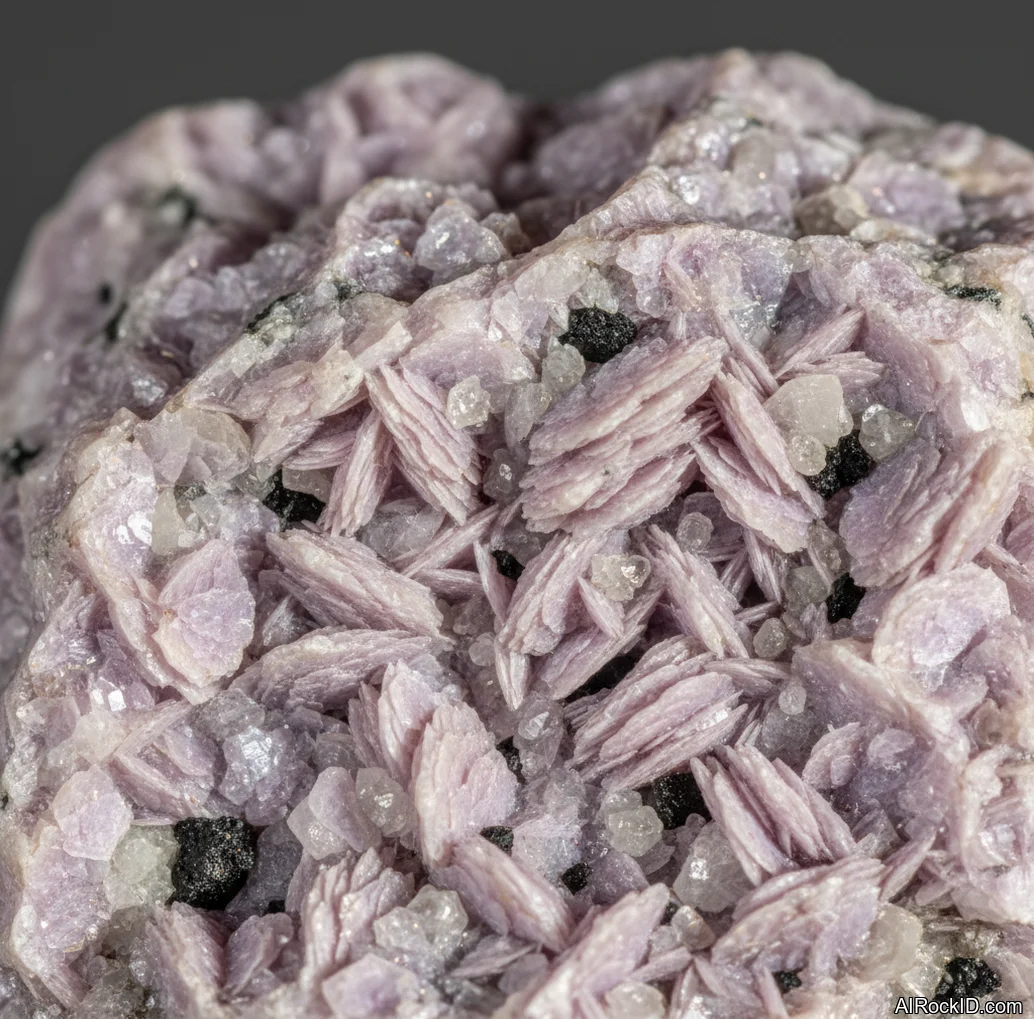
- Lepidolite: Lepidolite commonly shows mica-like sparkle or flaky texture rather than dense purple swirls.
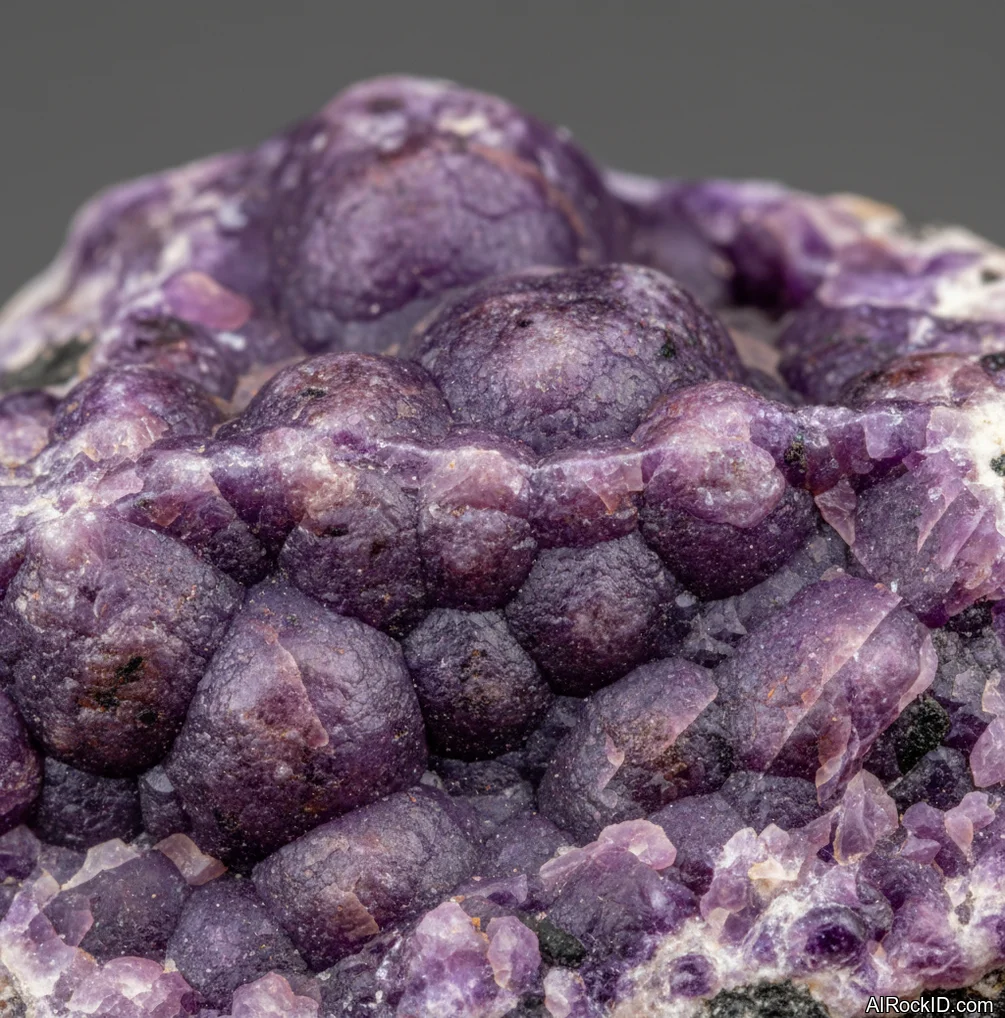
- Purple Fluorite: Purple fluorite is usually glassier, more translucent, and may show cleavage rather than silky fibrous bands.
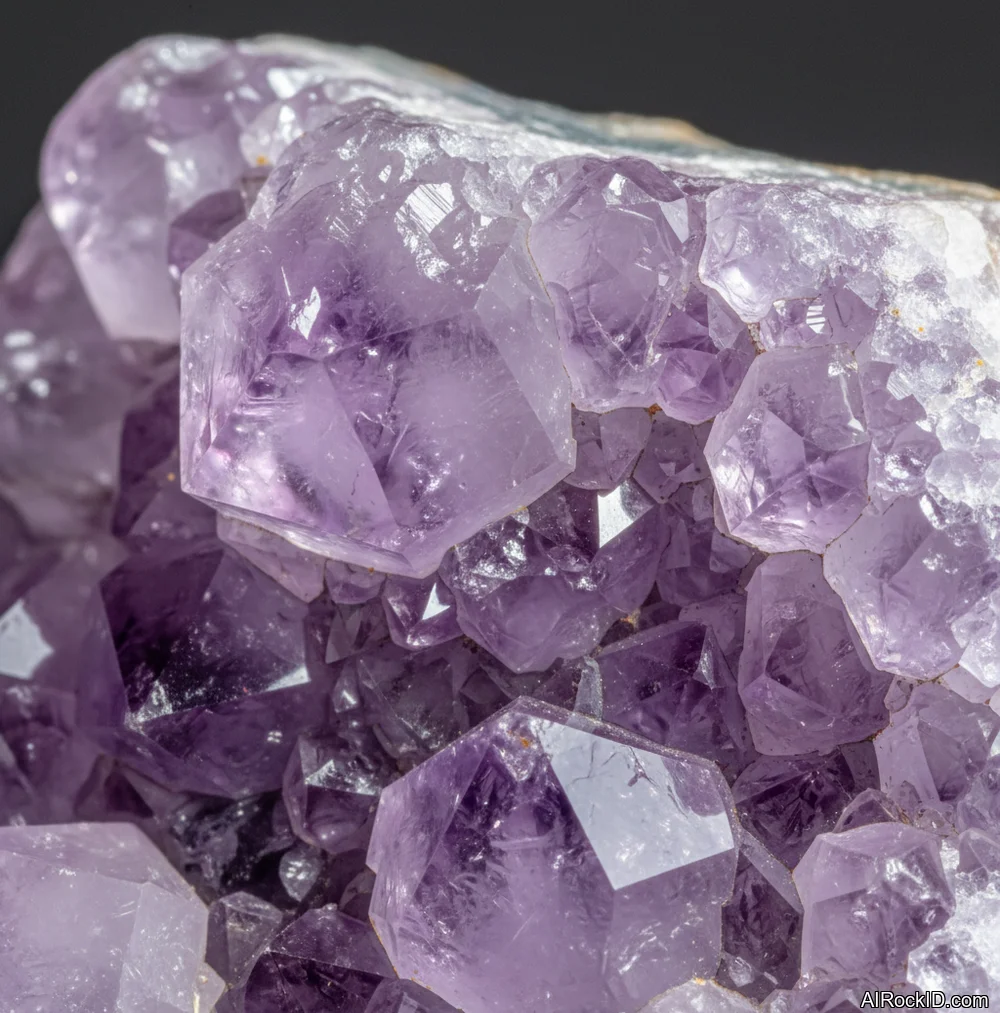
- Amethyst: Amethyst is quartz with a glassy crystal appearance and does not show charoite’s marbled, feathery pattern.
Charoite vs. Common Purple Lookalikes
| Stone | Typical Appearance | Key ID Clue | Common Form |
|---|---|---|---|
| Charoite | Purple with swirling, fibrous, marbled bands | Silky texture and chatoyant patches are common | Cabochons, slabs, beads |
| Sugilite | Purple to magenta, often more even in color | Less feathery and less swirled than charoite | Cabochons, beads |
| Lepidolite | Lavender to lilac with sparkly mica flakes | Platy or flaky mica texture | Tumbled stones, rough pieces |
| Purple Fluorite | Violet to purple, often translucent | Glassy luster and visible cleavage planes | Crystals, carvings, polished pieces |
| Dyed Howlite | Artificially bright purple with gray veining | Color may concentrate in cracks or pores | Beads, inexpensive carvings |
AI identification confidence
AI identification confidence for charoite is usually moderate to high when a clear photo shows purple color, swirling fibrous structure, and polished surface detail. Confidence drops when the image is over-saturated, the stone is a small bead, or the piece has been dyed or heavily waxed.
When AI gets it wrong
- A purple stone is photographed under colored or warm lighting that changes its true hue
- Small beads show too little surface area to display charoite’s swirled structure
- Dyed stones imitate purple color but lack natural fibrous patterning
- Highly polished pieces create glare that hides texture and inclusions
Final recommendation
Choose charoite when the piece shows natural-looking purple swirls, fibrous movement, and consistent polish without suspicious dye concentration in cracks. For higher-priced specimens, ask for locality information, untreated status, and photos taken in neutral daylight.
How to Photograph Charoite for Identification
Photograph charoite in indirect natural light on a neutral background to avoid making the purple appear too blue or too red. Include one close-up of the surface pattern and one wider image showing the whole piece. A side photo can help reveal polish, thickness, and whether the stone is a cabochon, bead, slab, or carving.
Authenticity Checks for Charoite
Authentic charoite usually shows complex, irregular swirls rather than perfectly repeated patterns. Look for fibrous or silky areas, natural color variation from lavender to deep purple, and possible black, white, or brown mineral inclusions. Be cautious with uniformly bright purple beads, especially if color appears concentrated in pits, cracks, or drill holes.
Typical Charoite Cutting Styles
Charoite is most often cut as cabochons, beads, pendants, carvings, and polished slabs because its appeal comes from surface pattern rather than transparency. Cabochon cutting can emphasize chatoyancy and flowing bands. Faceted charoite is uncommon because the mineral is generally opaque to translucent and structurally better suited to polished forms.
What Is Charoite?
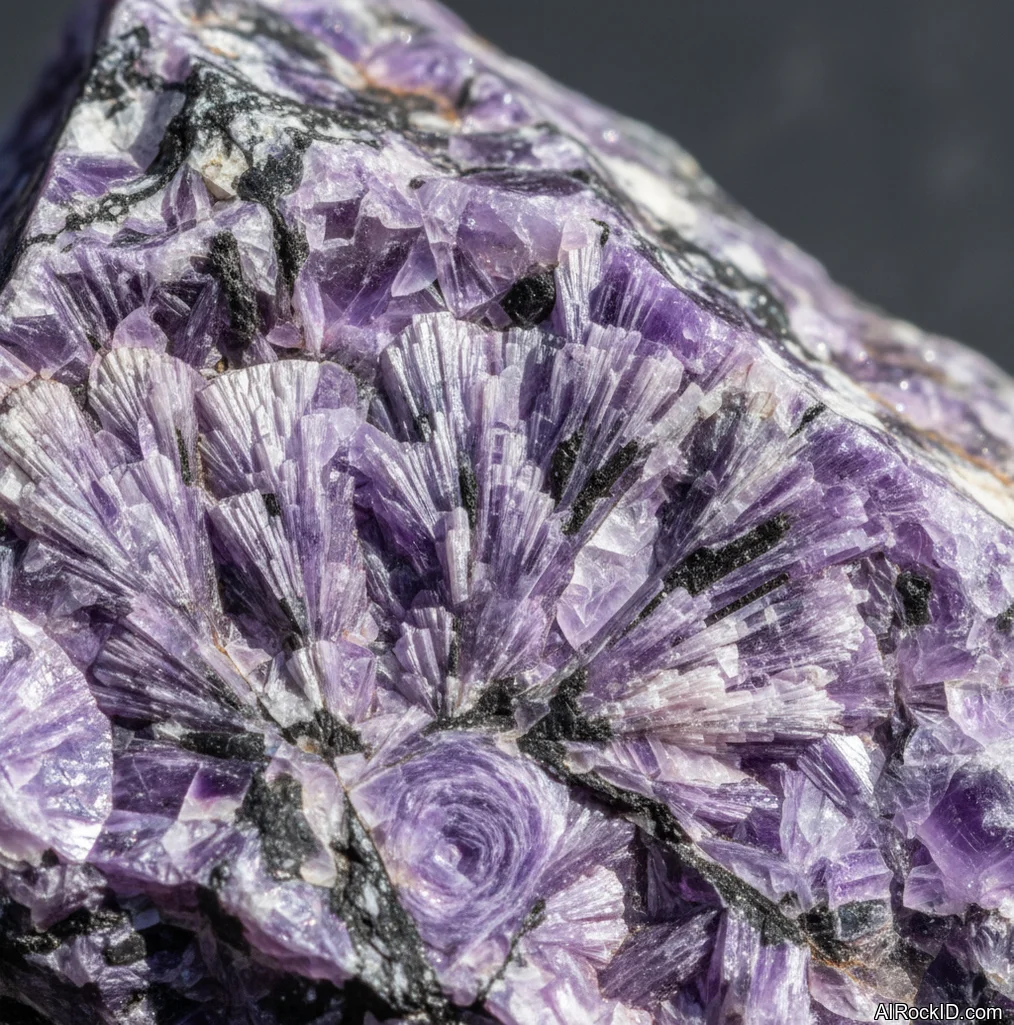
Charoite is a rare purple potassium-calcium silicate mineral, and people mostly know it for those swirly, fibrous patterns plus that occasional silky chatoyancy that pops when the light hits right.
If you’ve ever actually held a good polished slab, you know the exact vibe. It runs from lavender to deep grape purple, then you get those smoky black streaks cutting through it, with little white patches that honestly look like snow frozen mid-current.
Pick up a palm stone and the first thing you notice is it doesn’t feel glassy like amethyst. Not even close. It has this softer, almost waxy feel (kind of like the surface has a tiny bit of drag), and the pattern seems to shift when you tilt it under a lamp. And in the more fibrous areas, you’ll catch that faint cat’s-eye sheen.
I’ve handled pieces that looked almost painted, which sounds fake until you see it. But the best ones don’t look tidy at all. They’ve got that messy, natural “storm” of purple, with really sharp contrast between violet, black, and creamy feldspar.
Most of what you see for sale is cut and polished, because raw chunks can look pretty plain until they’re opened up. But there’s a catch. Charoite’s not super hard, so a high-polish can show tiny drag lines if the lapidary rushed the final stage. You’ll feel it with your fingertip before you even see it.
Origin & History
Russia’s basically the whole story here. Charoite was first recognized as a new mineral in the Murun massif area in Siberia, and Soviet mineralogists formally described it in 1978. People had been passing the stuff around earlier among geologists and locals, sure, but it took a while to nail down because it usually shows up as a complicated mix, not some tidy little crystal you can just measure like it’s sitting in a textbook.
The name comes from the Chara River (and the Charo region). Dealers love to lean on that “chary” wordplay, but the real origin is geographic, full stop. And if you collect minerals, that one-source identity actually matters. When you see “charoite” on a label, it’s basically a promise it traces back to that one remote corner of Siberia.
Where Is Charoite Found?
Charoite is found essentially in one region: the Murun Massif near the Chara River in Siberia, Russia.
Formation
Think of charoite as the mineral equivalent of “okay, some really weird chemistry went down here.” It shows up in a super specific contact-metasomatic setup, right where intrusions push in, fluids move through, and carbonate-rich rocks get caught in the crossfire. Get the mix just right and this potassium-calcium silicate grows in fibrous aggregates.
In a hand sample, it’s almost never by itself. You crack a piece open and, yeah, there’s usually quartz, feldspar, aegirine, plus a few other tag-alongs packed into the same chunk. And that’s where the charm lives (and where cutters start muttering). Some areas will take a mirror polish so clean you can see the shop lights reflected back at you. But then you hit a different patch and it undercuts, turning a little orange-peely, because the different minerals in the mix wear down at different rates. Annoying. Also kind of fascinating, right?
How to Identify Charoite
Color: Purple is the headline, from pale lilac to deep violet, commonly with black streaks and white to cream patches. The color usually comes in swirls or fibrous, feathery bands rather than flat, even blocks.
Luster: Waxy to silky in polished areas, sometimes with a soft chatoyant sheen.
Pick up a polished piece and tilt it under a single overhead light. Real charoite often shows a shifting, fibrous shimmer in some bands, not just a flat purple shine. The real test is the pattern: it looks tangled and directional, like fibers got stirred into paint, while dyed purple stones tend to look too even or too “printed.” And if you can, run a fingernail across a cheap cab that’s been coated. Coatings feel grabby and warm fast, while a solid charoite polish stays cool and slick.
Common Look-Alikes
Charoite is sometimes confused with these materials:
- Sugilite
- Purple Jade (dyed)
- Charoite glass imitation
- Seraphinite (with more green)
- Lepidolite
- Purple Agate (dyed)
Market Cautions & Treatments
When AI Can Get This Wrong
AI photo ID gets tripped up by dyed purple jade and glass fakes—both can nail the color but miss the texture. Sugilite throws it off too, since flat photos hide the swirling fibers. The real test is to check for that silky, fibrous chatoyancy in person and feel if it stays cool to the touch after a minute in your palm.
Properties of Charoite
Physical Properties
| Crystal System | Monoclinic |
| Hardness (Mohs) | 5-6 (Medium (4-6)) |
| Density | 2.54-2.58 g/cm3 |
| Luster | Waxy |
| Diaphaneity | Translucent |
| Fracture | Uneven |
| Streak | White |
| Magnetism | Non-magnetic |
| Colors | Purple, Lavender, Violet, Lilac, Black, White, Cream, Gray |
Chemical Properties
| Classification | Silicates |
| Formula | K(Ca,Na)2Si4O10(OH,F)·H2O |
| Elements | K, Ca, Na, Si, O, H, F |
| Common Impurities | Mn, Fe, Sr, Ba |
Optical Properties
| Refractive Index | 1.550-1.559 |
| Birefringence | 0.009 |
| Pleochroism | Weak |
| Optical Character | Biaxial |
Charoite Health & Safety
Charoite’s usually fine to pick up and keep on a shelf. But like any lapidary stone, don’t breathe in the dust if you’re cutting or sanding it (that powder gets everywhere, and it’s not something you want in your lungs).
Safety Tips
Use wet cutting, and if you’re grinding or polishing, put on a respirator. That fine dust gets everywhere, too, like it sticks to your sleeves and ends up on your face without you noticing. And after you’ve been handling rough, wash your hands. Seriously.
Charoite Value & Price
Price Range
Rough/Tumbled: $10 - $150 per palm stone/cab-sized piece
Cut/Polished: $2 - $15 per carat
Prices jump when the material has that tight, swirly pattern, strong contrast, and a silky chatoyancy you can actually see slide around as you tilt it under the light. But if it’s riddled with fractures, has those dull gray dead spots, or it’s mixed with rock that just won’t take a clean polish (it stays kind of muddy no matter what), the value drops fast.
Durability
Moderate — Scratch resistance: Fair, Toughness: Fair
It’s stable for normal wear, but the softer hardness means it picks up scratches and edge dings if you treat it like quartz.
How to Care for Charoite
Use & Storage
Store it in a soft pouch or a compartmented box so harder stones don’t scuff the polish. If it’s a ring or bracelet, keep it out of the “keys and coins” pocket.
Cleaning
1) Rinse with lukewarm water and a drop of mild soap. 2) Use a soft toothbrush to gently clean around settings or crevices. 3) Pat dry and let it air dry fully before putting it away.
Cleanse & Charge
If you do energy-style care, smoke cleanse or set it on a dry selenite plate. I skip salt baths for polished charoite because the finish can get dull over time.
Placement
Keep it off a sunny windowsill if you care about the surface staying crisp, and place it where it won’t get knocked onto tile. A shelf with felt pads works.
Caution
Skip ultrasonic cleaners, steam cleaning, and any of those harsh household chemicals. Charoite sits at about 5 to 6 on the hardness scale, so it’ll pick up scratches way faster than you’d think.
Works Well With
Charoite Meaning & Healing Properties
Most people grab charoite when they want calm without getting that foggy, half-asleep feeling. That’s the vibe I get too, especially from the pieces with those silky, chatoyant fibers that catch the light when you tilt them. Hold one on a loud, messy day and it feels steady, like your brain stops pinballing between open tabs for a minute. Simple.
But let me say the quiet part out loud. It’s not medicine. If anxiety, sleep, or stress is really messing with your life, crystals can be a supportive ritual, not a replacement for actual help. What charoite does well (at least in my experience) is give you something physical to latch onto. Cool stone sitting in your palm. That slow thumb-rub over the polish where it gets slightly tacky from skin warmth. That’s a real sensory reset, and you don’t need a huge mystical explanation to get something out of it.
Look at how people use it in real life. A lot of folks keep a palm stone on the nightstand by the bed, or wear a cab in a pendant that hangs right at the chest so you can touch it without making a thing of it. And there’s a practical angle here too: since it’s softer than quartz, I usually point people toward pendants and pocket stones, not a ring you wear every day. Because that “wear it everywhere” advice? You’ll bang it up, then you’ll spot a new scratch and get irritated every single time you notice it.
Common mistakes
- Identifying any purple polished stone as charoite without checking for fibrous swirls
- Confusing dyed howlite or dyed marble with natural charoite
- Assuming stronger purple color always means better authenticity
- Judging charoite from a single over-saturated product photo
- Buying expensive pieces without asking for untreated status or locality details
Identify Charoite from a photo
Compare Charoite traits, care tips, value clues, and common lookalikes with a clear photo.