Chevron Amethyst


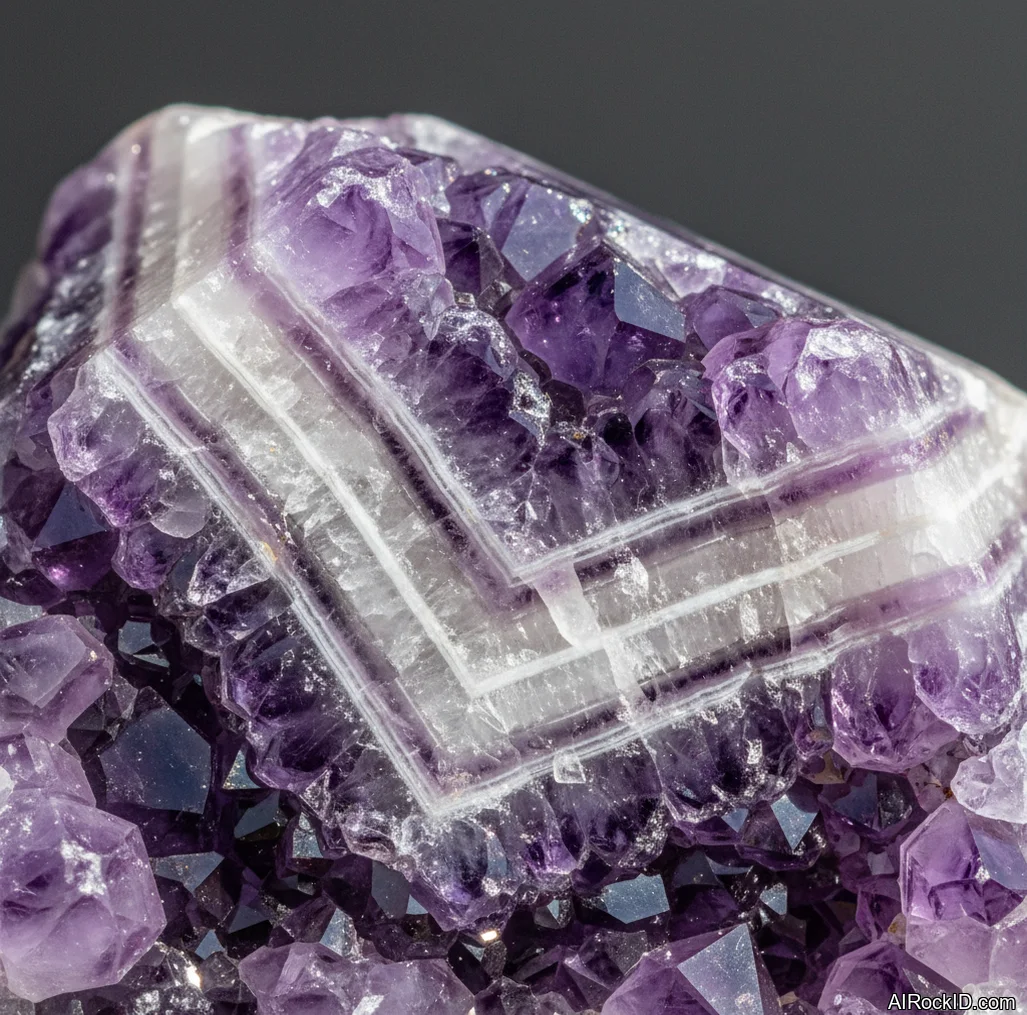
Quick answer: Chevron Amethyst is a naturally banded variety of quartz that combines purple amethyst with white or colorless quartz in V-shaped or zigzag patterns. It is commonly used for cabochons, tumbled stones, carvings, and decorative slabs, and it shares quartz’s typical Mohs hardness of 7.
AI Rock ID can help screen Chevron Amethyst by checking visible banding, color distribution, crystal habit, and quartz-like texture from a clear photo. RockIdentifier.io should be used as an identification aid, with gemological testing recommended for high-value purchases or uncertain specimens.
Good fit
- Collectors who like bold purple-and-white banding in quartz
- Beginners looking for a durable crystal that is easy to handle
- Jewelry buyers who prefer patterned cabochons or beads over transparent gemstones
- People comparing amethyst varieties by appearance rather than rarity
- Decorative stone buyers seeking natural-looking banded material
Not a good fit
- Buyers seeking transparent, faceted amethyst with even color
- Collectors who want a rare mineral species rather than a quartz variety
- Anyone needing a definitive identification from photos alone
- Jewelry wearers who dislike visible inclusions, fractures, or color zoning
Most commonly confused with
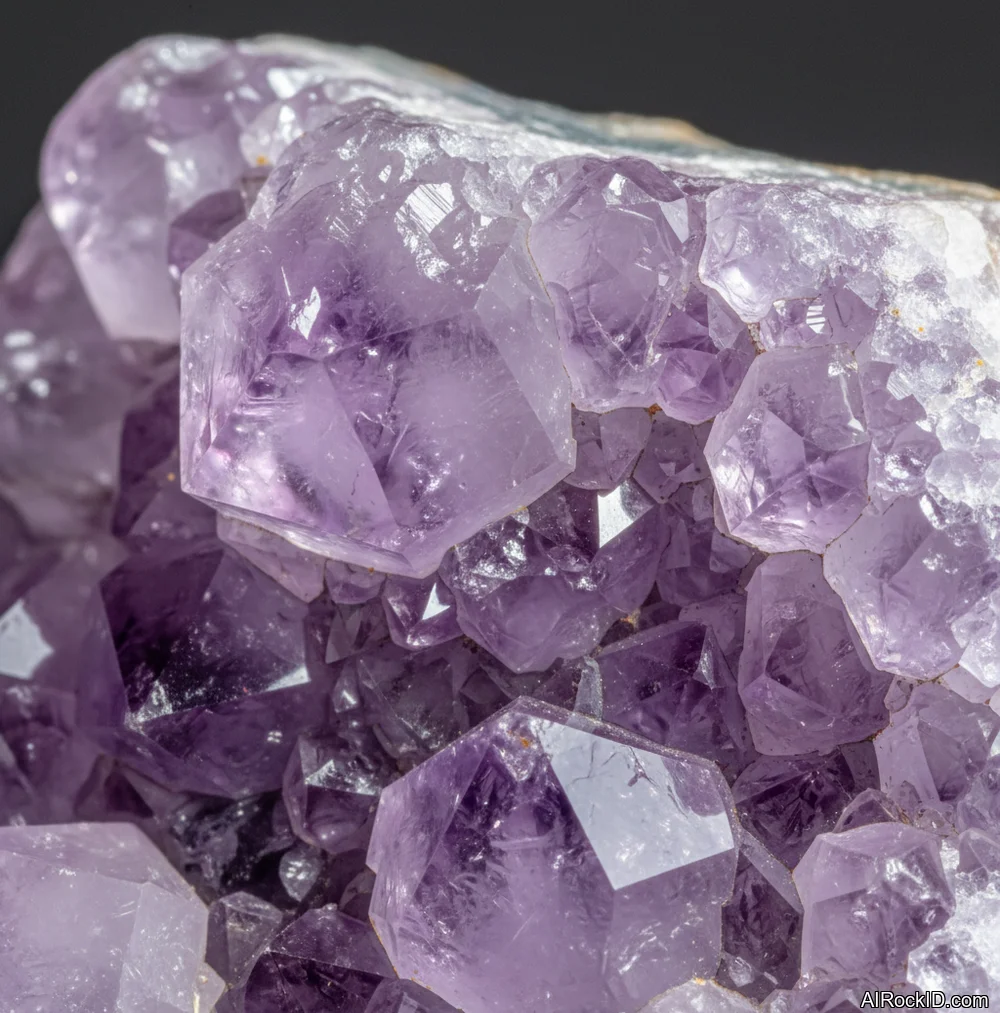
- Amethyst: Standard amethyst is usually more uniformly purple and may lack the white quartz chevrons.
- Banded Amethyst: Banded amethyst may show layered stripes, while Chevron Amethyst specifically has V-shaped or zigzag bands.
- Dream Amethyst: Dream Amethyst is often a trade name for Chevron Amethyst or similar banded amethyst material.
- Fluorite: Purple fluorite can look similar in color but is softer, has different cleavage, and is not quartz.
Chevron Amethyst vs. Similar Purple Stones
| Material | Typical Look | Key Difference | Mohs Hardness |
|---|---|---|---|
| Chevron Amethyst | Purple and white V-shaped quartz banding | Natural-looking zigzag amethyst and quartz zones | 7 |
| Amethyst | Purple quartz, often more even in color | Usually lacks strong white chevron bands | 7 |
| Banded Amethyst | Purple and white layered bands | Bands may be straight or irregular, not always chevron-shaped | 7 |
| Fluorite | Purple, green, or banded translucent stone | Softer with perfect cleavage and lower durability | 4 |
| Dyed Quartz | Bright or patchy purple color | Dye may collect in cracks and surface pits | 7 |
AI identification confidence
AI identification confidence is usually moderate for Chevron Amethyst when the photo clearly shows purple-and-white V-shaped banding and a quartz-like surface. Confidence drops when the stone is highly polished, photographed under colored light, or shown as a small bead with limited pattern visible.
When AI gets it wrong
- Polished beads may hide the chevron pattern and appear like ordinary amethyst or dyed quartz.
- Purple fluorite can be mistaken for amethyst if hardness, cleavage, and density are not checked.
- Strong photo filters or warm lighting can make pale quartz look more purple than it is.
- Trade names such as Dream Amethyst may describe the same or similar material, causing label confusion.
Final recommendation
Choose Chevron Amethyst if you want a durable quartz with visible purple-and-white patterning rather than a uniformly colored gemstone. For purchases sold as natural or high grade, look for consistent quartz luster, banding that continues through the stone, and seller photos taken in neutral lighting.
How to Check Chevron Amethyst Before Buying
Look for banding that appears integrated into the stone rather than painted or concentrated only on the surface. Natural Chevron Amethyst commonly has uneven purple saturation, white quartz zones, minor internal fractures, and a glassy quartz luster. Ask for photos in daylight or neutral lighting, especially when buying beads, towers, or carvings online.
Natural, Dyed, and Trade-Name Material
Most Chevron Amethyst on the market is natural quartz, but some low-quality quartz can be dyed to imitate stronger purple color. Dye is more suspicious when color pools in cracks, drill holes, or porous-looking areas. Names such as Dream Amethyst, dogtooth amethyst, and banded amethyst may overlap in retail use, so the visible pattern is often more informative than the label.
Photo Tips for More Accurate Identification
Photograph Chevron Amethyst on a plain white or gray background using natural, indirect light. Include close-up images of the banding, an unpolished edge if available, and any drill holes or cracks where dye might collect. A scale reference, such as a ruler or coin, helps distinguish small tumbled pieces from larger specimens or slabs.
What Is Chevron Amethyst?
Chevron Amethyst is a banded type of amethyst quartz, and it’s easy to spot because it forms those V-shaped, zigzag layers of purple amethyst against white milky quartz.
Grab a rough chunk and you notice the quartz heft immediately. It’s not hematite-heavy or anything, but it’s dense enough that a palm-sized piece actually feels like something in your hand. And the pattern is the whole reason people want it. Those stacked V shapes can look like a little mountain ridge or even that herringbone stitch you see on fabric, and if the cut is good the bands stay sharp, not all blurred out.
People sometimes look at it and go, “Is that dyed?” because the purple and white can come off almost too clean and graphic. But real chevron amethyst has a few dead giveaways if you look close. Little cloudy swirls trapped in the white quartz, a random pinprick of iron staining riding along one band (not every piece, but you’ll see it), and that cool-to-the-touch quartz feel you get when it’s been sitting on a dealer’s table for a while. Why fake it when it already looks like that?
Origin & History
“Amethyst” comes from the Greek *amethystos*, tied to an old belief that the stone had something to do with sobriety. That name’s been used since antiquity for purple quartz. “Chevron” is just the trade nickname for that V-band pattern, borrowed from the same word people use for military stripes or those zigzag designs you see on fabric.
Chevron amethyst isn’t some separate mineral that got “discovered” by one person the way a new species might. It’s a market term that caught on as lapidaries started cutting that banded amethyst-quartz material into points, palm stones (the kind that sit warm in your hand after a minute), and flat slices where the zigzag pops. And yeah, some dealers call it “dogtooth amethyst,” which trips people up because it’s got nothing to do with dogtooth calcite.
Where Is Chevron Amethyst Found?
Most chevron amethyst on shop shelves comes from Brazil and southern Africa, with smaller lots from India and Madagascar. It shows up anywhere amethyst and milky quartz grew together in layers.
Formation
Look closely at those bands and you’re basically staring at shifts in growth conditions that got locked in place like layers in a jar. Quartz grows out of silica-rich fluids, usually filling cavities and fractures in volcanic rock, or packing into hydrothermal veins. And when a bit of trace iron sneaks into the quartz and the crystal later gets hit with natural radiation, that’s when the purple amethyst color shows up.
Chevron patterning happens when the whole setup keeps switching back and forth. You’ll get a stretch that grows in clearer to purple quartz, then it shifts and drops a milkier quartz layer, then it flips again. That “V” look? It usually comes from how those bands cross the direction the crystal was growing, plus how the piece gets sliced when it’s cut. But the banding itself is real. It isn’t some surface gimmick.
Thing is, a lot of chevron points out there are cut specifically to punch up that zigzag, so you’re often seeing material that’s more massive and less crystalline than what you’d get from a really nice geode amethyst. Still pretty, sure. Just different.
How to Identify Chevron Amethyst
Color: Alternating purple amethyst bands and white to grayish-white milky quartz, often forming V-shaped or zigzag stripes. Purple ranges from pale lavender to medium grape-purple, rarely the inky Uruguay geode color.
Luster: Vitreous when polished or on clean broken surfaces, with a slightly duller look on chalky white bands.
Pick up a piece and tilt it under a single overhead light. Real quartz gives you that glassy flash on the polished faces, and the white bands often look a little “foggy” inside instead of flat paint-white. If you scratch it with a steel nail, it won’t bite, but it will scratch window glass easily. Cheap versions in resin feel warm and light, and the band edges look printed or too perfect.
Common Look-Alikes
Chevron Amethyst is sometimes confused with these materials:
- banded fluorite
- banded agate (especially dyed purple agate)
- dyed quartz (especially purple-dyed milky quartz)
- glass fakes with painted V patterns
- banded chalcedony
Market Cautions & Treatments
When AI Can Get This Wrong
AI photo ID messes up most with banded agate or fluorite, especially if the banding is tight and colors overlap. A photo can't tell you density—real Chevron Amethyst feels heavy, and glass or dyed agate doesn't. Scratching it with steel (it should scratch glass, not the other way around) and checking the V-pattern under a loupe both help confirm it's the real deal.
Properties of Chevron Amethyst
Physical Properties
| Crystal System | Trigonal |
| Hardness (Mohs) | 7 (Hard (6-7.5)) |
| Density | 2.65 g/cm3 |
| Luster | Vitreous |
| Diaphaneity | Transparent to translucent |
| Fracture | Conchoidal |
| Streak | White |
| Magnetism | Non-magnetic |
| Colors | Purple, Lavender, White, Grayish white |
Chemical Properties
| Classification | Silicates |
| Formula | SiO2 |
| Elements | Si, O |
| Common Impurities | Fe, Al, Ti, Mn |
Optical Properties
| Refractive Index | 1.544-1.553 |
| Birefringence | 0.009 |
| Pleochroism | Weak |
| Optical Character | Uniaxial |
Chevron Amethyst Health & Safety
Chevron amethyst is just quartz, and it’s non-toxic, so it’s safe to handle. But if you’re grinding or sawing it, use basic precautions, because that fine silica dust (the kind that hangs in the air and gets everywhere) is a real lung hazard.
Safety Tips
If you’re going to cut it or grind it, keep it wet, make sure there’s plenty of airflow, and wear a real respirator that’s actually rated for silica dust.
Chevron Amethyst Value & Price
Price Range
Rough/Tumbled: $5 - $80 per piece
Cut/Polished: $1 - $6 per carat
Price mostly comes down to what you can see at a glance in your hand: how crisp those chevrons look, how deep the purple actually goes, and whether the point is clean or it’s more of a chunky, cloudy palm stone. And yeah, the big, well-centered V patterns still cost more, even when the purple is only medium.
Durability
Durable — Scratch resistance: Excellent, Toughness: Good
It’s stable in normal indoor conditions, but prolonged strong sunlight can fade the purple over time.
How to Care for Chevron Amethyst
Use & Storage
Store it so it doesn’t rub against softer stones like calcite or fluorite, because quartz will scratch them up fast. I keep points in a padded tray and separate polished pieces with a cloth.
Cleaning
1) Rinse with lukewarm water. 2) Use a drop of mild soap and a soft toothbrush to get into grooves, then rinse well. 3) Pat dry and let it air-dry fully before putting it back on a shelf.
Cleanse & Charge
If you do energetic cleansing, running water and smoke are both gentle options for quartz. Avoid long, harsh sun baths if you care about the purple staying purple.
Placement
On a desk it reads like a little topographic map, especially as a cut point. But don’t put it in a bright windowsill unless you’re fine with slow fading.
Caution
Quartz can chip if it takes a hit on a sharp edge, and those polished points get surprisingly slick on glass shelves (I’ve watched one scoot a little when I bumped the shelf). So try not to leave it in prolonged direct sunlight, and don’t put it in an ultrasonic cleaner if the piece has fractures.
Works Well With
Chevron Amethyst Meaning & Healing Properties
Plain amethyst is pretty straightforward. Chevron amethyst feels… tidier? More “structured” in the way people reach for it, and I think it’s because the pattern literally looks like stacked arrows and layered bands, so your brain treats it like something organized.
In my own stash, it’s the one I grab when I want that classic amethyst calm vibe, but I also want something visually noisy to lock onto while I’m thinking. It gives your eyes a job. And honestly, that helps.
Most dealers and customers slot it into meditation, steady focus, plus dream or sleep routines. That’s the box it usually goes in. But look, here’s the practical bit said plainly: it’s still quartz, and it doesn’t replace therapy, sleep hygiene, or medical care. If a stone helps you stick to a routine, cool. If someone’s trying to sell it as a cure, walk away.
Pick up a polished chevron point and run your thumb across the band edges. You can feel it on a lot of pieces. The white quartz can come off a little more “sugary” under the polish than the purple zones (weird, right?), even when it looks glassy. That little tactile switch is why a lot of people end up using it for grounding exercises, even if they can’t put the mineral reason into words.
Common mistakes
- Assuming every purple-and-white quartz is automatically Chevron Amethyst instead of broader banded amethyst.
- Judging authenticity only by bright purple color, which can be affected by lighting, editing, or dye.
- Confusing purple fluorite with amethyst without checking hardness or cleavage.
- Expecting every piece to have perfect V-shaped bands; natural pieces may show irregular or partial chevrons.
- Using metaphysical names as proof of mineral identity rather than checking the stone’s physical features.
Identify Chevron Amethyst from a photo
Compare Chevron Amethyst traits, care tips, value clues, and common lookalikes with a clear photo.