Garden Quartz Lodolite


Quick answer: Garden Quartz Lodolite is a clear to translucent quartz variety containing visible mineral inclusions that can look like moss, landscapes, clouds, or underwater scenes. Identification focuses on confirming the quartz host, observing the internal inclusions, and checking for signs of dye, assembled stones, or glass imitations.
AI Rock ID can help screen Garden Quartz Lodolite by analyzing visual clues such as transparency, inclusion pattern, surface luster, and crystal habit from a clear photo. RockIdentifier.io provides crystal identification support, but inclusions in quartz can be complex, so unusual or high-value pieces should be confirmed by a qualified gemologist or mineral expert.
Good fit
- Collectors who enjoy scenic or highly included quartz specimens
- Buyers looking for a visually distinctive quartz rather than a flawless clear crystal
- Beginners who want a durable mineral that is relatively easy to care for
- People comparing natural inclusion patterns before purchasing polished stones or carvings
- Crystal enthusiasts interested in traditional symbolism associated with grounding, reflection, or inner landscapes
Not a good fit
- Anyone seeking a perfectly transparent quartz with no internal features
- Buyers who cannot inspect photos or videos before purchasing an included stone
- People who need a certified gem for high-value resale without documentation
- Use in rough handling situations where points, carvings, or polished tips may chip
Most commonly confused with
- Clear Quartz: Clear quartz usually lacks the dense scenic mineral inclusions that define Garden Quartz Lodolite.
- Rutilated Quartz: Rutilated quartz contains needle-like rutile inclusions, while Garden Quartz typically has mossy, cloudy, layered, or landscape-like inclusions.
- Phantom Quartz: Phantom quartz shows internal crystal-growth outlines, whereas Garden Quartz has more irregular mineral scenes or suspended inclusions.
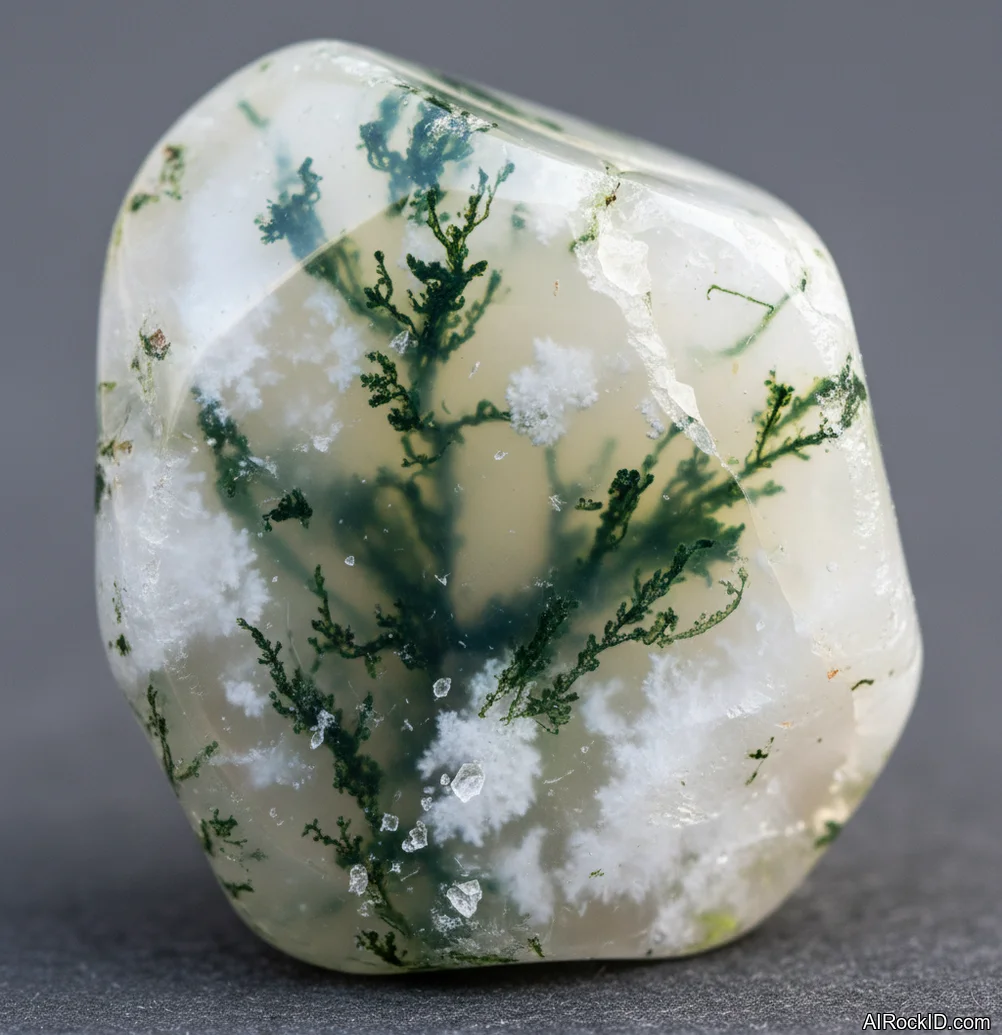
- Moss Agate: Moss agate is chalcedony with dendritic or moss-like patterns and usually has a waxier look than transparent quartz.
Garden Quartz Lodolite Lookalike Comparison
| Material | Main visual clue | Key difference |
|---|---|---|
| Garden Quartz Lodolite | Clear quartz with scenic internal mineral inclusions | Inclusions often appear layered, mossy, cloudy, or landscape-like |
| Rutilated Quartz | Fine golden, silver, red, or black needles | Needle-shaped rutile is more linear and distinct |
| Phantom Quartz | Ghost-like crystal outlines inside quartz | Shows repeated growth zones rather than random scenic inclusions |
| Moss Agate | Green or dark mossy patterns in chalcedony | Typically less transparent with a waxy luster |
| Included Glass | Bubbles or artificial-looking suspended effects | May lack quartz hardness and natural crystal structure |
AI identification confidence
AI identification can be moderately helpful for Garden Quartz Lodolite when photos clearly show the quartz body, internal inclusions, and surface reflections. Confidence is lower for polished spheres, heavily edited seller images, dyed pieces, or specimens photographed without scale and multiple angles.
When AI gets it wrong
- The photo shows only the surface reflection instead of the internal inclusions
- The stone is dyed, backed, coated, or assembled in jewelry
- A polished sphere or carving hides natural crystal-growth clues
- The specimen resembles moss agate, phantom quartz, or glass from a single angle
Final recommendation
Choose Garden Quartz Lodolite based on natural-looking inclusions, good transparency where desired, and seller photos taken under neutral lighting. For higher-priced specimens, request origin details, treatment disclosure, measurements, and additional images or video before buying.
How to Check Garden Quartz Lodolite Before Buying
Inspect the stone from several angles to confirm that the inclusions are internal rather than surface paint, foil, backing, or residue. Natural Garden Quartz may contain irregular mineral clouds, mossy forms, reddish iron staining, chlorite-like green areas, or layered growth features. Ask for photos in daylight or neutral light, especially if the listing uses saturated backgrounds or strong filters.
Natural Inclusions vs. Dye or Artificial Effects
Natural inclusions in Garden Quartz usually have uneven boundaries, depth, and variation throughout the crystal. Dye may concentrate in cracks, pits, or drilled areas and can appear too bright or too evenly distributed. Glass imitations may contain round bubbles or swirls that do not match the fracture and growth behavior of quartz.
Photo Tips for Identifying Garden Quartz Lodolite
Use a clean, close photo in indirect daylight with the specimen placed on a plain background. Include side views, a view through the clearest area, and one image with a ruler or coin for scale. Avoid flash glare, heavy magnification without context, and colored lighting that can make inclusions appear misleading.
What Is Garden Quartz Lodolite?
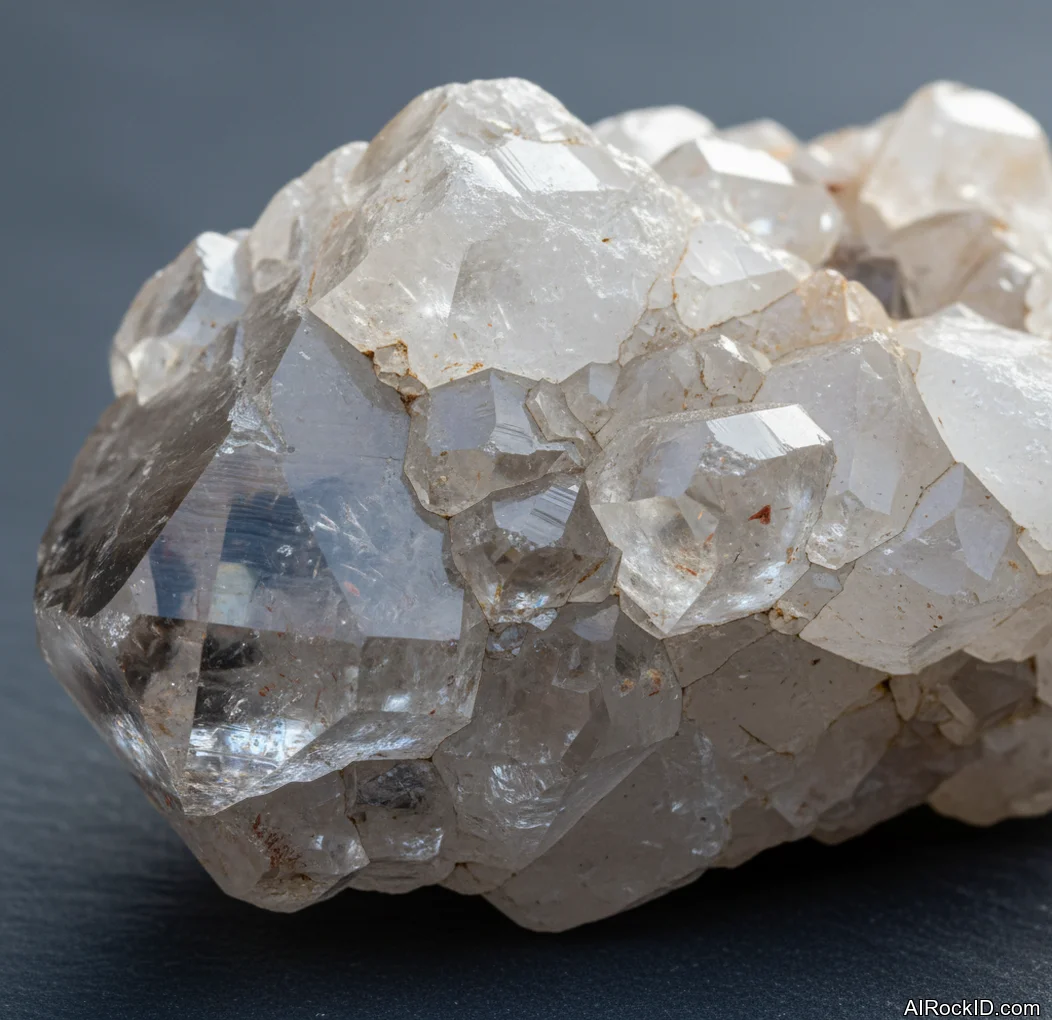
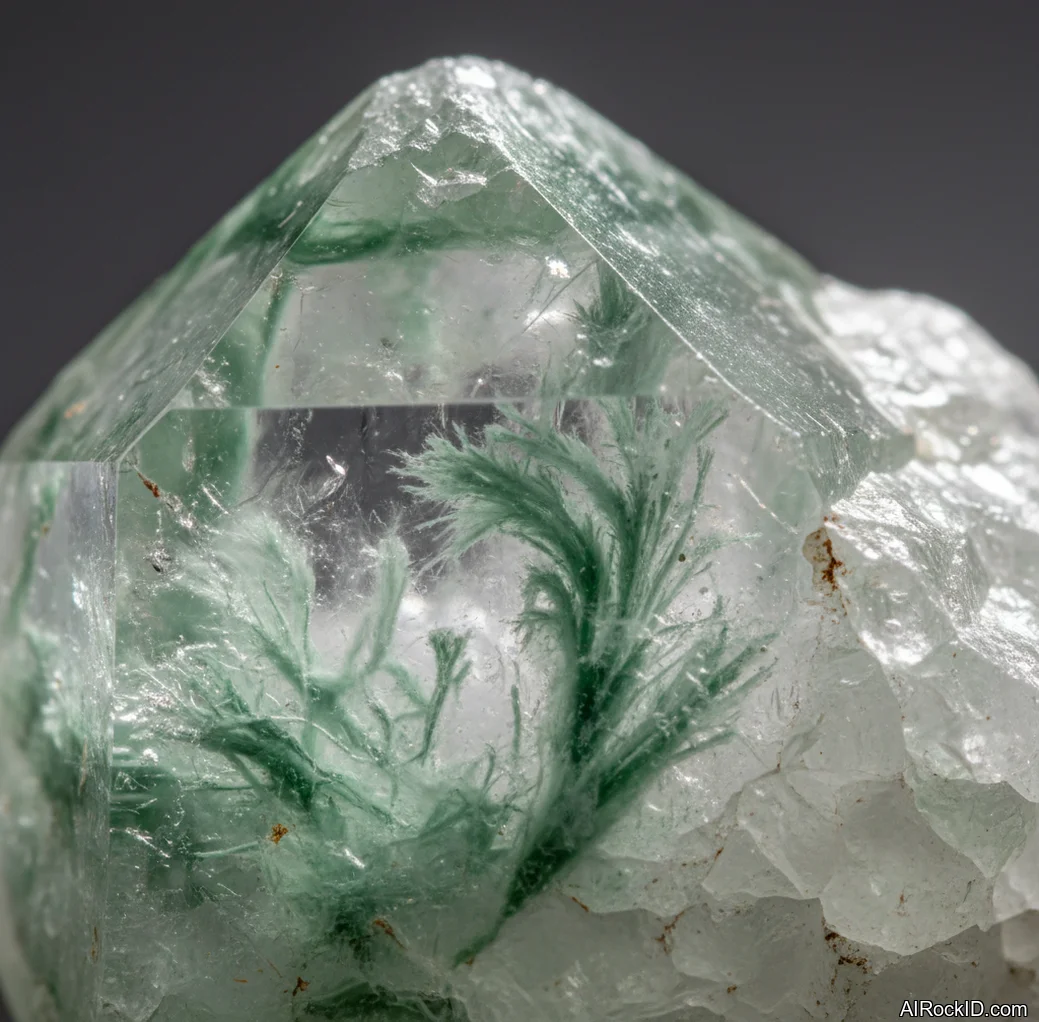
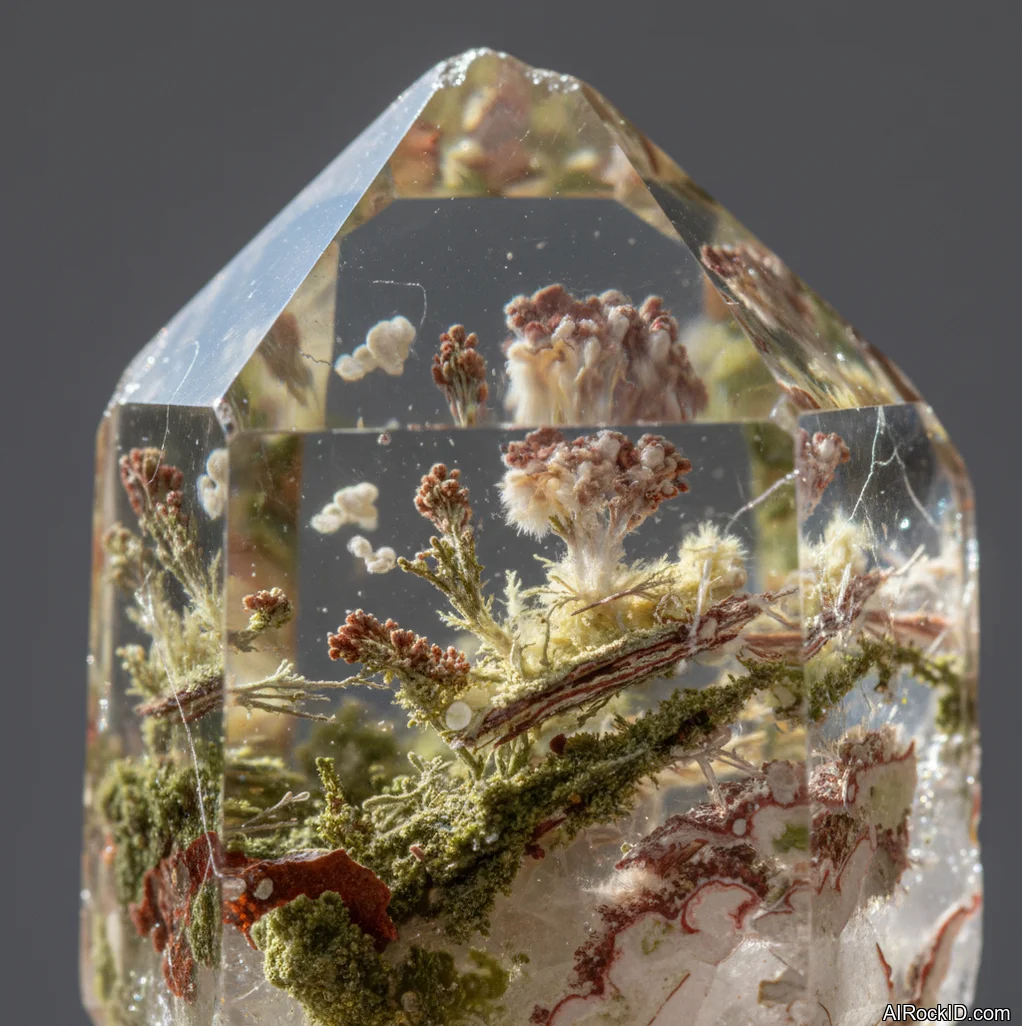
Garden Quartz (Lodolite) is clear quartz with visible mineral inclusions that end up looking like moss, gardens, or tiny underwater scenes sealed inside the crystal.
Pick up a good piece and you’ll feel that familiar quartz weight, cool at first, and kind of slick like glass that’s been sitting on a counter. But your eyes don’t hang around on the outside for long. They drop straight into the inclusions. Some look like green algae, some like rusty clouds, and some have those layered horizon lines that make you keep rotating it under a lamp just to see what pops (you know the move). I’ve handled a lot of quartz, and lodolite is one of the few that makes people stop mid-sentence at a show, because it honestly looks like there’s a whole tiny world trapped in there.
But there’s a catch. The trade uses the name pretty loosely. “Lodolite” can mean chlorite inclusions, iron oxide, clay, feldspar bits, or even a mix of all of it. Two stones can be sold under the same label and look totally different, so you’re buying the scene, not some strict recipe.
Origin & History
“Lodolite” is basically a trade name that popped up in Brazil’s gem market, and it’s tied to Portuguese. Dealers will tell you it comes from “lodo,” meaning mud, since the inclusions can look like silt just hanging there in water, like you shook up a jar and then froze the moment.
Thing is, scientifically it’s still just quartz. Quartz as the host mineral has been described forever, but the whole “garden quartz” concept is a newer lapidary and collector label, the kind of nickname that caught on because it lets people see it in their head without sitting through a mineralogy lecture.
Where Is Garden Quartz Lodolite Found?
Most of the pieces you see in shops are from Brazil and Madagascar, with Brazil, especially Minas Gerais, being the name I hear most often behind the table.
Formation
Picture quartz growing while little bits of “stuff” get caught inside it as it hardens up. Silica-rich fluids push through tiny cracks and pockets, the quartz crystals build outward, and small flakes or grains of other minerals either drift in with the fluid or settle right onto the fresh growth faces (kind of like dust landing on a tacky surface).
And if you really stare at a polished point and tilt it in the light, you can sometimes pick out growth zoning, like those inclusions got laid down in rounds. You’ll see a clear “window” near the termination, then a band packed with inclusions, then it goes clear again. That pattern’s a solid hint you’re looking at inclusions that were trapped during multiple pulses of growth, not something somebody painted on or glued behind the stone.
How to Identify Garden Quartz Lodolite
Color: The host is usually colorless to smoky-clear, while inclusions can be green (often chlorite), reddish-brown (iron oxides), black (manganese oxides or other dark minerals), or tan and cream (clays and feldspar-rich material).
Luster: Vitreous, like clean glass.
Pick up the piece and tilt it under a single strong light. Real inclusions sit at different depths, so the “scene” shifts with parallax instead of staying flat. The real test is the surface: quartz stays cool and slick, and it doesn’t feel waxy or warm like resin fakes. And if you see perfectly sharp “branches” that all sit on one plane, be a little suspicious, because some dyed composites and glass can mimic that look in photos.
Common Look-Alikes
Garden Quartz Lodolite is sometimes confused with these materials:
- Chlorite-included Quartz
- Phantom Quartz
- Scenic Jasper (fake or dyed)
- Glass with embedded moss or paint
- Dyed clear quartz (especially green or rusty tones)
- Rutilated Quartz
Market Cautions & Treatments
When AI Can Get This Wrong
AI image tools often mix up Lodolite with chlorite-included quartz or even scenic jasper, especially when the inclusions look like layers or landscapes. Photos flatten everything, so glass fakes with embedded fibers or paint can pass as the real thing. The giveaway in-hand is always weight and feel: quartz is heavy and cool, glass isn’t. Checking for natural surface pits or inclusions breaking the polish also helps.
Properties of Garden Quartz Lodolite
Physical Properties
| Crystal System | Trigonal |
| Hardness (Mohs) | 7 (Hard (6-7.5)) |
| Density | 2.65 g/cm3 |
| Luster | Vitreous |
| Diaphaneity | Transparent to translucent |
| Fracture | Conchoidal |
| Streak | White |
| Magnetism | Non-magnetic |
| Colors | Colorless, White, Smoky gray, Green, Reddish-brown, Black, Yellow-brown |
Chemical Properties
| Classification | Silicates |
| Formula | SiO2 |
| Elements | Si, O |
| Common Impurities | Fe, Mn, Al, Ti, Cl |
Optical Properties
| Refractive Index | 1.544-1.553 |
| Birefringence | 0.009 |
| Pleochroism | None |
| Optical Character | Uniaxial |
Garden Quartz Lodolite Health & Safety
Solid pieces are fine to handle, and they’re just as water-safe as regular quartz.
Safety Tips
If you need to cut it or grind it, handle it the same way you would quartz. Keep the dust out of your lungs. Use water to keep things wet and down, and wear the right respirator (not just a flimsy paper mask).
Garden Quartz Lodolite Value & Price
Price Range
Rough/Tumbled: $10 - $250 per piece
Cut/Polished: $2 - $20 per carat
Prices jump around a lot depending on how clear the quartz is and how easy it is to actually read the inclusion scene from the sweet spot angle. Crisp, well-polished points (the kind that catch the light cleanly when you tilt them in your hand) with layered “landscape” scenes or bold green chlorite plumes go for more than pieces that look muddy and low-contrast.
Durability
Durable — Scratch resistance: Excellent, Toughness: Good
Quartz is stable in normal household conditions, but points and polished edges can chip if they knock against harder stones or tile.
How to Care for Garden Quartz Lodolite
Use & Storage
Store it where the points won’t bang together, because quartz chips at the tips even though it’s hard. I keep nicer polished towers in individual pouches or a tray with dividers.
Cleaning
1) Rinse with lukewarm water to remove grit. 2) Use a drop of mild soap and a soft toothbrush around the base and any pits. 3) Rinse well and dry with a microfiber cloth so you don’t leave water spots on the polish.
Cleanse & Charge
If you do energetic cleansing, smoke, sound, or a quick rinse works fine. Skip saltwater if your piece has cracks or open seams that trap residue.
Placement
Look closely at the best viewing face and set that side toward your main light source. A windowsill works for viewing, but I don’t leave mine in harsh sun for months because some pieces have tiny internal fractures that show more with heat cycling.
Caution
Don’t hit it with big temperature swings, and don’t just chuck it in your pocket rattling around with your keys. Those polished points pick up these tiny little edge dings, and once you’ve spotted one, you’ll know exactly where to look for the next.
Works Well With
Garden Quartz Lodolite Meaning & Healing Properties
Most folks see lodolite and go, “Oh, clear quartz stuff.” But in your hand it doesn’t really behave like that, because your eyes keep snagging on whatever’s trapped inside. When I’m holding one during a quiet sit, my brain drops into this slower gear. I’ll catch myself fixated on one tiny mossy-green corner or a rusty little flare, and it’s weirdly easier to stick with a single thought instead of ricocheting all over the place.
Compared to plain clear quartz, I grab lodolite when I want grounded energy that isn’t a brick. It feels earthy. Like there’s actual soil and stone sealed in there, not just a clean, glassy point. And look, I’m not going to pretend a crystal replaces a doctor, therapy, or sleep. Not even close. I use it like a focus prop. It sets the mood, and then I still have to do the work.
Thing is, the market gets messy because sellers talk like every piece comes with the exact same “meaning.” It doesn’t. One cab with bright green chlorite hits me totally differently than a smoky, iron-stained piece that looks like storm clouds rolling in. If you’re buying it for metaphysical work, pick the one that actually grabs you in person (if you can). Photos squish the depth, and once that layered, 3D look is gone… what are you even buying it for?
Common mistakes
- Assuming every included clear quartz is Garden Quartz Lodolite without comparing the inclusion style
- Mistaking surface dirt, polishing compound, or coating for natural internal scenery
- Buying from a single highly edited photo that exaggerates color or contrast
- Overvaluing a common polished piece only because the inclusions look unusual
- Confusing moss agate or phantom quartz with Garden Quartz without checking transparency and structure
- Ignoring chips or fractures near drilled holes, points, or carving edges
Identify Garden Quartz Lodolite from a photo
Compare Garden Quartz Lodolite traits, care tips, value clues, and common lookalikes with a clear photo.