Kiwi Jasper


Quick answer: Kiwi Jasper is a trade name for a spotted, microcrystalline quartz material, commonly white to pale gray-green with dark speckles. It is often bought as beads, palm stones, and carvings, and its appearance can overlap with other spotted stones sold under different trade names.
AI Rock ID can help compare Kiwi Jasper against visually similar spotted stones by analyzing color, pattern, luster, and surface texture from a photo. RockIdentifier.io should be used as a supportive identification tool, not a substitute for gemological testing when value, treatment, or exact species matters.
Good fit
- Buyers who like soft gray-green, cream, and black spotted patterns
- Beginners looking for a durable quartz-family stone for handling or display
- Collectors comparing trade-name jaspers and spotted chalcedony materials
- Jewelry makers seeking a neutral speckled bead material
Not a good fit
- Anyone needing a formally recognized mineral species name rather than a trade name
- Buyers who require transparent or high-brilliance gemstones
- Situations where exact origin, treatment status, or composition must be documented
Most commonly confused with
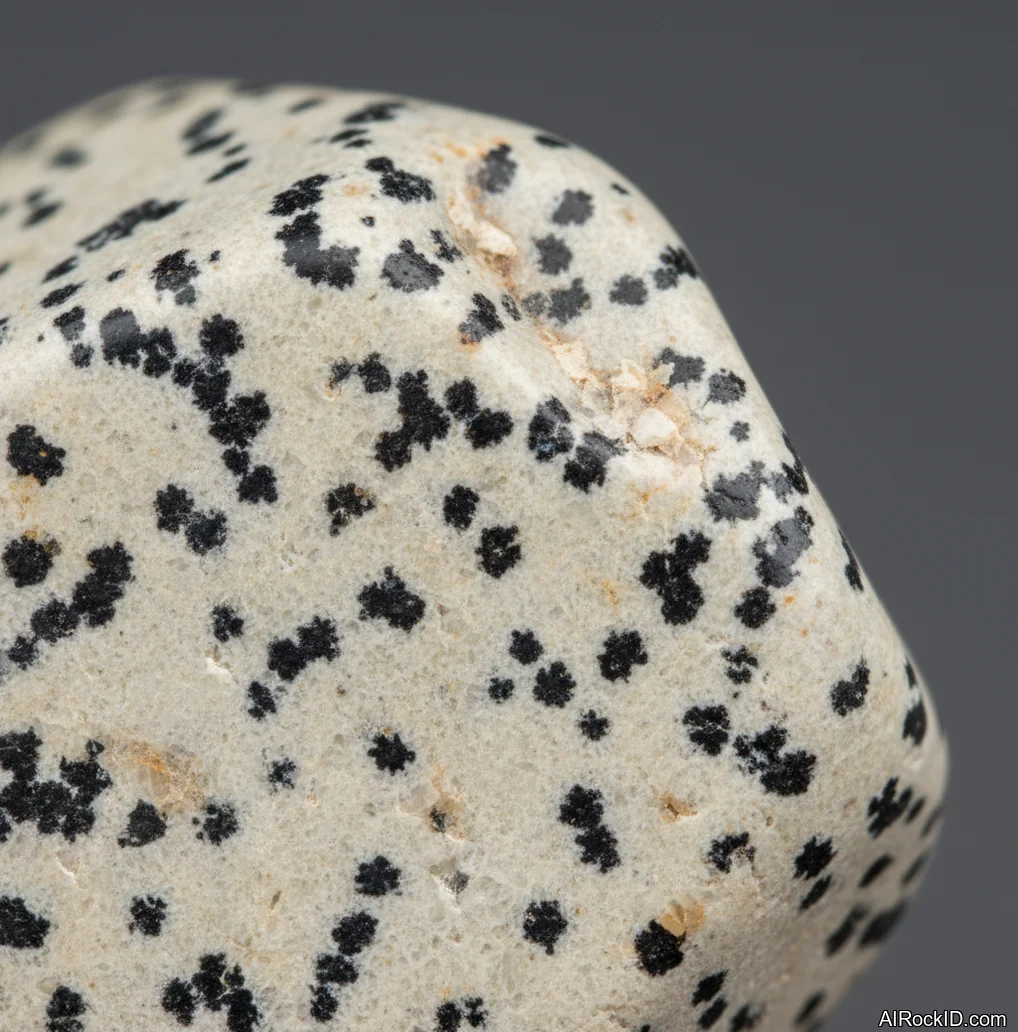
- Dalmatian Jasper: Usually cream to tan with black tourmaline-like spots, while Kiwi Jasper is commonly paler gray-green with softer speckling.
- Sesame Jasper: A trade name often used for white or gray jasper with black speckles; it may overlap commercially with some material sold as Kiwi Jasper.
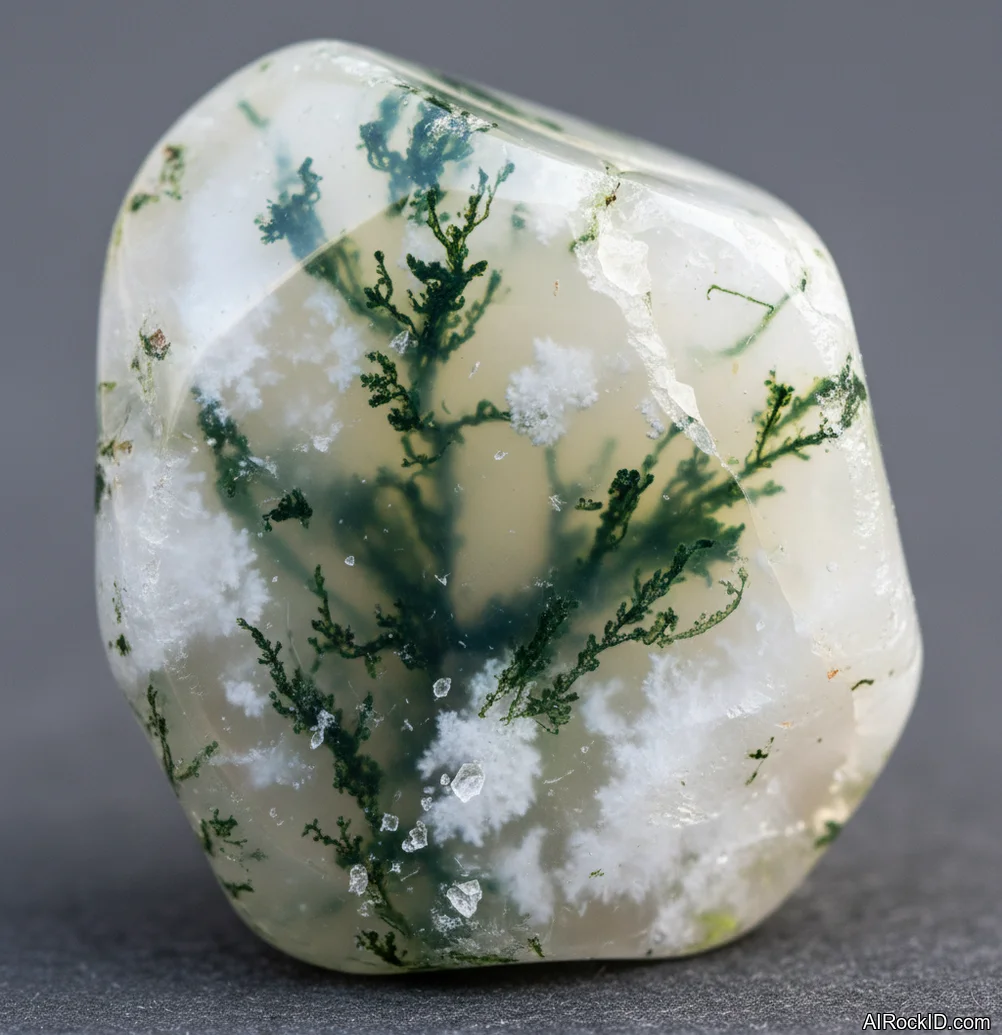
- Tree Agate: Typically shows green branching or mossy inclusions rather than evenly scattered dark speckles.
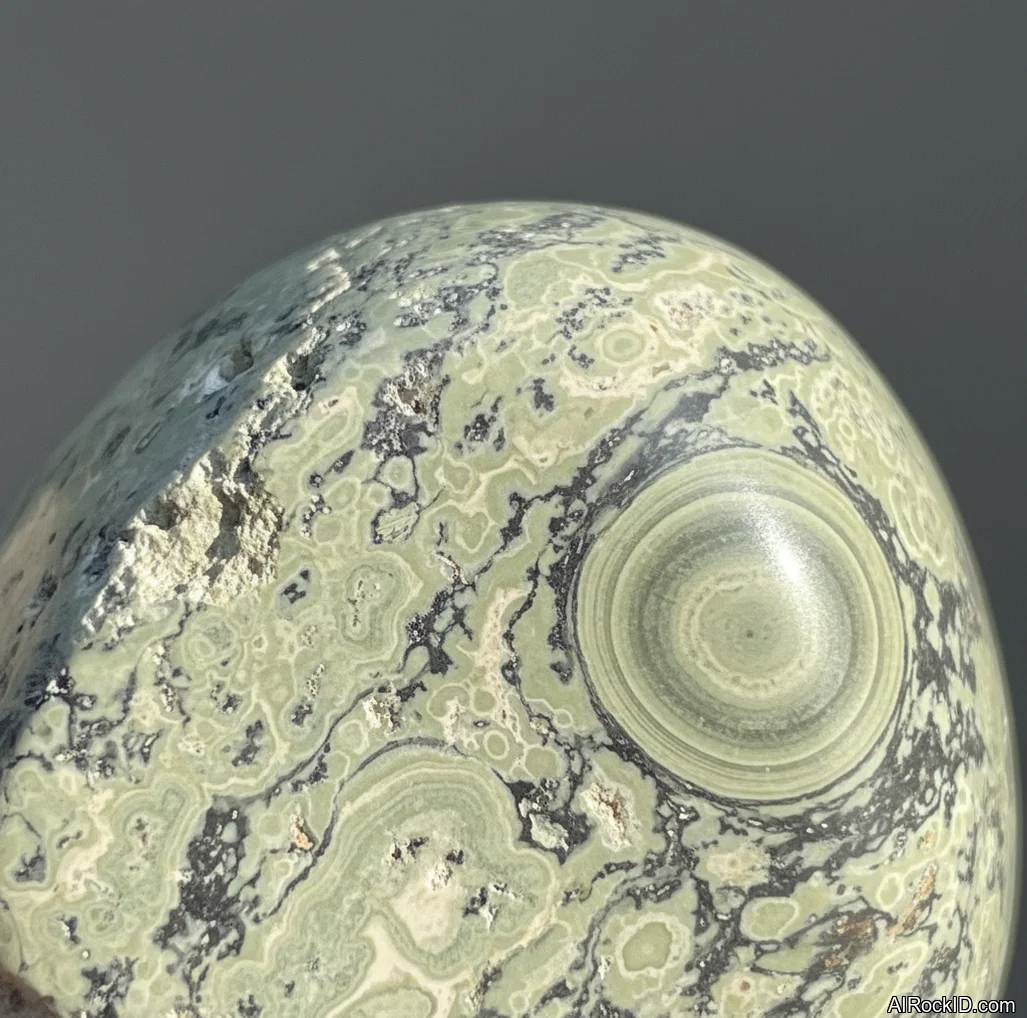
- Ocean Jasper: Often has orbicular circles, bands, or multicolor patterns instead of a simple pale body with black dots.
Kiwi Jasper Lookalike Comparison
| Stone | Typical Look | Key Difference |
|---|---|---|
| Kiwi Jasper | White to pale gray-green with black speckles | Soft greenish cast and fine spotted pattern |
| Dalmatian Jasper | Cream or beige with bold black spots | Warmer base color and more dog-coat-like contrast |
| Sesame Jasper | White to gray with small dark speckles | Trade naming can overlap; often less green |
| Tree Agate | White base with green branching inclusions | Branch-like inclusions rather than dots |
| Ocean Jasper | Orbicular, banded, or multicolor patterns | Circular or scenic patterning is common |
AI identification confidence
AI identification confidence for Kiwi Jasper is usually moderate because it is a trade-name material with lookalikes that share spotted quartz textures. A clear, well-lit photo of an unfiltered surface improves results, especially when paired with hardness, luster, and seller information.
When AI gets it wrong
- The photo is taken under green-tinted lighting or heavy image filters.
- The stone is polished so strongly that speckles, grain, or surface texture are obscured.
- A seller uses Kiwi Jasper, Sesame Jasper, and spotted jasper as interchangeable trade names.
- The specimen is dyed, composite, or mislabeled as a similar decorative stone.
Final recommendation
Choose Kiwi Jasper by appearance first, because the name is used commercially for spotted quartz material rather than a strict mineral species. For higher-priced items, ask for natural-color disclosure, clear photos, and any available information about origin or treatments.
How to Check Kiwi Jasper Before Buying
Look for a consistent pale white, gray, or gray-green base with natural-looking black speckles rather than paint-like surface dots. Ask whether the stone is natural-color, dyed, stabilized, or a composite, especially for very bright green pieces. Be cautious with listings that promise a rare species name without providing basic mineral or material details.
Photo Tips for Identifying Kiwi Jasper
Use daylight or a neutral white light and photograph the stone on a plain background. Include one close-up and one full-stone image so the overall color and speckle distribution are both visible. Avoid saturated filters, wet surfaces, and colored backdrops because they can make gray-green jasper appear more vivid than it is.
Natural Variation in Kiwi Jasper
Kiwi Jasper can range from nearly white to pale sage, gray, or muted green. Speckles may be fine and scattered or more concentrated in patches, and polished pieces often appear smoother and lighter than rough material. Because the name is trade-based, two items sold as Kiwi Jasper may not match exactly.
What Is Kiwi Jasper?
Kiwi Jasper is an opaque, fine-grained jasper (microcrystalline quartz). It’s usually a pale gray to gray-green stone with those peppery black speckles, plus the occasional tan or rust-colored patch.
Grab a tumbled piece and you can feel that familiar quartz heft right away. Not heavy like hematite. But it also won’t give you that weird “plasticky” vibe some dyed stones do. The pattern is the whole reason people pick it up in the first place: tiny black dots and little smudges that honestly look like kiwi seeds, and sometimes you’ll catch softer cloudy zones that remind me of lichen on a rock (the kind you’d find on a damp trail).
Most of the stuff you see for sale is polished. Raw chunks are out there, but they’re often kind of blocky and, well, quiet-looking until somebody gives them a decent cut and polish. And yeah, despite the name, it’s usually not from New Zealand. That one gets people every time at shows.
Origin & History
“Kiwi jasper” is a trade name that really caught on in the late 20th century, right when beads and tumbled stones started selling like crazy. But it was never “described” as a formal mineral the way something like spodumene was, because this is a rock name tied to a certain look and pattern, not one strict composition.
Thing is, the name’s basically marketing shorthand. Sellers leaned hard into the kiwi fruit idea: that pale inside, then those black, seed-like specks you can spot the second you dump a handful of tumbled pieces into a tray. And you’ll hear “sesame jasper” tossed around in the same bins too, usually for the same material or something extremely close.
Where Is Kiwi Jasper Found?
Most commercial Kiwi Jasper on the market is imported and sold under a trade name, with common supply coming through Asian lapidary channels. It’s also widely distributed through rock shops in the USA.
Formation
Jasper is basically silica that never bothered to form big, showy crystals. It’s microcrystalline quartz and chalcedony instead, and that material can fill little gaps, replace whatever was there first, or glue sediments together, and the end result is hard and opaque.
Those speckles you see in Kiwi Jasper? They’re usually tiny inclusions or small patches of darker minerals that got trapped in the silica while it was coming together.
Look, if you hold a polished face under a bright desk lamp and tilt it back and forth, the surface has this super-fine texture, almost like sugar, except it’s packed in and doesn’t move. That tight grain is why it takes such a clean shine. But there’s a catch. If the black spots are softer than the surrounding quartz, the polish can “undercut” those areas, and some cabochons end up with little low dips you can actually catch with a fingernail (kind of annoying once you notice it).
How to Identify Kiwi Jasper
Color: Base color ranges from off-white to light gray and gray-green, usually with scattered black speckles and occasional tan, cream, or rusty patches. Patterns are mottled and random rather than banded.
Luster: Waxy to vitreous when polished, dull when raw.
If you scratch it with a steel nail, it shouldn’t mark easily, and it’ll scratch common window glass. The real test is the feel: polished Kiwi Jasper stays cool in your hand for a while, unlike resin or dyed composite pieces that warm up fast. And check the speckles with a loupe, natural spots look embedded and irregular, while printed or coated fakes can look too crisp or sit on the surface.
Common Look-Alikes
Kiwi Jasper is sometimes confused with these materials:
- Kambaba jasper (green-black orbicular jasper)
- Dalmatian jasper (cream/tan with black spots, often sold side-by-side with Kiwi Jasper)
- Rhyolite (including rain forest jasper style material with mottled gray-green and black)
- Dendritic opal or dendritic agate (white to gray with black branching inclusions that photograph like speckles)
- Dyed howlite or dyed magnesite sold as “Kiwi” (gray-green dye with black speckle printing or stain)
- Speckled epoxy/resin or glass “stone” (cast material with suspended black flecks)
Market Cautions & Treatments
When AI Can Get This Wrong
Photos trip AI up when the stone is pale gray-green with evenly scattered black dots, because that same look shows up in dalmatian jasper, rhyolite, and dyed howlite listings. The real test is physical: Kiwi Jasper should scratch glass and won’t take a steel knife scratch easily, while howlite/magnesite will. A quick loupe check helps too, since resin or glass fakes may show bubbles or a too-uniform “sprinkled” pattern that doesn’t blend into the stone grain.
Properties of Kiwi Jasper
Physical Properties
| Crystal System | Trigonal |
| Hardness (Mohs) | 6.5-7 (Hard (6-7.5)) |
| Density | 2.58-2.65 |
| Luster | Waxy |
| Diaphaneity | Opaque |
| Fracture | Conchoidal |
| Streak | White |
| Magnetism | Non-magnetic |
| Colors | White, Gray, Gray-green, Black, Tan, Cream, Rust |
Chemical Properties
| Classification | Silicates |
| Formula | SiO2 |
| Elements | Si, O |
| Common Impurities | Fe, Mn, Al, Ca |
Optical Properties
| Refractive Index | 1.530-1.540 |
| Birefringence | 0.009 |
| Pleochroism | None |
| Optical Character | Uniaxial |
Kiwi Jasper Health & Safety
Kiwi Jasper is usually fine to handle, and it’s fine if it gets wet. But like any silica-rich rock, the real issue isn’t the stone in your hand, it’s the dust in your lungs. If you’re grinding it or cutting it with a saw and you see that chalky haze hanging in the air (and it’ll cling to your fingers), that’s the part you don’t want to breathe.
Safety Tips
If you need to cut it or sand it, keep it wet so you’re not kicking up a cloud of dust, and put on a properly fitted respirator that’s rated for fine particulates (the kind that actually seals to your face).
Kiwi Jasper Value & Price
Price Range
Rough/Tumbled: $3 - $20 per tumbled stone
Cut/Polished: $0.50 - $3.00 per carat
Price mostly comes down to the pattern and how well it’s been polished. A clean, pale base with crisp, peppery speckles (the kind that pop when you tilt it under a light and you can see the shine run across the surface) and not many pits will move way faster than the muddy gray stuff.
Durability
Durable — Scratch resistance: Good, Toughness: Good
It’s stable in normal household conditions, but polished surfaces can lose shine if they bang around with harder stones like corundum.
How to Care for Kiwi Jasper
Use & Storage
Tossing it in a bowl with harder gems will haze the polish over time. I keep my jaspers in soft bags or separated in a drawer tray.
Cleaning
1) Rinse with lukewarm water. 2) Use a mild soap and a soft toothbrush to lift skin oils from the polish. 3) Rinse again and pat dry with a clean cloth.
Cleanse & Charge
If you do the metaphysical side, a quick rinse and a night on a dry windowsill away from harsh sun is plenty. Avoid salt baths if the piece has pits that trap residue.
Placement
It reads best under natural light where the speckles pop. On a desk, it’s the kind of stone you end up rubbing with your thumb while you think.
Caution
Skip harsh cleaners and ultrasonic machines. They can dull the surface, and they’ve got a nasty habit of turning up tiny fractures you didn’t even know were there. And if your piece is porous or really pitted, make sure it’s dried well after washing, especially down in those little pinholes where water likes to hang around.
Works Well With
Kiwi Jasper Meaning & Healing Properties
Look at Kiwi Jasper for a second and you’ll get why people call it a “calm” stone. The colors stay soft, kind of muted, and the speckles keep it from looking like a flat slab of paint. When I’m standing at the counter sorting a tray of tumbles, it’s one of the few jaspers where my eyes stop bouncing around and my brain drops down a gear just from the patterning.
In crystal-healing circles, folks usually reach for it to steady emotions and take the edge off everyday stress. It’s more of a supportive, background kind of stone than a big, dramatic “your whole life changes today” one. And yeah, I’ve had customers pick it out on purpose for desk work or studying because it doesn’t feel intense. But keep your feet on the ground. It’s not medicine, and it’s not a substitute for real help if you’re dealing with anxiety or sleep issues.
One practical thing, from handling a lot of it: smooth Kiwi Jasper works really well in a worry-stone shape. The polish usually comes out satiny instead of that super slick, glassy finish, so your thumb actually grips and doesn’t skid off. But if you’re buying online, expect a few little pits here and there (tiny pinholes, basically). Normal. That’s just what happens with jasper that has mixed inclusions.
Common mistakes
- Assuming every pale spotted stone is Kiwi Jasper without comparing Dalmatian Jasper, Sesame Jasper, or Tree Agate.
- Treating Kiwi Jasper as a strict mineral species instead of a commercial name for a quartz-family material.
- Judging color from a single seller photo taken under warm or green lighting.
- Assuming very bright green material is natural without asking about dye or enhancement.
- Overpaying for common bead-grade material because it is described with vague rarity claims.
Identify Kiwi Jasper from a photo
Compare Kiwi Jasper traits, care tips, value clues, and common lookalikes with a clear photo.