Turkish Amethyst


Quick answer: Turkish Amethyst is a purple variety of quartz associated with deposits and trade material from Turkey. It is usually identified by its violet color, quartz hardness, glassy luster, and natural growth patterns such as points, clusters, or geode surfaces.
AI Rock ID can help screen a suspected Turkish Amethyst by comparing color, crystal habit, luster, and visible inclusions against known mineral patterns. RockIdentifier.io provides educational identification support, but final confirmation may require hardness testing, magnification, or a gemological assessment.
Good fit
- Collectors who want a purple quartz specimen with a specific regional label
- Beginners looking for a durable display crystal that is easier to maintain than many softer minerals
- Buyers comparing natural amethyst clusters, points, and small polished stones
- People who prefer lavender to deep violet quartz tones
Not a good fit
- Anyone needing a guaranteed origin without seller documentation
- Buyers who want a rare gem rather than a common quartz variety
- Use in rough handling situations where points or cluster edges may chip
- People seeking a crystal that can be safely left in direct sunlight for long periods
Most commonly confused with
- Amethyst: Turkish Amethyst is a locality-based name for amethyst, while amethyst can come from many regions worldwide.
- Fluorite: Purple fluorite is softer, often shows cubic cleavage, and scratches more easily than quartz.
- Purple Glass: Glass may show bubbles, swirl marks, or molded shapes and lacks natural quartz crystal growth.
- Ametrine: Ametrine has both purple amethyst and yellow citrine color zones in the same quartz specimen.
Turkish Amethyst vs. Similar Purple Materials
| Material | Key Difference | Typical Clue |
|---|---|---|
| Turkish Amethyst | Purple quartz from Turkey or sold with a Turkish locality label | Glassy luster, hexagonal quartz habit, hardness of 7 |
| Purple Fluorite | Softer calcium fluoride mineral | Cubic cleavage and lower scratch resistance |
| Purple Glass | Man-made material, not a mineral crystal | Rounded bubbles, molded surfaces, or uniform color |
| Ametrine | Quartz with purple and yellow color zoning | Distinct amethyst-citrine color boundary |
| Lepidolite | Lithium mica rather than quartz | Flaky texture and pearly to silky sheen |
AI identification confidence
AI identification confidence is usually moderate to high for clear photos of natural amethyst color, luster, and crystal habit. Confidence is lower when the specimen is polished, dyed, heavily included, or photographed under colored lighting.
When AI gets it wrong
- Purple glass or resin can look like polished amethyst in photos.
- Fluorite may appear similar when crystal shape or cleavage is not visible.
- Lighting can make pale quartz, smoky quartz, or colorless quartz appear violet.
- A Turkish origin label cannot be verified from appearance alone.
Final recommendation
Choose Turkish Amethyst when you like purple quartz and the seller provides clear photos, transparent locality information, and a fair return policy. For higher-value pieces, request documentation or purchase from a seller who explains whether the origin is verified or simply a trade description.
How to Check Turkish Origin Claims
A Turkish origin claim is strongest when it comes with mine, region, dealer, or collection history information. Appearance alone cannot prove that an amethyst formed in Turkey, because amethyst from different regions can share the same purple color and quartz structure. For important purchases, ask whether the locality is documented, inferred from trade supply, or simply used as a descriptive sales name.
Natural, Treated, and Dyed Material
Natural amethyst can range from pale lavender to deep violet, and some quartz may be heated or otherwise treated in the gem trade. Dyed or coated pieces may show concentrated color in cracks, unusually even surface color, or residue in pits. A seller should disclose treatments when known, especially for polished stones, beads, and intensely colored specimens.
Photo Tips for Identification
Photograph Turkish Amethyst in natural white light on a neutral background to show its true color. Include close-up images of crystal faces, broken edges, inclusions, and the base of clusters when available. Avoid purple LED lighting or saturated filters, because they can make non-amethyst materials appear violet.
What Is Turkish Amethyst?
Turkish Amethyst is just amethyst: a purple variety of quartz (SiO2) that comes out of deposits in Turkey.
Grab a decent piece and the first thing you clock is the feel. Classic quartz weight. Cool in your palm. And those tiny sharp edges where the points butt up against the matrix will absolutely catch a fingertip if you rub it the wrong way.
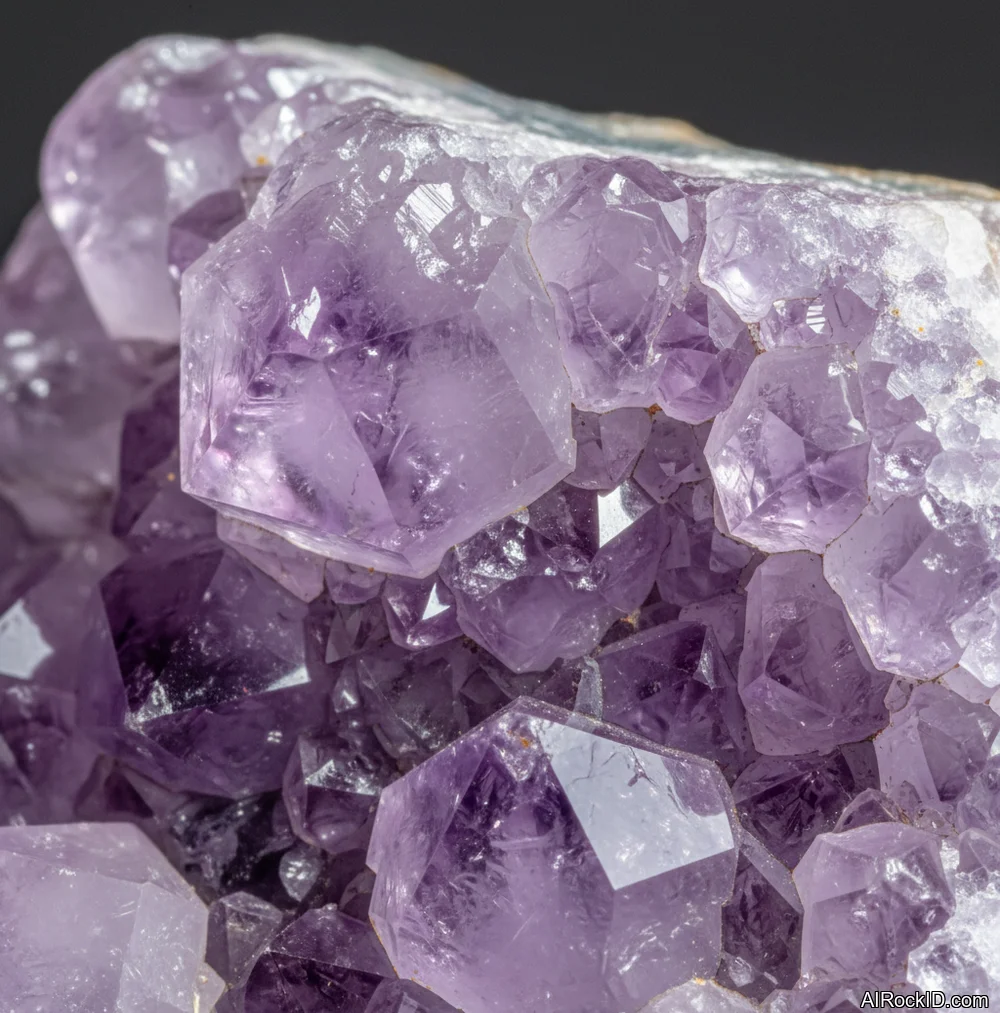
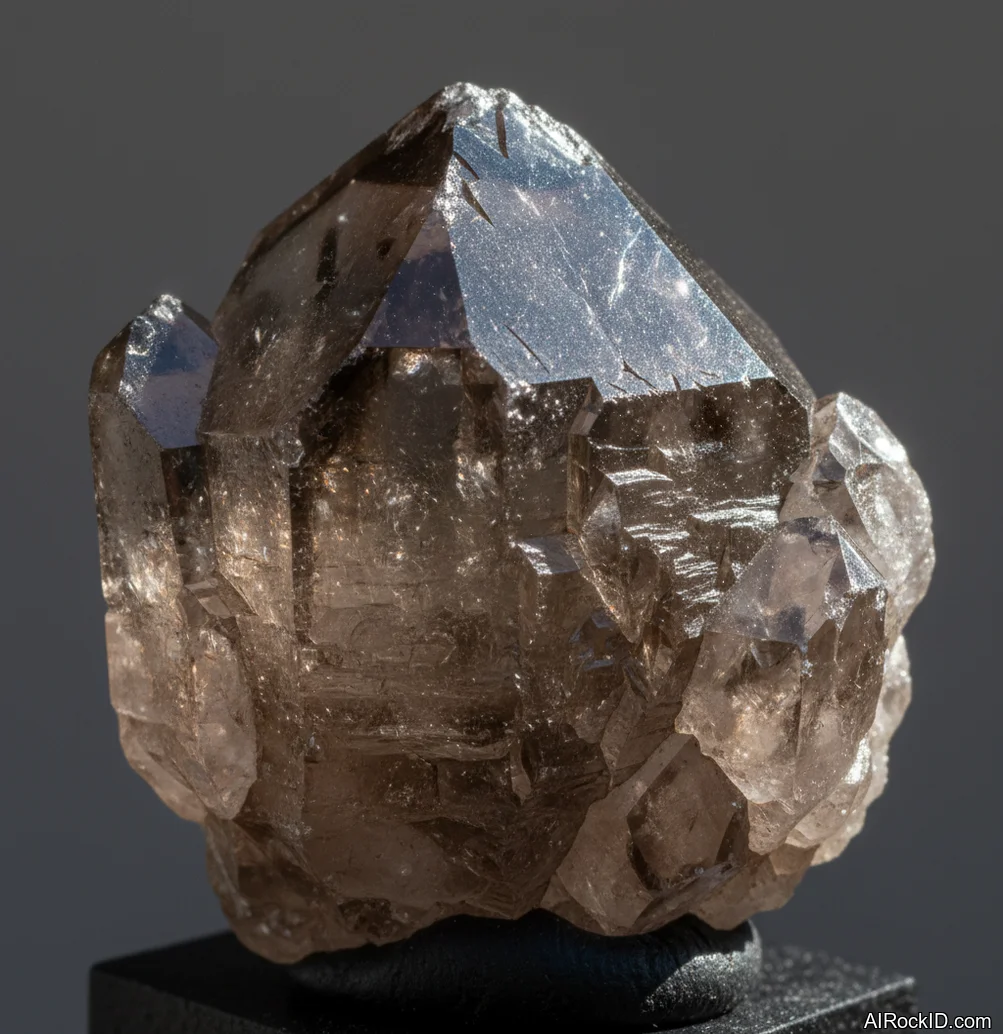
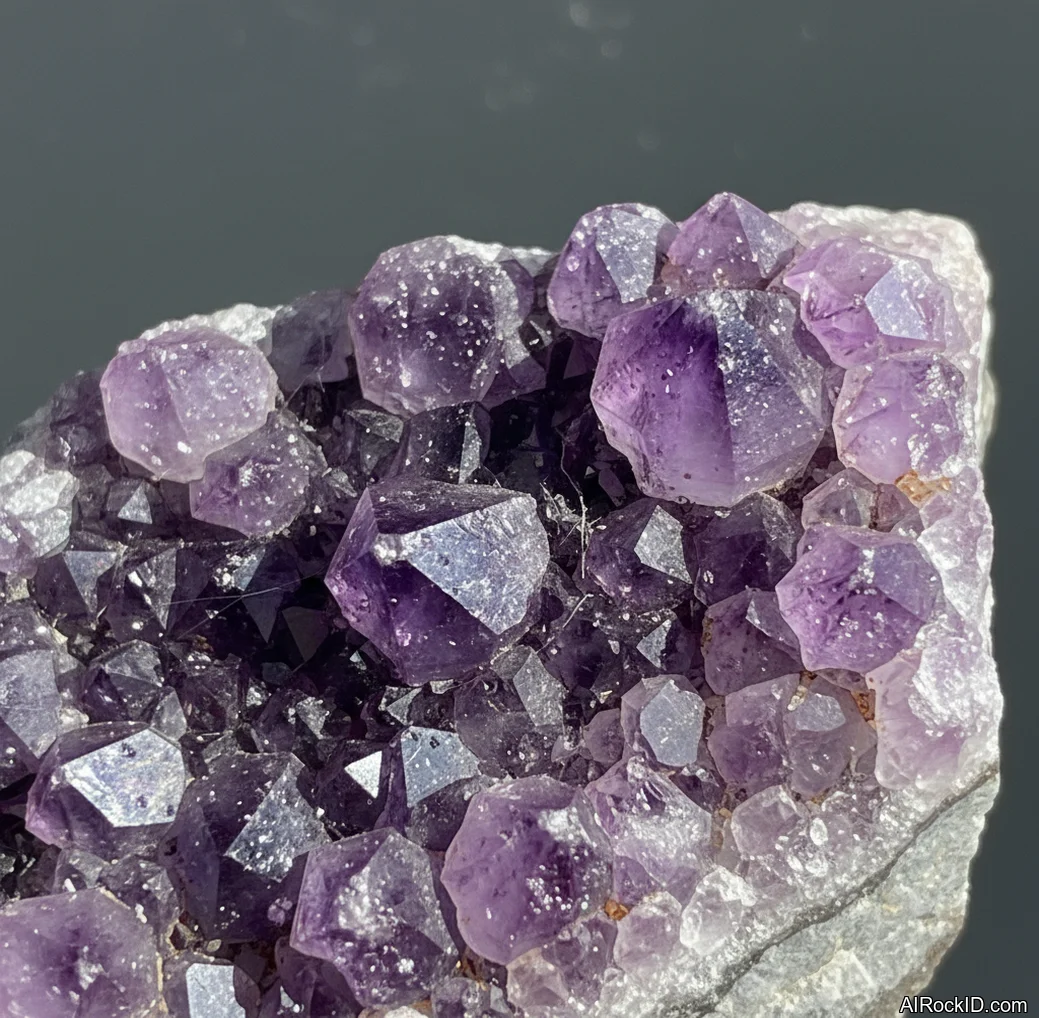
Most Turkish material I’ve handled runs more lavender to grape-purple, not that super-dark, almost inky Uruguay look. If you tilt it under a desk lamp, you’ll often see color zoning slide in and out (it’s pretty obvious once you know to look). Some pieces come with a smoky undertone or lighter tips, which sounds bad on paper, but in a tray at a show it reads more natural, kind of “alive,” like it hasn’t been overcooked to look perfect.
People sometimes hear “Turkish” and assume it’s some totally different mineral. It’s not. Same amethyst. It’s just a locality label. But that label matters, because the crystal habit and the color can come off a little different than the Brazil or Uruguay stuff most people recognize right away.
Origin & History
Amethyst as a name goes all the way back to the Greek “amethystos,” which basically means “not drunk,” and it’s tied to those old stories about the stone and sobriety. The mineral itself is quartz, and people have described and re-described it for centuries, but modern mineralogy nailed it down as SiO2, with amethyst being the purple, iron-bearing color variety.
“Turkish Amethyst” isn’t some formal species name. Most dealers use it as a trade or locality tag for amethyst coming out of Turkey, and it started popping up more consistently once export channels and specimen trading opened up more. I still remember the first time I saw it printed on a little white label at a small show (the kind with smudged ink and a bent corner). It was sitting next to Brazil clusters, and the Turkish piece looked quieter in color, but cleaner in the faces.
Where Is Turkish Amethyst Found?
Turkish amethyst comes from a handful of quartz-bearing volcanic and hydrothermal areas in western Turkey, where pockets and veins can produce crystal clusters and drusy plates.
Formation
Most amethyst shows up when silica-rich fluids seep through cracks and little pockets in rock, and quartz starts coating the walls first. Get the chemistry just right, especially tiny traces of iron, and that same quartz grows in as amethyst instead. Over a long stretch of time, natural radiation nudges the purple color along, which is why two pieces from the same general area can still end up looking surprisingly different.
Look, if you stare at a cluster long enough, you can almost see the timeline in it. The points often have subtle color zoning, like faint bands piled up toward the tips, not always even or perfectly straight. And if you’ve ever actually cracked open a geode, you know that split-second reveal: the outside is dusty and kind of blah, but inside the quartz faces look glassy and feel cold to the touch (like refrigerated glass), like they’ve just been sitting in the dark forever.
How to Identify Turkish Amethyst
Color: Typically lavender to medium purple, sometimes with smoky or grayish undertones and visible zoning from pale to deeper violet within the same crystal.
Luster: Vitreous, like broken glass on clean crystal faces.
Pick up the piece and check temperature. Real quartz stays cool longer than glass fakes in a warm room. If you scratch it with a steel knife, it shouldn’t bite easily, but it will scratch window glass without much drama. The problem with dyed quartz is the color pools in cracks and around the base, while natural amethyst usually looks more even, with zoning that follows the crystal growth instead of random blotches.
Common Look-Alikes
Turkish Amethyst is sometimes confused with these materials:
- Dyed quartz sold as "Turkish amethyst" (dye sits in fractures and around druzy edges)
- Purple glass or "cranberry" glass chunks (lighter weight, warms fast in your hand, round bubbles under a loupe)
- Fluorite (purple fluorite can look close in photos, but it’s softer and shows easy cleavage planes)
- Purple sapphire/spinel in jewelry listings (deep, even purple with no quartz-style zoning or crystal habit)
- Iolite (often a gray-violet that shifts with angle, especially in polished stones)
- Heat-treated amethyst pushed toward orangey "citrine" and then mislabeled back as amethyst (weirdly uniform honey patches or muddy brown zones)
Market Cautions & Treatments
When AI Can Get This Wrong
At first glance, phone pics of Turkish amethyst (lavender to grape-purple) get miscalled as purple fluorite or dyed quartz because the color range overlaps hard. AI struggles most with polished/tumbled pieces where you can’t see quartz points, growth lines, or the way amethyst color sits in bands. The real test is physical: fluorite won’t reliably scratch glass and shows flat cleavage breaks, while real amethyst (Mohs 7) will scratch glass and stays cool and “quartz-heavy” in the hand compared to glass.
Properties of Turkish Amethyst
Physical Properties
| Crystal System | Trigonal |
| Hardness (Mohs) | 7 (Hard (6-7.5)) |
| Density | 2.65 g/cm3 |
| Luster | Vitreous |
| Diaphaneity | Transparent to translucent |
| Fracture | Conchoidal |
| Streak | White |
| Magnetism | Non-magnetic |
| Colors | Lavender, Purple, Violet, Pale lilac, Smoky purple |
Chemical Properties
| Classification | Silicates |
| Formula | SiO2 |
| Elements | Si, O |
| Common Impurities | Fe, Al, Mn |
Optical Properties
| Refractive Index | 1.544-1.553 |
| Birefringence | 0.009 |
| Pleochroism | Weak |
| Optical Character | Uniaxial |
Turkish Amethyst Health & Safety
Solid pieces are fine to pick up and rinse off. Thing is, the only real day-to-day hazard is the obvious one: raw clusters can have needle-sharp points and edges that’ll bite you if you grab them the wrong way.
Safety Tips
If you’re trimming or grinding it, handle it the same way you would any silica-bearing material. Keep the dust out of your lungs. Use water to knock it down, and wear proper respiratory protection (not just a flimsy paper mask).
Turkish Amethyst Value & Price
Price Range
Rough/Tumbled: $10 - $150 per piece
Cut/Polished: $2 - $15 per carat
Color saturation pushes the price up in a hurry, and so do terminations that are clean and not chipped or frosted over. And with Turkish material being sold as locality pieces, the value spikes again if the label gets specific and the crystal faces look sharp and crisp, not bruised from bouncing around in a box.
Durability
Durable — Scratch resistance: Excellent, Toughness: Good
It’s stable for everyday handling, but prolonged strong sunlight can fade the purple over time.
How to Care for Turkish Amethyst
Use & Storage
Store it so points don’t rub each other, especially if it’s a cluster. A little wrap or a stand saves the tips from chipping.
Cleaning
1) Rinse with lukewarm water and a drop of mild soap. 2) Use a soft toothbrush to get into druse and crevices. 3) Rinse again and air-dry; avoid long hot soaks.
Cleanse & Charge
If you’re into that side of the hobby, a quick rinse and a night on a windowsill with indirect light is plenty. Skip harsh sun if you care about keeping the color.
Placement
Keep it out of constant direct sun and away from places where it can get knocked onto tile. It looks best where side light can catch the crystal faces.
Caution
Skip ultrasonic and steam cleaners, especially if the cluster has little fractures or those included zones you can spot when you tilt it under a lamp. And don’t park it in a sunny window for months on end, unless you’re fine watching that purple fade and lose that crisp look.
Works Well With
Turkish Amethyst Meaning & Healing Properties
Compared to the flashier stones, amethyst is the one people actually stay loyal to. I’ve stood behind the counter and watched someone scoop up five different pieces, turn them over under the track lights, then drift right back to the purple quartz because it just feels steady. Simple. No drama.
Most people link amethyst with a calmer mind, better sleep, and staying clear-headed. That’s the classic use people talk about. In my own routine, I’ll set a small cluster on my nightstand when I’m winding down, not because I think it’s medicine, but because it’s a physical reminder to slow down (same idea as dimming a lamp). It’s basically my cue to stop scrolling and let the room get quiet.
But look, not every piece lands the same. I’ve handled Turkish amethyst that’s pale and pretty, but it doesn’t have that deep, velvety look people expect when they picture “real” amethyst, and yeah, that can change how connected someone feels to it. So if you’re doing intention work with crystals, grab the piece you genuinely want to hold in your hand, not the one with the fanciest label. Why fight your own instincts?
Common mistakes
- Assuming every purple quartz specimen with a Turkish label has verified Turkish origin
- Using color alone to separate amethyst from fluorite, glass, or dyed quartz
- Leaving amethyst in strong sunlight and expecting the color to remain unchanged
- Confusing natural color zoning with damage or poor quality
- Overpaying for vague locality claims without documentation
- Testing hardness on a visible polished face instead of an inconspicuous area
Identify Turkish Amethyst from a photo
Compare Turkish Amethyst traits, care tips, value clues, and common lookalikes with a clear photo.