Benitoite


Quick answer: Benitoite is a rare blue barium titanium silicate best known from San Benito County, California. Because faceted stones are uncommon and can resemble sapphire, tanzanite, or blue zircon, identification should rely on optical properties, fluorescence, and documentation rather than color alone.
AI Rock ID can help screen a possible benitoite specimen by comparing visible color, crystal habit, transparency, and context clues from photos. RockIdentifier.io should be used as an identification aid, while high-value benitoite should be confirmed by a qualified gemologist or laboratory report.
Good fit
- Collectors seeking a rare California-associated mineral or gemstone
- Buyers who value documented origin and gemological reports
- People comparing small blue gemstones that may be sapphire, tanzanite, zircon, or benitoite
- Specimen collectors interested in fluorescent minerals
Not a good fit
- Low-budget shoppers looking for a durable everyday ring stone
- Anyone who wants identification based only on blue color
- Buyers unwilling to request documentation for expensive stones
- Jewelry wearers who need a gem for heavy daily impact or abrasion
Why people search for this
People often search for benitoite because it is rare, strongly associated with California, and visually similar to several better-known blue gemstones. Searches also commonly focus on whether a stone is natural, synthetic, or misidentified.
Most commonly confused with
- Sapphire: Sapphire is corundum and is much harder; benitoite is a barium titanium silicate with diagnostic dispersion and fluorescence.
- Tanzanite: Tanzanite is a zoisite variety that often shows strong pleochroism; benitoite has different optical constants and crystal chemistry.
- Blue Zircon: Blue zircon can show high brilliance and strong double refraction, but it has a different density, chemistry, and typical treatment history.
- Blue Topaz: Blue topaz is far more common and usually treated; benitoite is rarer and identified by different optical and fluorescence features.
Benitoite vs. Common Blue Lookalikes
| Stone | Key difference | Common ID clue | Buyer caution |
|---|---|---|---|
| Benitoite | Barium titanium silicate | Often fluoresces blue to violet under shortwave UV | Request a lab report for costly stones |
| Sapphire | Corundum with much greater hardness | Usually no benitoite-type dispersion pattern | May be heat treated or synthetic |
| Tanzanite | Zoisite with strong pleochroism | Blue-violet color shifts can be prominent | Often heat treated |
| Blue zircon | Zircon with high double refraction | Facet doubling may be visible under magnification | Blue color is commonly treatment-related |
| Blue topaz | Aluminum fluorosilicate, widely available | Lower rarity and different optical properties | Most blue material is irradiated and heated |
AI identification confidence
AI photo identification for benitoite is usually moderate at best because several blue gemstones share similar color, brilliance, and faceted appearance. Confidence improves when photos include crystal form, matrix, UV fluorescence, scale, and any provenance or test results.
When AI gets it wrong
- A faceted blue stone is photographed without scale, magnification, or multiple lighting angles
- The image is color-enhanced, overexposed, or taken under strong blue-tinted light
- Only a jewelry setting is visible, hiding pavilion features and inclusions
- The specimen lacks location information or UV fluorescence observations
Final recommendation
Treat benitoite purchases as documentation-driven decisions, especially for faceted gems and claimed California-origin specimens. Use visual ID tools for screening, then confirm important pieces with refractive index, specific gravity, UV response, and a reputable gemological report.
How to Check Benitoite Authenticity
Authentic benitoite identification usually combines gemological testing with provenance. Useful checks include refractive index, birefringence, specific gravity, shortwave UV fluorescence, magnification, and comparison with known optical data. For expensive stones, a report from a recognized gemological laboratory is more reliable than a seller description or visual inspection alone.
Benitoite Buying Red Flags
Be cautious of large, clean, intensely blue stones offered at unusually low prices, because fine faceted benitoite is scarce. Vague labels such as “California blue gem,” “benitoite color,” or “rare blue crystal” do not confirm species. Listings should clearly state whether the item is natural, synthetic, assembled, treated, or only a lookalike.
Best Photos for Benitoite Identification
Useful identification photos show the stone in daylight-equivalent light, under magnification, and next to a size reference. For rough specimens, include crystal shape, matrix, and close-ups of termination faces. If safe equipment is available, separate shortwave and longwave UV photos can provide additional clues, but UV response should not be used as the only proof.
What Is Benitoite?
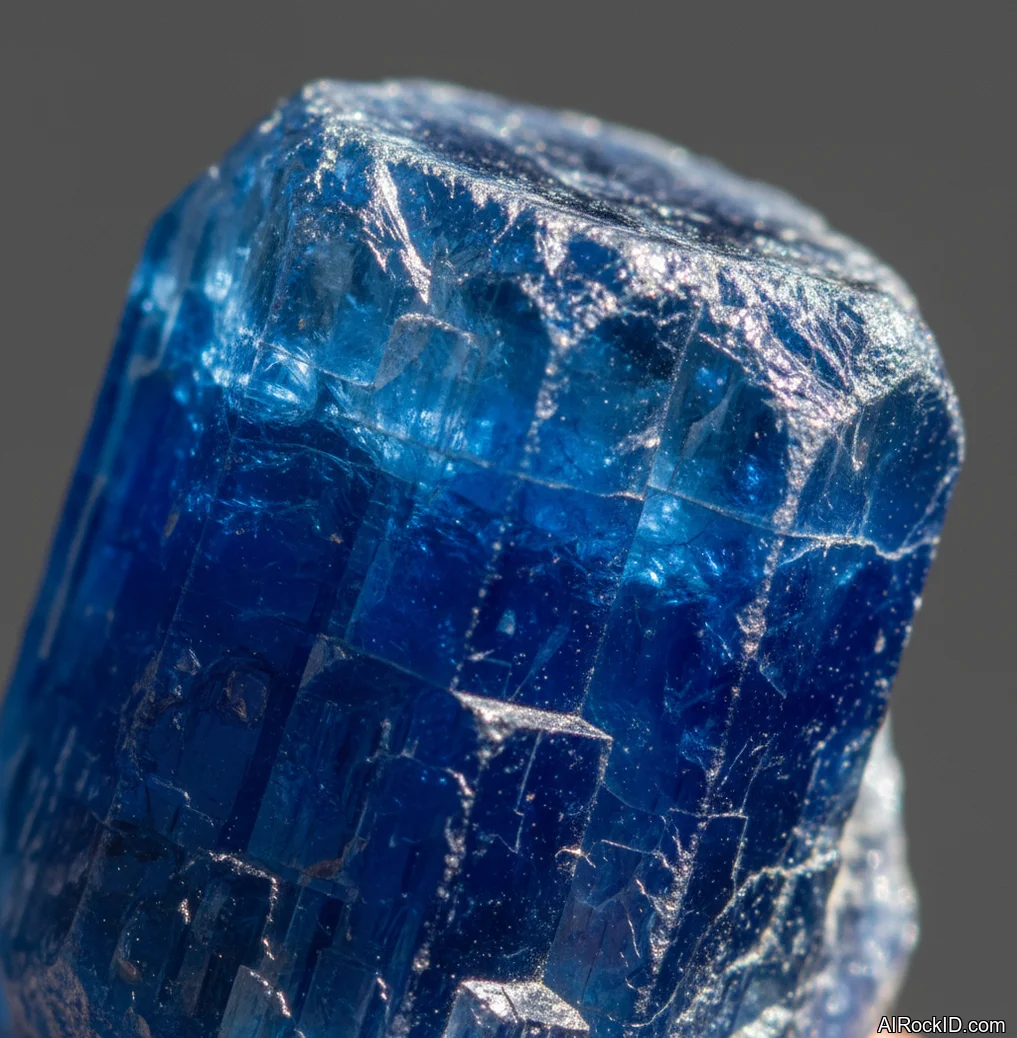
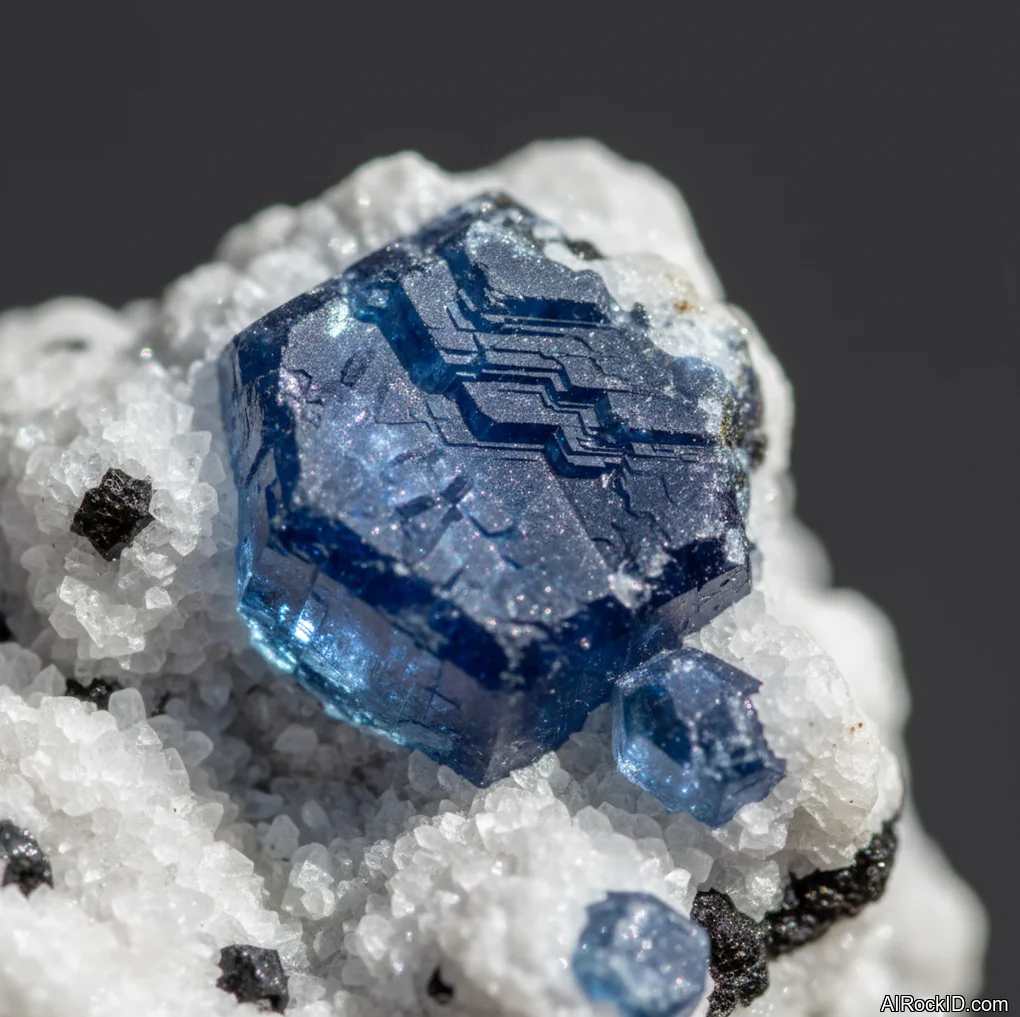
Benitoite is stupid-rare. It’s a barium titanium silicate mineral (BaTiSi3O9) that collectors chase mostly because it shows this sapphire-blue color that doesn’t look quite real. You notice the blue first, sure. But then you tip it a hair and the thing flashes so hard it’s almost distracting. Even tiny crystals kick light all over the place, and the best pieces honestly look like a little blue LED perched on a bed of white natrolite.
Hold an actual benitoite specimen and there’s this immediate, odd little tell: it stays cool in your hand longer than you expect. The crystal faces feel sharp and crisp too, almost knife-edged, unless they’ve been knocked around. A lot of the classic specimens come as small triangular plates or these short, sort-of-hexagonal-looking crystals, and they sit perfectly in a thumbnail box like somebody sized them on purpose. Hit good material with a UV lamp and it pops a blue-white glow. Look, you can literally watch someone go from “yeah right” to “okay, wow” the second that fluorescence turns on.
But the reality check is real. Clean, undamaged crystals are tough to come by, and most of what you’ll see for sale has some edge wear or tiny bruises from being stuck in the host rock. And if you’re buying a faceted stone, that’s a whole other price bracket: a benitoite that’s bright, eye-clean, and well-cut costs way more than the small collector crystals you see laid out in flats at a show.
Origin & History
San Benito County, California is where the name comes from, and the mineral itself was first described in 1907. It traces back to the New Idria area, where the early pieces got lumped in with other blue gems until someone finally ran the right tests and untangled the mess. And once the official type locality was pinned down, it got famous in a hurry because the crystals were genuinely gemmy, not just kind of “blue-ish” when you squint.
Most dealers still talk about the classic stuff as “California benitoite,” like it’s a brand name. But it sort of is, isn’t it? California even named benitoite the state gem in 1985, which feels like a throwaway fact until you’re staring into a display case of blue stones and it hits you how few of them actually came from one tiny area.
Where Is Benitoite Found?
The classic gem crystals come from San Benito County, California. Small occurrences are reported from a handful of other places, but they rarely match the California material for collectible crystals.
Formation
San Benito benitoite shows up in a pretty odd setting: altered serpentinite cut by natrolite veins, plus other minerals carrying barium and titanium. It’s a picky little recipe that almost never comes together, and even when it does, you don’t always get nice, clean crystals out of it.
Look at the classic specimens in person and you’ll usually spot benitoite sitting on that snowy-white natrolite, the kind that looks almost sugary under a light. And a lot of the time neptunite’s right there too, tucked in close. That combo isn’t some coincidence. The chemistry had to cooperate, and the fluids had to be just right, but it only happened in small pockets and thin seams, not in big zones you could really mine. So yeah, it has that “pocket minerals” feel. A couple of jaw-dropping crystals, then… nothing.
How to Identify Benitoite
Color: Most benitoite is a vivid medium to deep blue, sometimes with a slight violet cast. In daylight it can read “sapphire,” and under some indoor lights it can shift a little toward inky blue.
Luster: Vitreous to adamantine when clean and well-formed.
Under UV light, many benitoites fluoresce a strong blue-white, and that’s one of the quickest sanity checks at a show table. The real test is the combination: sharp triangular crystal habit, high sparkle, and that natrolite matrix look that’s chalky-white and fibrous. Cheap versions and look-alikes can be blue, but they usually don’t have the same crisp faces, and they don’t “snap” with dispersion when you rock them under a point light.
Common Look-Alikes
Benitoite is sometimes confused with these materials:
- Blue sapphire (especially small, well-formed crystals)
- Blue spinel (natural and synthetic)
- Kyanite (deep blue, polished pieces)
- Glass fakes (especially colored CZ or 'benitoite glass')
- Tanzanite (especially heated, smaller crystals)
- Dyed quartz (cobalt-blue varieties)
Market Cautions & Treatments
When AI Can Get This Wrong
AI image tools mix up benitoite with blue sapphire and synthetic spinel all the time, especially when the classic white natrolite matrix isn’t visible. In-hand, benitoite’s high dispersion and strong blue UV reaction set it apart—no other blue mineral throws rainbow flashes like that under a loupe. If you can check for the bright blue fluorescence or spot those sharp triangular crystal outlines, you’ve probably got the real thing.
Properties of Benitoite
Physical Properties
| Crystal System | Hexagonal |
| Hardness (Mohs) | 6-6.5 (Hard (6-7.5)) |
| Density | 3.65-3.69 g/cm3 |
| Luster | Vitreous |
| Diaphaneity | Transparent to translucent |
| Fracture | Conchoidal |
| Streak | white |
| Magnetism | Non-magnetic |
| Colors | blue, violet-blue, colorless, pink, white |
Chemical Properties
| Classification | Silicates |
| Formula | BaTiSi3O9 |
| Elements | Ba, Ti, Si, O |
| Common Impurities | Fe, Mn |
Optical Properties
| Refractive Index | 1.757-1.804 |
| Birefringence | 0.047 |
| Pleochroism | Weak |
| Optical Character | Uniaxial |
Benitoite Health & Safety
Benitoite is pretty safe to handle and put on display. But like any mineral, if you’re cutting or grinding it, don’t breathe in the dust. (That fine powder gets everywhere, and you’ll feel it in your throat.)
Safety Tips
If you’re doing lapidary work, keep water running, make sure you’ve got decent ventilation, and wear a proper respirator (the kind that actually seals, with snug straps). But for normal collecting, it’s pretty simple: if the matrix is dusty and you’ve been handling it, just wash your hands afterward.
Benitoite Value & Price
Price Range
Rough/Tumbled: $50 - $2,000+ per specimen
Cut/Polished: $1,500 - $6,000+ per carat
Price can swing a lot depending on color, how crisp the crystal is, and if it’s a clean-on-matrix piece or one of those chipped floaters (you know, the kind with little bruised edges and a scuffed spot where it was knocked loose). And for faceted stones, the value leans hard on brilliance, cut quality, and face-up size, since benitoite is usually small.
Durability
Moderate — Scratch resistance: Fair, Toughness: Fair
It’s stable in normal conditions, but facet edges and thin crystal tips can chip if you let it rattle around in a box.
How to Care for Benitoite
Use & Storage
Store benitoite in a perky box or a padded specimen jar so the crystal edges don’t tap against anything harder. I keep mine separate from quartz points because a single bump can leave a tiny white nick on a blue face.
Cleaning
1) Rinse gently with lukewarm water to loosen dust. 2) Use a soft brush (makeup brush works) around natrolite fibers and crystal edges. 3) Pat dry and let it air-dry fully before closing it up.
Cleanse & Charge
If you do energetic cleansing, stick to smoke, sound, or a dry selenite plate. I skip salt and harsh soaks because matrix minerals can be delicate even when the benitoite itself is fine.
Placement
A small spotlight makes it pop, and a UV light is fun for quick demos. Keep it somewhere it won’t get bumped, because benitoite chips easier than people expect from a “gem.”
Caution
Skip ultrasonic cleaners and strong acids. They’ll wreck the associated minerals sitting on the matrix (you’ll sometimes see the surface go dull or tiny grains flake off right along the edges). And don’t just drop it in your pocket with your keys or other stones either. One shuffle around and you’ll end up with fresh scratches and little chips you can feel with a fingernail.
Works Well With
Benitoite Meaning & Healing Properties
Most folks who wander into my benitoite corner aren’t looking for “soft vibes.” They’re after clarity that cuts, like clicking on a desk lamp in a messy room and suddenly seeing the unpaid bills, the coffee rings, all of it. In crystal-shop language, benitoite gets tied to mental focus, pattern spotting, and that calm you get when you finally understand what’s happening. That’s mood and mindset territory, not a medical claim.
Compared to amethyst, benitoite feels way more “in your head” than “in your heart.” I’ve had nights where I parked a tiny piece next to my notebook, close enough that it caught the light, and it kind of pushed me into actually writing. But, yeah, sometimes it just sits there looking expensive (and a little too perfect). If you’re into this stuff, the effect is subtle. Very personal.
But don’t mix up rarity with strength. A rare stone doesn’t automatically mean it’ll be better for everyone. If you get overstimulated easily, benitoite can feel almost too bright, especially when it’s paired with other high-sparkle stones. I’ve noticed it settles down if you combine it with something grounding, or if you treat it like a short-session stone instead of leaving it on your desk 24/7.
Common mistakes
- Assuming any vivid blue transparent gem is benitoite
- Relying on UV fluorescence alone without gemological testing
- Confusing high brilliance with proof of rarity
- Buying a faceted stone without asking for measurements, weight, and documentation
- Ignoring common treated blue alternatives such as blue topaz and blue zircon
- Using trade names or seller keywords as proof of mineral identity
Identify Benitoite from a photo
Compare Benitoite traits, care tips, value clues, and common lookalikes with a clear photo.