Blue Flower Agate


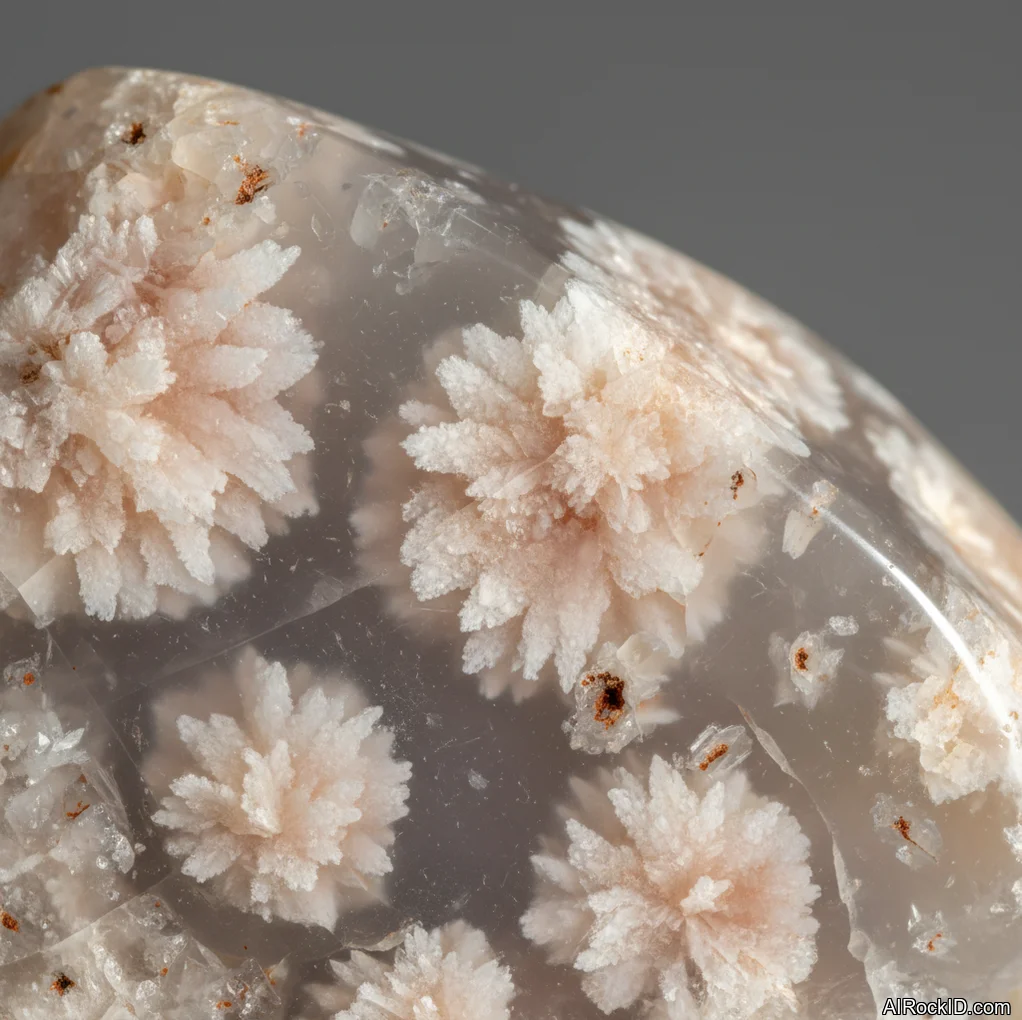
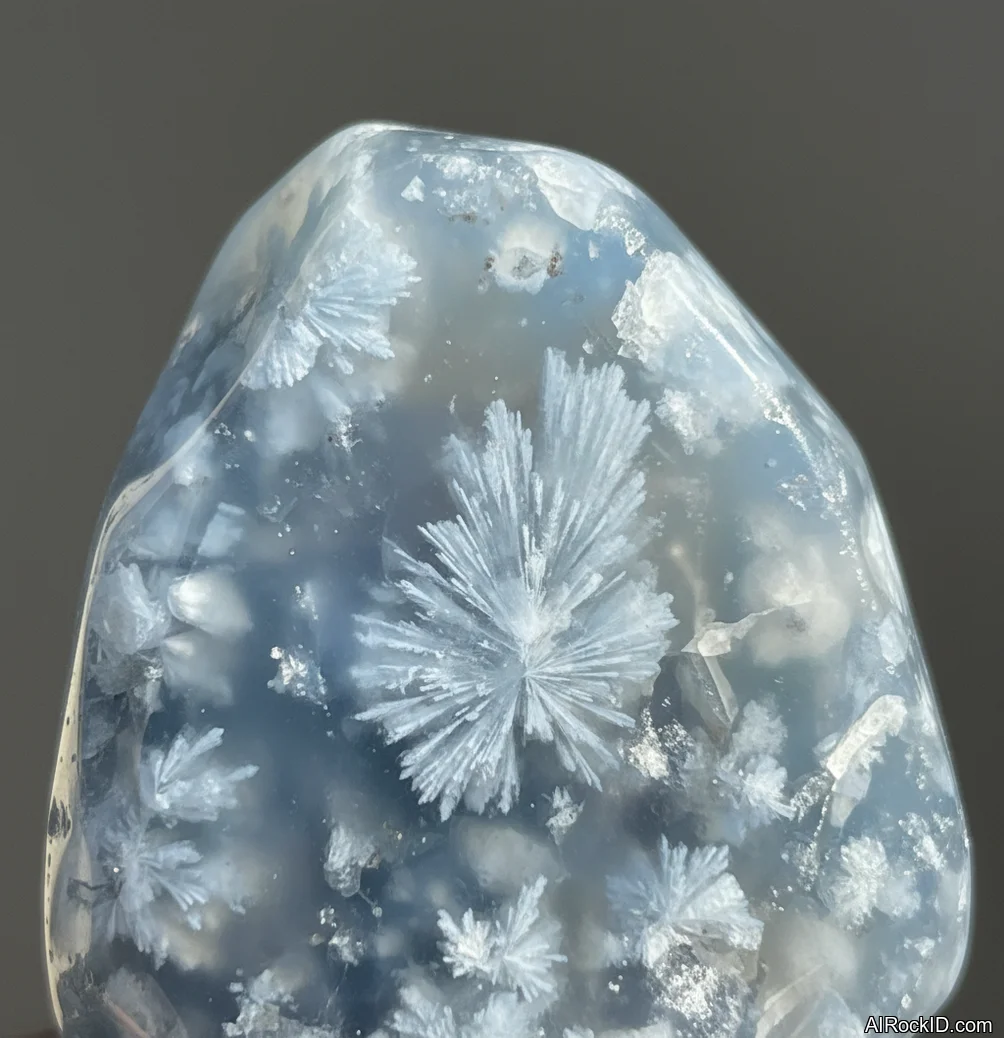
Quick answer: Blue Flower Agate is a patterned chalcedony known for soft blue to gray-blue color and plume-like inclusions that can resemble small blossoms. It is usually identified by its waxy luster, translucent chalcedony base, and internal flower-like formations rather than by a single uniform color.
AI Rock ID can help screen Blue Flower Agate by comparing visible color, banding, translucency, and plume patterns from a clear photo. RockIdentifier.io provides crystal identification support, but final confirmation may require hardness testing, magnification, or seller documentation for treated or mislabeled pieces.
Good fit
- Collectors who like soft blue chalcedony with visible internal plumes
- Beginners seeking a visually distinctive agate that is usually easy to recognize
- Jewelry buyers looking for cabochons, beads, or polished freeforms with gentle color
- Anyone comparing agate varieties that have floral, mossy, or plume-like patterns
Not a good fit
- Buyers who need a rare mineral species rather than a trade variety of chalcedony
- Collectors who prefer sharply banded agates with high-contrast fortification patterns
- Anyone expecting every piece to show obvious flower shapes, since patterns vary widely
Most commonly confused with
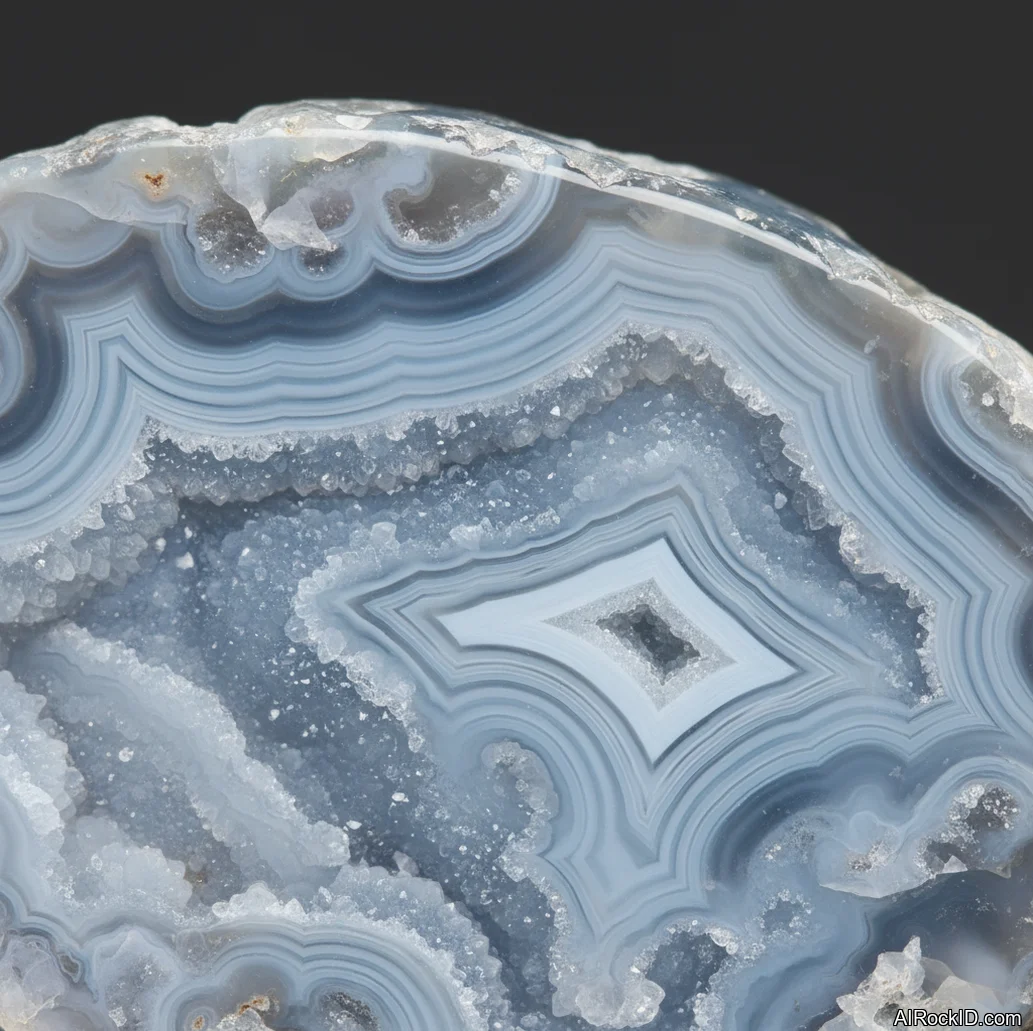
- Blue Lace Agate: Blue Lace Agate typically shows delicate parallel or wavy bands rather than plume-like flower inclusions.
- Moss Agate: Moss Agate commonly has green, brown, or black dendritic inclusions rather than soft blue-gray floral plumes.
- Plume Agate: Plume Agate is a broader category with feathery inclusions in many colors; Blue Flower Agate is a blue-toned trade variety within this visual style.
- Larimar: Larimar is a blue pectolite with cloudy white patterns and lower hardness, not a chalcedony agate with internal plumes.
Blue Flower Agate vs. Similar Blue Stones
| Stone | Typical Look | Key Difference |
|---|---|---|
| Blue Flower Agate | Soft blue to gray-blue chalcedony with plume-like flower inclusions | Flower or plume pattern appears inside a waxy, translucent agate base |
| Blue Lace Agate | Pale blue with fine, lace-like banding | Bands are more linear and layered, not plume-shaped |
| Moss Agate | Clear to milky chalcedony with mossy inclusions | Inclusions are usually green, brown, or black and more branch-like |
| Larimar | Sky blue to turquoise with cloudy white patches | Pectolite, not agate; often has a softer, more porcelain-like look |
| Dyed Agate | Bright or saturated blue, sometimes uneven | Color may collect in fractures, drill holes, or surface pits |
AI identification confidence
AI photo identification is often moderately reliable for Blue Flower Agate when the image clearly shows blue chalcedony, translucency, and plume-like inclusions. Confidence drops when the stone is heavily polished, photographed under blue lighting, or shown as small beads where internal patterns are hard to see.
When AI gets it wrong
- The photo is taken under cool LED lighting that makes gray or white agate appear blue.
- The specimen is a small bead or cabochon with limited visible internal pattern.
- The stone has been dyed, and the color looks natural from the surface only.
- The image lacks scale, side views, or close-up detail of inclusions and translucency.
Final recommendation
Choose Blue Flower Agate by pattern clarity, natural-looking color distribution, polish quality, and accurate seller labeling. If authenticity matters, ask whether the stone is natural, dyed, stabilized, or sold under a trade name rather than assuming every blue floral agate is untreated.
How to Spot Dyed or Enhanced Blue Flower Agate
Natural-looking Blue Flower Agate usually has soft, uneven blue to gray-blue tones that follow the chalcedony and inclusion structure. Dyed pieces may show very saturated blue color, color pooling in cracks, or darker staining around drill holes and surface pits. A seller should be able to state whether a piece is natural, dyed, or treated.
Photo Tips for Identifying Blue Flower Agate
Use bright indirect daylight and photograph the stone from the front, back, side, and close-up. Include a neutral background and avoid blue-tinted lighting or heavy filters. A close photo of the plume inclusions is more useful for identification than a distant image of the overall shape.
Buying Checklist for Blue Flower Agate
Look for clear images that show the actual item, not only a representative sample. Check for chips, surface-filled cracks, uneven dye, and overly vague labels such as “blue agate” without pattern detail. For beads and cabochons, inspect drill holes, edges, and backs because treatment or lower polish quality is often easier to see there.
What Is Blue Flower Agate?
Blue Flower Agate is a blue-toned variety of chalcedony (microcrystalline quartz) with flower-like plume inclusions.
Look, the first time you see it, it honestly looks like someone flicked tiny drops of ink into milky chalcedony and then hit pause mid-swish. Weirdly satisfying. The “flowers” aren’t petals (obviously). They’re soft plumes and little sprays trapped inside the stone, usually white, gray, or that powdery blue, sitting on a background that runs from sky blue to denim.
And if you pick up a palm stone, you feel it immediately. Cool like quartz always is, and it doesn’t have that plasticky vibe dyed material can get. Most pieces you run into are polished into towers, freeforms, slabs, even little display faces, because the pattern shows up way better on a flat surface than it does on a rounded tumble.
Origin & History
“Agate” traces back to the Achates River in Sicily (modern Dirillo). It’s an old-school name that got recycled for pretty much any banded chalcedony people ran into. “Flower agate,” though, is just a trade label, not an official mineral name, and it showed up fairly recently when dealers started splitting plume and blossom-pattern chalcedonies off into their own buckets.
Blue Flower Agate lives in that same plume-agate neighborhood. It wasn’t “first described” like somebody found a brand-new mineral species and filed paperwork. It’s more like a look that caught on once enough rough started showing up at gem shows and in online shops, and once cutters noticed that blue base color photographs insanely well under shop lights (seriously, it pops).
Where Is Blue Flower Agate Found?
Most Blue Flower Agate on the market is sold as a Madagascar-type plume chalcedony, with other plume agates in similar colors coming out of Brazil, India, Indonesia, and parts of the western USA.
Formation
Look close and you can usually spot the rhythm in it. It didn’t all form at once. Chalcedony seeps into cavities and fractures in volcanic rock in pulses, stacking up layer by layer as silica-rich fluids cool, then gel, then do it again over time.
That “flower” pattern? It’s from plume inclusions that grew while the silica was still going down. Picture tiny mineral filaments, or those dendritic little sprays, getting caught in place as the chalcedony sealed the pocket shut (like watching frost creep across a window, only trapped in stone). The blue color usually comes from trace elements plus the way light scatters through microcrystalline silica, sometimes pushed a bit by iron or other impurities. And yeah, some of the super-blue pieces you see online are dyed. Whole separate headache, honestly.
How to Identify Blue Flower Agate
Color: Base color ranges from pale icy blue to medium denim-blue, usually with white to gray-blue plume “flowers” floating inside. Some pieces show faint banding, but the plumes are the main event.
Luster: Polished surfaces show a waxy to vitreous luster, like most good chalcedony.
Pick up a piece and check the temperature. Real chalcedony stays cool in your hand longer than glass or resin. If you scratch it with a steel nail, it shouldn’t take a mark, but it will scratch common window glass at Mohs 7. And watch for dye: color pooled in fractures, super-uniform electric blue, or blue that concentrates around the edges is a red flag.
Common Look-Alikes
Blue Flower Agate is sometimes confused with these materials:
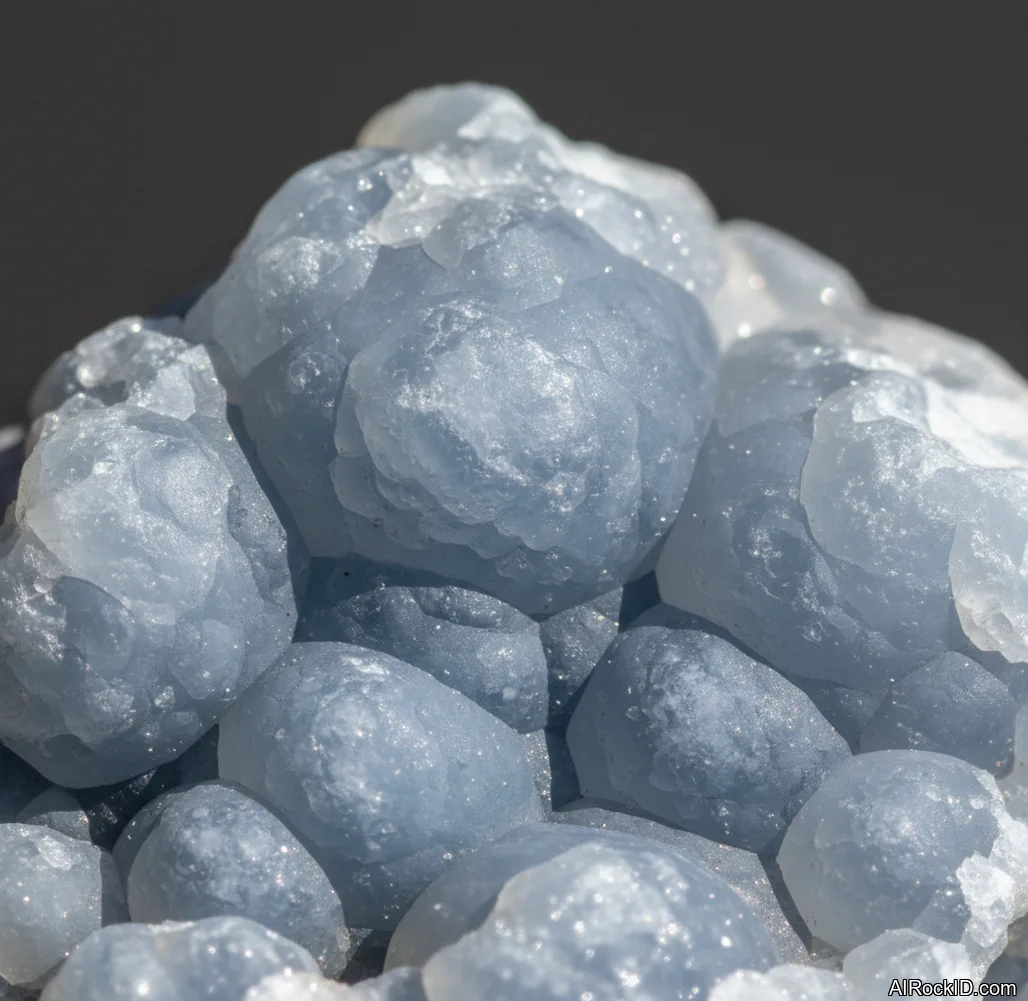
- Blue chalcedony (plain or banded), sometimes sold as “blue agate” when it’s really just uniform chalcedony
- Dyed white/gray agate with “flower” patterns emphasized by stain (watch for dye in fractures around the plumes)
- Blue lace agate (banded, lacy lines instead of plume sprays)
- Dendritic agate or dendritic opal (branchy black/brown manganese patterns that can read as “floral” in photos)
- Glass imitations with suspended wisps or bubbles (the “flowers” look too floaty and you’ll spot round bubbles under a loupe)
Market Cautions & Treatments
When AI Can Get This Wrong
In photos, AI mixes Blue Flower Agate up with blue lace agate and dendritic agate all the time because it keys off “blue + pattern” and ignores whether the pattern is banding, branches, or plumes. Pick up a piece and do two quick checks: chalcedony stays cool to the touch and won’t show bubbles under a 10x loupe, and it should scratch glass with that quartz bite at 6.5 to 7.
Properties of Blue Flower Agate
Physical Properties
| Crystal System | Trigonal |
| Hardness (Mohs) | 6.5-7 (Hard (6-7.5)) |
| Density | 2.58-2.64 g/cm3 |
| Luster | Waxy |
| Diaphaneity | Translucent to opaque |
| Fracture | Conchoidal |
| Streak | White |
| Magnetism | Non-magnetic |
| Colors | Light blue, Sky blue, Gray-blue, White, Gray |
Chemical Properties
| Classification | Silicates |
| Formula | SiO2 |
| Elements | Si, O |
| Common Impurities | Fe, Mn, Al |
Optical Properties
| Refractive Index | 1.530-1.540 |
| Birefringence | None |
| Pleochroism | None |
| Optical Character | Uniaxial |
Blue Flower Agate Health & Safety
Blue Flower Agate is non-toxic, so it’s safe to hold in your hand. Thing is, like any silica-based stone, the solid chunk isn’t the problem. The real risk shows up when you cut or grind it and that super-fine dust gets in the air (the kind that clings to your fingertips and leaves a faint grit on the workbench).
Safety Tips
If you’re shaping it, keep a spray bottle or hose handy to wet things down, make sure you’ve got decent airflow, and wear a proper respirator that’s actually rated for silica dust. (Not a flimsy paper mask.)
Blue Flower Agate Value & Price
Price Range
Rough/Tumbled: $5 - $120 per piece
Cut/Polished: $2 - $12 per carat
Price bounces around depending on how crisp the pattern is, how “3D” those plumes actually look when you tilt it, and how clean the polish comes across up close. Thing is, with online listings the lighting can crank the blue way up, so it ends up looking louder on screen than it does in normal room light.
Durability
Durable — Scratch resistance: Good, Toughness: Good
It’s stable like most quartz, but dyed material can fade if it lives in strong sun for months.
How to Care for Blue Flower Agate
Use & Storage
Store it like you’d store any polished quartz. Keep it from rubbing against softer stones that can pick up scuffs, and separate it from harder stuff like topaz that can scratch the polish.
Cleaning
1) Rinse with lukewarm water. 2) Use a drop of mild soap and a soft brush for skin oils. 3) Rinse again and dry with a microfiber cloth.
Cleanse & Charge
Running water, smoke, or a night on a clean selenite plate all work fine for most people’s routines. If you suspect dye, skip long sun baths and stick to gentle methods.
Placement
On a desk, it reads calm and tidy because the pattern looks like little clouds. If you’ve got a shelf with backlighting, set it where light can pass through the thinnest edge for the best depth.
Caution
Skip harsh chemicals and don’t use an ultrasonic cleaner, especially if the piece has any fractures or there’s stabilizing resin in it. And if the material looks dyed, don’t park it in a sunny window either. Why risk the color fading?
Works Well With
Blue Flower Agate Meaning & Healing Properties
Most dealers sell Blue Flower Agate as this gentle, steadying stone, and honestly, that tracks with how it feels when you actually use it.
When I’m sorting inventory at a show, I’ll toss a palm stone in my pocket. Not for the “vibes,” exactly. It’s the cool weight sitting against your leg, the slick polish, the way the edges feel slightly rounded from being handled a thousand times. Simple. You run your thumb over that smooth spot and, for a minute, your brain quits sprinting.
People also link the “flower” pattern to growth stuff, like starting small and letting it build into something real. I get it. Those plumes look like tiny bursts frozen in place (almost like someone paused a little firework mid-pop), and it’s easy to stare at them while you journal and use them as a visual anchor when you’re trying to stay on track. Why not?
But look, here’s the honest catch. If you’re waiting for some dramatic jolt of energy, this isn’t that kind of stone. It’s more like background support. Quiet. And the effect is mostly about attention and ritual, not medicine.
Thing is, if anxiety or sleep is a serious issue, crystals can feel comforting in your hands, sure, but they don’t replace real care.
Common mistakes
- Assuming every blue agate with a soft pattern is Blue Flower Agate.
- Confusing banded Blue Lace Agate with plume-patterned Blue Flower Agate.
- Judging authenticity from color alone without checking cracks, drill holes, and seller treatment notes.
- Expecting all pieces to show distinct flower shapes rather than irregular plumes or cloudy inclusions.
- Using heavily filtered online photos as the only basis for buying.
- Treating a trade name as a separate mineral species instead of a visual variety of chalcedony.
Identify Blue Flower Agate from a photo
Compare Blue Flower Agate traits, care tips, value clues, and common lookalikes with a clear photo.