Colorless Topaz


Quick answer: Colorless topaz is a transparent variety of topaz that can resemble diamond, white sapphire, quartz, glass, and cubic zirconia. Its Mohs hardness of 8 and high clarity make it useful for jewelry, but identification often requires checking refractive index, specific gravity, crystal habit, and inclusions.
AI Rock ID can help screen a clear crystal by comparing visible traits such as transparency, luster, crystal shape, and surface features. RockIdentifier.io can support visual identification, but gemological testing is recommended for valuable colorless topaz or stones sold as fine jewelry.
Good fit
- Collectors who want a naturally colorless transparent topaz specimen
- Jewelry buyers looking for a hard, clear gem with a glassy luster
- Students comparing colorless gems by hardness, refractive index, and density
- People who want a diamond lookalike but prefer a different mineral species
Not a good fit
- Buyers who need a diamond substitute with diamond-level durability
- Anyone purchasing an expensive stone without lab testing or seller documentation
- Rings intended for heavy daily wear without protective settings
- People who expect metaphysical traditions to replace medical care
Most commonly confused with
- Quartz: Quartz is softer at Mohs 7 and has lower refractive index and density than colorless topaz.
- Diamond: Diamond is much harder at Mohs 10 and has a higher refractive index and stronger dispersion.
- White Sapphire: White sapphire is corundum with Mohs 9 hardness and different optical properties from topaz.
- Cubic Zirconia: Cubic zirconia is synthetic, denser, and usually shows stronger fire than colorless topaz.
Colorless Topaz vs Common Clear Lookalikes
| Material | Mohs hardness | Useful identification clue |
|---|---|---|
| Colorless topaz | 8 | High density for a clear gem; perfect basal cleavage may be present |
| Quartz | 7 | Lower density and RI; common hexagonal crystal habit |
| White sapphire | 9 | Harder corundum; typically higher RI than topaz |
| Diamond | 10 | Much higher brilliance and thermal conductivity |
| Glass | About 5–6 | May contain rounded bubbles and scratches more easily |
AI identification confidence
AI identification confidence for colorless topaz is usually moderate because many clear minerals and simulants look similar in photos. Confidence improves when images show crystal termination, cleavage, inclusions, scale, and results from simple non-destructive tests such as hardness comparison or specific gravity.
When AI gets it wrong
- A faceted clear stone is photographed without scale, facet detail, or inclusions.
- Lighting creates diamond-like fire or glare that hides natural features.
- The specimen is glass, quartz, white sapphire, or cubic zirconia with a similar transparent appearance.
- The stone has been treated, recut, or mounted in jewelry where diagnostic areas are hidden.
Final recommendation
For buying colorless topaz, prioritize sellers who disclose treatments, provide measurements, and allow independent gemological verification for higher-value stones. For casual collecting, clear crystal habit, credible labeling, and a return policy are more useful than relying on appearance alone.
How to Check Colorless Topaz Authenticity
A reliable identification should combine visual inspection with gemological properties such as refractive index, specific gravity, and optic character. Colorless topaz commonly has RI around 1.609–1.643 and higher density than quartz, which helps separate it from many clear lookalikes. Avoid destructive scratch testing on finished gems because topaz has perfect cleavage and can chip if stressed.
Buying Colorless Topaz: What to Ask
Ask whether the stone is natural, treated, synthetic, or a simulant, and request the carat weight, dimensions, and origin if available. For faceted stones, clarity, cut quality, windowing, and chips along facet junctions can affect appearance and value. For expensive purchases, a report from a recognized gemological laboratory is preferable to a verbal identification.
Natural Crystal Clues
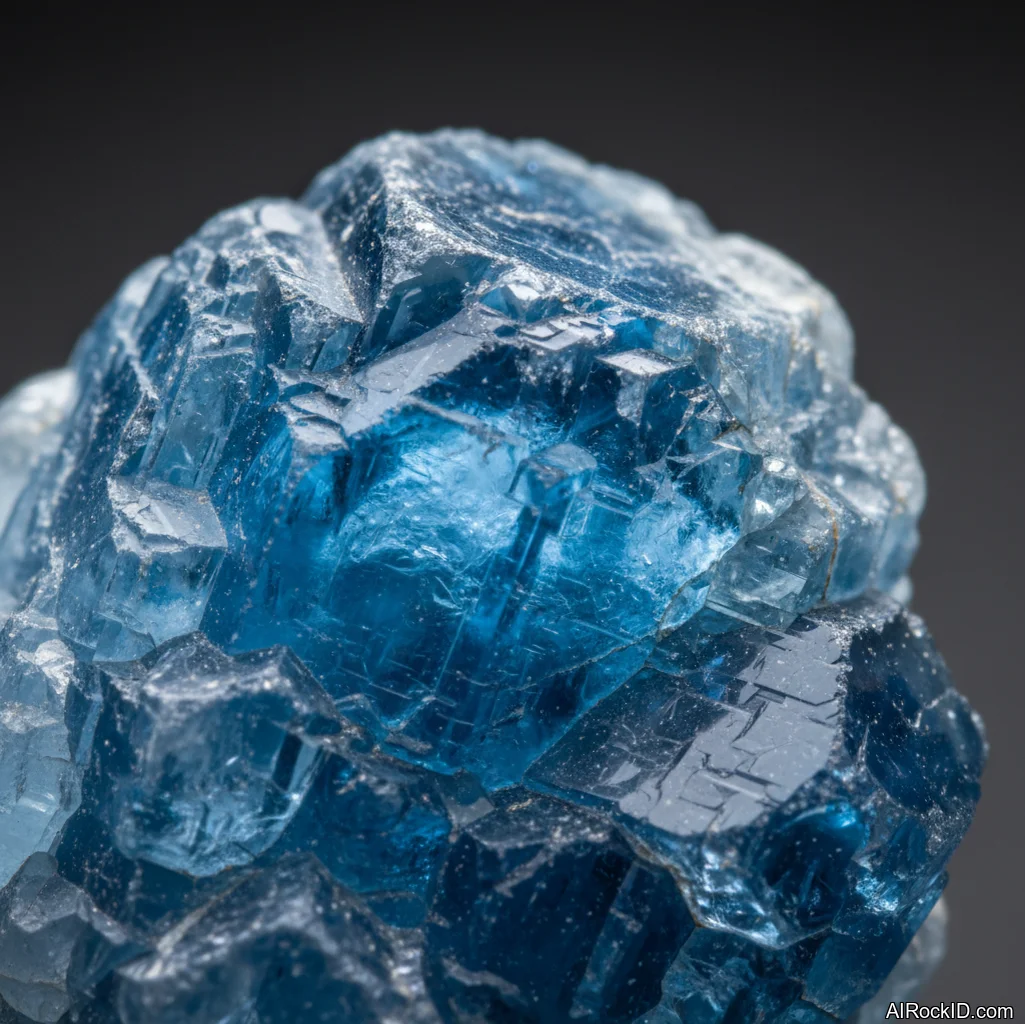
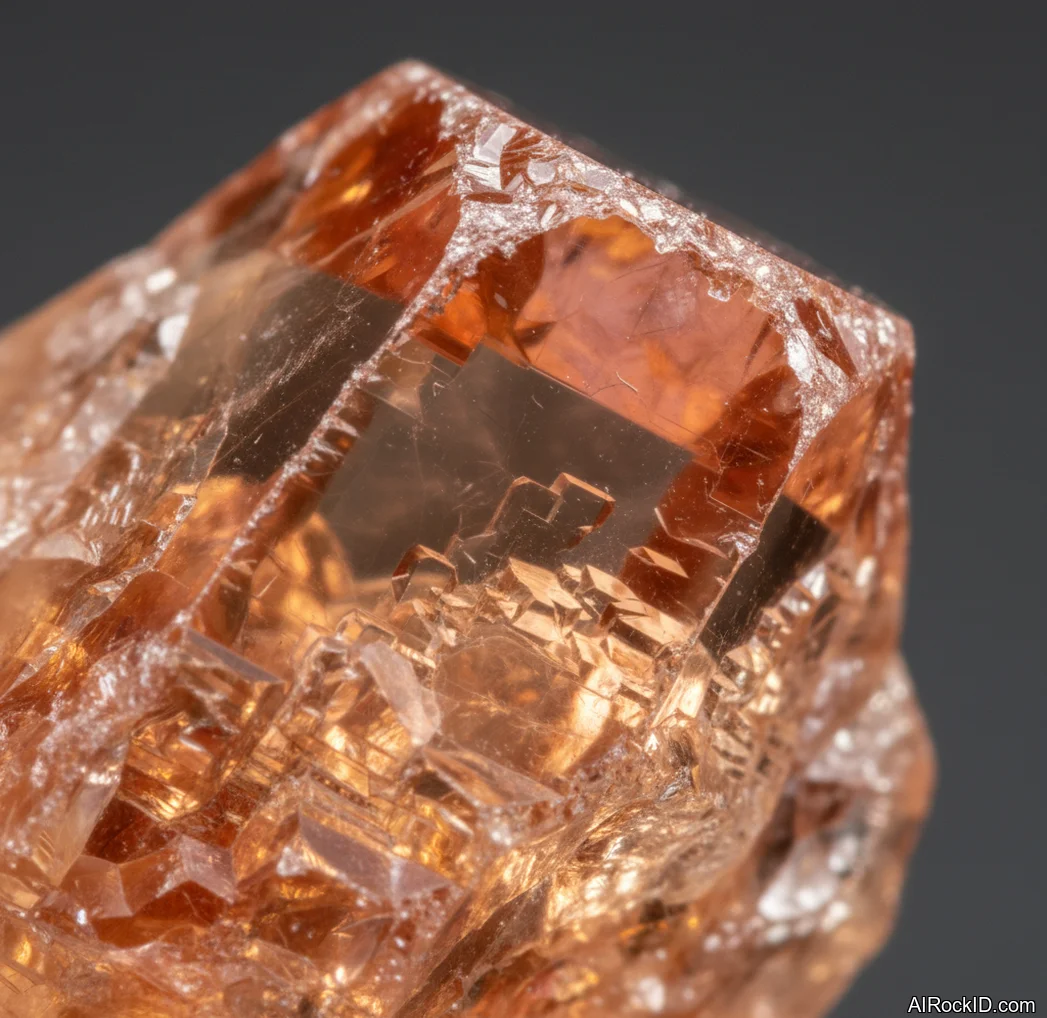
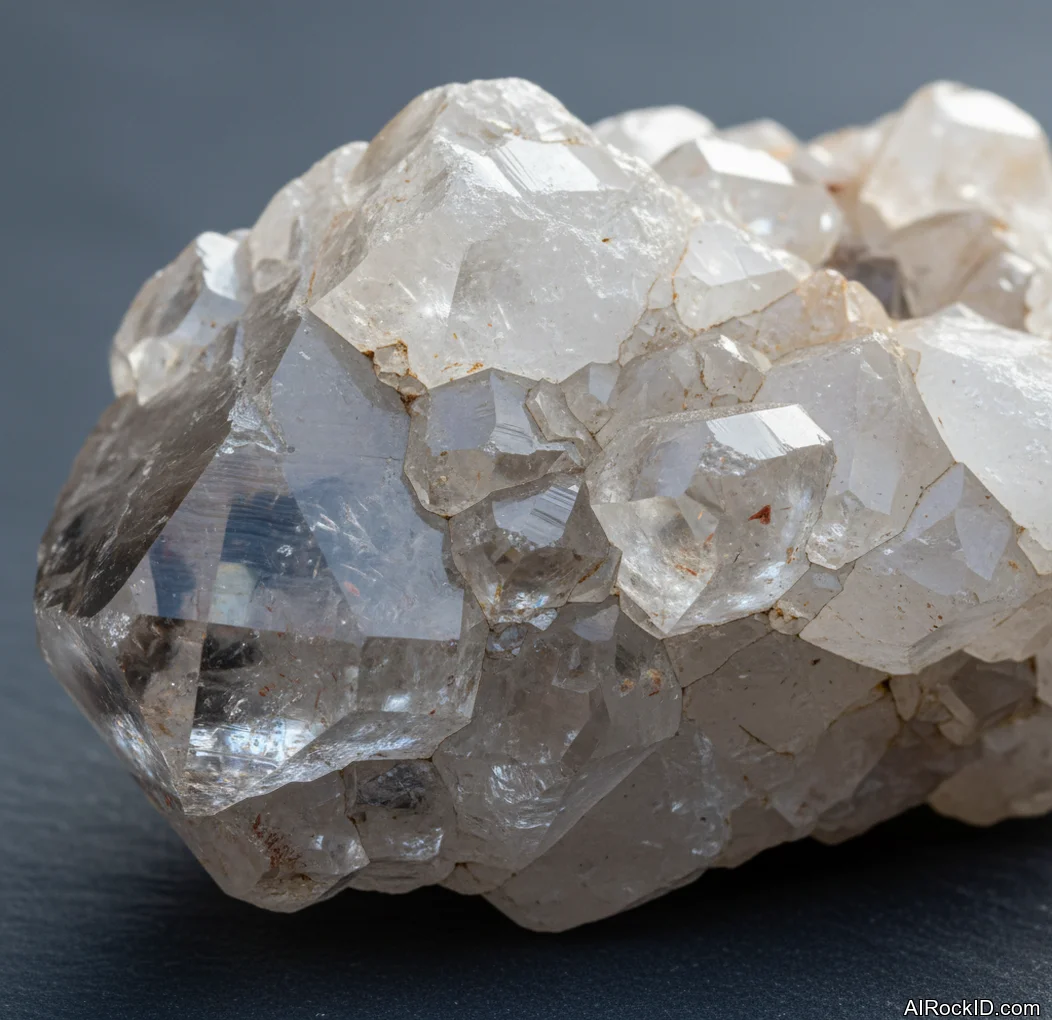
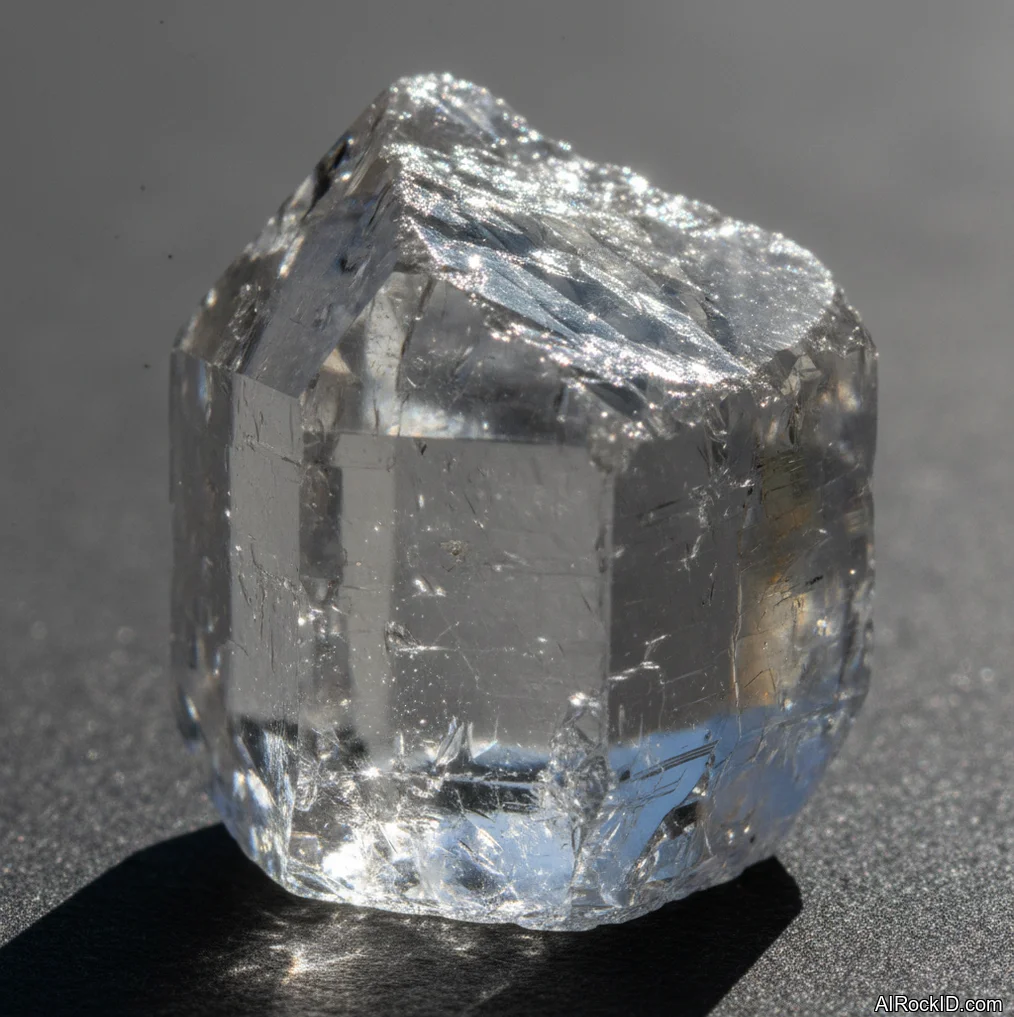
Natural topaz crystals are often prismatic and may show well-formed terminations, vertical striations, and a glassy luster. Cleavage-related flat surfaces can occur, but they should not be confused with broken glass or manufactured facets. Matrix, growth zoning, and natural inclusions can support a specimen identification when evaluated with the crystal form.
What Is Colorless Topaz?
Colorless topaz is the transparent, near-colorless form of the mineral topaz (Al2SiO4(F,OH)2). In your hand, it’s a little heavier than you expect for something that looks like “just clear,” and that heft is one of the first giveaways when you’re pawing through a mixed flat of quartz lookalikes at a show.
Pick up a clean crystal and you’ll get it right away. Sharp edges. Glassy faces. Those wide, flat planes that suddenly kick back a mirror-flash when you tilt it under a table lamp (the kind with the warm bulb that makes everything look yellower than it is). It’s not loud in color, obviously, but the good stuff has this crisp, icy look that photographs way better than you’d assume. And in jewelry, it’s the kind of stone people clock as diamond or zircon from across the room, right up until the light hits and you see the sparkle is just… different. Cleaner, but not the same.
But here’s the thing collectors learn fast. Topaz has perfect cleavage, so even though it’s hard, it can pop or chip if it gets knocked the wrong way. I’ve literally watched a dealer crack open a parcel, click two crystals together, and end up with a fresh cleavage break that looked like somebody took a razor to it. Yep. It happens.
Origin & History
Early European writers tossed around “topaz” like it meant any yellow-ish stone that caught the light. The word usually gets traced back to “Topazos,” an old name tied to an island in the Red Sea (people often point to Zabargad). And that’s kind of hilarious, because that island is known for peridot, not topaz, which really shows how sloppy gem names were before mineralogy got organized.
Topaz as an actual mineral species didn’t get properly pinned down until the late 1700s, when chemistry and crystallography started running the show. The classic reference people keep circling back to is Richard Kirwan’s work in the 1790s, along with his contemporaries who were sorting minerals by composition and physical properties, not just color and old stories. By then, “colorless” topaz was already being used as a clear gem material, and yeah, it sometimes got pressed into service as a diamond stand-in when money was tight.
Where Is Colorless Topaz Found?
Colorless topaz shows up in granitic pegmatites and rhyolite-related cavities, and it’s often sold out of big-producing regions like Brazil and Russia, with smaller finds from the western USA.
Formation
Look for topaz anywhere fluorine-rich fluids actually got room to work. Most of the colorless stuff shows up in granitic pegmatites, when the last bits of melt and fluid get loaded with volatiles like F and start growing clean, well-shaped crystals in those little pockety cavities. So you’ll usually find topaz hanging out with quartz, feldspar, mica, and in some pockets you’ll also run into beryl or tourmaline.
But topaz isn’t just a pegmatite thing. You can also get it in rhyolites and in greisen systems, where hot, chemically spicy fluids chew up granite and then drop minerals into fractures and open cavities. And if you’ve ever picked up topaz from a vug, you already know: those crystal faces can be absurdly sharp and bright, the kind that’ll catch on a cotton cloth if you wipe it (ask me how I know). Like it had all the breathing room in the world while it grew, not jammed into some tight seam.
Thing is, perfectly water-clear crystals aren’t a sure bet. A lot of “colorless” pieces still have a foggy band, tiny healed fractures you only notice when you roll the stone under a light, or that faint champagne tint that doesn’t really show itself until you set it right next to truly colorless quartz.
How to Identify Colorless Topaz
Color: Colorless topaz is transparent to near-transparent and typically looks water-clear, sometimes with a faint gray, champagne, or icy-blue cast in thicker sections.
Luster: Vitreous luster with bright, hard reflections on clean faces.
If you scratch it with a steel blade, the blade loses. Topaz is Mohs 8, so it’ll bite into glass and laugh at a pocketknife. Pick up a crystal and pay attention to the “snap” of the reflections when you rotate it; topaz faces can go from dark to blinding fast because of the flat planes and strong internal reflections. The real test is cleavage: one clean smack can leave a flat, shiny break that looks too perfect, while quartz usually chips more messily.
Common Look-Alikes
Colorless Topaz is sometimes confused with these materials:
- Rock crystal quartz (clear quartz), especially polished points and tumbles
- Colorless beryl (goshenite), cut stones and clean crystals
- Phenakite (phenacite), small bright crystals sold as “rare clear topaz” and vice versa
- Danburite, usually as clear faceted stones or pale crystals
- Cubic zirconia (CZ) sold as “white topaz” in jewelry
- Lead glass / crystal glass imitations (sometimes sold as “topaz” in tourist markets)
Market Cautions & Treatments
When AI Can Get This Wrong
At first glance, AI photo ID trips hard on clear stuff: quartz, goshenite, danburite, and even glass all photograph as “generic transparent.” Photos almost never show topaz’s cleavage or that slightly higher heft you feel the second it hits your palm. The real test is a quick hardness and density reality check: topaz (8) will scratch quartz (7), and a small piece that feels oddly heavy for its size is worth a closer look with a loupe for cleavage planes and fracture-fill.
Properties of Colorless Topaz
Physical Properties
| Crystal System | Orthorhombic |
| Hardness (Mohs) | 8 (Very Hard (7.5-10)) |
| Density | 3.49-3.57 g/cm3 |
| Luster | Vitreous |
| Diaphaneity | Transparent |
| Fracture | Conchoidal |
| Streak | White |
| Magnetism | Non-magnetic |
| Colors | Colorless, White, Clear |
Chemical Properties
| Classification | Silicates |
| Formula | Al2SiO4(F,OH)2 |
| Elements | Al, Si, O, F, H |
| Common Impurities | Fe, Cr, Ti |
Optical Properties
| Refractive Index | 1.609-1.643 |
| Birefringence | 0.008-0.010 |
| Pleochroism | None |
| Optical Character | Biaxial |
Colorless Topaz Health & Safety
Colorless topaz is safe to handle and it’s non-toxic. Thing is, the only real “risk” is physical. Those sharp edges and cleavage breaks? They can feel weirdly razor-like, the kind that’ll nick you before you even realize you brushed it.
Safety Tips
If you’re trimming a specimen or messing with broken shards, put on eye protection. And wrap the piece in a cloth first, the kind that actually grips, so it doesn’t skitter and skate across the table when your tool bites in.
Colorless Topaz Value & Price
Price Range
Rough/Tumbled: $5 - $60 per specimen
Cut/Polished: $10 - $80 per carat
Clean transparency and a crisp termination, plus bigger size, can jack the price up fast. The cheap pieces? Usually they’re tiny, have little chips along the edges (you can feel them if you run a fingernail over the corner), or they get dumped into listings as some generic “clear gemstone” with no real crystal shape.
Durability
Durable — Scratch resistance: Excellent, Toughness: Fair
Colorless topaz is stable in normal conditions, but its perfect cleavage means it can chip or split from impact even though it resists scratching.
How to Care for Colorless Topaz
Use & Storage
Store it wrapped or in a compartmented box so it can’t bang into harder stones or other topaz. I keep my nicer crystals in little gem jars because one accidental tap can start a cleavage break.
Cleaning
1) Rinse with lukewarm water and a drop of mild soap. 2) Use a soft toothbrush to get dust out of growth lines and around the termination. 3) Rinse again and pat dry with a microfiber cloth; skip harsh cleaners and don’t use ultrasonic if the stone has fractures.
Cleanse & Charge
For a simple reset, rinse briefly in water and dry well, or use smoke or sound if you don’t want liquids around display labels. If you leave it in sun for “charging,” do it for a short time and keep it from rolling off a windowsill.
Placement
On a shelf, angle it so one big face catches light, otherwise it can disappear visually. A dark base or a little black paper behind it makes the edges and internal reflections pop.
Caution
Go easy on it. Topaz has perfect cleavage, so one bad knock, or even a single drop onto a hard bench, can split it cleanly. And don’t crank it down in a vise (you’ll feel it bite and then, yep, it’s gone). Also, don’t toss it into a mixed tumble bag with quartz or corundum; it’s just asking for a sharp pressure point and a clean break.
Works Well With
Colorless Topaz Meaning & Healing Properties
Compared to louder stones, colorless topaz is the quiet kid. It just sits there. People who go for it usually want the table to feel clean and uncluttered, not packed with rainbow bands and constant sparkle.
In my own little routine, I grab it when my brain’s all over the place and I need one object that looks simple, but still has some structure once you actually stare into it for a minute. Thing is, it’s not “blank.” It’s more like clear glass with bones.
Look close and you’ll see why people tie it to clarity. A decent crystal throws off internal reflections that feel crisp, almost architectural, and it’s easy to use that as a spot to rest your attention while you’re breathing or journaling. And since it’s topaz, it has that hard presence in your hand. Cool to the touch at first. Solid weight. You can feel the edges when you turn it over, and it’s a nice counterweight to softer, waxier stones that heat up fast.
But I’m keeping this grounded. None of this replaces medical care, and a clear stone isn’t going to magically fix a messy life, right? What it can do is act like a clean visual cue. I’ve watched people do well with it as a reminder to slow down, simplify, and finish one thing before starting three more. And if you like pairing stones, it sits nicely with clear quartz for amplification vibes, or with fluorite when you want the mental organization theme without that “all intensity, all the time” feeling.
Common mistakes
- Assuming every clear, hard-looking stone is diamond or white topaz.
- Using color alone to identify colorless topaz.
- Confusing quartz crystals with topaz crystals because both can be transparent and glassy.
- Ignoring cleavage risk when setting topaz in rings or cleaning it ultrasonically.
- Buying a faceted clear stone without asking whether it is glass, cubic zirconia, or another simulant.
- Relying on a single photo for identification when weight, hardness, and refractive index are unavailable.
Identify Colorless Topaz from a photo
Compare Colorless Topaz traits, care tips, value clues, and common lookalikes with a clear photo.