Dendritic Agate
What Is Dendritic Agate?
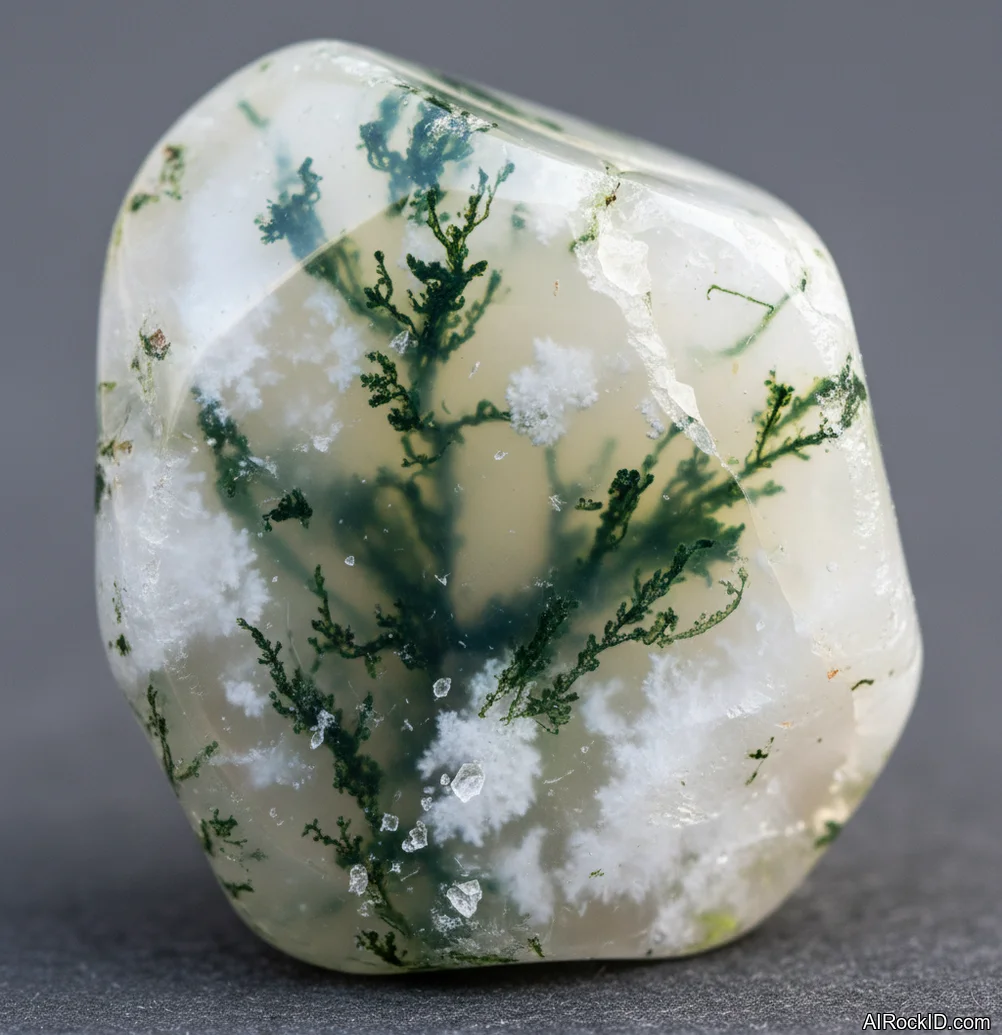
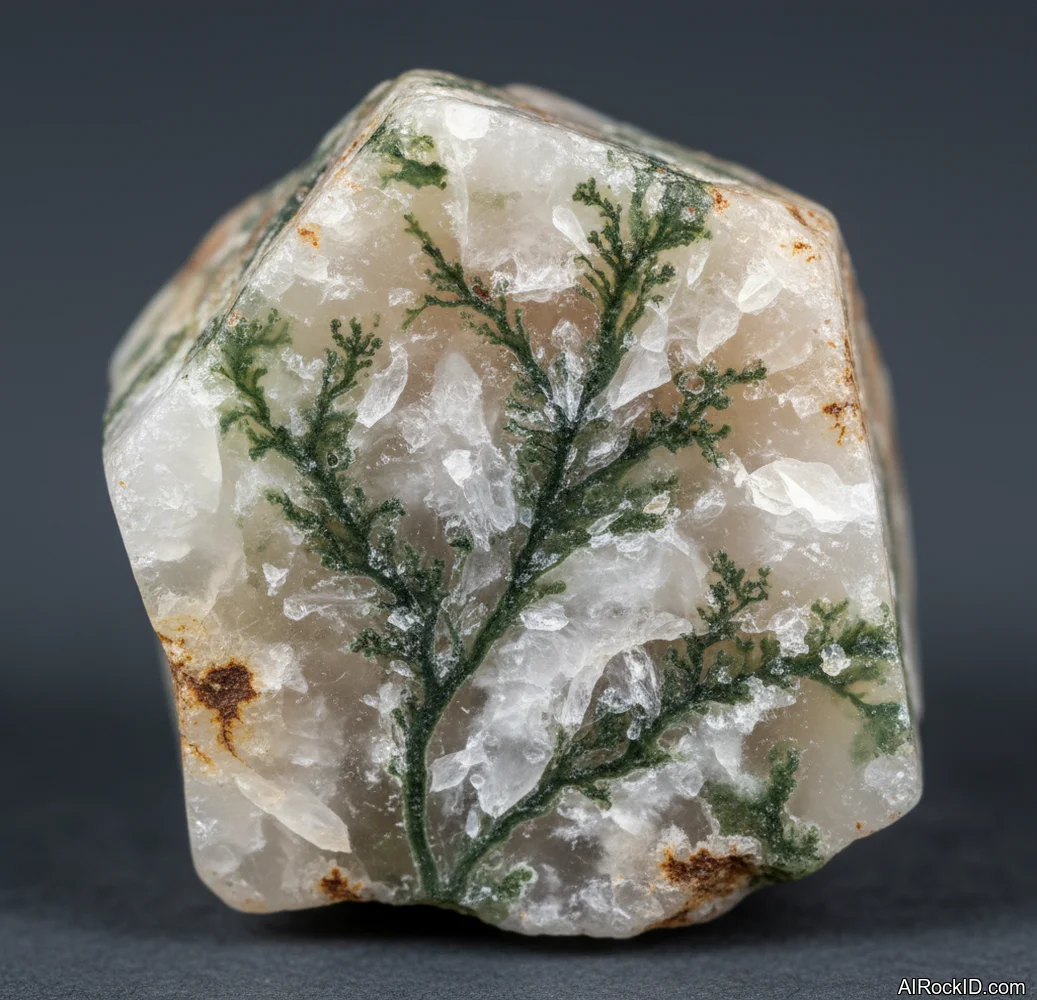
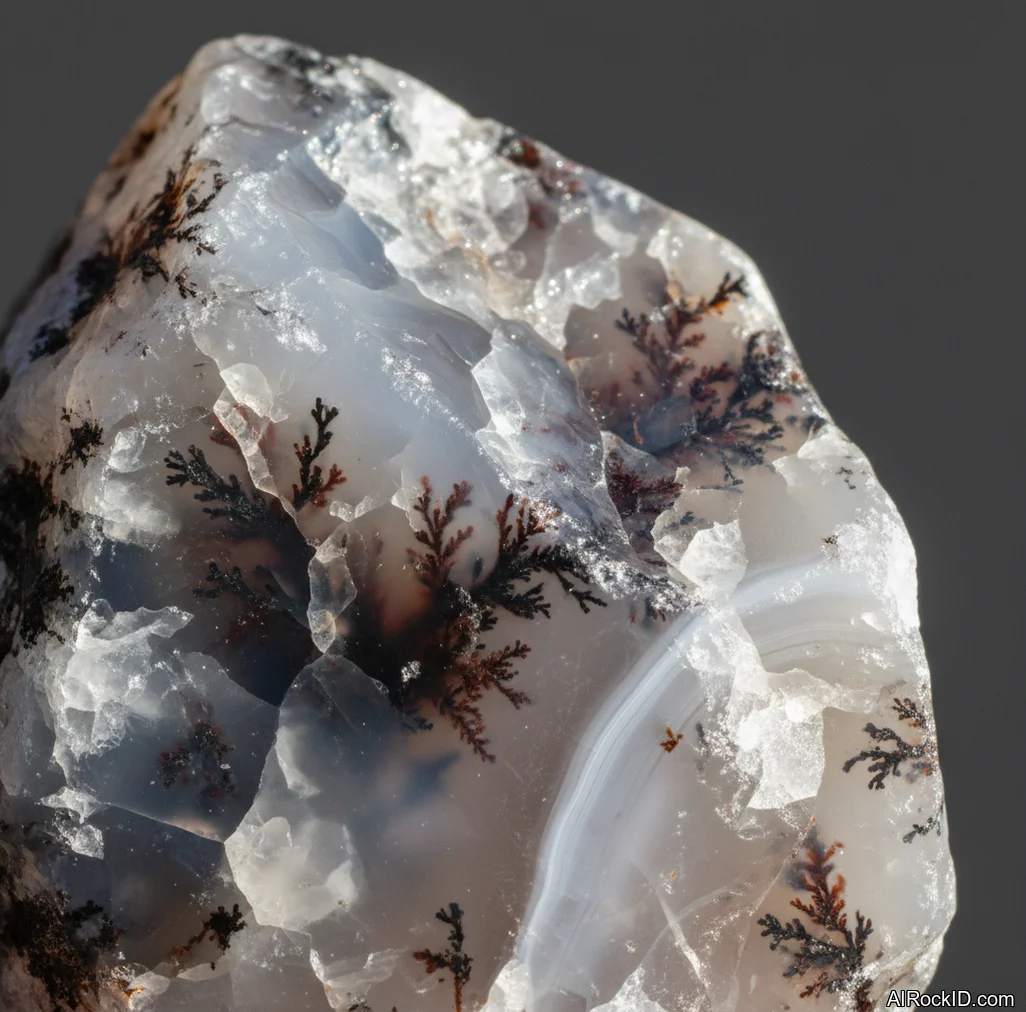
Dendritic agate is a type of chalcedony (microcrystalline quartz) with these branching, plant-ish inclusions called dendrites. They’re usually manganese or iron oxides. Most pieces come in white, gray, or that creamy off-white color, with inky black to brown “fern” patterns that honestly look like tiny winter trees trapped in stone.
Grab a polished palm stone and you’ll notice the temperature first. It stays cool in your hand even after a full minute of holding it. The dendrites don’t sit on top and they don’t feel bumpy at all. They’re inside the stone, like somebody used a fine-tip pen under a clear coat. And if you tip it under a bright light, the chalcedony starts to look a little waxy, almost soft, while those dendrites keep their sharp, crisp edges.
People will call it “fossil plant agate” at a glance. But it isn’t fossil wood, and it isn’t actual plant material either. It’s mineral staining that formed along tiny cracks. Thing is, the best pieces usually have a lot of open, clean “sky” around the branches, instead of being crammed edge-to-edge with dark fuzz.
Origin & History
“Agate” traces back to the Achates River in Sicily, where people were picking up agates way back in antiquity, and Theophrastus later wrote about them in the 4th century BCE. “Dendritic” comes from the Greek dendron, meaning tree, which is pretty much spot-on once you’ve actually looked at those branching patterns up close.
As a named look, dendritic agate has been treated more like a lapidary trade term than a strict mineral species. Old dealer labels bounce around between “dendritic agate,” “dendritic chalcedony,” and “moss agate,” even though moss agate usually shows greener, more cloudlike inclusions. I’ve bought flats at shows where one tray had three different names slapped on it, and all the stones came out of the same parcel.
Where Is Dendritic Agate Found?
Dendritic agate turns up in silica-rich nodules and veins in lots of places, with commercial material commonly cut from Brazilian, U.S., and Russian rough.
Formation
Pick up a slab and really stare at it for a minute, and you can usually tell why the patterns look like something nature sketched by hand. Chalcedony starts out when silica-rich fluids move through little cavities and fractures, often in volcanic rocks or sedimentary settings where silica can get mobilized. It’s kind of weird to think about, but that silica can be gel-like at first, and as it hardens into microcrystalline quartz, other fluids can still creep in (sometimes right along hairline seams you only notice when the light hits just right).
Those dendrites show up when manganese and iron oxides precipitate along tiny cracks, bedding planes, or micro-voids. And they spread in those branching, diffusion-like patterns, a lot like frost creeping across a window. But here’s the thing: they aren’t “growths” poking into open space the way a crystal would. They’re stains sealed inside the chalcedony.
So calling every piece “agate” gets messy. A lot of dendritic pieces don’t have that classic agate banding people expect. But in the trade, the name still sticks. Why? Habit, mostly.
How to Identify Dendritic Agate
Color: Body color is usually milky white, cream, light gray, or tan, with black, brown, or reddish-brown branching dendrites. Some pieces have subtle translucent zones where light passes through the edges.
Luster: Polished surfaces show a waxy to vitreous shine, depending on how high the polish is.
Pick up two pieces and compare them under a phone flashlight. Real dendrites look sharp and “in” the stone, not printed on top, and the branches often fade at the tips instead of stopping like a pixel line. If you scratch it with a steel nail, it shouldn’t take a scratch, but it will scratch common glass. And if the pattern repeats in an obvious loop across multiple stones, you’re probably looking at a manufactured print or resin.
Properties of Dendritic Agate
Physical Properties
| Crystal System | Trigonal |
| Hardness (Mohs) | 6.5-7 (Hard (6-7.5)) |
| Density | 2.58-2.64 g/cm3 |
| Luster | Waxy |
| Diaphaneity | Translucent to opaque |
| Fracture | Conchoidal |
| Streak | White |
| Magnetism | Non-magnetic |
| Colors | white, cream, gray, tan, black, brown, reddish-brown |
Chemical Properties
| Classification | Silicates |
| Formula | SiO2 |
| Elements | Si, O |
| Common Impurities | Fe, Mn |
Optical Properties
| Refractive Index | 1.530-1.540 |
| Birefringence | None |
| Pleochroism | None |
| Optical Character | Uniaxial |
Dendritic Agate Health & Safety
Solid dendritic agate is safe to touch, and it’s fine around water in normal day-to-day use. But if you start cutting it or grinding it, that’s where the real issue shows up: breathing in the silica dust.
Safety Tips
If you’re going to shape or sand it, keep it wet, crack a window or run a fan for ventilation, and wear a real respirator that’s actually rated for fine silica dust (not just a flimsy paper mask).
Dendritic Agate Value & Price
Price Range
Rough/Tumbled: $5 - $60 per piece
Cut/Polished: $0.50 - $5 per carat
Prices jump when the dendrites look sharp and ferny, spaced out enough to breathe, and set off by that clean, pale chalcedony border, especially on bigger cabs that take a slick, glassy polish you can feel under your thumb. But once the base goes muddy gray and the dendrites turn into blotchy, crowded clumps, the value drops in a hurry.
Durability
Very Durable — Scratch resistance: Good, Toughness: Good
It’s stable in normal wear, but a high polish can still get dulled by grit and quartz dust over time.
How to Care for Dendritic Agate
Use & Storage
Keep it in a pouch or a divided box if it’s polished, because quartz-on-quartz contact can leave little rub marks. I don’t toss cabs loose in a pocket with keys. They’ll survive, but the shine won’t.
Cleaning
1) Rinse with lukewarm water to remove grit. 2) Wash with mild soap and a soft brush, especially around drilled holes or settings. 3) Rinse well and dry with a microfiber cloth to keep the polish bright.
Cleanse & Charge
A simple rinse and a wipe is plenty if you like keeping it “fresh.” If you use smoke or sound, keep it gentle and don’t overthink it.
Placement
On a desk or a shelf, it looks best where side light can catch the dendrites and give them depth. If you display slabs, prop them so you can tilt them, because the patterns read differently at different angles.
Caution
Don’t use harsh cleaners or ultrasonic machines on set jewelry. They can wiggle a setting loose, and if the stone was treated, they might even leave softer fillers looking a little cloudy (you can sometimes see that hazy film right along the edges). And if you’re cutting it, handle it like any quartz: keep silica dust under control. Why risk breathing that stuff?
Works Well With
Dendritic Agate Meaning & Healing Properties
Most folks who pick up dendritic agate for reasons other than collecting are chasing that “nature” feeling. And I get it. If you sit there staring at those branchy patterns for a minute, your eyes kind of stop racing. It’s an easy stone to hang out with since it doesn’t yell at you with color. It just sits there, like a quiet pencil sketch somebody forgot to frame.
In my own pile, it’s the one I grab when my brain’s all over the place and I want something steady sitting on the table while I work. Not because I think it’s medicine. More because the pattern gives your attention somewhere to land without pulling you off task (you know what I mean?). But don’t let anyone pitch it like some cure-all. If you’re dealing with anxiety or sleep stuff that’s bigger than “today was a lot,” crystals are a side tool, not the main tool.
One practical thing I’ve noticed at shows: people click with it faster when they can actually hold it. A palm stone that’s cold at first, then warms up in your hand, with that smooth, almost waxy polish and a clean white background plus one bold dendrite feels calming in a way a busy, heavily patterned piece sometimes doesn’t. So if you’re into journaling or meditation, it fits that slow, watchful mood really well. Why fight that?
Identify Any Crystal Instantly
Snap a photo and get properties, value, care instructions, and healing meanings in seconds.