Golden Healer Quartz


Quick answer: Golden Healer Quartz is a trade name for quartz with yellow, gold, or orange color caused by iron-oxide staining, coatings, or inclusions. The color may appear as a surface film, internal veils, cloudy zones, or concentrated patches, so identification depends on both quartz features and iron-related coloration.
AI Rock ID can help compare Golden Healer Quartz with similar yellow or iron-stained crystals from a photo, especially when the image shows crystal shape, luster, and color distribution. RockIdentifier.io provides crystal identification support and educational reference pages for quartz varieties and common lookalikes.
Good fit
- Collectors who like natural quartz with warm yellow to orange iron staining
- Beginners who want a durable crystal that is easier to handle than softer minerals
- Buyers comparing tumbled stones, points, clusters, and polished freeforms
- Anyone checking whether a yellow quartz specimen is natural, coated, dyed, or heat-altered
Not a good fit
- Buyers who need a strictly gemological variety with a single standardized definition
- Collectors seeking uniform color, since natural iron staining is often patchy
- Anyone expecting metaphysical traditions to replace medical care or safety guidance
Most commonly confused with
- Citrine: Citrine is yellow quartz colored by trace elements or treatment, while Golden Healer Quartz usually refers to clear or milky quartz with iron-oxide staining or inclusions.
- Hematoid Quartz: Hematoid Quartz commonly shows red, orange, or brown iron inclusions; Golden Healer Quartz is typically described when the iron color trends yellow to golden.
- Lemon Quartz: Lemon Quartz is often a treated or irradiated quartz with a brighter lemon-yellow tone, while Golden Healer Quartz usually has more uneven golden staining.
- Iron-Stained Quartz: Some ordinary quartz with iron staining may be sold as Golden Healer Quartz when the color and appearance fit the trade description.
Golden Healer Quartz vs. Similar Yellow Crystals
| Material | Typical Color Source | Key Difference | Hardness |
|---|---|---|---|
| Golden Healer Quartz | Iron-oxide staining or inclusions | Golden color often appears as coatings, veils, or patchy zones in quartz | 7 |
| Citrine | Natural trace elements or treatment | More evenly yellow to orange quartz; many commercial pieces are heated amethyst or smoky quartz | 7 |
| Hematoid Quartz | Iron oxide inclusions | Usually stronger red, rust, brown, or orange iron tones | 7 |
| Lemon Quartz | Commonly treated quartz | Often brighter lemon-yellow and more uniform in cut stones | 7 |
| Yellow Calcite | Impurities in calcite | Much softer with rhombohedral cleavage and acid reaction | 3 |
AI identification confidence
AI identification is usually more reliable when Golden Healer Quartz shows visible quartz structure, glassy luster, and uneven golden iron staining. Confidence is lower for polished tumbles, uniformly yellow stones, overexposed photos, or specimens that may have been dyed, coated, or heat-treated.
When AI gets it wrong
- A polished yellow tumble lacks crystal faces, inclusions, or context for judging whether it is quartz or calcite.
- Lighting makes clear quartz look warmer or more golden than it appears in daylight.
- A seller photo is highly saturated, filtered, or taken against a yellow background.
- The specimen is dyed, coated, or treated in a way that hides natural color patterns.
Final recommendation
Choose Golden Healer Quartz based on clear quartz-like hardness, glassy luster, and natural-looking iron color distribution rather than the trade name alone. Ask for untreated, daylight photos when buying higher-priced pieces, especially if the color is unusually uniform or vivid.
How to Tell If Golden Healer Quartz Is Natural
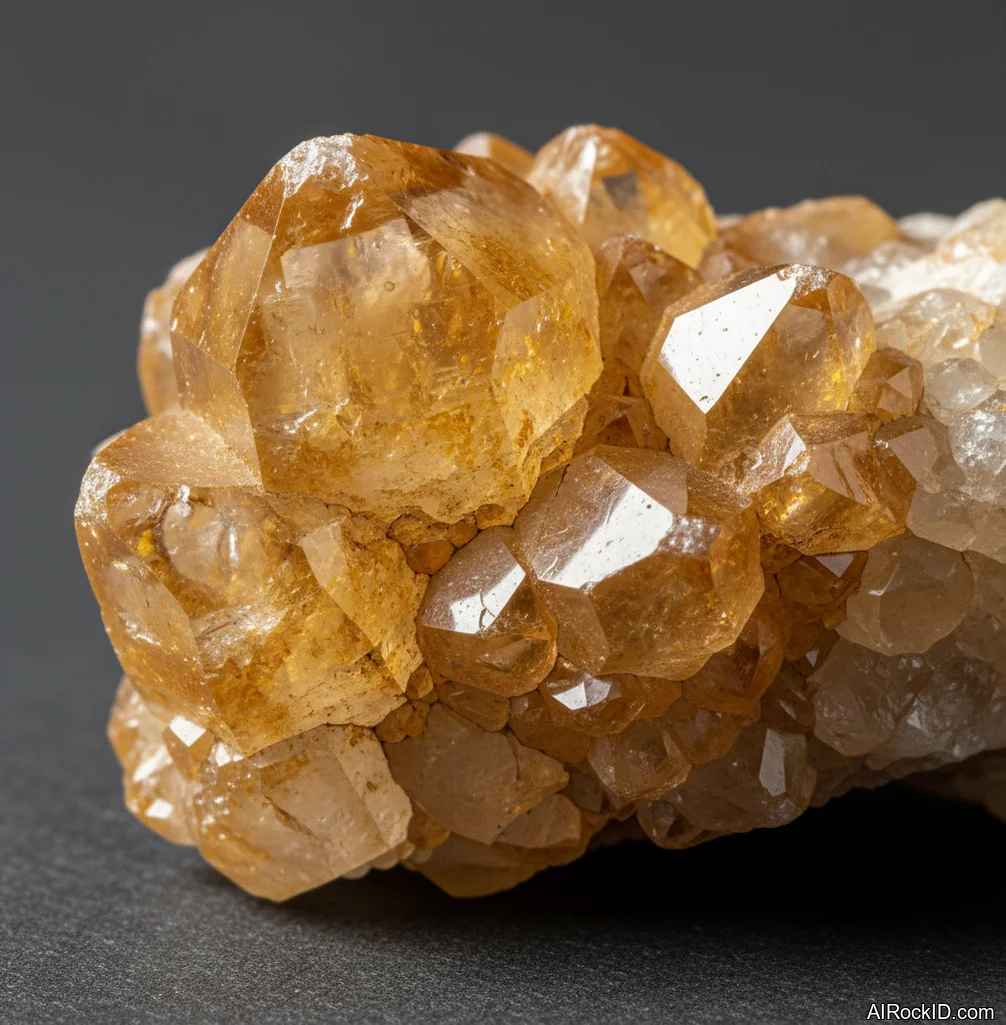
Natural Golden Healer Quartz often has uneven yellow, orange, or gold iron staining along fractures, terminations, growth zones, or internal veils. Very uniform neon-yellow color, color concentrated only in surface scratches, or residue that transfers when rubbed can suggest dye, coating, or artificial enhancement. A basic hardness check against glass can support quartz identification, but it does not prove the color is natural.
What to Ask Before Buying Golden Healer Quartz
Ask whether the piece is natural, dyed, coated, heat-treated, or acid-cleaned, since these details affect value and collectability. Request daylight photos from more than one angle for polished pieces, points, and clusters. For expensive specimens, a clear return policy or written seller disclosure is more useful than a vague label.
Photo Tips for Identifying Golden Healer Quartz
Use indirect daylight and include one close-up plus one full-specimen photo to show color zoning, luster, and crystal shape. Avoid yellow bulbs, heavy filters, wet surfaces, and saturated backgrounds because they can make ordinary quartz appear more golden. A photo beside a neutral white or gray object can make color comparison more reliable.
What Is Golden Healer Quartz?
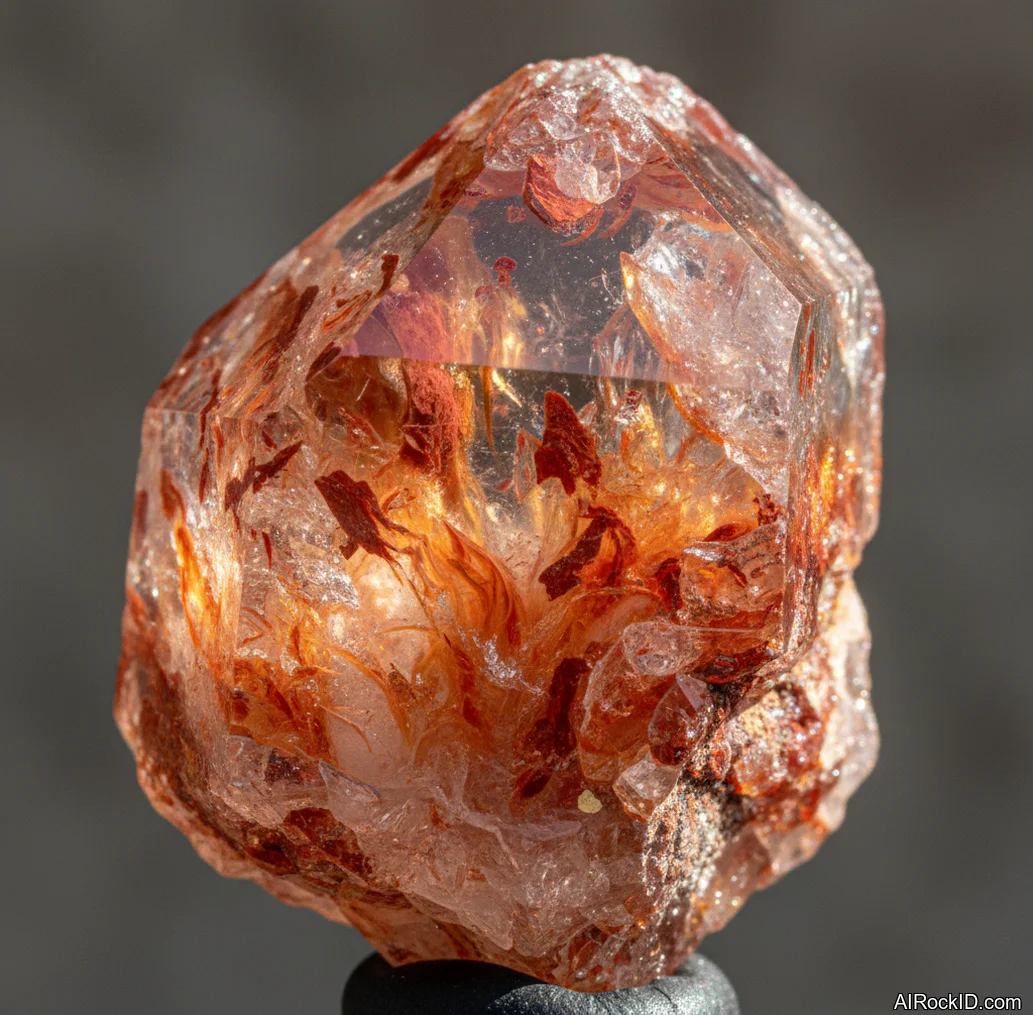
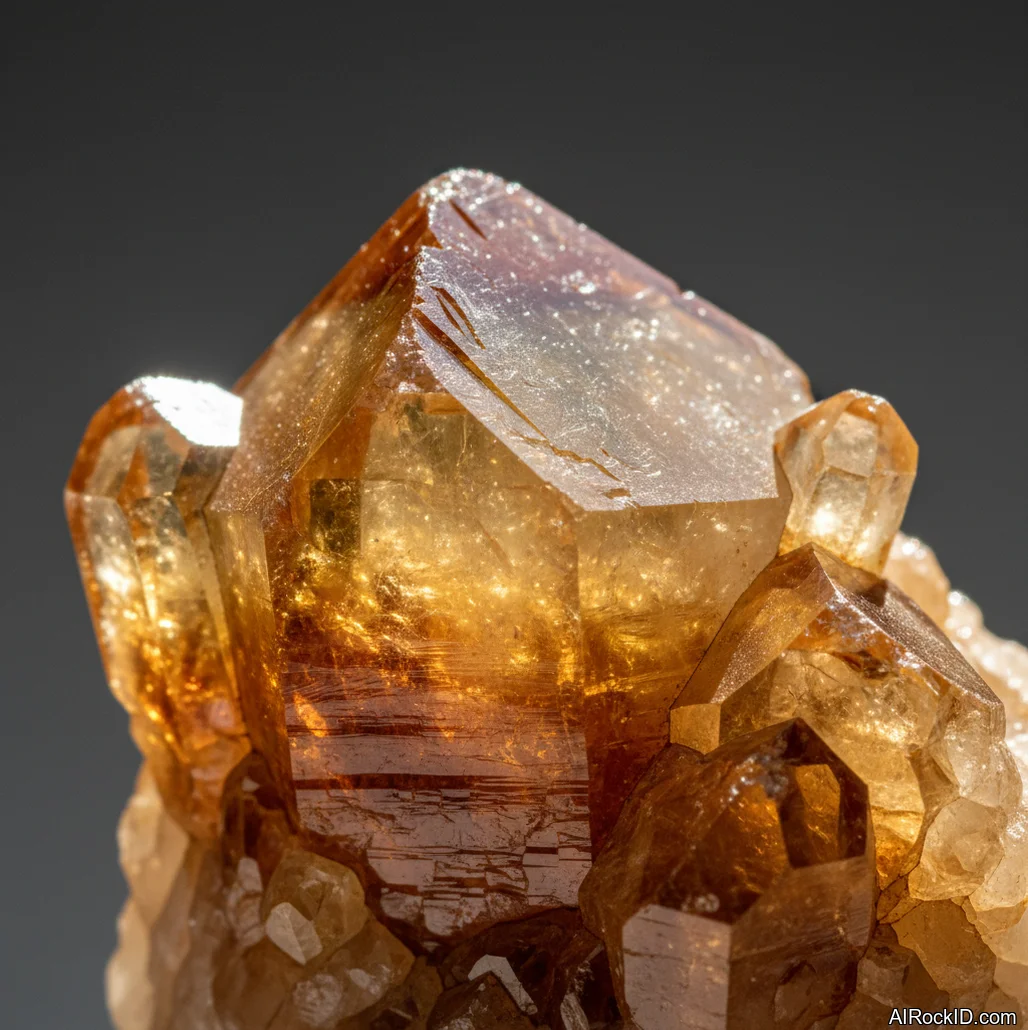
Golden Healer Quartz is clear to translucent quartz, and that yellow-to-golden color comes from iron-oxide staining, usually limonite or goethite, sitting in fractures, veils, or as a coating.
Pick up a point and you’ll feel it right away. It stays weirdly cool in your hand, even after you’ve been talking with it sitting in your palm for a minute. And the “gold” isn’t some extra crystal slapped on top. It’s iron oxides riding those internal cracks and wispy inclusions, so when you tilt it under a shop light you get that honey flash, then it disappears, then it hits again. Some pieces look like there’s a faint tea wash inside (almost like someone swirled it with weak black tea). Others have bold, brushy bands that line up right along healed fractures. You can see where the crystal broke and sealed back up if you take your time with it.
People mix it up with citrine at first glance. But in person it doesn’t read the same. Citrine usually looks like an overall body color. Golden Healer is more like clear quartz with golden weathering trapped inside, and you can often follow the color along little internal “roads” where it cracked and re-sealed. I’ve handled plenty of tumbled stuff where the color looks like a uniform yellow filter, and that’s usually your clue it’s dyed quartz or something heat-treated that’s being marketed loosely. Right?
Origin & History
“Golden Healer Quartz” is just a trade name. It isn’t an official mineral species, and nobody’s formally defined it as a real quartz variety.
So you won’t see a tidy, consistent entry for it like you do for amethyst or smoky quartz. And to be honest, different dealers slap the label on slightly different-looking pieces.
Most of what’s sold under that name is ferruginous quartz. That’s quartz with iron oxides or hydroxides staining fractures, coating surfaces, or showing up as thin included films (the kind that can look like a yellow wash sitting just under the surface when you tilt it in the light). If the iron runs more red-brown, you’ll also hear it called hematoid quartz.
Thing is, the “healer” part comes straight out of the metaphysical market. It really took off in the 1990s and 2000s, right when online crystal shops started leaning hard on catchy names as a sales strategy.
Where Is Golden Healer Quartz Found?
It turns up anywhere quartz grows and iron-bearing fluids can stain it, with lots of commercial material coming from Brazil and smaller runs from alpine pockets and pegmatites in other regions.
Formation
Look at the color pattern for a second and you can pretty much tell where the crystal’s been hurt before. Quartz grows out of silica-rich fluids in veins, pegmatites, and hydrothermal systems. Then later on it takes a hit, stress or a temperature swing, and it cracks. Tiny cracks, the hairline kind you only catch when you tilt it under a lamp.
Iron-bearing water slips into those micro-fractures. Give it time and that iron oxidizes, leaving yellow to brown films right along the crack lines. After that, the quartz can “heal” and seal the fractures back up, so that golden staining ends up trapped inside like it got laminated.
Raw pieces pulled from pocket clay usually come out with this crusty, earthy coating. It’s the same iron stuff, just sitting on the outside. Some collectors actually like seeing that because it’s a quick tell the color isn’t a surface dye job. But yeah, it’s not always pretty.
And if you go at it too hard with a stiff brush, you can scrub off that natural coating. Sure, the crystal looks “cleaner,” but it can also end up looking kind of flat. Over-prepped. Like you can tell it’s been messed with.
How to Identify Golden Healer Quartz
Color: Golden Healer Quartz ranges from pale straw-yellow to deeper honey or golden-brown, usually appearing as internal veils, fracture staining, or surface coatings rather than an even body color.
Luster: Vitreous luster, like typical quartz, even when the color is strong.
Pick up the piece and rotate it under a single light source. Real iron staining will sit on internal planes and cracks and you’ll see it “track” along those lines instead of filling the whole crystal evenly. The real test is a loupe: dye tends to pool in pits and around drill holes, while natural staining looks like thin films and wisps that follow growth and fracture features. If you scratch it with a steel nail you shouldn’t get a mark, but it will scratch glass without much effort.
Common Look-Alikes
Golden Healer Quartz is sometimes confused with these materials:
- Citrine (especially heat-treated amethyst passed off as natural golden quartz)
- Yellow Quartz (regular iron-stained quartz with no internal veils)
- Dyed Quartz (artificial yellow dye used on clear quartz clusters)
- Glass fakes (yellow-tinted glass sold as 'golden healer')
- Lemon Quartz (irradiated quartz, usually much more neon in color)
- Golden Calcite (softer, reacts to acid, but sometimes mislabeled)
Market Cautions & Treatments
When AI Can Get This Wrong
AI photo ID often mistakes Golden Healer for heat-treated citrine or even yellow calcite, especially if the iron staining is only on the surface. Photos can’t show the cool, dense feel or the subtle gold veils inside. The real test is backlighting: true Golden Healer has floating color in cracks, not just a surface wash.
Properties of Golden Healer Quartz
Physical Properties
| Crystal System | Trigonal |
| Hardness (Mohs) | 7 (Hard (6-7.5)) |
| Density | 2.65 g/cm3 |
| Luster | Vitreous |
| Diaphaneity | Transparent to translucent |
| Fracture | Conchoidal |
| Streak | White |
| Magnetism | Non-magnetic |
| Colors | Colorless, Yellow, Golden, Honey-brown, Brown |
Chemical Properties
| Classification | Silicates |
| Formula | SiO2 |
| Elements | Si, O |
| Common Impurities | Fe, Al, Ti |
Optical Properties
| Refractive Index | 1.544-1.553 |
| Birefringence | 0.009 |
| Pleochroism | None |
| Optical Character | Uniaxial |
Golden Healer Quartz Health & Safety
Golden Healer Quartz is just quartz that’s chemically stable, with that iron staining on it, so it’s generally fine to handle and even give a quick rinse. The real thing to watch out for isn’t some chemical issue, it’s the physical stuff: a broken point can have razor-sharp edges that’ll nick you before you even notice.
Safety Tips
If you’re grinding, drilling, or sanding quartz, assume the dust is a silica hazard. Use wet methods to keep it from going airborne, and wear the right respiratory protection too (not just a flimsy dust mask).
Golden Healer Quartz Value & Price
Price Range
Rough/Tumbled: $5 - $80 per piece
Cut/Polished: $1 - $10 per carat
Prices jump for crystals with clean terminations, strong (but still natural-looking) golden zoning, and big points that don’t have that annoying little chip right on the tip. And yeah, most dealers will tack on extra if the piece has those obvious internal “golden veil” scenes you can spot from across the table without even picking it up.
Durability
Durable — Scratch resistance: Excellent, Toughness: Good
Quartz holds up well in daily handling, but sharp impacts can chip terminations and edges, especially on long points.
How to Care for Golden Healer Quartz
Use & Storage
Store points so the tips don’t knock together, because that’s how you get those little white chips on the termination. I keep mine in a tray with padding or in individual boxes if the faces are crisp.
Cleaning
1) Rinse with lukewarm water to remove loose clay or dust. 2) Wash with mild soap and a soft toothbrush, working along the grooves, then rinse well. 3) Pat dry and let it air-dry fully before putting it back in a closed container.
Cleanse & Charge
For people who do energetic care, a simple rinse and a night on a windowsill away from harsh midday sun is common. If you’re worried about coatings, skip salt soaks and stick to gentle methods.
Placement
Put it where side light can hit it, because that’s when the internal gold veils actually show up. A dark shelf eats the effect.
Caution
If you actually like that natural iron oxide skin, go easy on the harsh acids and the heavy-duty scrubbing. That stuff can strip it off or at least bleach the color lighter than you wanted. And don’t park anything with a tall, tippy point where it can fall over onto tile. Seriously, who wants to hear that crack?
Works Well With
Golden Healer Quartz Meaning & Healing Properties
Plain clear quartz and Golden Healer are both quartz, but in modern crystal circles Golden Healer gets used in a more “whole body” kind of way. Mostly because the color reads warm and steady. Simple as that.
In my own stash, it’s the one I reach for when I want quartz clarity but don’t want that icy, hyper-bright vibe super-clear points can throw off when they’re sitting on the table catching every bit of light. And yeah, that’s a mood thing, not a lab measurement.
Most dealers pitch it as something that restores balance and helps you feel put back together after burnout. Look, I’ll keep it grounded: it’s a quartz point with iron staining, and any health claims should stay in the realm of personal practice. Still, I’ve watched customers pick one up, tilt it under the shop lights, and you can literally see their shoulders drop. Is it the stone, the ritual, the tactile focus? Thing is, sometimes that’s the whole point.
But there’s market friction here. A lot of “golden healer” listings are just dyed quartz, or they’re heat-treated amethyst being sold under a softer name. If the color looks sprayed-on uniform, or if every crack is the exact same neon yellow, I’d pass. The good stuff looks like nature did it slowly, with uneven veils and little patchy zones that actually track when you rotate the crystal in your fingers (you’ll see the color shift and break up instead of staying flat).
Common mistakes
- Assuming every yellow quartz specimen is citrine rather than iron-stained quartz
- Using the name Golden Healer Quartz as proof of natural color without checking treatment history
- Judging authenticity from color alone instead of hardness, luster, inclusions, and seller disclosure
- Confusing yellow calcite with quartz because both can be pale yellow and translucent
- Overvaluing small tumbled stones only because they are labeled with a popular trade name
Identify Golden Healer Quartz from a photo
Compare Golden Healer Quartz traits, care tips, value clues, and common lookalikes with a clear photo.