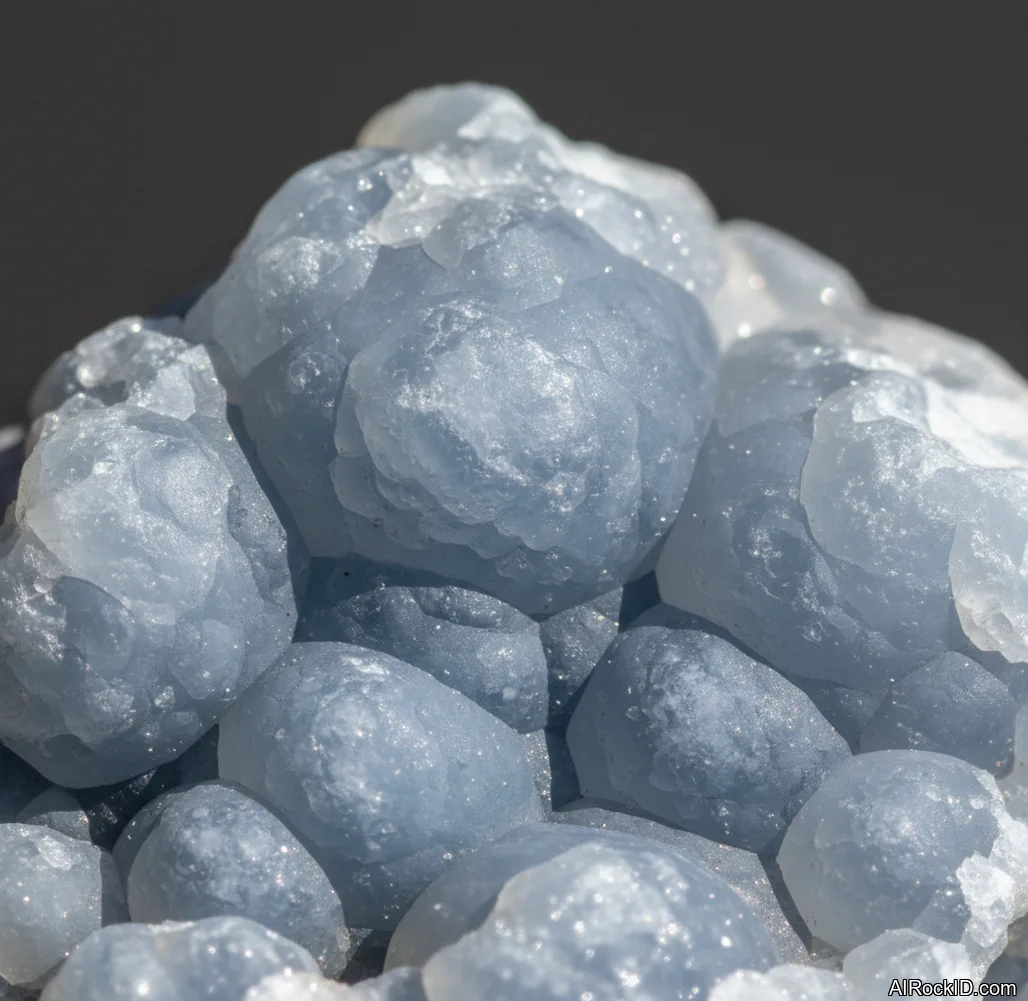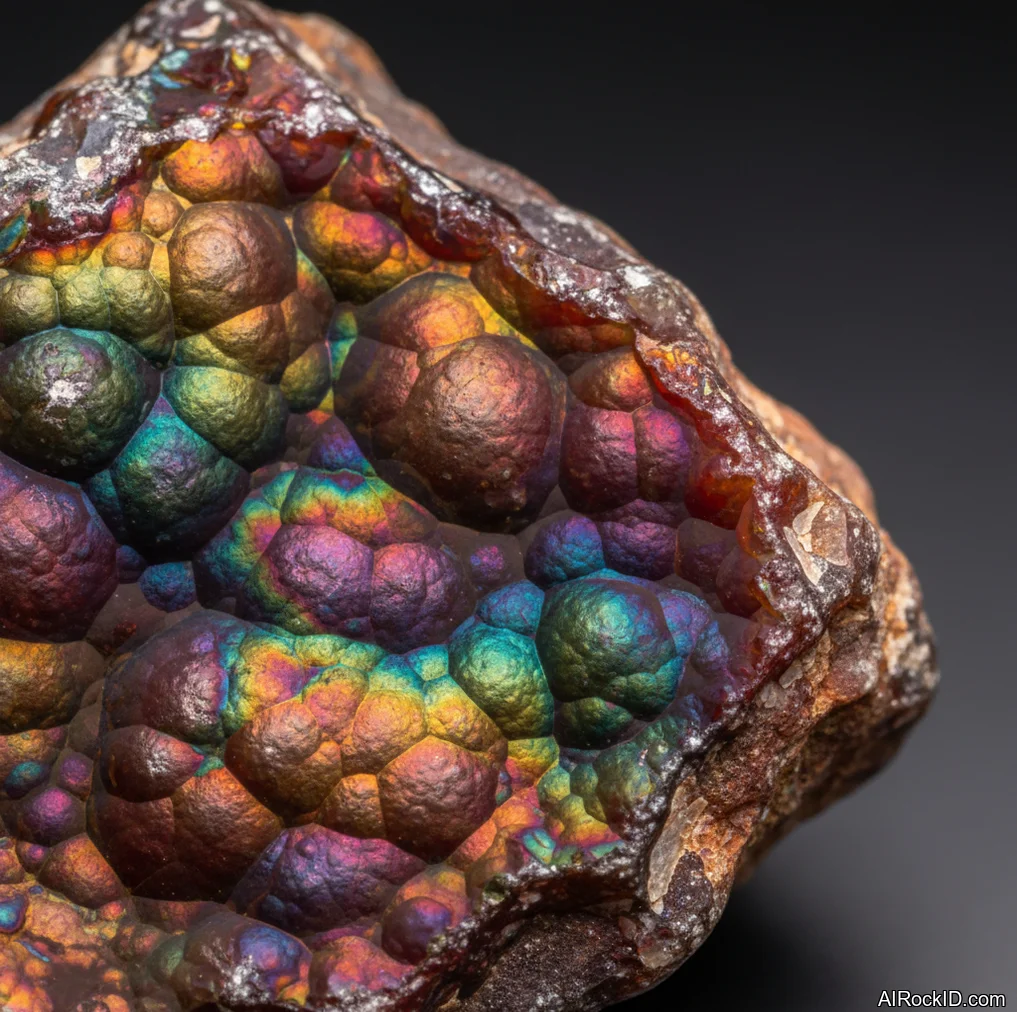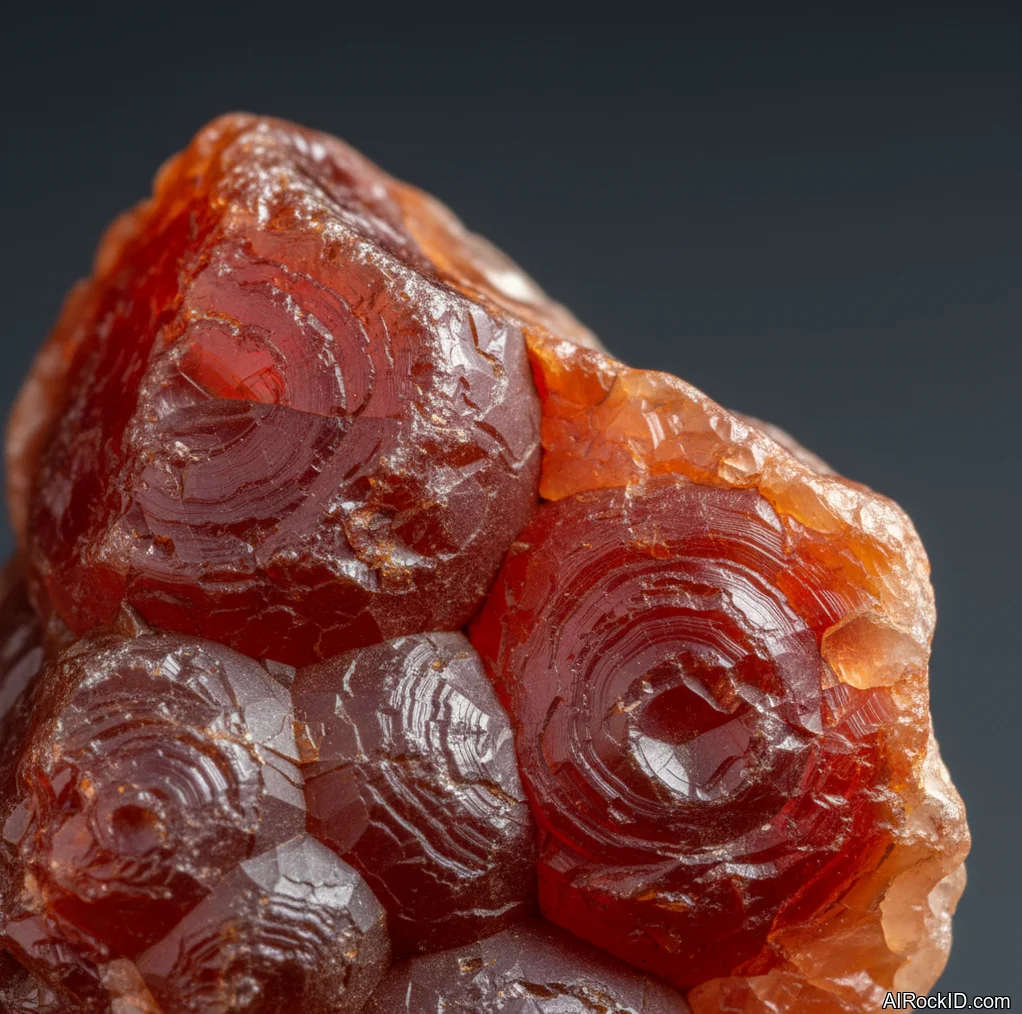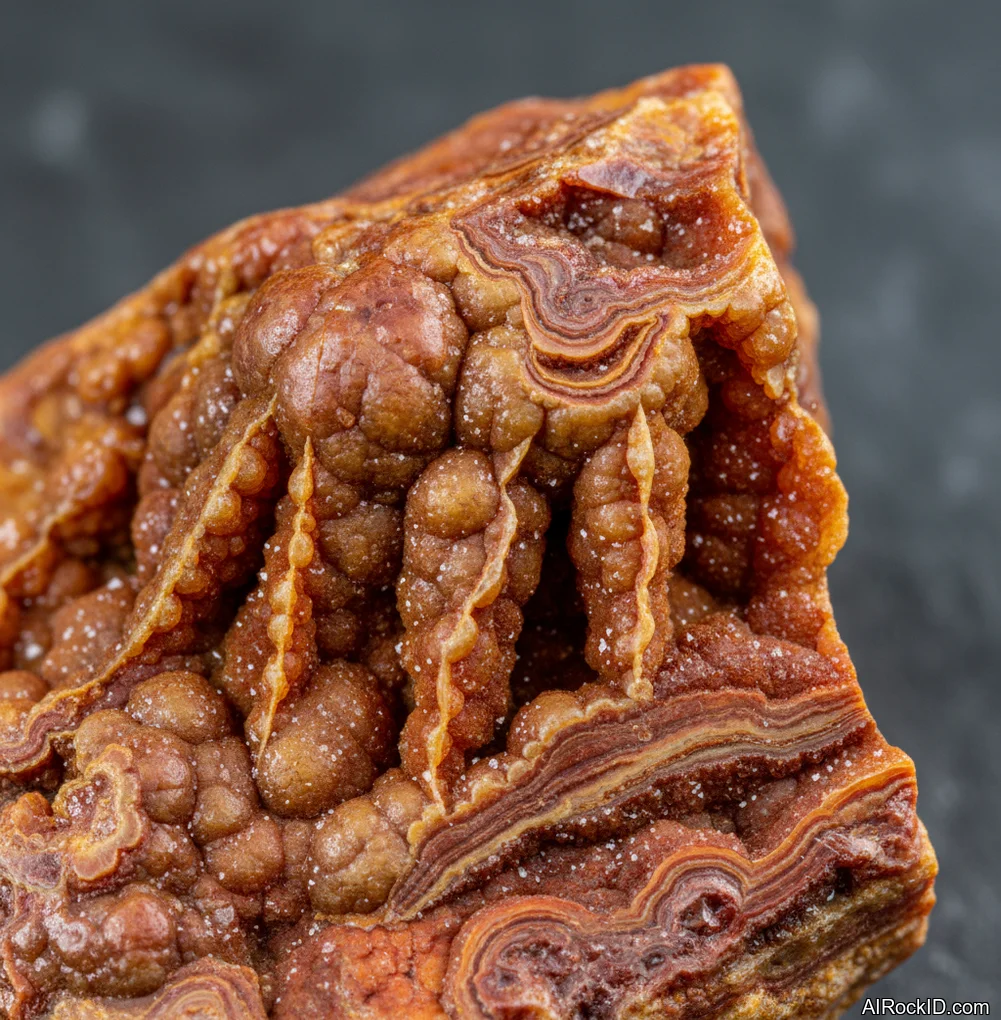
Magma Chalcedony


Quick answer: Magma Chalcedony is a patterned chalcedony variety valued for fiery red, orange, brown, gray, and black visual effects. Its appearance can overlap with jasper, agate, and dyed chalcedony, so identification should focus on waxy luster, translucency at thin edges, hardness, and pattern structure.
AI Rock ID can help compare a Magma Chalcedony photo against visually similar chalcedony, jasper, agate, and glass materials. RockIdentifier.io provides crystal identification support, but unusual color treatments or trade names may still require seller documentation or gemological testing.
Good fit
- Collectors who like flame-like red, orange, and black chalcedony patterns
- Buyers who want a quartz-family stone with good everyday durability
- People comparing natural chalcedony patterns with dyed or enhanced stones
- Beginners learning the visual differences between chalcedony, agate, and jasper
Not a good fit
- Anyone needing a formally standardized mineral species name rather than a trade or descriptive name
- Buyers who require untreated material without asking for disclosure from the seller
- Situations where exact origin, treatment status, or composition must be certified
Most commonly confused with
- Red Jasper: Usually more opaque and earthy, with less edge translucency than chalcedony.
- Fire Agate: Can show iridescent internal fire, while Magma Chalcedony is usually identified by colored patterning rather than optical play-of-color.
- Carnelian: Typically orange to reddish chalcedony with a more uniform translucent body color.
- Dyed Agate: May show overly saturated color concentrated in fractures, pores, or band edges.
Magma Chalcedony Lookalikes
| Material | Key Difference | Helpful Check |
|---|---|---|
| Magma Chalcedony | Waxy chalcedony with flame-like red, orange, brown, gray, or black patterns | Mohs about 6.5–7; may show slight translucency at thin edges |
| Red Jasper | More opaque and granular-looking in many pieces | Usually little to no edge translucency |
| Carnelian | More uniform orange to red body color | Often translucent through a larger area |
| Fire Agate | May display iridescent internal color layers | Look for optical fire rather than surface-like patterning |
| Dyed Agate | Color may appear unnaturally intense or concentrated | Check fractures, drill holes, and band edges for dye buildup |
AI identification confidence
AI identification confidence is usually moderate for Magma Chalcedony because the name is often based on appearance rather than a strict mineral classification. Clear photos in daylight, close-ups of edges, and images of both polished and rough surfaces improve results.
When AI gets it wrong
- Photos taken under warm lighting can exaggerate orange and red tones.
- Polished cabochons may hide fracture texture, dye concentration, or natural banding.
- Trade names can vary by seller, so the same material may be listed as jasper, agate, or chalcedony.
- Glass and resin imitations can look convincing in low-resolution images.
Final recommendation
Choose Magma Chalcedony by inspecting pattern quality, polish, durability needs, and treatment disclosure rather than relying on the trade name alone. For higher-priced pieces, ask for origin details, untreated status, and return options if identification is uncertain.
How to Check Authenticity Before Buying
Ask whether the stone is natural, dyed, stabilized, or sold under a trade name. Examine drill holes, cracks, and edges for concentrated color, which can indicate dye. A genuine chalcedony piece should feel hard and take a good polish, but appearance alone cannot prove treatment status.
Best Photos for Identification
Use sharp photos taken in indirect daylight on a neutral background. Include one full-stone image, one close-up of the pattern, and one edge photo showing translucency if present. Avoid heavy filters, flash glare, and colored lighting because they can change the apparent red and orange tones.
Trade Name and Labeling Notes
Magma Chalcedony is best understood as a descriptive or commercial name for chalcedony with volcanic-looking color patterns. Because naming practices vary, similar stones may be sold as magma agate, jasper, plume chalcedony, or fantasy agate. A precise label should be supported by mineral composition, appearance, and any treatment disclosure.
What Is Magma Chalcedony?
Magma Chalcedony is just a trade name for chalcedony, which is microcrystalline quartz (SiO2). The “magma” part comes from the fiery red, orange, and brown patterning you see in it, usually caused by iron-oxide staining in volcanic-hosted material.
Pick up a palm stone and you see it instantly. It’s got that smooth, slightly waxy chalcedony feel, the kind that almost grabs your skin a little when your fingers are dry, but then you get these smoky, ember-like streaks that look like they’re sitting under the surface. Some pieces run mostly gray with a few rusty little licks of color, and others look like someone stirred paprika into cloudy jelly (messy, but you get the idea).
People call it “magma” at first glance because it looks molten. But it’s still quartz doing quartz things. Most of what you’ll see for sale is tumbled or cut into cabochons. Raw chunks are out there too, but they usually don’t read as “flames” until you wet them or polish a face. Funny how big a difference a little water makes, right?
Origin & History
Most dealers are using “Magma Chalcedony” as a market label, not a formally defined mineral variety tied to one official type locality. I first started noticing it called that at gem shows in the 2010s, usually sitting in those plastic bins right beside the fancy agates and jasper.
Thing is, the name is basically a visual sales pitch: magma-ish swirls and ember colors. And depending on who’s selling it, that exact same material might get tagged as magma agate or even “fire chalcedony,” which gets messy fast. Why? Because true fire agate is a different look altogether, and it’s a different kind of botryoidal chalcedony with that play-of-color thing going on.
Where Is Magma Chalcedony Found?
It turns up in volcanic and basalt-associated chalcedony/agate deposits, especially where iron oxides can stain silica. A lot of the commercial material is sold without a tight locality tag.
Formation
Look at the pattern long enough and it starts reading like a little record of water pushing through rock. Chalcedony shows up when silica-rich water seeps into cavities, fractures, or vesicles in volcanic rock, then slowly turns to gel and hardens as time drags on. That “magma” vibe usually comes from iron oxides and hydroxides, like hematite and goethite, getting carried along or dropping out in pulses.
Next to banded agate, this material tends to come off swirly and kind of chaotic. And that’s your clue the silica didn’t settle into neat, even layers. It’s closer to repeated staining, partial filling, plus small chemistry shifts while the cavity was still open. I’ve cut rough where the outside is this dull brown skin (chalky, almost waxy under the fingers), but the second you grind a window into it, you hit translucent gray with a rusty, smoky bloom floating inside. Weirdly satisfying, right?
How to Identify Magma Chalcedony
Color: Typically translucent gray to smoky chalcedony with red, orange, brown, or black swirls, clouds, or streaks from iron-oxide staining. Some pieces grade into jaspery, more opaque areas.
Luster: Waxy to vitreous when polished.
Pick up a piece and feel the temperature. Real chalcedony stays cool in the hand longer than glassy imitations. If you scratch it with a steel needle, it won’t bite easily, but a quartz point will mark it. The problem with a lot of “magma” material is labeling, so ask whether it’s dyed; super-uniform neon orange with color pooled in cracks is a red flag.
Common Look-Alikes
Magma Chalcedony is sometimes confused with these materials:
- Carnelian (heated or dyed orange chalcedony)
- Red or orange agate
- Fire Quartz (hematoid quartz)
- Dyed gray or red agate slices
- Glass palm stones with embedded color
- Synthetic 'volcanic agate' from China
Market Cautions & Treatments
When AI Can Get This Wrong
AI photo ID gets tripped up by dyed agate and hematoid quartz, especially when the iron staining forms streaks. Fire quartz can look close, but check the texture: real Magma Chalcedony feels waxy and 'grippy,' not slick or glassy. A hardness test helps too—glass fakes scratch easier than real chalcedony.
Properties of Magma Chalcedony
Physical Properties
| Crystal System | Trigonal |
| Hardness (Mohs) | 6.5-7 (Hard (6-7.5)) |
| Density | 2.58-2.64 |
| Luster | Waxy |
| Diaphaneity | Translucent to opaque |
| Fracture | Conchoidal |
| Streak | White |
| Magnetism | Non-magnetic |
| Colors | gray, smoky gray, white, red, orange, brown, black |
Chemical Properties
| Classification | Silicates |
| Formula | SiO2 |
| Elements | Si, O |
| Common Impurities | Fe, Mn, Al |
Optical Properties
| Refractive Index | 1.530-1.543 |
| Birefringence | None |
| Pleochroism | None |
| Optical Character | Uniaxial |
Magma Chalcedony Health & Safety
Solid chalcedony is safe to handle, and it’s totally fine if it gets wet for a short time. The one thing I’d actually worry about? Silica dust, but only if you’re grinding or cutting it.
Safety Tips
If you’re going to work it like a lapidary, do it wet and keep water running right where the grit’s kicking up. And don’t skip ventilation either, because that fine dust hangs in the air longer than you think. Wear a proper respirator that’s actually rated for fine particulate (not just a flimsy mask).
Magma Chalcedony Value & Price
Price Range
Rough/Tumbled: $5 - $60 per piece
Cut/Polished: $2 - $15 per carat
Clean translucency plus that bold, flame-like patterning is what brings the money. And if the rough is locality-proven and it’s been cut into well-shaped cabs with real depth (you can see it down inside, not just a skin of color on top), expect the price to jump.
Durability
Durable — Scratch resistance: Good, Toughness: Good
It’s stable like most quartz, but rough edges can chip if you toss it in a pocket with keys.
How to Care for Magma Chalcedony
Use & Storage
Store it like you’d store any quartz cab or tumble: separate from softer stuff, and don’t let it rattle against glassy obsidian edges. A little cloth pouch goes a long way.
Cleaning
1) Rinse with lukewarm water and a drop of mild soap. 2) Use a soft toothbrush to clean around pits or druzy pockets. 3) Rinse well and dry with a microfiber cloth.
Cleanse & Charge
If you do ritual-style cleansing, running water or smoke works fine, and moonlight won’t hurt it. I skip harsh salt so it doesn’t get stuck in tiny surface pits.
Placement
Looks best where light can enter from the side, like a windowsill shelf that isn’t in full hot sun all day. On a dark stand, the orange tones read stronger.
Caution
Don’t toss it in an ultrasonic cleaner if you can see fractures, little pits, or there’s still matrix stuck on it. That buzzing can grab a weak spot and make it worse fast. And don’t heat it up to “bring out color.” Sounds tempting, sure, but it can open up fresh cracks or leave the surface looking kind of hazy, like the polish got knocked back.
Works Well With
Magma Chalcedony Meaning & Healing Properties
Plain gray chalcedony feels pretty neutral to me. But the “magma” stuff? People use it in a more wake-up-and-move kind of way. In my own stash, it’s the stone I grab when I’m stuck in the same mental rut and need a little push, without that sharp, buzzy edge I get from clear quartz points.
Hold a polished piece after you’ve been on your feet all day at a show and you notice the weight right away. It’s got this steady, grounded heft in your palm. Not dense like hematite, just… solid. Reassuring. That’s what a lot of folks are chasing with it: warmth plus structure. And look, I’ll say it plainly, none of this is medical. It’s not replacing sleep, food, or actual treatment.
If you’re sensitive to visual noise, you’ve gotta be picky. Some pieces are so busy they end up feeling distracting on a desk. The calmer ones (you know the type), with a few strong ember swirls in translucent gray, come off more soothing but still keep that little “spark” people want from the name.
Common mistakes
- Assuming every red-orange patterned stone is Magma Chalcedony without checking translucency or texture
- Confusing a seller trade name with a formal mineral species
- Overlooking dye signs around cracks, pits, and drilled bead holes
- Using color alone to separate chalcedony from jasper, agate, or glass
- Judging authenticity from a single polished product photo
Identify Magma Chalcedony from a photo
Compare Magma Chalcedony traits, care tips, value clues, and common lookalikes with a clear photo.