Midnight Lace Obsidian
What Is Midnight Lace Obsidian?
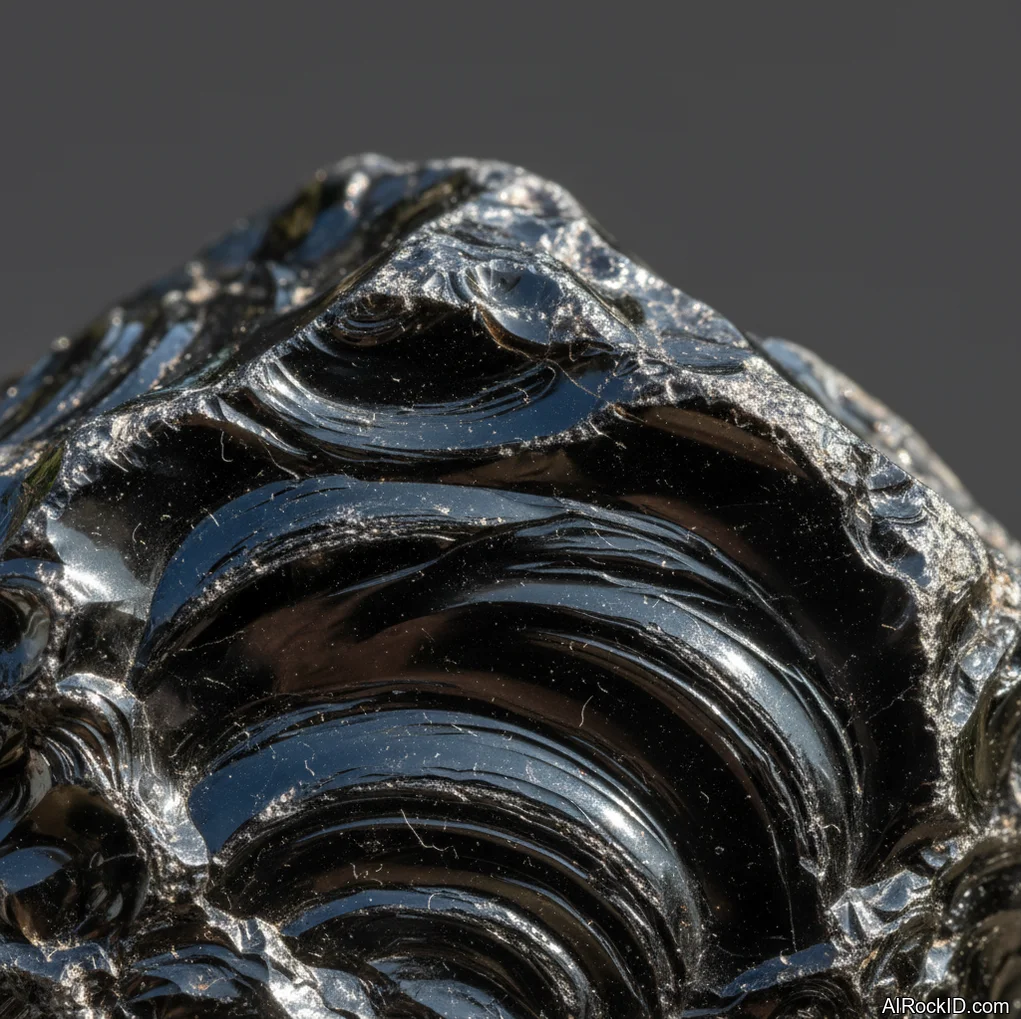
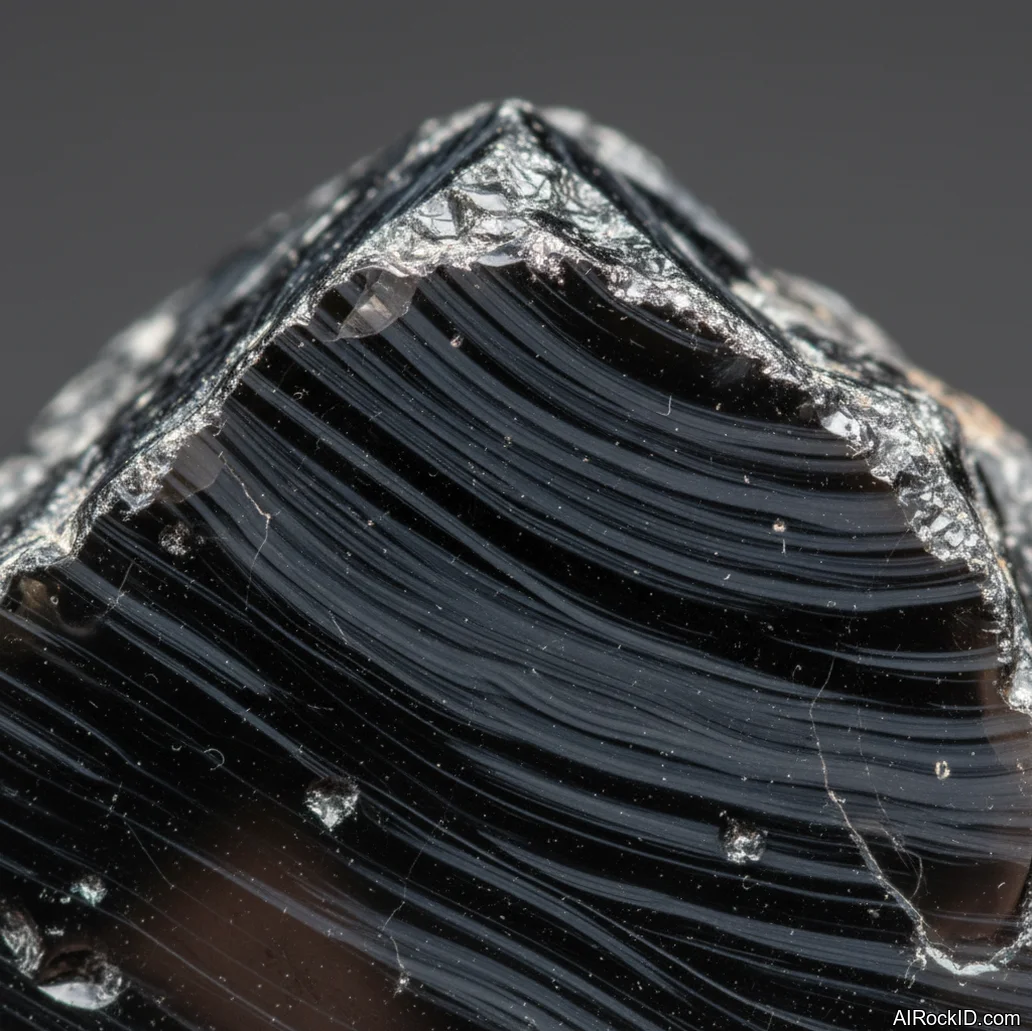
Midnight Lace Obsidian is a type of obsidian (volcanic glass) with lacey, flow-banded layers in black, charcoal, and smoky gray.
Pick up a palm stone and two things hit you fast. One, it’s colder than you’d think, like it clings to the room’s chill longer than most rocks. Two, the pattern isn’t just sitting on top like paint. Tip it under a lamp and the bands sort of drift in and out because you’re looking into glass, not a crystal with sharp faces.
People glance at it and go, “Oh, black obsidian.” But the lace is the whole point. Some pieces have tight, wispy banding, almost like woodgrain. Others show wider, hazy ribbons that look like smoke caught in the glass. And most of what you’ll see for sale is polished, since the raw material can pass for a plain dark lump until you hit it with water or catch that fresh, shiny break.
Origin & History
“Obsidian” as a word traces back to the Roman writer Pliny the Elder. He wrote about a glassy volcanic stone that was supposedly brought to Rome by a man named Obsidius. And that name ended up sticking to the material in general, even though obsidian shows up in plenty of volcanic regions and doesn’t rely on one special place.
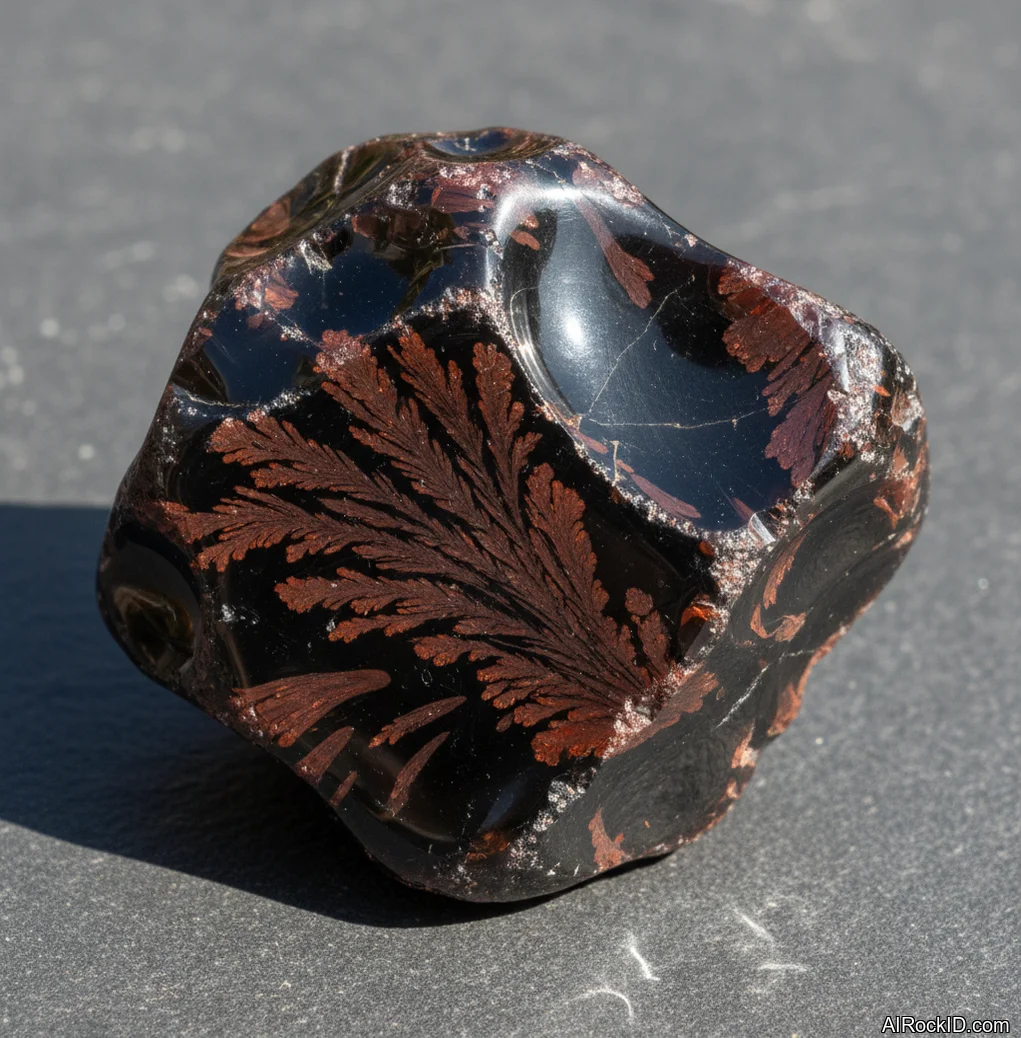
“Midnight Lace Obsidian,” though, is just a trade name, not an official geologic term. Sellers slap it on darker, higher-contrast flow-banded pieces, the kind where the gray bands really do look like lace sitting on a near-black base once it’s been cut and polished (you can see it most when the surface is smooth and glossy). You might run into the same kind of stone tagged as “lace obsidian” or “banded obsidian,” depending on who’s selling it.
Where Is Midnight Lace Obsidian Found?
Flow-banded obsidian shows up anywhere you get silica-rich lava that cools fast, with classic collecting localities in the western USA and Mexico.
Formation
Obsidian happens when silica-rich lava cools so fast the atoms never get a chance to line up into crystals. It’s like you slammed the brakes on a liquid right as it was trying to turn solid. No time to organize, so it locks in as glass.
That’s also why it snaps with that clean, shell-like conchoidal fracture. And yeah, the fresh edges can look (and feel) basically razor sharp.
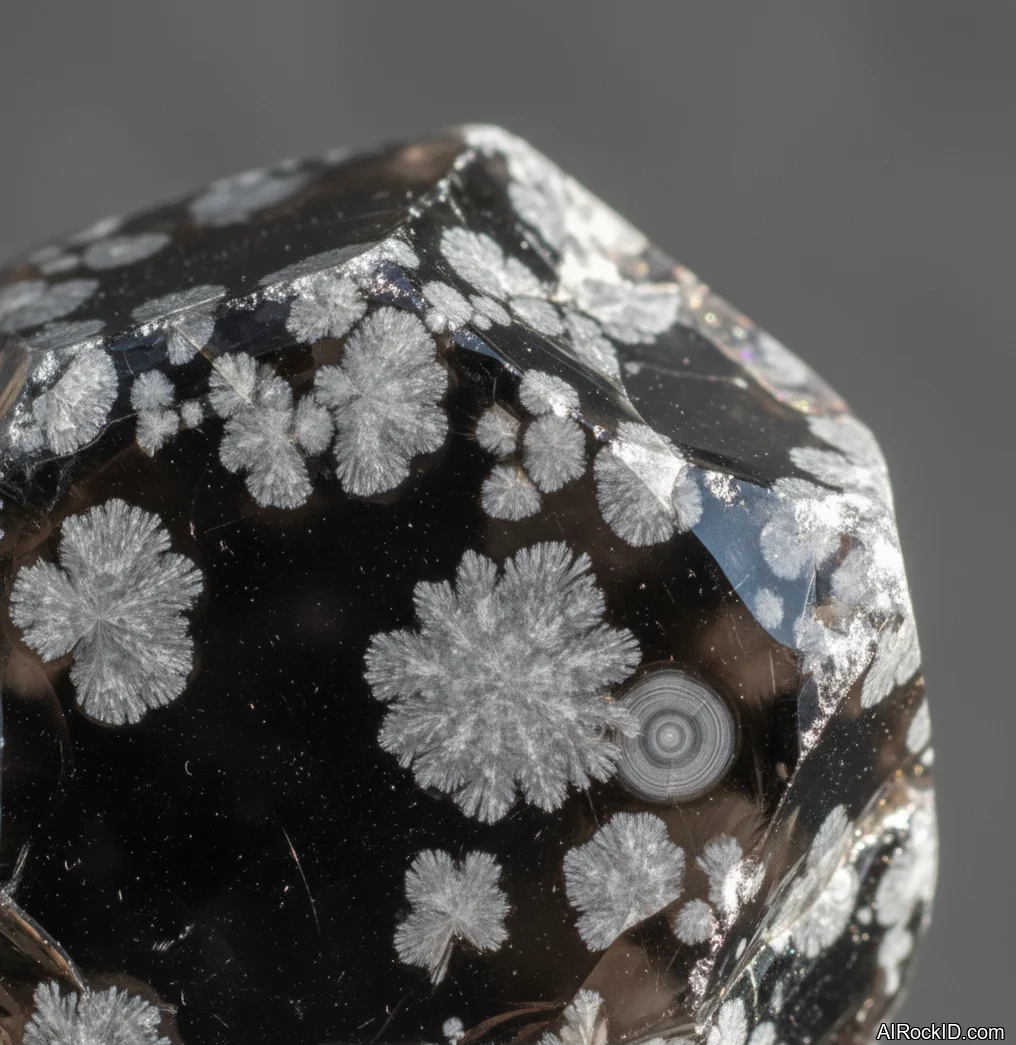
The “lace” banding people talk about is just flow banding. While the lava’s still moving, it stretches and folds zones that have slightly different compositions, bubble content, plus that fine little dusting of tiny crystals into layers. You can even catch the banding curling around small spherulites or trapped gas pockets if you look close.
Thing is, the surface tells on it. If you’ve ever held a piece where one side is weathered and the other side is freshly chipped, it’s kind of shocking. The weathered face goes dull and chalky. But the fresh glass? It looks like a wet black mirror.
How to Identify Midnight Lace Obsidian
Color: Mostly black to deep charcoal with smoky gray, silver-gray, or brownish-gray bands that look like lace, woodgrain, or flowing ribbons. Some pieces show subtle translucence on thin edges.
Luster: Vitreous, glassy luster when fresh or polished.
Look closely at a bright light reflection and you’ll see it behaves like glass, with a slick, mirror-like glare rather than the softer sheen you get on basalt. If you scratch it with a steel nail, it may mark, but a quartz point will bite in fast since obsidian sits around Mohs 5 to 5.5. The real test is the break: a tiny chip (don’t do this on a finished piece) shows curved, shell-like fracture surfaces that feel wicked sharp under a fingertip.
Properties of Midnight Lace Obsidian
Physical Properties
| Crystal System | Amorphous |
| Hardness (Mohs) | 5-5.5 (Medium (4-6)) |
| Density | 2.35-2.60 g/cm3 |
| Luster | Vitreous |
| Diaphaneity | Opaque to translucent |
| Fracture | Conchoidal |
| Streak | White to light gray |
| Magnetism | Non-magnetic |
| Colors | Black, Charcoal gray, Smoky gray, Brownish gray, Silver gray |
Chemical Properties
| Classification | Silicates |
| Formula | SiO2 |
| Elements | Si, O |
| Common Impurities | Fe, Mg, Ca, Na, K, Al, Ti, Mn |
Optical Properties
| Refractive Index | 1.48-1.51 |
| Birefringence | None |
| Pleochroism | None |
| Optical Character | Isotropic |
Midnight Lace Obsidian Health & Safety
Midnight Lace Obsidian is usually fine to handle, and it’s fine around water too. But if you cut it, grind it, or sand it, you’ll kick up a really fine dust that’s rich in silica. Freshly broken chips are no joke either. They can come off razor-sharp and nick your skin before you even notice.
Safety Tips
Wear eye protection and a proper P100 respirator anytime you’re shaping it. And do it wet if you can. Wet-grinding keeps the dust from puffing up into that nasty, floating cloud that ends up in your nose and on the bench. Treat any broken edges like broken glass, because that’s basically what they feel like. Sharp. Sneaky. The kind that’ll slice you before you even notice.
Midnight Lace Obsidian Value & Price
Price Range
Rough/Tumbled: $5 - $40 per tumbled/palm stone; $30 - $250 per polished slab or display piece
Cut/Polished: $1 - $8 per carat (cabochons, typical commercial material)
High-contrast, tight bands and a clean, glassy polish can jack the price up in a hurry. But if you’ve got fractures you can catch with a fingernail, a dull finish, or that muddy gray banding that just looks washed out, the value falls off hard, even when the chunk is big.
Durability
Moderate — Scratch resistance: Fair, Toughness: Fair
It’s stable in normal indoor conditions, but it chips on edges easily and shows scratches quicker than quartz-based stones.
How to Care for Midnight Lace Obsidian
Use & Storage
Store it where it won’t rub against harder stones like quartz or topaz. A simple cloth pouch keeps the polish from picking up those annoying hairline scuffs.
Cleaning
1) Rinse with lukewarm water and a drop of mild soap. 2) Wipe with a soft microfiber cloth, getting into any grooves in carved pieces. 3) Dry fully before putting it back in a pouch or display case.
Cleanse & Charge
For a non-fussy reset, rinse and then let it sit somewhere dark and dry overnight. If you use smoke cleansing, keep the piece moving so soot doesn’t haze the shine.
Placement
On a desk or shelf, it looks best where a single light source can rake across the surface and bring the banding out. If it’s near a window, rotate it sometimes so one side doesn’t stay dusty and dull.
Caution
Skip ultrasonic cleaners and anything seriously abrasive. Don’t just chuck it in your pocket rattling around with your keys (you know how that goes), and don’t leave sharp, raw edges sticking out where a kid or a pet can snag them.
Works Well With
Midnight Lace Obsidian Meaning & Healing Properties
Protection and grounding are the big ideas people pin on obsidian, and Midnight Lace is what they reach for when they want that feeling without the solid, flat black look. Look, what I see in real life is pretty straightforward. People grab it when they’re trying to feel steadier. And the banding helps, honestly, because your eyes can track those wavy lines in a way that’s weirdly soothing, kind of like watching rain crawl down a window.
On a rough day, if you pick up a polished piece, it hits your palm like a cold stone. Simple as that. You feel the weight right away, the slick surface, the chill that hangs on for a second before your hand warms it up (or tries to). That physical part matters more than most folks want to admit. It’s hard to spiral at full speed when your brain keeps getting pulled back to temperature, heft, and the way the light slides across that lace pattern when you tilt it.
Thing is, none of this is medical care. It won’t replace therapy, sleep, or actual treatment. But as something you fold into a routine, it works for a lot of collectors. And I’ve noticed the people who can’t stand those “mirror black” stones tend to do better with the lace variety, because it reads softer and less intense even though it’s still the same family of volcanic glass. Why does that matter? Because sometimes the look of the stone is the whole hurdle.
Identify Any Crystal Instantly
Snap a photo and get properties, value, care instructions, and healing meanings in seconds.