Snowflake Obsidian
What Is Snowflake Obsidian?
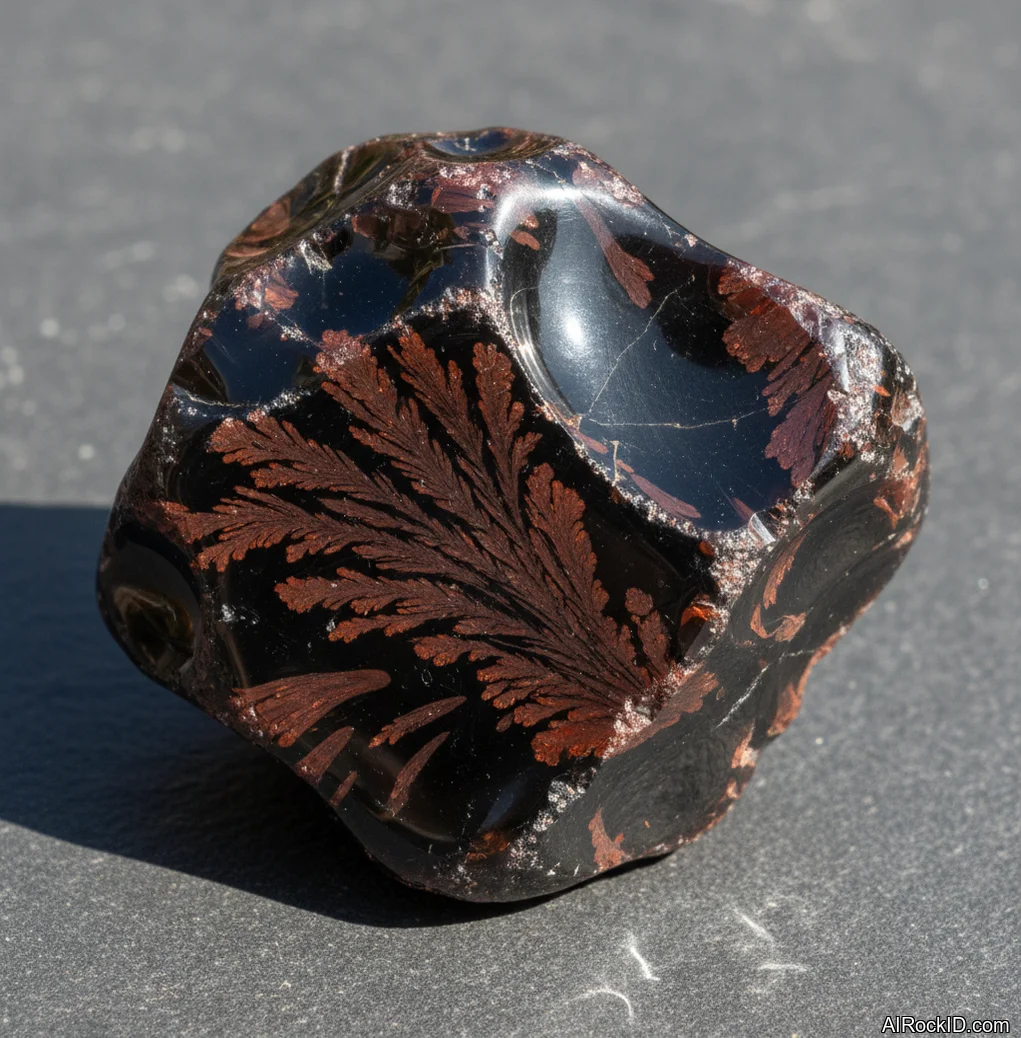
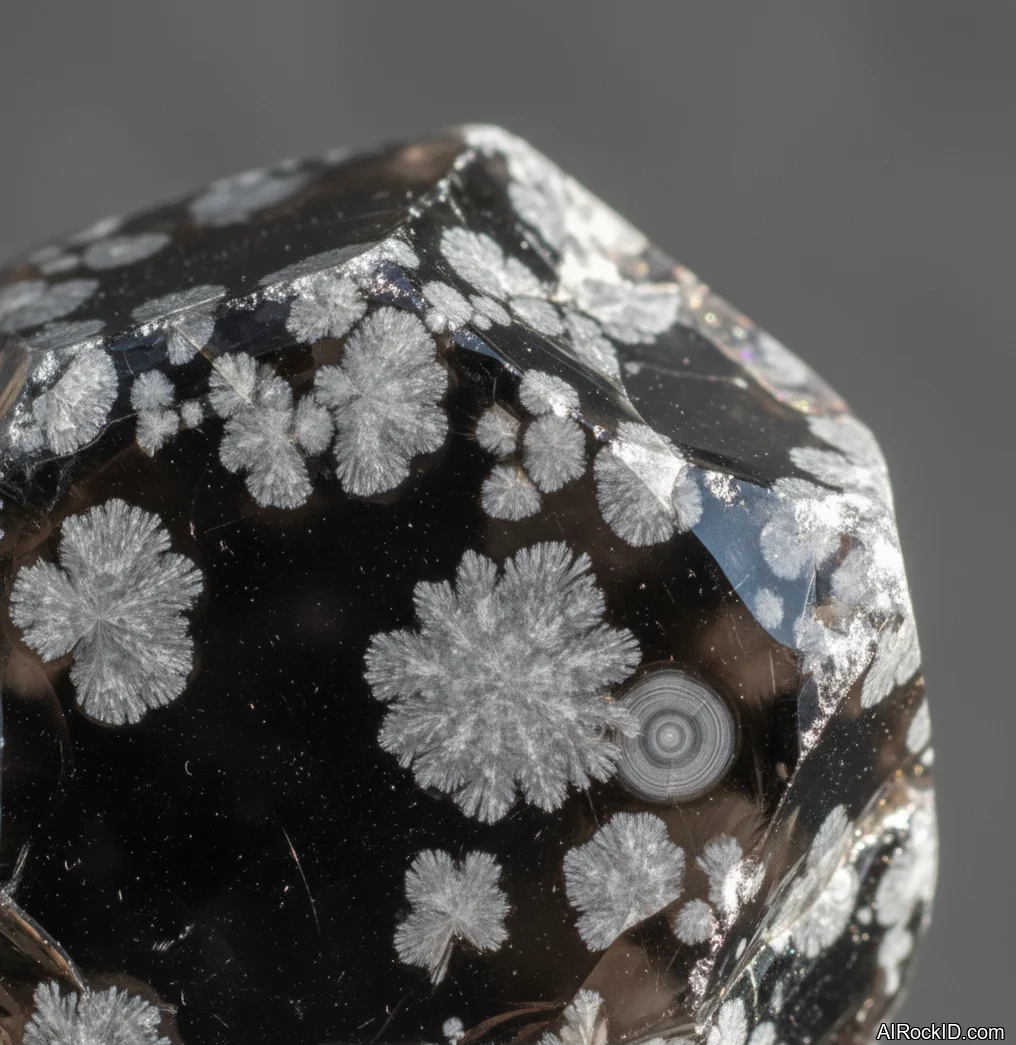
Snowflake Obsidian is a black volcanic glass (obsidian) with white to gray “snowflake” spherulites, typically cristobalite, scattered through it.
Pick up a palm stone and you notice it fast: that slick, glassy polish. It’s cool to the touch. But the white patches look oddly soft, like somebody dabbed pale paint into the black and then froze it there. The pattern isn’t some surface stain, either. It’s inside the glass, and when you tip it under a lamp, the flakes don’t budge while the glare slides around on top.
Most of what you’ll see for sale is tumbled, cabbed, or carved, because raw chunks are sharp. Really sharp. I’ve handled rough nodules where the edges were so fresh they’d catch your skin the way broken bottle glass does, and you feel that little tug before you even realize what happened. So I keep rough pieces wrapped (paper or cloth) instead of just tossing them loose in a tray.
Origin & History
Obsidian got used way before anyone bothered to formally describe it, mostly because it breaks in a way that leaves crazy sharp edges, the kind that’ll shave a sliver off your fingertip if you’re careless. That fracture is the whole trick.
The name “obsidian” usually gets traced back to Latin and an old story about someone called Obsidius who was tied to a similar stone, and that’s basically how the modern term ended up sticking in European writing. Not exactly glamorous, but names stick like that.
“Snowflake obsidian,” though, is just a trade name based on how it looks, not a separate mineral species. The little “snowflakes” are spherulites that formed when the glass cooled and devitrified in patches (you can usually feel those spots as slightly different under a fingernail if the surface is polished). Dealers have used the name forever because it sells the look instantly. Why explain what someone can see in two seconds? People spot it and they’re already there.
Where Is Snowflake Obsidian Found?
It shows up in volcanic regions where rhyolitic to dacitic lavas produced obsidian, with classic commercial material coming from the western United States and Mexico.
Formation
Obsidian shows up when silica-rich lava chills out so fast the atoms never get a chance to line up into proper crystals. It freezes mid-motion, basically. So instead of a neat crystal lattice, what you’re holding is volcanic glass, with that slick, almost bottle-like shine and edges that can feel scary-sharp if it’s freshly chipped. No crystal system, because there aren’t crystals.
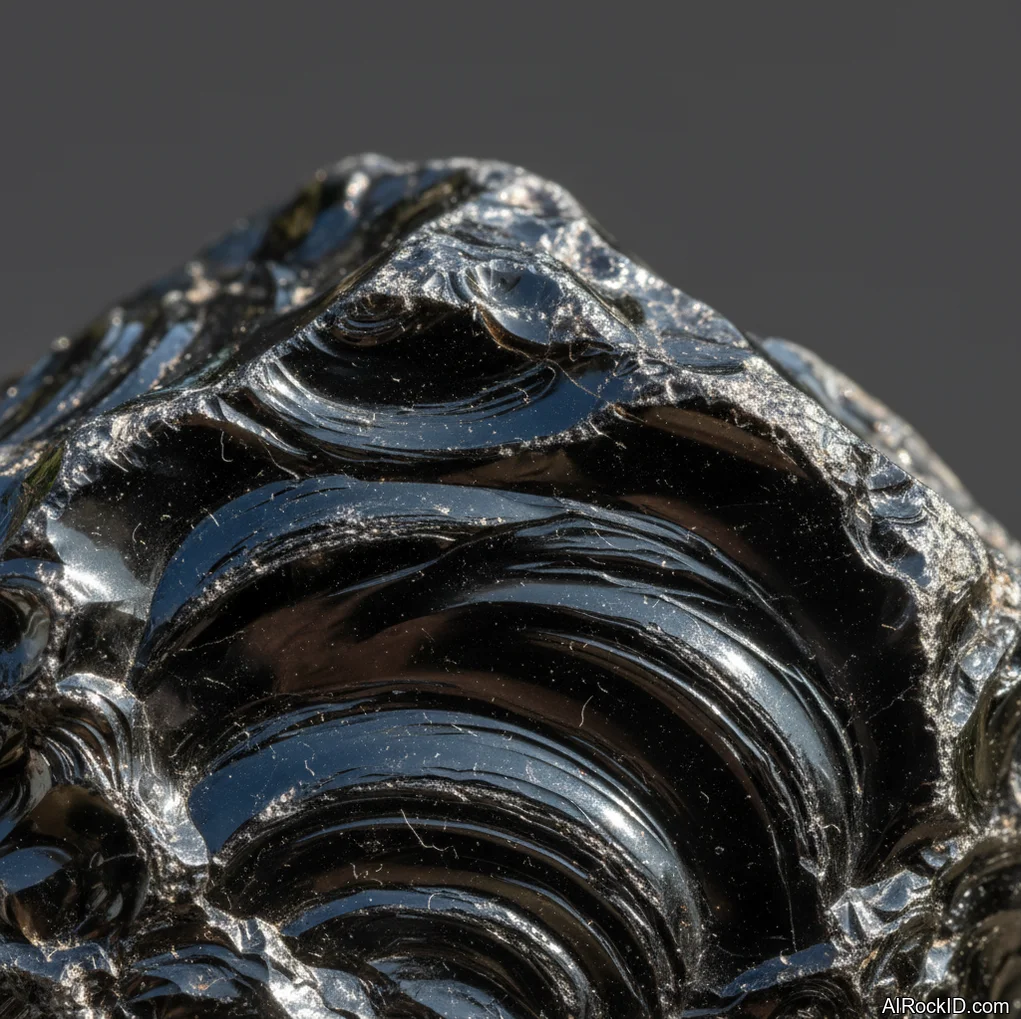
And that’s also why it breaks the way it does. When you snap it, you get that smooth, swooping conchoidal fracture, like curved shell ripples, not blocky faces.
Snowflake obsidian is a little different in the timing. The “snow” doesn’t form right at the instant the glass does. It shows up later, during cooling or even reheating, when tiny crystal bundles start growing inside the glass. Those little burst-looking clusters are called spherulites, and they’re commonly cristobalite, which is a silica polymorph.
Thing is, if you look closely, you can sometimes see zones where the flakes get thicker, then thin out again, or they’ll line up in faint bands (almost like someone dragged a brush through them). That usually matches how the lava was flowing or a shift in the cooling rate. And yeah, some pieces really do look like a full-on blizzard trapped in black glass, while others barely have a few flakes, more like scattered stars.
How to Identify Snowflake Obsidian
Color: Jet black to charcoal gray glass with scattered white to light gray snowflake-like spots or rosettes. The flakes are usually a few millimeters to over a centimeter across depending on the piece.
Luster: Vitreous, glassy luster when polished; dull to sub-vitreous on fresh breaks.
Look closely at the flakes in strong light: in real material they sit inside the glass, not on top, and they don’t smear or fade at the surface like paint or dye. The real test is the break surface on rough pieces: it should show classic conchoidal fracture and wicked sharp edges. And compared to black onyx or dyed agate, obsidian feels more like glass in the hand, with crisp reflections and a slightly “hard” slickness under your thumb.
Properties of Snowflake Obsidian
Physical Properties
| Crystal System | Amorphous |
| Hardness (Mohs) | 5-5.5 (Medium (4-6)) |
| Density | 2.35-2.60 g/cm3 |
| Luster | Vitreous |
| Diaphaneity | Opaque |
| Fracture | Conchoidal |
| Streak | White |
| Magnetism | Non-magnetic |
| Colors | Black, Gray, White |
Chemical Properties
| Classification | Silicates |
| Formula | SiO2 (dominant composition; volcanic glass with variable minor oxides) |
| Elements | Si, O |
| Common Impurities | Fe, Mg, Ca, Na, K, Al, Ti, Mn |
Optical Properties
| Refractive Index | 1.48-1.51 |
| Birefringence | None |
| Pleochroism | None |
| Optical Character | Isotropic |
Snowflake Obsidian Health & Safety
It’s safe to handle and it’s fine around water. But the edges can be rough, and some spots get sharp enough to nick your skin if you slide a finger along them. The real day-to-day risk is what happens if it breaks: it can chip, and those little flakes can come off razor-sharp.
Safety Tips
Wrap rough pieces up, or tuck them somewhere they can’t bang around against harder stones, and don’t carry raw chunks loose in your pocket (they’ll rattle and chip before you even notice).
Snowflake Obsidian Value & Price
Price Range
Rough/Tumbled: $5 - $60 per piece
Cut/Polished: $1 - $6 per carat
Price usually follows the pattern density, the contrast, and how clean the polish comes out. Big, clean spheres and carvings run higher because the rough has to start off thick and pretty fracture-free, or it’ll crack while you’re shaping it (and you can hear that ugly little “tink” when it goes).
Durability
Moderate — Scratch resistance: Fair, Toughness: Fair
It’s stable in normal household conditions, but it can chip on edges and doesn’t love hard knocks the way microcrystalline quartz does.
How to Care for Snowflake Obsidian
Use & Storage
Keep it in a pouch or a lined box if it’s polished, and wrap rough pieces so the edges don’t nick other stones. If you stack it with quartz points, the obsidian will usually be the one that comes out with little crescent chips.
Cleaning
1) Rinse with lukewarm water and a drop of mild soap. 2) Wipe with a soft cloth or microfiber and get into carvings with a soft toothbrush. 3) Rinse again and dry fully so water spots don’t dull the shine.
Cleanse & Charge
A quick rinse, smoke cleansing, or leaving it on a shelf away from direct sun all work fine. If you use salt, keep it dry and don’t grind salt against a polished face since it can leave tiny scratches.
Placement
On a desk it reads like a calm black-and-white pattern instead of a mirror, which is nice if you don’t want a super reflective stone. I like it near other matte stones because it can look overly glossy next to them.
Caution
Skip ultrasonic cleaners and steam, seriously. And don’t let it tumble onto tile or concrete. Keep an eye on bracelets and rings too, since the edges are where little chips tend to show up first.
Works Well With
Snowflake Obsidian Meaning & Healing Properties
Pick up a piece of snowflake obsidian and it just feels solid in your hand. Not some mystical lightning strike. More like the paperweight you keep on your desk so your notes don’t skate off when the window’s cracked.
When I’m sorting flats at a show and my brain’s toast, I’ll roll a tumbled piece between my thumb and finger. The surface stays cool like glass does, and you can feel those little raised “snowflakes” under your skin, kind of bumpy against the polish. It gives your hands something dumb and simple to do (which is honestly the point).
People tie obsidian to protection and “cutting through” mental clutter, mostly because of how it fractures and the fact it was used for blades. With the snowflake variety, the vibe folks talk about is calmer and more organized: black base, white islands. So in real life it usually comes out as grounding, taking a breath, and catching patterns in how you react to stuff. It’s not medical. It’s more like a reminder you can literally hold.
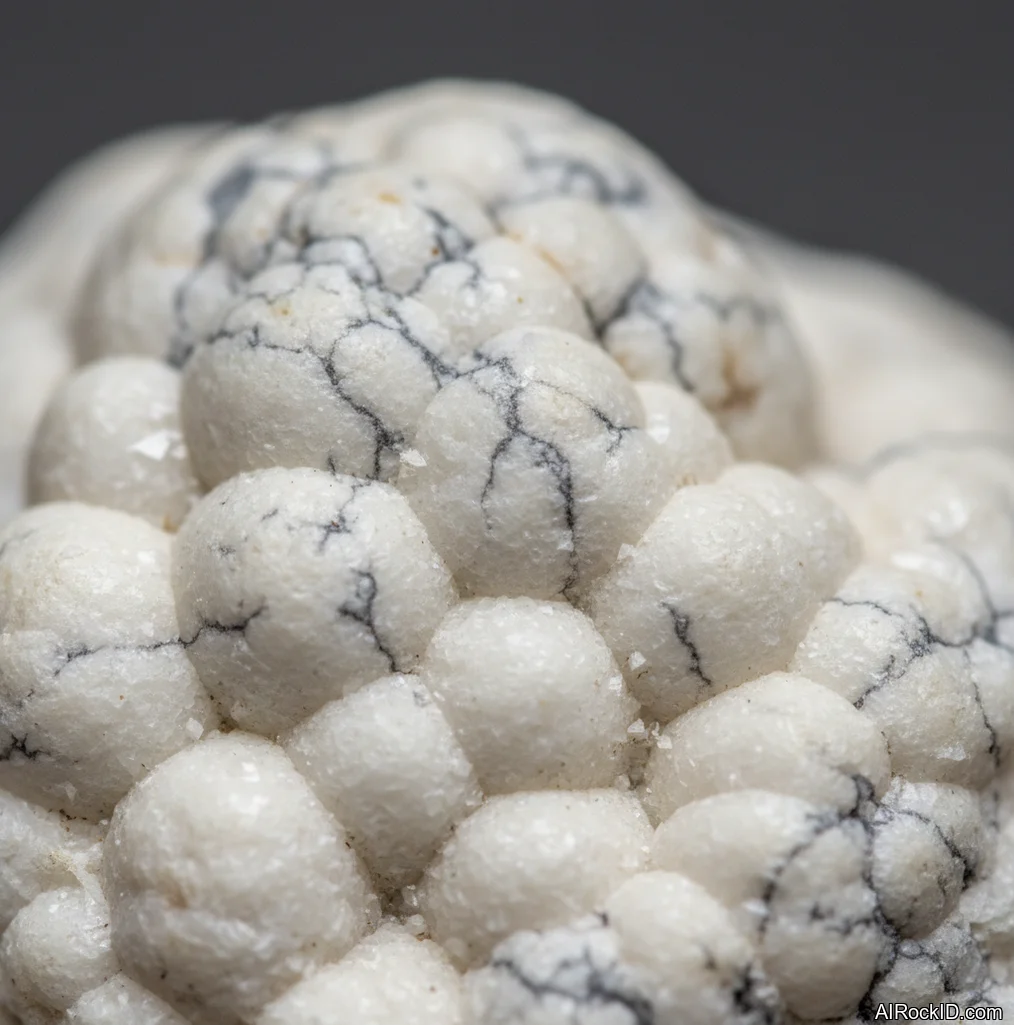
But there’s a catch that shops don’t always mention. Obsidian can feel intense for some people, even snowflake, because it’s still glass, and it still has that sharp, reflective feel just from how it looks and behaves. Want the same black-and-white look but softer in your hands? Howlite is often the move instead.
And if you’re picking it up for meditation, try a couple shapes first. A palm stone sits totally different than a point. Points in obsidian are often just carved glass, too, and the tip can chip if you tap it on anything. Ask me how I know.
Identify Any Crystal Instantly
Snap a photo and get properties, value, care instructions, and healing meanings in seconds.