Orca Agate


Quick answer: Orca Agate is a black-and-white banded variety of chalcedony, most often associated with Madagascar material sold as polished stones, slabs, and carvings. Its whale-like patterning is the main identifying feature, but similar black-and-white agates and dyed chalcedony can be confused with it.
AI Rock ID can help screen Orca Agate by checking visible banding, luster, color distribution, and chalcedony-like texture from a clear photo. RockIdentifier.io should be used as an identification aid rather than a substitute for gemological testing when value, origin, or treatment status matters.
Good fit
- Collectors who like high-contrast black, white, and gray banding
- Beginners looking for a durable polished stone for display or handling
- Buyers who prefer agate patterns over transparent gemstones
- People comparing Madagascar chalcedony varieties
- Jewelry users who want a hard, low-porosity stone when properly set
Not a good fit
- Anyone needing a transparent or faceted gemstone appearance
- Buyers who require certified geographic origin without lab documentation
- Situations where a stone may receive hard impacts, despite agate's good hardness
- People seeking medical benefits from a crystal
Most commonly confused with
- Banded Agate: General banded agate can show black-and-white layers, but it is not necessarily the Madagascar material sold as Orca Agate.
- Onyx: Onyx often has straighter, more uniform parallel bands, while Orca Agate usually shows more irregular, organic chalcedony patterns.
- Sardonyx: Sardonyx typically includes brown, red, or orange bands rather than the mostly black, white, and gray palette of Orca Agate.
- Zebra Jasper: Zebra Jasper is usually more opaque and rock-like, while Orca Agate has the waxy to vitreous polish and fine texture of chalcedony.
Orca Agate vs. Similar Black-and-White Stones
| Stone | Typical appearance | Key difference |
|---|---|---|
| Orca Agate | Black, white, and gray chalcedony bands or patches | Often sold as Madagascar agate with whale-like patterning |
| Onyx | Clean, parallel black-and-white bands | Bands are usually straighter and more uniform |
| Zebra Jasper | Opaque black-and-white striped rock | Less translucent and typically duller than polished agate |
| Dyed Agate | Strong artificial-looking black or colored zones | Color may gather in cracks, pits, or porous edges |
| Sardonyx | White bands with brown, red, or orange layers | Warmer colors are common |
AI identification confidence
AI identification confidence for Orca Agate is usually moderate when the stone is polished, well lit, and shows clear black-and-white chalcedony banding. Confidence is lower for close-up photos without scale, rough pieces, dyed material, or stones labeled by trade name rather than mineral species.
When AI gets it wrong
- A polished stone has black-and-white patterning but no visible chalcedony texture or banding.
- Lighting glare makes white bands look like fractures or artificial coating.
- The image shows only a small area, hiding the full pattern and translucency.
- The stone has been dyed or enhanced, making natural color distribution difficult to judge.
Final recommendation
Choose Orca Agate based on clear patterning, polish quality, and honest seller disclosure about treatments and origin. For higher-priced pieces, request additional photos, size and weight details, and any available documentation rather than relying only on the trade name.
How to Check Orca Agate Before Buying
Look for crisp but natural-looking black, white, and gray zones with a smooth waxy to vitreous polish. Ask whether the piece is natural, dyed, stabilized, or coated, especially if the black areas look unusually flat or the white areas appear stained. Photos in daylight, side views, and close-ups of pits or edges can reveal dye concentration or surface coating.
Orca Agate Treatments and Trade Names
Orca Agate is a trade name, not a separate mineral species; mineralogically, it is chalcedony in the agate family. Some agates are dyed or otherwise enhanced in the gem trade, so a seller's description should distinguish natural patterning from treated color. A geographic claim such as Madagascar origin is difficult to verify from appearance alone.
Photo Tips for Identifying Orca Agate
Use bright indirect light and include the whole stone, a close-up, and a side view. A photo next to a coin or ruler helps show scale, while a shot of a thin edge may show the slight translucency expected in chalcedony. Avoid heavy filters because they can make gray bands look blue, black, or artificially sharpened.
What Is Orca Agate?
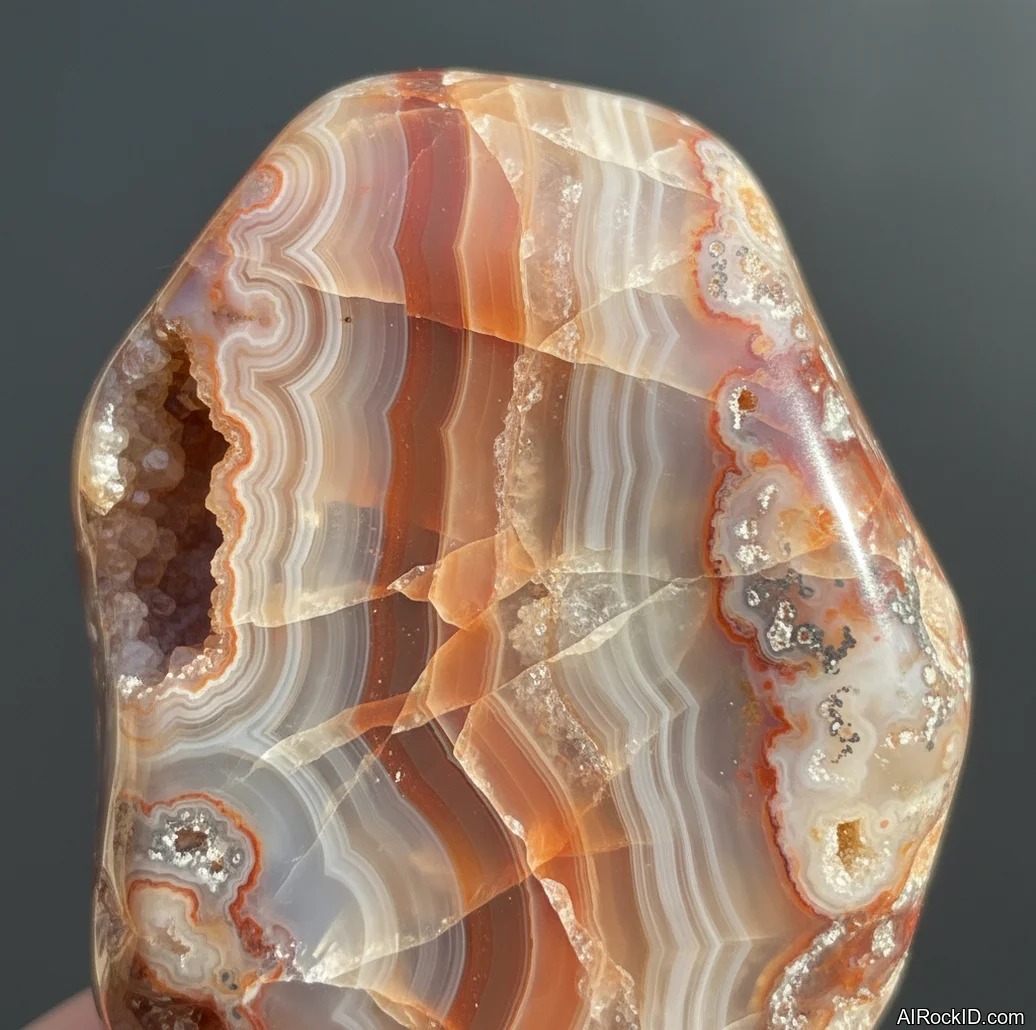
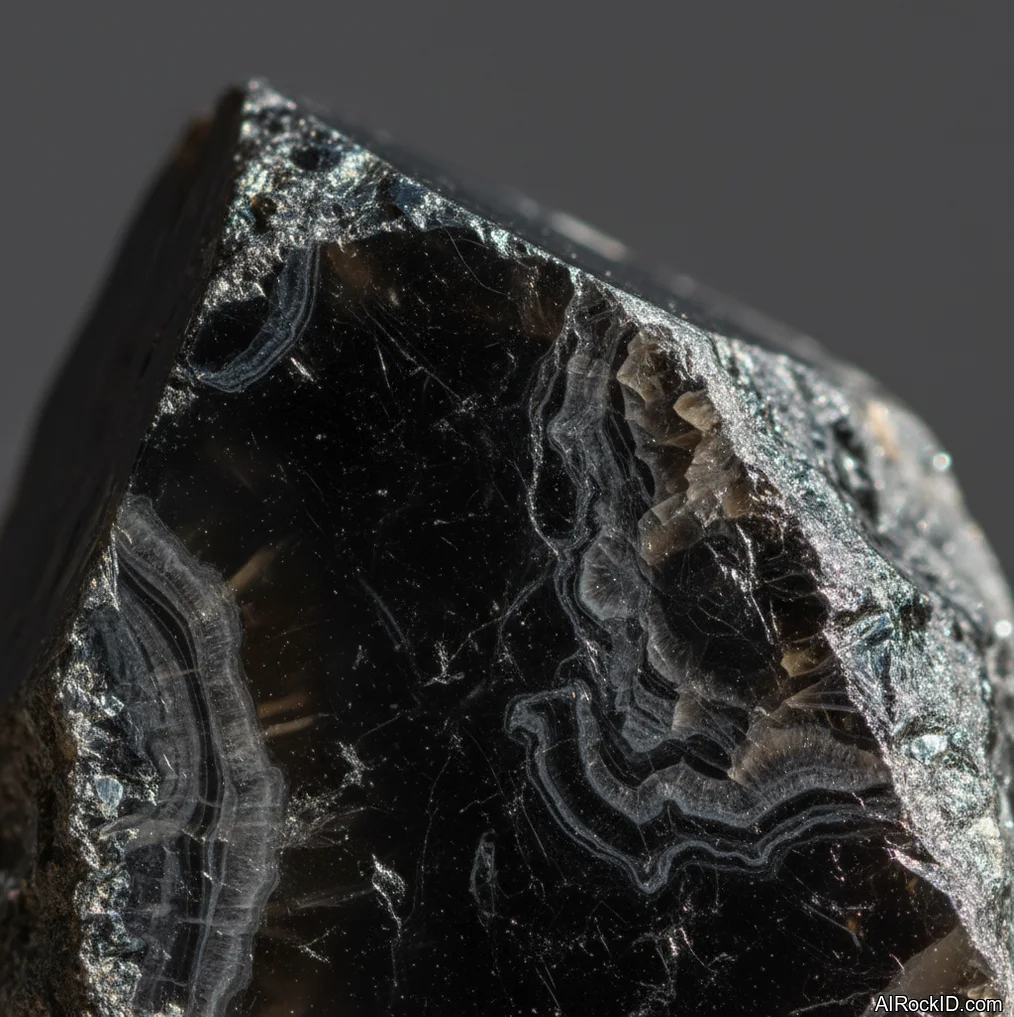
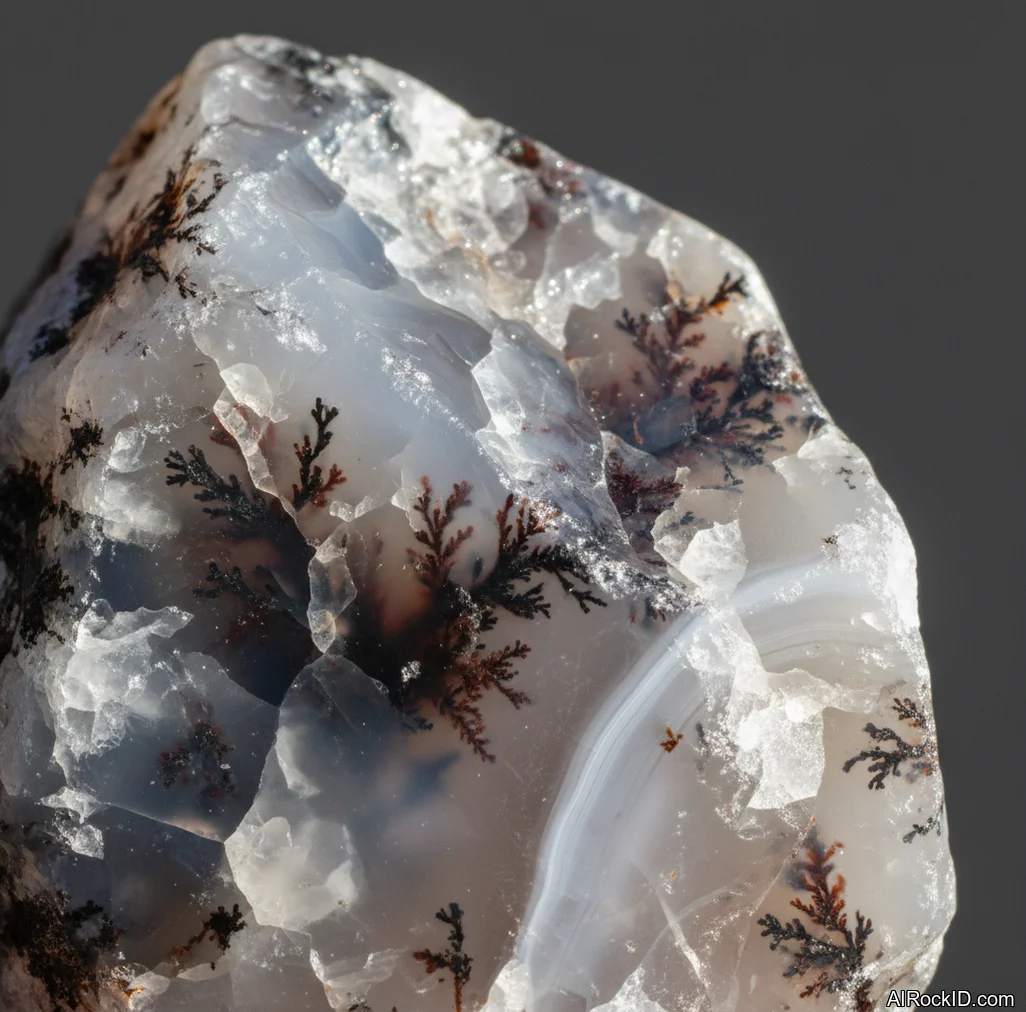
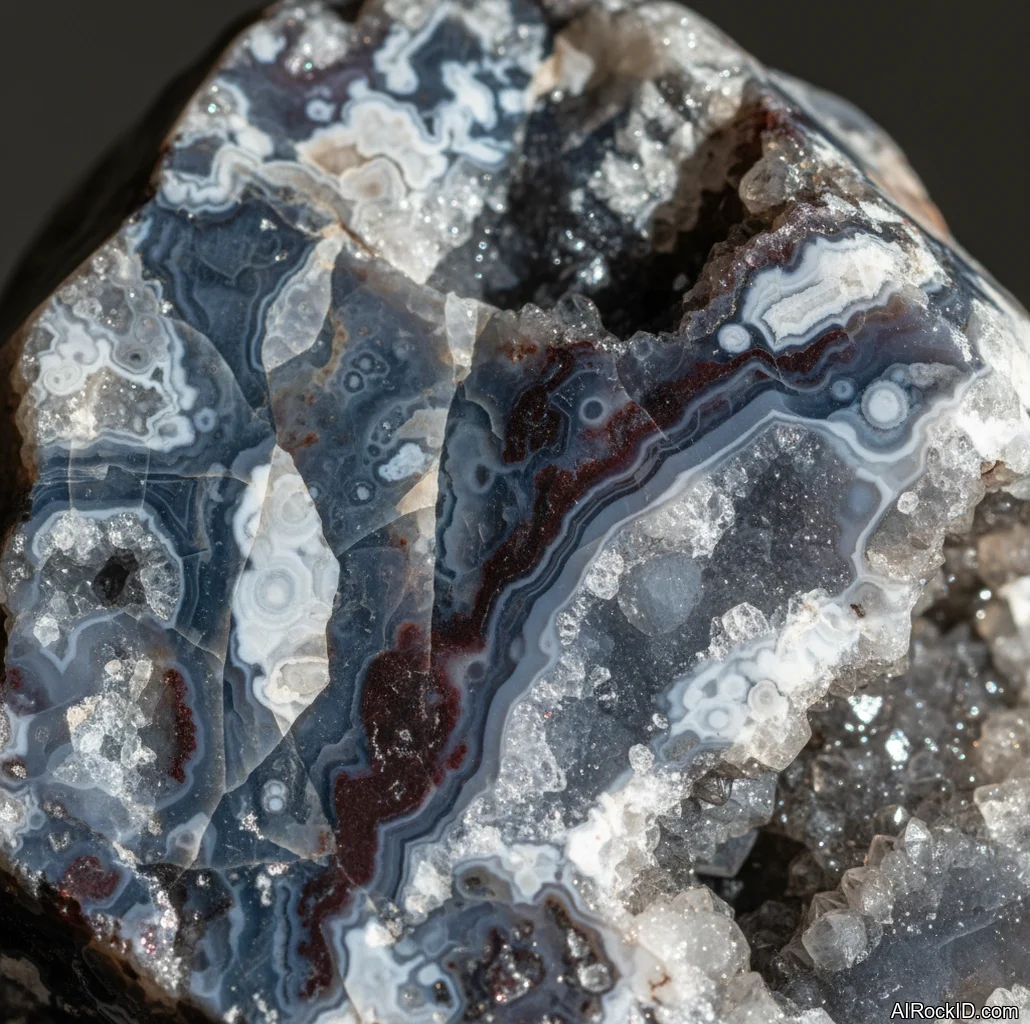
Orca Agate is a black, gray, and white banded chalcedony (agate) people trade for those patterns that honestly look like orca whales or stormy sea foam. Most pieces you run into are polished, since the pattern shows up best with a shine, but I’ve handled a few rough chunks where the bands don’t really show until you splash a little water on the surface and, all of a sudden, the whole thing wakes up.
Grab a palm stone and you feel it immediately. Smooth, but with that slightly “grippy” agate polish that catches your skin just a bit. Cool at first touch. The bands look like someone painted them on, but they didn’t. And the pattern swings all over the place from piece to piece. Some are inky black with thin white ribbons, while others lean smoky gray with big cloudy patches that kind of glow at the edges when you hold them up to a lamp (I’ve done that more times than I’ll admit).
Origin & History
Orca Agate isn’t some old museum label. It’s a trade name, and it really only caught on once that banded black-and-white agate from Madagascar started popping up in the late 2010s and early 2020s. Dealers saw the “orca” vibe right away and pushed it hard. And honestly, it stuck because you can spot those black-and-white bands from across the room, even under bad shop lighting.
The material itself is chalcedony, so it’s in the same family as Botswana agate and lace agate. People will also call it “Orca jasper,” but that’s basically store language. Jasper’s usually opaque and kind of grainy, while this behaves like agate and chalcedony when you cut it, run it on the wheels, polish it up, and hold it to the light to see what it’s doing. Why call it jasper, then? Because it sells, I guess.
Where Is Orca Agate Found?
Commercial Orca Agate on the market is sourced from Madagascar, with material coming out of the northern and northwestern regions in mixed chalcedony agate deposits.
Formation
Most agate gets going the same way. Silica-rich fluids slip through cracks and little cavities, then they drop off one thin layer after another until the whole space is packed tight. In volcanic ground, those cavities are often old gas bubbles trapped in basalt. But you’ll also see silica plugging fractures where the rock bent, popped open, and left just enough room for the fluid to move in.
If you stare at Orca Agate up close, the banding basically keeps a record of how it grew. Some bands look razor-sharp. Others go hazy, almost like someone smudged them with a thumb. And some pieces have tiny drusy pockets where the very last bit of silica finished up as micro quartz (you can catch that little sugar-sparkle when you tilt it under a light). But here’s the thing: the black isn’t some magical mineral swap. It’s usually tiny inclusions and impurities that darken parts of the chalcedony while it’s forming.
How to Identify Orca Agate
Color: Mostly black, charcoal, gray, and white with banding or cloud-like patches; some pieces show translucent gray edges when backlit.
Luster: Waxy to vitreous when polished, more dull and chalky in rough.
Pick up a real piece and it stays cool in your hand longer than glassy fakes, and the bands look “inside” the stone instead of printed on the surface. If you scratch it with a steel nail, it shouldn’t bite easily, but a quartz point will leave a mark because it’s basically the same hardness. The problem with dyed agate is the color tends to pool along tiny cracks and pits, so check holes and edges with a loupe.
Common Look-Alikes
Orca Agate is sometimes confused with these materials:
- Botswana Agate (gray/white banded agate, often sold side-by-side with “orca” style pieces)
- Black Onyx / banded black chalcedony (especially when the white bands are thin and the body is very dark)
- Zebra Jasper (banded black-and-white jasper that looks similar in photos but is more opaque and grainy up close)
- Dyed banded agate (gray agate pushed to inky black; dye can make the “orca” contrast look too sharp)
- Man-made black-and-white glass (lampwork or cast “agate” with swirly bands and a too-perfect gloss)
Market Cautions & Treatments
When AI Can Get This Wrong
At first glance, phone cams tag Orca Agate as Botswana agate, black onyx, or zebra jasper because all three read as gray-and-white stripes with a dark base. The real test is texture and translucency: shine a small flashlight through a thin edge, Orca Agate will glow a bit in the lighter bands, while zebra jasper stays stubbornly opaque and grainier. If the photo shows perfect, high-contrast bands with no depth, AI also miscalls glass, so check for bubbles and that warm-to-the-touch feel in person.
Properties of Orca Agate
Physical Properties
| Crystal System | Trigonal |
| Hardness (Mohs) | 6.5-7 (Hard (6-7.5)) |
| Density | 2.58-2.64 g/cm3 |
| Luster | Waxy |
| Diaphaneity | Translucent to opaque |
| Fracture | Conchoidal |
| Streak | White |
| Magnetism | Non-magnetic |
| Colors | Black, Gray, White, Charcoal, Smoky gray |
Chemical Properties
| Classification | Silicates |
| Formula | SiO2 |
| Elements | Si, O |
| Common Impurities | Fe, Mn, C |
Optical Properties
| Refractive Index | 1.530-1.543 |
| Birefringence | 0.009 |
| Pleochroism | None |
| Optical Character | Uniaxial |
Orca Agate Health & Safety
Orca Agate isn’t toxic, so you can handle it without worrying. And once it’s polished and finished, it’s totally fine if it gets splashed or sits near water. But don’t start grinding or sanding it in open air with no dust control, because that fine powder goes everywhere (you’ll see it settle on the bench and even on your fingertips). Why breathe that stuff in?
Safety Tips
If you’re going to cut or polish it, keep it wet and put on a real respirator that’s actually rated for silica dust. And for day-to-day handling, don’t just chuck it in a pouch with diamonds or corundum, because it’ll come out with little scuffs all over it.
Orca Agate Value & Price
Price Range
Rough/Tumbled: $10 - $80 per piece
Cut/Polished: $1 - $8 per carat
Price mostly follows the pattern first: how sharp the bands look and how much the black pops against the white. Then it’s size, and then how clean the polish came out. Big pieces that have that crisp, high-contrast banding and a face that doesn’t show pits (you know, those tiny pinholes you can feel if you run a fingernail over them) get expensive fast.
Durability
Durable — Scratch resistance: Good, Toughness: Good
It’s stable in normal conditions, but like most chalcedony it can take a dull spot if it gets dragged around with harder stones in a pocket or bowl.
How to Care for Orca Agate
Use & Storage
Store it in a soft pouch or a separate compartment so the polish doesn’t get hazed by harder gems. I don’t leave mine rolling around in a dish with quartz points for that reason.
Cleaning
1) Rinse with lukewarm water and a drop of mild soap. 2) Use a soft toothbrush to clean pits and edges, then rinse well. 3) Pat dry with a microfiber cloth and let it air-dry fully before storing.
Cleanse & Charge
If you’re into energetic care, water rinse or smoke cleansing works fine, and moonlight is gentle. I skip salt so it doesn’t crust up in tiny cavities.
Placement
A desk or nightstand is where I notice it most, because the banding reads well under a lamp. Backlighting near a window can bring out the smoky translucent zones, but don’t bake it on a hot sill.
Caution
Skip harsh chemicals, ultrasonic cleaners, or anything that gets really hot. And don’t use saltwater if the piece has tiny pits or those drusy, sugar-grain-looking spots, because the salty stuff can sink in and get stuck there.
Works Well With
Orca Agate Meaning & Healing Properties
People usually grab Orca Agate when they want something that reads calm without going full pastel. In my own pile, it’s the stone I reach for when my head feels noisy, mostly because those black-and-white bands give my eyes a steady place to park. That’s it.
A lot of people who use it in a metaphysical way tie it to grounding and emotional steadiness, in the same general lane as other black-and-white stones. But it’s not a sedative disguised as a rock. Some days it’s just a cool palm stone with that satisfying, solid heft, and the smooth polish feels almost slick at the edges. And that’s fine. If you’re dealing with anxiety or sleep problems, crystals should be a support tool, not the plan.
One collector reality check, though. You’ll see tons of Orca Agate sold as perfectly matched sets, and sure, some are totally legit. But the pattern can also be “curated” by slicing one nodule into a bunch of similar faces, so everything lines up and looks like it was meant to be together. Nothing wrong with that (it’s smart cutting), just don’t pay a rare-stone premium for something that’s basically good polish and clever slicing. Who wants to overpay for that?
Common mistakes
- Assuming every black-and-white agate is Orca Agate
- Treating a trade name as proof of Madagascar origin
- Ignoring possible dye when color is very intense or concentrated in cracks
- Confusing opaque jasper with fine-grained chalcedony
- Judging authenticity from a single filtered seller photo
- Expecting every piece to show a perfect whale-like pattern
Identify Orca Agate from a photo
Compare Orca Agate traits, care tips, value clues, and common lookalikes with a clear photo.