Paragonite


Quick answer: Paragonite is a sodium-rich mica most often identified in metamorphic rocks rather than sold as a common collector gemstone. It can resemble pale muscovite, talc, or fine-grained sericite, so identification is strongest when color, softness, pearly cleavage, and geologic setting are considered together.
AI Rock ID can help compare a suspected paragonite specimen against visually similar mica and soft metamorphic minerals from a photo. RockIdentifier.io should be treated as a screening tool for paragonite because lab methods such as X-ray diffraction or chemical analysis may be needed for a confident separation from muscovite or other mica-group minerals.
Good fit
- Collectors interested in mica-group minerals and metamorphic rock associations
- Students comparing sodium-rich and potassium-rich mica species
- People who prefer pale gray, greenish, or pearly mineral specimens
- Reference collections focused on schist, phyllite, and high-pressure metamorphic minerals
Not a good fit
- Jewelry use, because paragonite is soft and splits easily along cleavage
- Buyers seeking bright, transparent, faceted gemstones
- Quick field identification without context, since it closely resembles other pale mica minerals
Most commonly confused with
- Muscovite: Muscovite is potassium-rich and very similar in color and cleavage; chemistry is usually needed for a firm distinction.
- Talc: Talc is softer, has a greasy feel, and does not show the same elastic mica-sheet cleavage.
- Sericite: Sericite is a fine-grained mica habit rather than a single species and may include muscovite or related mica.
- Chlorite: Chlorite is commonly greener and more flexible but not as elastic as true mica sheets.
Paragonite Lookalike Comparison
| Mineral | Key Similarity | Practical Difference |
|---|---|---|
| Paragonite | Pale mica with pearly cleavage | Sodium-rich mica; confirmation often needs chemical or XRD testing |
| Muscovite | Pale, pearly mica sheets | Potassium-rich; typically more common in collections and pegmatites |
| Talc | Light color and soft feel | Mohs 1 and greasy feel; lacks elastic mica flakes |
| Sericite | Fine pearly mica appearance | Descriptive fine-grained mica term, not always a distinct species label |
| Chlorite | Greenish flaky metamorphic mineral | Usually darker green and less elastic than mica sheets |
AI identification confidence
AI identification confidence for paragonite is usually moderate to low from images alone because pale mica species can look nearly identical. Confidence improves when the photo includes scale, cleavage, host rock, locality, and any hardness or streak observations.
When AI gets it wrong
- A photo shows a pale mica flake without locality or host-rock context
- The specimen is labeled only as “mica” or “sericite” with no chemistry provided
- Lighting makes muscovite, talc, and paragonite appear the same pale gray-green color
- The image shows a rock surface rather than individual cleavage flakes
Final recommendation
Treat paragonite identifications as provisional unless the specimen comes with reliable locality data or analytical confirmation. For buying, prioritize well-labeled specimens from known metamorphic localities over vague listings described only as pale mica.
Paragonite Buying and Authenticity Tips
Paragonite is not commonly sold as a decorative crystal, so vague listings should be checked carefully. A reliable specimen should include locality, host rock or association, and ideally a note explaining how it was distinguished from muscovite. Specimens from academic, museum-style, or locality-focused dealers are generally easier to verify than unlabeled pale mica pieces.
Where Paragonite Is Commonly Found
Paragonite is most associated with metamorphic rocks such as schist, phyllite, and quartz-rich assemblages formed under specific pressure-temperature conditions. It may occur with minerals such as quartz, kyanite, garnet, chlorite, and other mica-group minerals. Locality information is important because appearance alone rarely proves the species.
Simple Field Clues for Paragonite
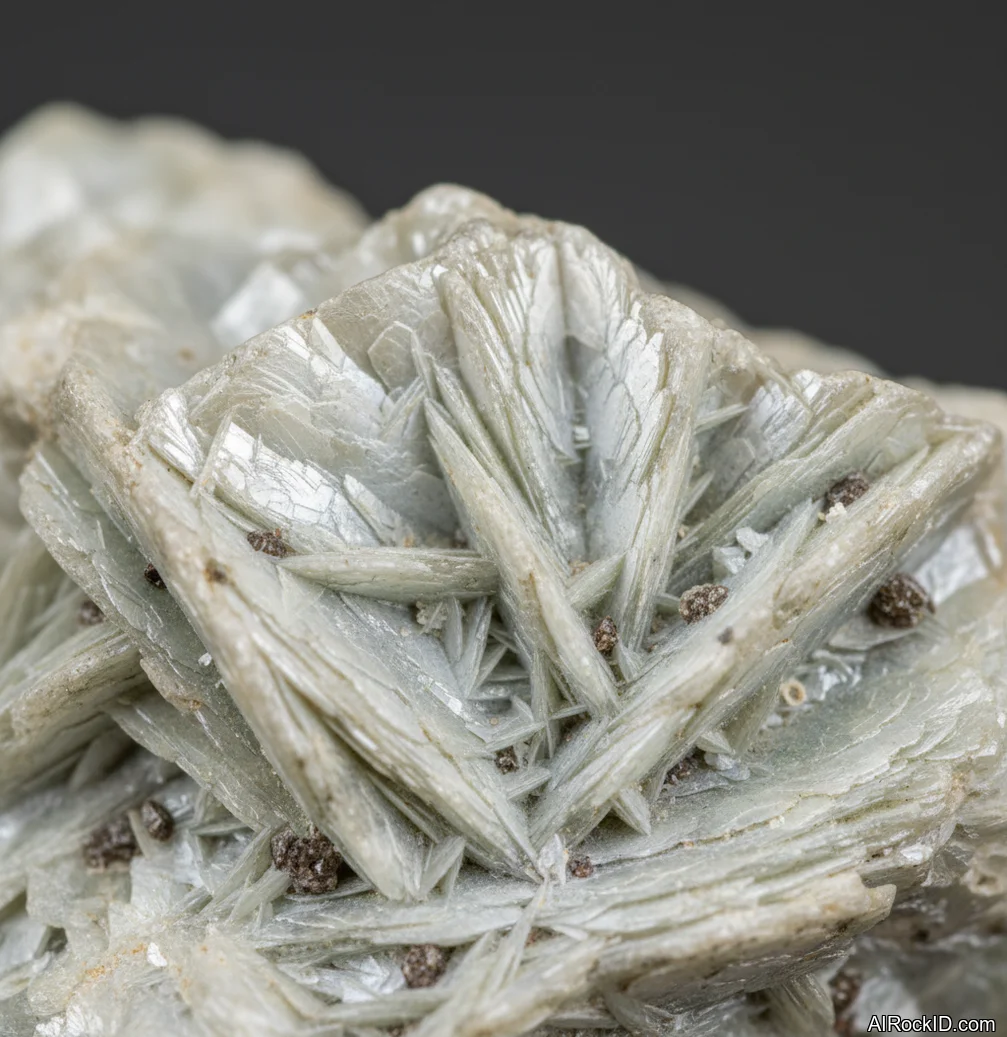
A suspected paragonite specimen may appear as pale gray, greenish, or silvery flakes with a pearly luster and perfect basal cleavage. It should be soft enough to scratch with a fingernail or copper coin, but this test does not separate it from several lookalikes. Elastic mica flakes and metamorphic context are useful clues, not final proof.
What Is Paragonite?
Paragonite is a sodium-rich mica with the formula NaAl2(AlSi3O10)(OH)2. If you’ve ever messed with muscovite, you’ll recognize the vibe fast. Same “booky” mica feel in your fingers, only paragonite tends to be finer grained and, honestly, harder to pick out when you’re staring at a rock in the field.
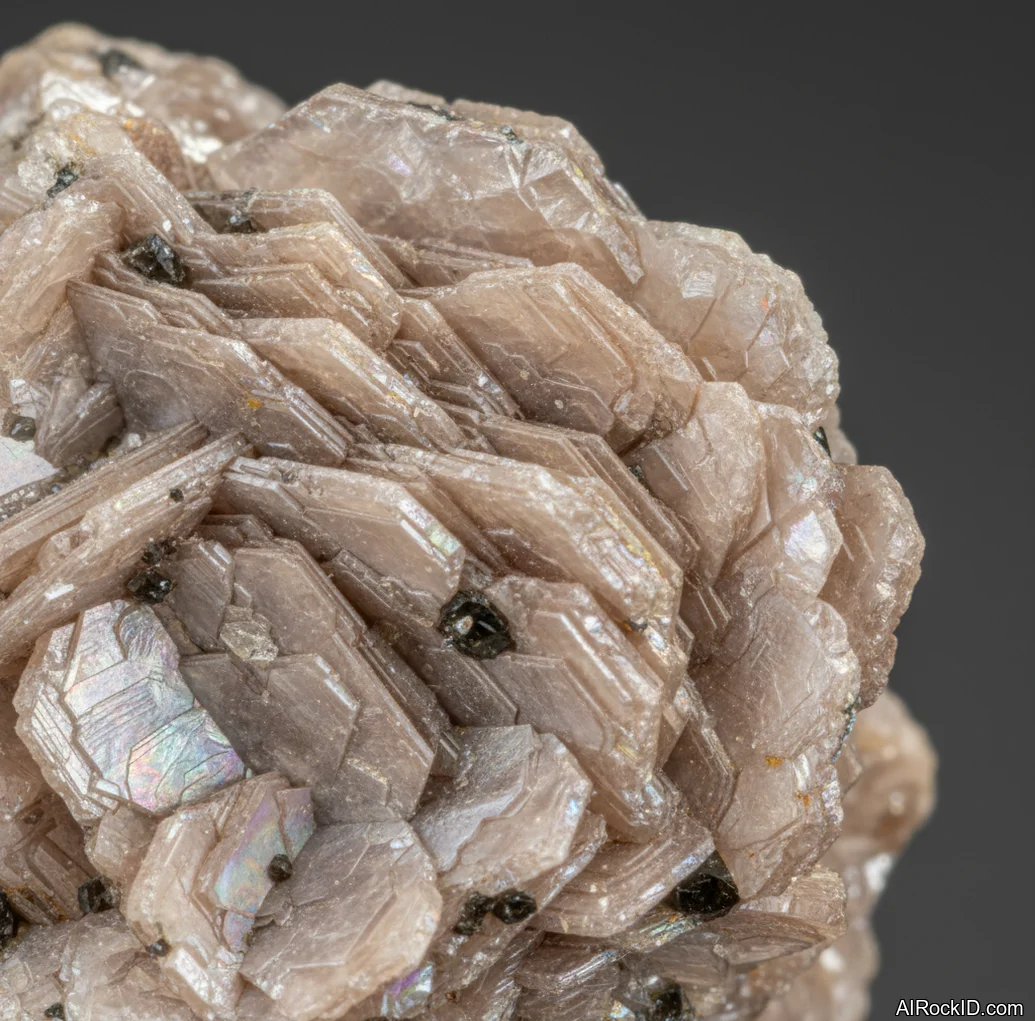
Thing is, the texture gives it away before anything else does. You pick up a piece and those tiny plates just want to part into thin sheets. Fresh cleavage catches the light with this soft, pearly silver flash, sometimes with a faint green or blue-gray cast if you tilt it back and forth under a strong lamp (the kind that makes everything look a little too honest).
It’s not the mineral that shouts at you from across a dealer table. But hit it with a direct light and that sheen pops. Subtle, but there.
Most specimens I run into are sitting in schist or blueschist matrix, not big standalone “crystals” you can pluck out cleanly. And that’s kind of the point. It’s a field-geology mineral that ended up in collections because it tells you something about pressure, fluids, and the rock’s whole story.
Origin & History
Paragonite got its first proper description in 1843, thanks to Albrecht Breithaupt. The name comes from the Greek “paragon,” which basically means “misleading” or “deceptive,” since it’s so easy to mix up with other micas, especially muscovite.
And honestly, that name fits. I’ve stood at shows and heard people shrug and call it “just muscovite,” even while it’s flashing those same silky, sheet-like flakes under the booth lights. But then you’ll see the opposite too: sellers slapping the label paragonite on any pale mica sitting in schist (you know the kind, thin plates that want to split into little shiny pages when you touch them). Without testing, you can get fooled either way. Why wouldn’t you?
Where Is Paragonite Found?
You’ll run into paragonite in high-pressure metamorphic terrains, especially Alpine-type settings and blueschist belts. It’s usually reported as fine mica in schists rather than big, clean plates.
Formation
Look at the rocks paragonite likes to sit in and the same idea keeps popping up: pressure. It shows up during metamorphism when there’s sodium around and the conditions let mica grow, most often in blueschist and eclogite-adjacent assemblages or in certain pelitic schists.
Compared to muscovite, it’s basically the sodium end-member. And it can turn up alongside glaucophane, lawsonite, garnet, chlorite, albite, quartz, and sometimes kyanite, depending on the exact pressure-temperature path the rock took.
Thing is, it’s a pain to ID because the grains can be really tiny. In a lot of hand samples you just catch that silvery shimmer running along the foliation (the kind that flashes when you roll the rock under a lamp), and that’s all you get until you put a lens on it.
How to Identify Paragonite
Color: Usually colorless to pale gray, silvery white, or light greenish-gray. In some schists it reads as a cool blue-gray sheen rather than a strong “green mineral” color.
Luster: Pearly to vitreous on cleavage faces.
Pick up a piece and tilt it under a single strong light source. Paragonite gives a smooth, satiny flash on fresh cleavage, but the flakes are often finer than muscovite in the same style of rock. If you scratch it with a copper coin, it’ll mark pretty easily, and if you try to peel a flake with a pin, it wants to split into thin sheets. The real test is lab work: paragonite and muscovite can look almost identical without optical methods or XRD.
Common Look-Alikes
Paragonite is sometimes confused with these materials:
- Muscovite (white mica, often sold as “mica sheets” or “sericite” when fine-grained)
- Phengite (mica that looks like muscovite but can run greener, common in high-pressure rocks with paragonite)
- Chlorite (greenish micaceous flakes, softer feel and more “greasy” looking in schist)
- Talc (soft, soapy plates in similar pale colors, but it’s way softer and feels slick)
- Kaolinite/illite clay aggregates (chalky white, can mimic fine paragonite in altered zones but won’t peel into elastic sheets)
- Dyed mica flakes and pearlescent craft mica (treated/colored mica sold in jars; sometimes pitched as “rare paragonite”)
Market Cautions & Treatments
When AI Can Get This Wrong
At first glance, phone ID apps call paragonite “muscovite” or “mica” almost every time, especially when it’s fine-grained in schist and just looks like a silvery sheen. Photos also trip up on pale green material and spit out chlorite because both can look like soft green shimmer on a rock face. The real test is hands-on: tease an edge with a pin and see if it parts into tiny elastic sheets with a pearly flash, then check hardness, it should scratch with a copper coin but won’t have talc’s soapy smear.
Properties of Paragonite
Physical Properties
| Crystal System | Monoclinic |
| Hardness (Mohs) | 2.5-3 (Soft (2-4)) |
| Density | 2.78-2.83 g/cm3 |
| Luster | Pearly |
| Diaphaneity | Transparent to translucent |
| Fracture | Uneven |
| Streak | White |
| Magnetism | Non-magnetic |
| Colors | Colorless, White, Silvery gray, Pale greenish gray, Bluish gray |
Chemical Properties
| Classification | Silicates |
| Formula | NaAl2(AlSi3O10)(OH)2 |
| Elements | Na, Al, Si, O, H |
| Common Impurities | Fe, Mg, K |
Optical Properties
| Refractive Index | 1.586-1.610 |
| Birefringence | 0.024 |
| Pleochroism | Weak |
| Optical Character | Biaxial |
Paragonite Health & Safety
Paragonite isn’t considered toxic, so you can handle it without worry. But like any mica, it’ll drop these tiny little flakes, especially if you’re dealing with a crumbly bit that feels a little dusty on your fingers. So don’t go rubbing your eyes right after handling it, okay?
Safety Tips
If you’re trimming matrix or scraping mica books, put on eye protection, and rinse your hands afterward. And just give your display shelf a fast wipe (I usually feel the gritty little flakes under the cloth) so the loose bits don’t end up everywhere.
Paragonite Value & Price
Price Range
Rough/Tumbled: $10 - $80 per specimen
Price usually follows how confident the label is and the story behind it. If it’s from a well-documented Alpine or blueschist locality and it’s sitting on a solid matrix (the kind that actually looks good in a case, not crumbly), it’ll cost more than some vague “mica in schist” with no real info. And big, clean, display-worthy plates don’t show up often, so when they do, the price climbs fast.
Durability
Nondurable — Scratch resistance: Poor, Toughness: Fair
It’s stable as a mineral, but the thin mica sheets bruise, flake, and shed at the edges if you handle it a lot.
How to Care for Paragonite
Use & Storage
Store it so nothing presses on the cleavage faces, because mica dents and peels. I like a perky box or a flat display with a little putty supporting the matrix, not the mica itself.
Cleaning
1) Blow off grit with a bulb blower or canned air from a distance. 2) Use a very soft brush to lift dust off the plates in one direction. 3) If you must use water, do a quick rinse and pat dry, then let it air dry fully before boxing it up.
Cleanse & Charge
If you do energetic cleansing, keep it gentle: smoke, sound, or moonlight are low-contact options. Skip salt piles, since salt grains love to wedge into mica layers.
Placement
Put it where light can rake across the surface, because the whole point is that pearly flash. Keep it away from high-traffic spots where people will pick at the edges.
Caution
Don’t put it in an ultrasonic cleaner, and don’t throw it in a tumbler either. Skip strong acids and any hard scrubbing; those plates can start lifting at the edges (you’ll see them curl up), and the specimen will look ragged really fast.
Works Well With
Paragonite Meaning & Healing Properties
Paragonite doesn’t scream “metaphysical shop” the second you see it. Most of the time it’s this pale, flaky mica stuck in schist, the kind of rock that looks more like a homework sample than something you’d put on an altar. But when people reach for mica-type minerals in that world, they usually latch onto the same themes: layers, reflection, and clearing out mental clutter.
Thing is, the feel of it is half the point. Grab a paragonite-bearing schist and lightly drag your thumb across the foliation. The texture shifts under your skin as you move, like the rock has a grain that flips direction, almost like riffling through pages. That little tactile moment is exactly why I’ve seen it show up in journaling sessions and those slow, quiet meditation setups. Not because it’s pretty. Because it makes you pause.
But look, if you’re expecting some huge “energy punch,” paragonite tends to read as subtle for most people, and that can get mistaken for nothing happening at all. I think of it more like a study mineral that happens to have a side benefit (nice, but not the main event). And if you’ve got anxiety, pain, or anything medical going on, treat crystals as comfort objects and a nudge to do the real-world basics too: sleep, food, and actual care. Sounds boring, sure. Still true.
Common mistakes
- Assuming any pale mica sheet is paragonite without checking chemistry or locality
- Confusing sericite, a fine-grained mica habit, with a confirmed paragonite specimen
- Using color alone to separate paragonite from muscovite
- Buying unlabeled pale mica as paragonite without provenance or analytical support
- Testing hardness too aggressively, which can damage thin mica flakes
Identify Paragonite from a photo
Compare Paragonite traits, care tips, value clues, and common lookalikes with a clear photo.