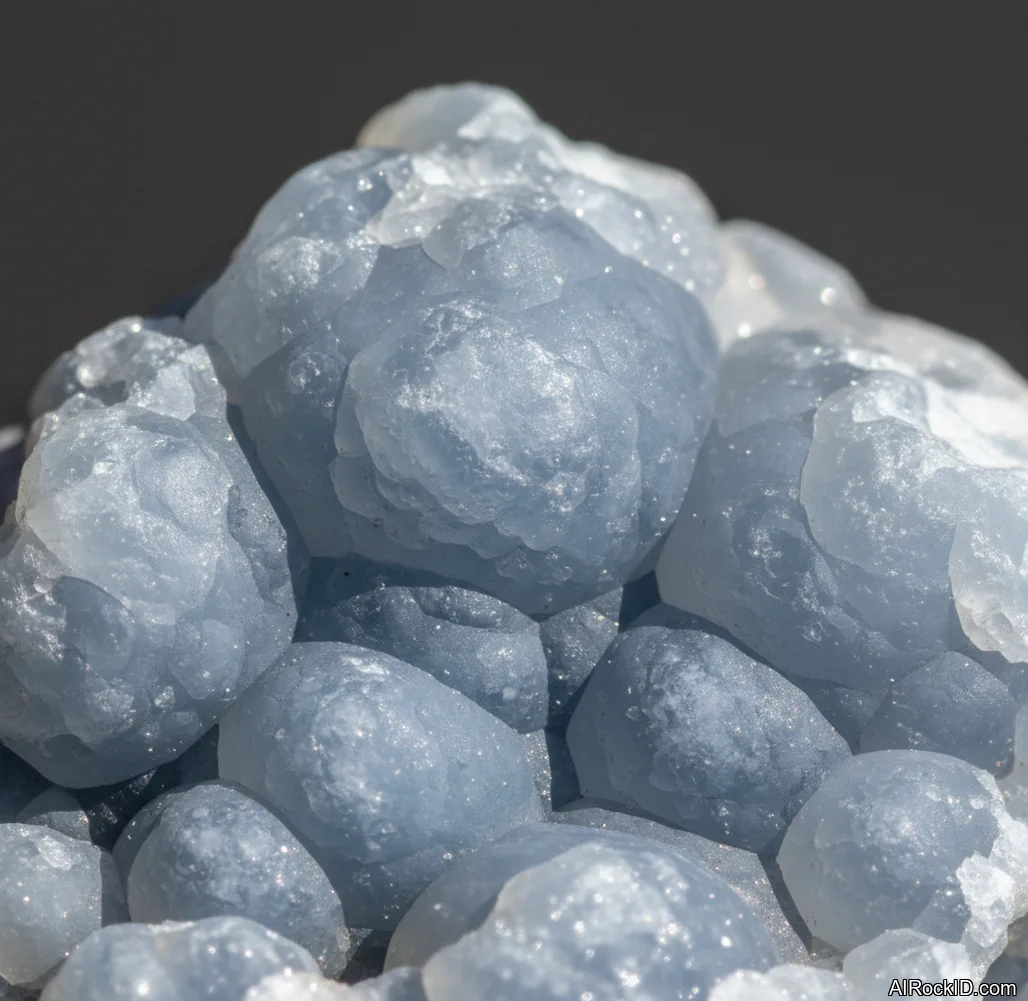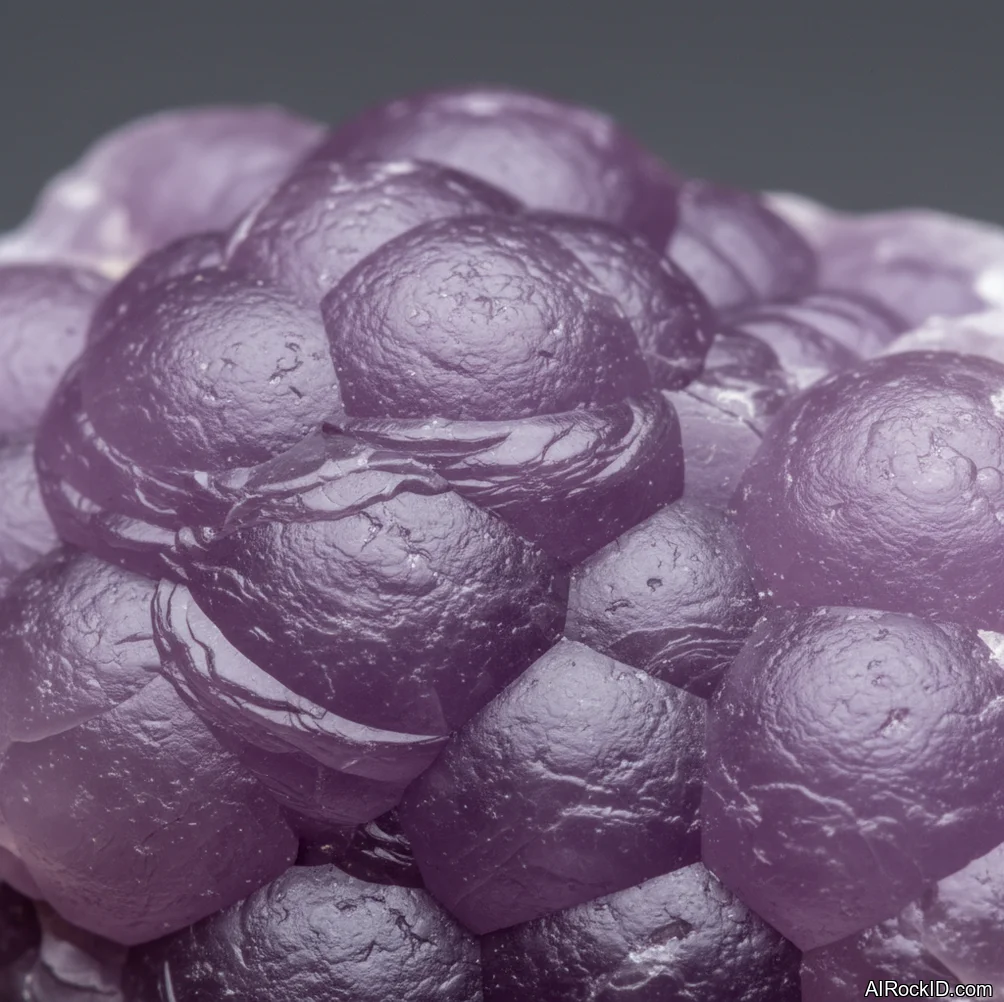
Purple Chalcedony


Quick answer: Purple Chalcedony is a lavender-to-violet variety of microcrystalline quartz with a waxy to vitreous luster and typically translucent appearance. It is often confused with amethyst, purple agate, and dyed chalcedony, so color distribution, banding, and seller disclosure are important when identifying it.
AI Rock ID can help compare Purple Chalcedony against visually similar quartz varieties by analyzing color, translucency, texture, and banding from a photo. RockIdentifier.io provides identification support, but final confirmation may require hardness testing, magnification, or gemological evaluation.
Good fit
- Collectors who like soft lavender, lilac, or violet quartz varieties
- Jewelry buyers looking for a durable gemstone around Mohs 6.5–7
- Beginners comparing chalcedony, agate, and amethyst specimens
- Anyone who prefers subtle color over strong purple saturation
Not a good fit
- Buyers who want guaranteed natural color without seller documentation
- Collectors seeking sharply faceted brilliance like transparent amethyst
- People who need a stone that resists all chemicals, heat, or ultrasonic cleaning
- Anyone relying on a crystal for medical treatment or diagnosis
Most commonly confused with
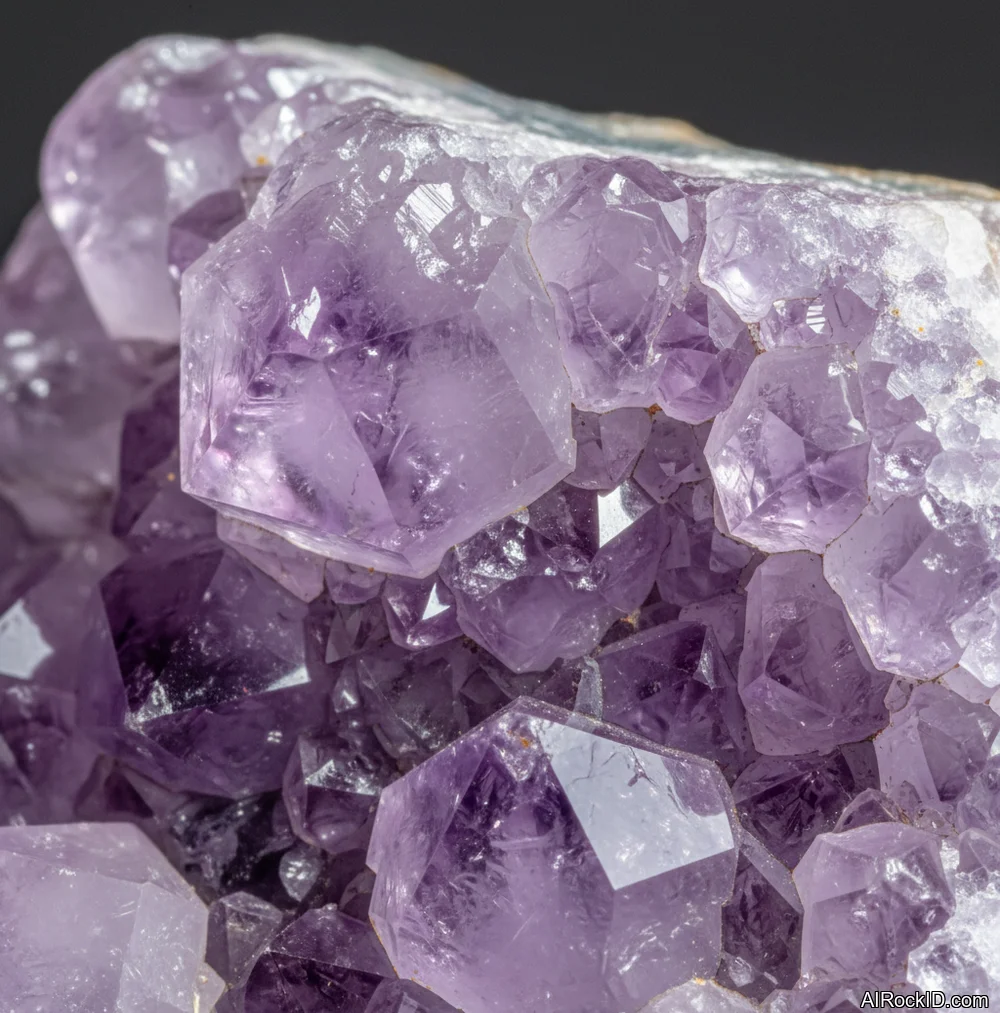
- Amethyst: Amethyst is crystalline quartz and is usually more transparent with visible crystal faces or faceted clarity.
- Purple Agate: Purple agate commonly shows curved or parallel banding, while purple chalcedony may appear more uniform or softly clouded.
- Dyed Chalcedony: Dyed material can show unusually vivid color, concentrated color in cracks, or color pooling near surface pits.
- Charoite: Charoite typically has swirling fibrous patterns and a lower hardness than quartz-family chalcedony.
Purple Chalcedony Lookalike Comparison
| Stone | Typical Appearance | Key Difference |
|---|---|---|
| Purple Chalcedony | Lavender to violet, waxy or vitreous, translucent to opaque | Microcrystalline quartz with no obvious large crystal structure |
| Amethyst | Transparent to translucent purple quartz | Often forms visible crystals and may show stronger clarity |
| Purple Agate | Purple chalcedony with distinct bands | Banding is the main visual clue |
| Dyed Chalcedony | Bright or uneven purple, sometimes concentrated in cracks | Color may look unnaturally intense or patchy |
| Fluorite | Purple, glassy, often cubic or cleavable | Softer and more easily scratched than chalcedony |
AI identification confidence
AI identification confidence for Purple Chalcedony is usually moderate because many purple quartz-family stones overlap in color and texture. Photos taken in natural light, with close-ups of banding, surface texture, and translucency, improve the chance of separating chalcedony from amethyst, agate, dyed material, or fluorite.
When AI gets it wrong
- The photo is heavily edited, overly saturated, or taken under purple-tinted lighting
- The specimen is polished, tumbled, or carved, hiding natural structure
- Dyed chalcedony has an even color that resembles natural lavender chalcedony
- The image lacks scale, surface detail, or a view of broken or unpolished areas
Final recommendation
Choose Purple Chalcedony based on evenness of color, translucency, polish quality, and honest disclosure about any dyeing or treatment. For higher-value pieces, request natural-light photos and basic identification details rather than relying on color alone.
How to Check Purple Chalcedony Authenticity
Authentic Purple Chalcedony should have the general hardness and texture of chalcedony, with a waxy to vitreous surface and no obvious glass bubbles. Natural pieces often show subtle color variation, while dyed material may show concentrated purple in fractures, pits, or porous zones. A simple scratch comparison against softer materials can support identification, but destructive testing is not recommended for finished jewelry.
Buying Tips for Purple Chalcedony
Ask whether the color is natural, dyed, heated, or otherwise treated, especially when the purple is very vivid or uniform. Look for clear photos in daylight, close-ups of the surface, and views of any banding or internal cloudiness. Transparent pricing should reflect size, polish, craftsmanship, and treatment disclosure rather than color name alone.
Photo Tips for Identifying Purple Chalcedony
Photograph Purple Chalcedony on a neutral background in indirect daylight to avoid making the color look too blue or too saturated. Include one close-up, one full-stone image, and one photo with a common object for scale. If the stone is translucent, a backlit photo can help show whether it has banding, cloudiness, or dye concentration.
What Is Purple Chalcedony?
Purple chalcedony runs lavender to violet, and it’s a variety of chalcedony, which is the microcrystalline form of quartz (SiO2). It’s not that loud, glassy purple you see on amethyst points. This stuff looks quieter. More like the color’s tucked under a thin wash of milk.
Grab a tumbled piece and you’ll notice the usual quartz heft, but the skin of it feels slicker than you’d guess. Almost soapy. When I’m sorting a tray at a show, this is the one I keep rolling between my thumb and finger because the color shifts with the light. In the shade it goes kind of gray-lilac, then under a booth lamp it warms up into a deeper violet. Funny, right?
Most of what you’ll run into is cut and polished. True “crystal” shapes aren’t really a thing here, because chalcedony grows as masses, seam fill, and nodules. And yeah, sellers will sometimes label it purple agate, especially if there’s banding. But plenty of purple chalcedony is just cloudy and even, with no bands at all.
Origin & History
The name chalcedony goes way back. It’s tied to the old port of Chalcedon, which is Kadıköy in modern Turkey, and you still hear that connection come up when people talk stones at a bench, turning a cabochon under a lamp to catch the color.
Pliny the Elder mentioned chalcedony in the 1st century CE, and that’s a big reason the name stuck around in the gem world instead of getting swapped out later.
But “purple chalcedony” isn’t its own mineral species with one neat “first described on this date” moment like some rarer minerals have. It’s just a color variety, showing up anywhere silica gels and microcrystalline quartz form the way they do.
And the phrase “lavender chalcedony” got used a lot more by dealers in the late 1900s, when attractive material started coming out of places like Turkey and parts of Africa. So that trade name has been floating around gem shows ever since.
Where Is Purple Chalcedony Found?
Purple chalcedony turns up in silica-rich volcanic and sedimentary settings, especially where nodules and seams form in host rock like basalt or rhyolite.
Formation
Think of chalcedony as silica that just didn’t get the room (or the patience) to grow into big, neat quartz crystals. Silica-rich fluids snake through cracks, little cavities, and porous zones in the rock. Then something changes, temperature drops, chemistry shifts, pressure tweaks, and the silica turns to gel or drops out in layers. Give it time and it firms up into that microcrystalline quartz texture.
Color’s the weird part. Those purple tones usually come from trace elements and tiny defects in the silica lattice, sometimes with a nudge from included minerals. And if you’ve ever held a rough piece, you know why some of it looks kind of “flat” until it’s polished. The outside can feel chalky and dull, but crack it open and there’s that purple heart inside, like a nodule that kept the good color tucked away from weathering. Who hasn’t seen that?
How to Identify Purple Chalcedony
Color: Lavender, lilac, gray-violet, or soft grape-purple, usually with a cloudy or misty look rather than clear transparency. Some pieces show faint banding or zoning, but many are fairly even-colored.
Luster: Waxy to vitreous, often looking more waxy on tumbled surfaces.
Look closely at the edges against a flashlight. Real chalcedony usually glows a bit at thin spots, kind of like light passing through fog. If you scratch it with a steel nail, it shouldn’t mark easily, but it will scratch glass without drama. And here’s a hands-on thing I use at shows: glass and plastic imitations warm up fast in your palm, while real chalcedony stays cool longer and feels denser for its size.
Common Look-Alikes
Purple Chalcedony is sometimes confused with these materials:
- Dyed chalcedony/agate sold as “purple chalcedony” (often pale gray base with purple dye)
- Dyed quartzite or dyed howlite (takes color fast and shows loud, even purple)
- Amethyst (especially pale, tumbled amethyst that reads “milky lavender” in photos)
- Purple fluorite (tumbled fluorite can mimic the soft lilac, but it’s much softer)
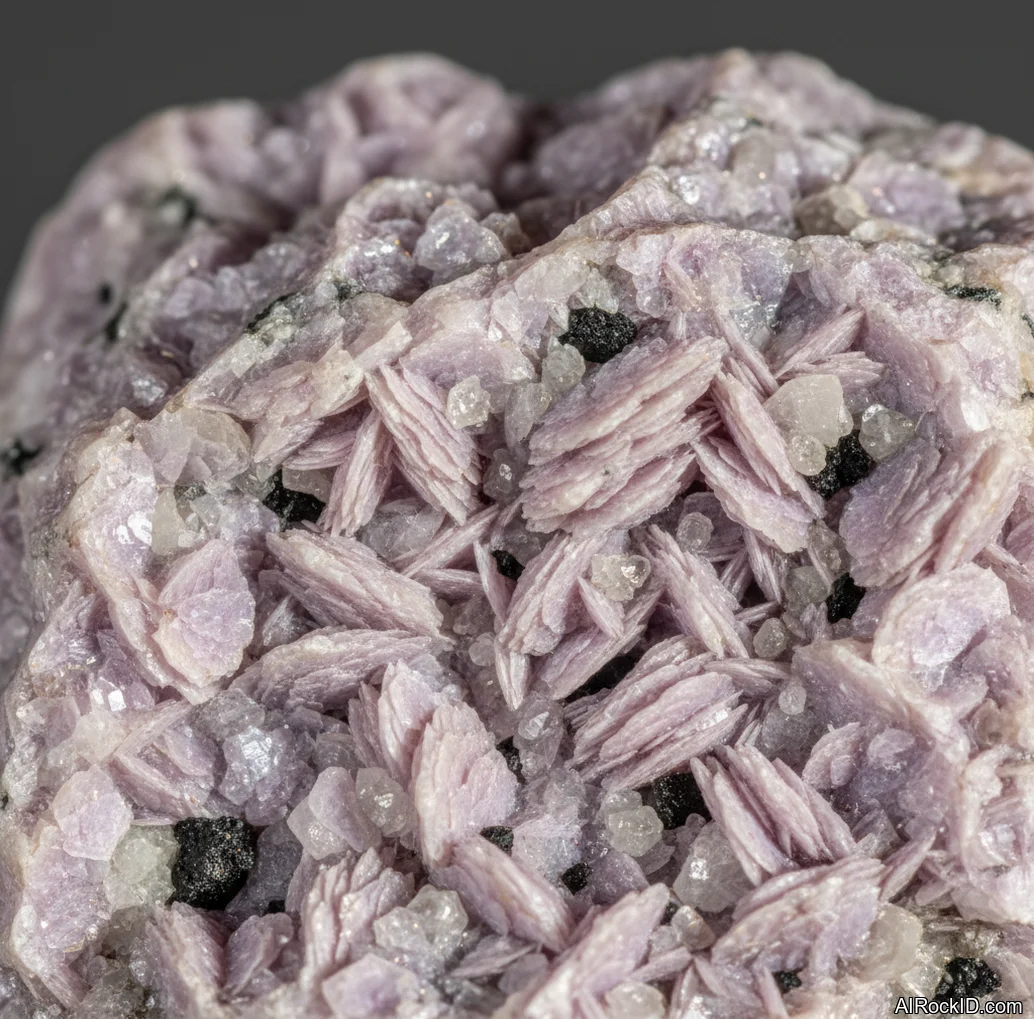
- Lavender lepidolite (mica shimmer can be missed in quick listings)
- Purple glass (slag/cullet sold as tumbled “chalcedony”)
Market Cautions & Treatments
When AI Can Get This Wrong
At first glance in a phone photo, purple chalcedony gets mixed up with pale amethyst and purple fluorite because all three can read as soft lavender when the lighting’s bad. AI struggles most when the stone’s tumbled and wet-looking, since chalcedony’s waxy polish hides the microtexture that would normally give it away. The real test is hardness and feel: chalcedony will scratch glass and stays cool and slightly “soapy” under your thumb, while fluorite won’t scratch glass and often shows faint cleavage flashes when you tilt it.
Properties of Purple Chalcedony
Physical Properties
| Crystal System | Trigonal |
| Hardness (Mohs) | 6.5-7 (Hard (6-7.5)) |
| Density | 2.58-2.64 g/cm3 |
| Luster | Waxy |
| Diaphaneity | Translucent |
| Fracture | Conchoidal |
| Streak | white |
| Magnetism | Non-magnetic |
| Colors | lavender, lilac, purple, gray-violet, bluish purple |
Chemical Properties
| Classification | Silicates |
| Formula | SiO2 |
| Elements | Si, O |
| Common Impurities | Fe, Mn, Ti |
Optical Properties
| Refractive Index | 1.530-1.543 |
| Birefringence | 0.009 |
| Pleochroism | None |
| Optical Character | Uniaxial |
Purple Chalcedony Health & Safety
Purple chalcedony is generally safe to handle, and it’s fine around water too. The real day-to-day concern only pops up if you’re cutting or grinding it, because that’s when you can kick up silica dust (the kind that hangs in the air and gets in your nose).
Safety Tips
If you’re shaping or polishing, keep it wet and wear real respiratory protection that’s actually rated for fine particulates. And don’t dry-sand it indoors.
Purple Chalcedony Value & Price
Price Range
Rough/Tumbled: $5 - $60 per piece
Cut/Polished: $2 - $15 per carat
Price usually follows color and translucency. Clean lavender that actually glows when you tilt it in your hand under a lamp will run higher. But if it’s got that gray cast or a chalky, washed-out look, it stays cheap, even when the piece is huge.
Durability
Durable — Scratch resistance: Good, Toughness: Good
It’s stable like most quartz, but polished surfaces can pick up scuffs if you toss it in a pocket with keys.
How to Care for Purple Chalcedony
Use & Storage
Store it separately from softer stones so it doesn’t act like sandpaper in a mixed pouch. A small cloth bag or divided box is plenty.
Cleaning
1) Rinse with lukewarm water. 2) Use a drop of mild soap and a soft toothbrush for skin oils and polish residue. 3) Rinse again and pat dry with a microfiber cloth.
Cleanse & Charge
If you do the metaphysical side, a quick rinse and a night on a windowsill that doesn’t get harsh midday sun is simple. I also like setting it on plain quartz for a day because it keeps the vibe low-key and doesn’t risk scratches.
Placement
On a desk, it looks best where side light can hit the edges and bring out that internal haze. I keep one small palm stone near my keyboard because it’s smooth enough to fidget with.
Caution
If your piece has fractures or any drusy pockets, skip the harsh chemical cleaners and don’t toss it in an ultrasonic cleaner either. And don’t park dyed material in strong sun for weeks on end, because the color can fade.
Works Well With
Purple Chalcedony Meaning & Healing Properties
A lot of people grab purple chalcedony when they want calm, but not that heavy, drowsy kind of calm. To me it reads quieter than amethyst, less “spark” and more like a steady hum you can sit next to. And since it’s chalcedony, it has that smoothed-out, rounded vibe people always mention with microcrystalline quartz.
If you’ve ever held a palm stone on a rough day, you probably get the appeal. The feel is the whole point. It’s cool in your hand at first, kind of silky, and there aren’t any sharp edges or pointy terminations yanking your attention around. I’ve had customers circle back and tell me they keep one in a pocket just because rubbing that slick surface helps them stop spiraling (simple, but it works for them).
But look, there are limits. None of this is a stand-in for medical care, and chalcedony isn’t going to fix a panic disorder by itself. What it can do, if you’re into this side of the hobby, is act like a physical cue: you notice it, you breathe, you slow down. That’s usually what’s really going on. And honestly? Still useful.
Common mistakes
- Assuming every lavender quartz-like stone is amethyst
- Calling any purple banded chalcedony Purple Chalcedony without noting that it may be purple agate
- Treating vivid purple color as proof of higher value without checking for dye
- Using color alone to identify polished or tumbled stones
- Ignoring seller disclosures about enhancement, stabilization, or artificial coloring
Identify Purple Chalcedony from a photo
Compare Purple Chalcedony traits, care tips, value clues, and common lookalikes with a clear photo.