Quantum Quattro


Quick answer: Quantum Quattro is a trade name for a blue-green copper-mineral mixture, commonly described as quartz with chrysocolla, shattuckite, malachite, and related copper minerals. It is best identified as a mixed lapidary material rather than a single mineral species.
AI Rock ID can help screen Quantum Quattro by comparing its blue-green color zoning, matrix, and polish against visually similar copper-bearing stones. RockIdentifier.io is most useful when the photo includes both close-up texture and the full specimen under neutral lighting.
Good fit
- Collectors who like mixed copper-mineral lapidary stones
- Jewelry buyers looking for blue-green patterned cabochons or beads
- Beginners who want a visually distinctive stone but do not need a single-species mineral ID
- People comparing chrysocolla-rich stones with malachite or shattuckite patterns
Not a good fit
- Buyers who need a certified single-mineral specimen
- Rings or high-wear jewelry unless the stone is well protected
- Anyone expecting uniform color or consistent mineral proportions
- Wet environments, ultrasonic cleaners, or harsh chemical cleaning
Most commonly confused with
- Chrysocolla: Chrysocolla is often one component of Quantum Quattro, while Quantum Quattro is a mixed rock material with additional copper minerals.
- Azurite Malachite: Azurite malachite usually shows stronger deep blue azurite with green malachite, while Quantum Quattro often includes softer blue-green chrysocolla and quartz matrix.
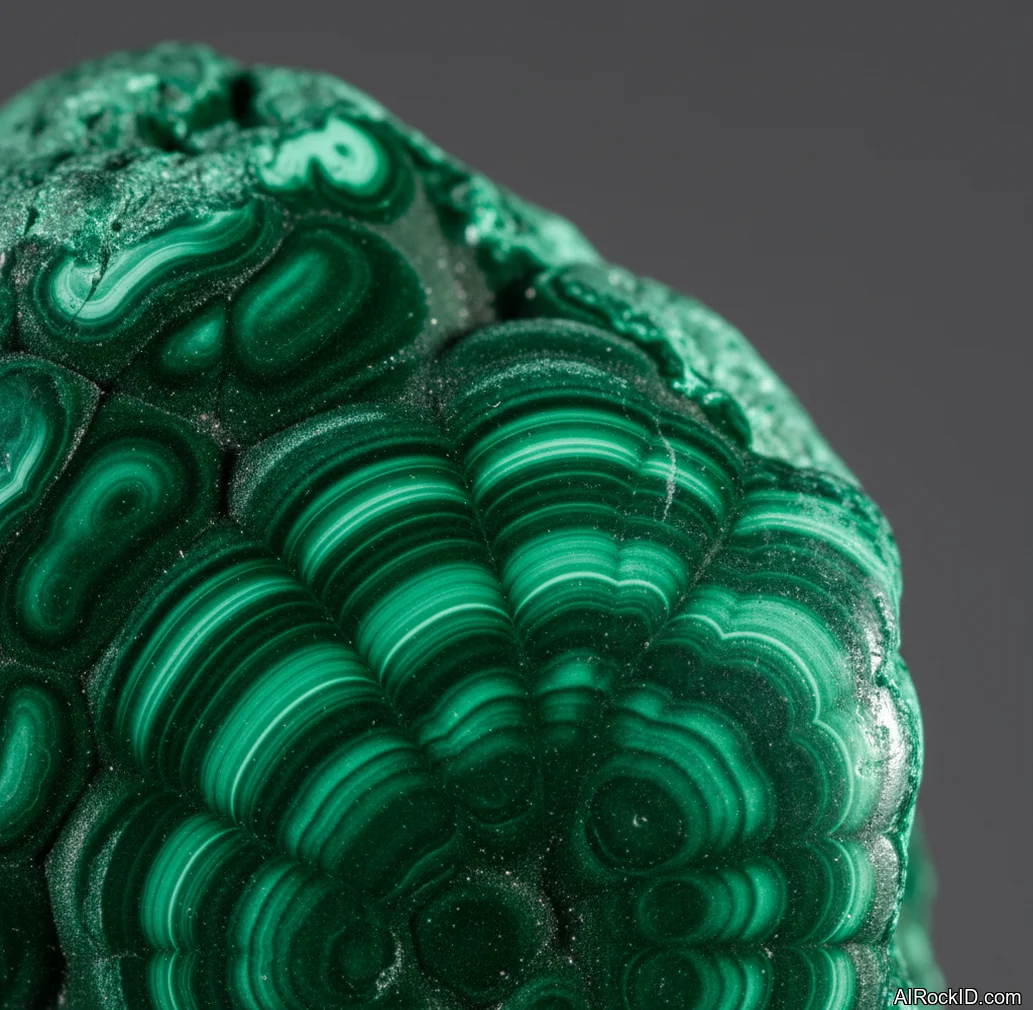
- Malachite: Malachite typically has green banding and lacks the blue shattuckite or chrysocolla zones common in Quantum Quattro.
- Turquoise: Turquoise is usually more uniform and waxy, while Quantum Quattro commonly shows mixed patches, veins, and multiple copper-mineral colors.
Quantum Quattro vs. Similar Blue-Green Stones
| Material | Typical Look | Key Difference |
|---|---|---|
| Quantum Quattro | Mixed blue, green, gray, and white patches | Trade-name mixture, often with quartz and several copper minerals |
| Chrysocolla | Blue to blue-green, sometimes with matrix | Single dominant copper mineral rather than a named multi-mineral blend |
| Azurite Malachite | Deep blue and bright green areas | Usually stronger azurite blue and malachite green contrast |
| Turquoise | Blue to green, often waxy or webbed | Phosphate mineral with a different composition and usually less mixed patching |
| Malachite | Green bands, eyes, or swirls | Primarily green and typically lacks blue chrysocolla or shattuckite zones |
AI identification confidence
AI identification confidence for Quantum Quattro is usually moderate because it is a trade-name mixture, not a single diagnostic mineral. A result should be treated as a visual match unless confirmed by seller documentation, locality, or mineral testing.
When AI gets it wrong
- Photos are taken under saturated blue or green lighting that exaggerates copper-mineral colors
- A polished cabochon hides the matrix and makes the stone look like turquoise or chrysocolla
- The specimen is dyed magnesite, dyed howlite, or another porous stone with similar color
- Only one color area is shown, instead of the full mixed pattern
Final recommendation
Choose Quantum Quattro for its mixed copper-mineral appearance, not for a guaranteed fixed formula. For higher-value purchases, ask for clear photos, disclosure of treatments, and any available locality or lapidary source information.
How to Spot Dyed or Misrepresented Quantum Quattro
Dyed lookalikes may show unnaturally even blue-green color, dye concentrated in cracks, or color bleeding onto a cotton swab after gentle testing with water. Genuine mixed copper-mineral material usually has irregular mineral boundaries, natural matrix, and color variation rather than a uniform surface tone. A seller should be able to state whether the stone is natural, stabilized, dyed, or reconstructed.
What to Ask Before Buying Quantum Quattro
Ask whether the piece is sold as natural rough, stabilized lapidary material, dyed stone, or a composite. Request photos in daylight or neutral light, including the back of cabochons and drill holes on beads. For jewelry, ask about setting protection because softer copper-bearing minerals can scratch or dull with wear.
Best Photo Tips for Identification
Photograph Quantum Quattro on a plain white or gray background with indirect daylight. Include one close-up of the surface, one full-stone photo, and a scale reference such as a coin or ruler. Avoid heavy filters, flash glare, or colored backgrounds because they can make chrysocolla, malachite, and shattuckite appear more similar than they are.
What Is Quantum Quattro?
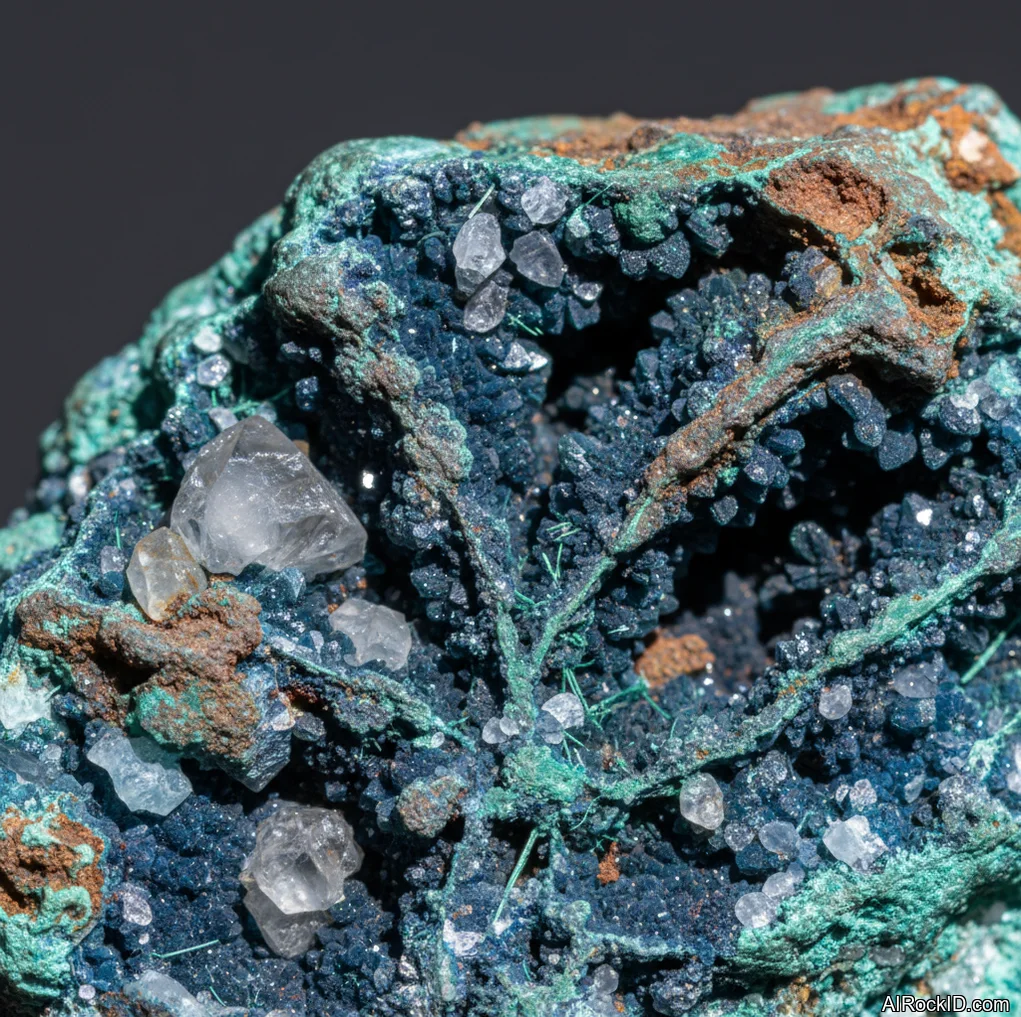
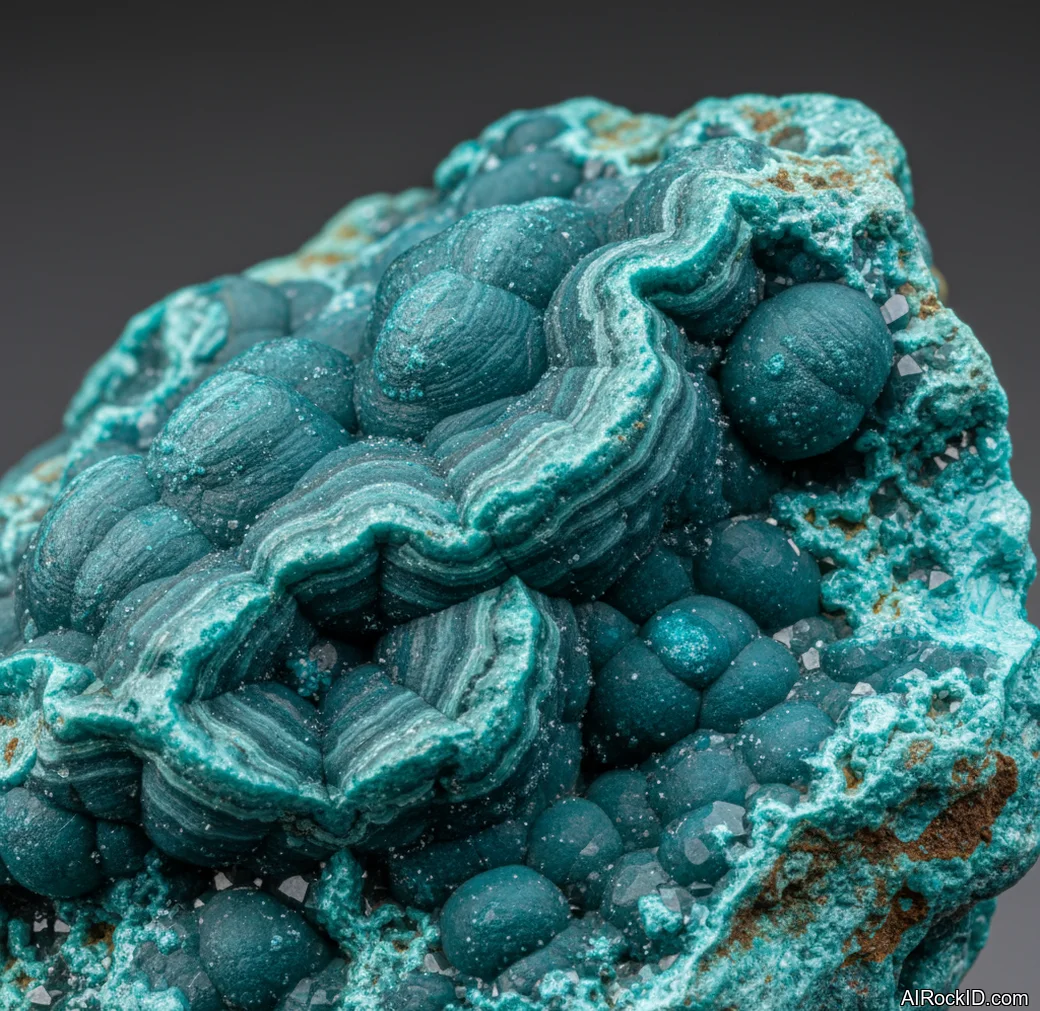
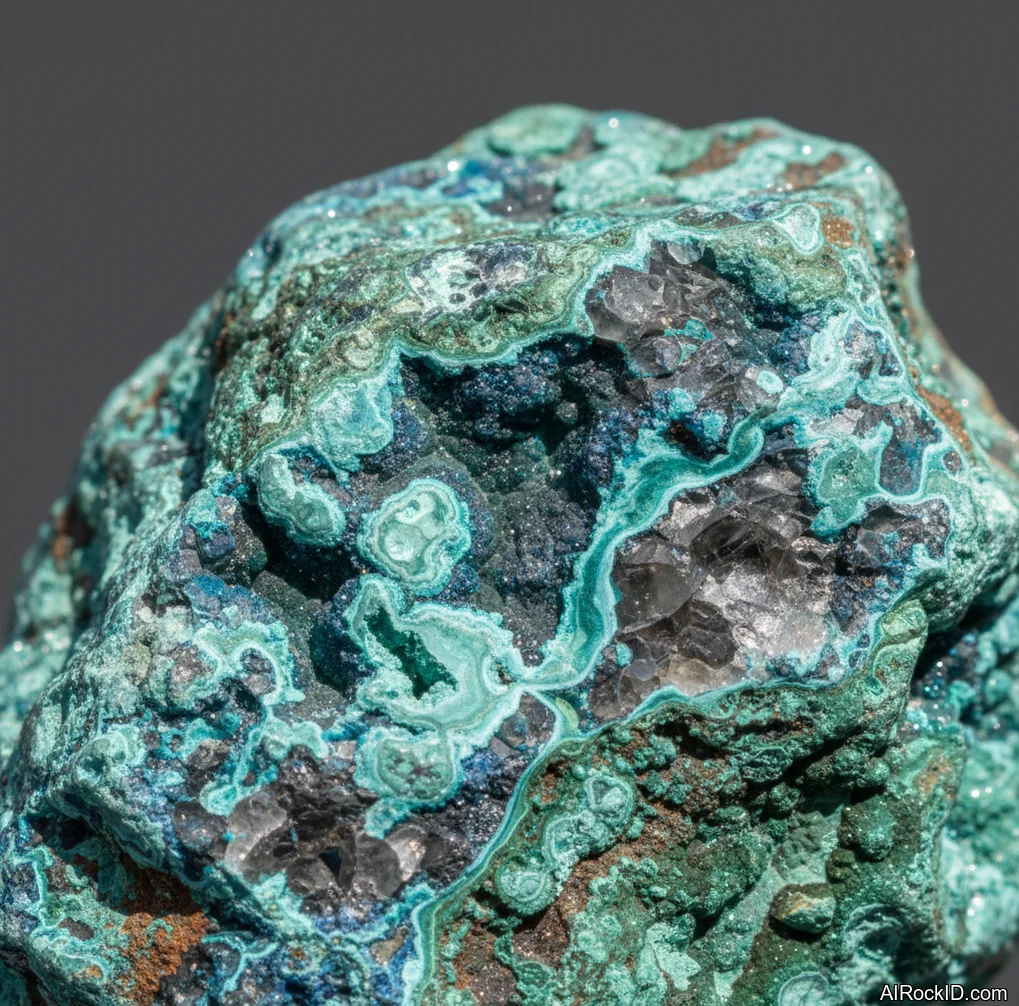
Quantum Quattro is a trade name for a copper-mineral mix, usually chrysocolla, shattuckite, plus malachite, all sitting in quartz (silica) and sometimes with tiny bits of dioptase mixed in.
Grab a decent piece and two things hit you right away. The heft. It has that quartz feel in your hand, cool at first touch and surprisingly solid, like a smooth river stone that’s been sitting in the shade. But then the colors are pure copper country: dusty sky blues, inky blue specks, and little green blooms that look like somebody dabbed paint down into hairline cracks (and yeah, you can sometimes feel those tiny seams with a fingernail if the polish isn’t super thick). Most of what you’ll see for sale is cut into slabs, palm stones, or cabs, since the whole draw is the pattern, not any crystal shape.
People glance at it and assume it’s one mineral. It’s not. And that’s kind of the point. Under a bright shop light you can usually pick out a few different looks right away: waxy blue areas that are often chrysocolla, sharper darker blue patches that are often shattuckite, and those green malachite freckles that sometimes polish up almost glassy while the softer blue zones stay more satin. How could it be just one thing when it does that?
Origin & History
“Quantum Quattro” isn’t a term you’ll find in a geology journal. It’s a newer lapidary and metaphysical market name for that specific, splashy look of copper minerals sitting in silica, and it really started making the rounds in the late 1990s into the 2000s.
Most dealers pin the name on material from Namibia, and honestly, that matches what I’ve seen at shows. The best pieces, the ones with that tight polish and the deep blue-green patches that catch under the lights when you tilt them in your hand, usually get labeled “Namibian Quantum Quattro.” The “quattro” bit is basically a sales-friendly wink at the four components people tend to list: chrysocolla, shattuckite, malachite, and quartz. But thing is, real stones aren’t neat little recipes, right? A lot of pieces are a bit messy and can have other copper minerals in small amounts mixed in.
Where Is Quantum Quattro Found?
Most commercial Quantum Quattro on the market is sold as Namibian material from copper deposits; similar copper-in-quartz mixes also show up in parts of the southwestern United States and northern Mexico.
Formation
Think oxidized copper deposit. It starts with copper sulfides deeper in the system, then groundwater and oxygen move in closer to the surface and go to work. Give it time and you end up with secondary copper minerals like malachite, chrysocolla, and shattuckite forming along fractures and in porous zones.
Now bring in silica-rich fluids. Quartz can fill those same cracks, cement breccias, or straight-up replace earlier material. That’s why some chunks feel hard and almost glassy in your hand and take a killer polish, but other bits have soft, chalky pockets that grab grit and then undercut on the wheel (super annoying). The best lapidary rough is usually heavily silicified, where the copper minerals are locked into quartz instead of sitting there loose and crumbly.
How to Identify Quantum Quattro
Color: Quantum Quattro usually shows a mix of medium to deep blue (shattuckite), softer turquoise-blue to blue-green (chrysocolla), and bright to dark green (malachite) in a white to gray quartz host.
Luster: Polished surfaces range from vitreous (quartz-rich) to waxy or satiny (copper-rich patches).
Look closely for multiple blues, not one flat color. When I turn a cab under overhead lights, the quartzy areas flash bright while the blue zones stay more muted and velvety. The real test is hardness: a quartz-rich piece will scratch glass easily, but a more chrysocolla-heavy chunk might drag or leave a weaker scratch and can feel a touch “grabby” under a steel point.
Common Look-Alikes
Quantum Quattro is sometimes confused with these materials:
- Chrysocolla (especially with quartz or in massive form)
- Shattuckite (pure, without the mix)
- Azurite-malachite mixes
- Dyed howlite or magnesite made to mimic blue-green copper stones
- Glass fakes in blue-green shades
- Eilat stone (which is a similar copper mix from Israel)
Market Cautions & Treatments
When AI Can Get This Wrong
AI photo ID struggles with Quantum Quattro when it's shown as polished chunks or cabochons—often calling it chrysocolla or even dyed howlite. The mix of copper blues and greens throws off most models, especially if the quartz isn't obvious. A real test is the heft and the way the colors break apart under 10x magnification—look for tiny, uneven quartz grains and color patches instead of a smooth, uniform blue.
Properties of Quantum Quattro
Physical Properties
| Crystal System | Trigonal |
| Hardness (Mohs) | 2.0-7.0 (Medium (4-6)) |
| Density | 2.4-2.7 |
| Luster | Vitreous |
| Diaphaneity | Opaque |
| Fracture | Conchoidal |
| Streak | white to pale blue-green |
| Magnetism | Non-magnetic |
| Colors | blue, turquoise, blue-green, green, white, gray, black |
Chemical Properties
| Classification | Silicates |
| Formula | SiO2 (host quartz; mixture includes Cu-bearing silicates and carbonates) |
| Elements | Si, O, Cu, Al, C, H |
| Common Impurities | Fe, Mn, Ca |
Optical Properties
| Refractive Index | 1.544-1.553 |
| Birefringence | 0.009 |
| Pleochroism | None |
| Optical Character | Uniaxial |
Quantum Quattro Health & Safety
Handling it, moving it around, and even a quick splash of water are usually fine once the piece is finished. But don’t grind or sand it unless you’ve got proper dust control, because you really shouldn’t be breathing in dust from copper-bearing minerals.
Safety Tips
If you need to cut it or smooth it out, do it wet and wear the right respirator. And don’t skip the basics, wash your hands before you eat.
Quantum Quattro Value & Price
Price Range
Rough/Tumbled: $20 - $200 per piece
Cut/Polished: $2 - $12 per carat
Price bounces around based on how quartz-heavy and solid the rough chunk is, and how crisp those blue patterns end up once it’s polished. Thick, beefy slabs that feel dense in your hand, with tight, inky shattuckite patches and hardly any of those annoying soft pits or little crumbly spots, go for more.
Durability
Moderate — Scratch resistance: Fair, Toughness: Fair
Quartz-rich Quantum Quattro wears like chalcedony to quartz, but soft chrysocolla-heavy zones can bruise and undercut with hard knocks.
How to Care for Quantum Quattro
Use & Storage
Store it like you’d store a softer inlay stone, not like a chunk of agate. I keep mine in a small box with a cloth divider because the quartzy parts can still scratch softer neighbors and the soft spots can get dinged.
Cleaning
1) Rinse quickly in lukewarm water. 2) Use a drop of mild soap and your fingers or a soft toothbrush for crevices. 3) Pat dry and let it fully air-dry before putting it back in a pouch.
Cleanse & Charge
If you do energetic cleansing, stick to gentle stuff like smoke, sound, or a quick pass on a selenite plate. I avoid long salt soaks because it’s a mixed material and you don’t gain anything by pushing it.
Placement
Look closely at your piece and put the “best face” where light can rake across it from the side. On a shelf, angled daylight makes the blues separate out way better than flat overhead lighting.
Caution
Don’t assume every Quantum Quattro is solid, hard quartz straight through. Some pieces have little pockets of softer chrysocolla, and those spots can pit if you hit them with an ultrasonic cleaner or bang the stone around with rough wear (you can sometimes feel it, too, like a slightly chalky dip under your fingernail). So skip long soaks if you’re seeing any visible cracks or those chalky-looking areas.
Works Well With
Quantum Quattro Meaning & Healing Properties
People don’t usually buy Quantum Quattro by accident. They’re after a pretty specific feel: a calmer head, more straight-up communication, and that crisp “reset” you tend to associate with blue stones. Thing is, that’s metaphysical territory, not medicine. If you’ve got anxiety, sleep problems, or anything clinical going on, crystals aren’t a swap for a doctor or therapist. Full stop.
Hold a palm stone for a second and you’ll get why it ends up in the “soothing” pile. It’s got that cool quartz chill right away, like it’s been sitting in the shade, and the blue-green mix looks like water and sky happening at the same time. And when I’m sorting trays at a show, I always see people hover over the pieces where the darker shattuckite lines look like little ink strokes across the face. Those are the ones folks call “clarifying” or “truth telling.” The malachite specks, on the other hand, get folded into the whole protection and boundaries talk.
But here’s where it gets messy: some sellers pitch it like it’s one miracle stone with one fixed effect. It isn’t. It’s a blend, and the blend varies. A heavily silicified piece feels steady and “clean,” while a softer, more chrysocolla-heavy one can feel almost chalky on the back (you notice it the second you rub your thumb over it) and it just doesn’t hold up as well in jewelry. So if you’re picking one for personal practice, handle a few. Go with the one you actually keep reaching for. That matters more than whatever ingredient list is printed on a tag.
Common mistakes
- Assuming Quantum Quattro is a formal mineral species instead of a lapidary trade name
- Identifying every blue-green patch as turquoise without checking texture and matrix
- Expecting every piece to contain the same exact minerals in the same proportions
- Using acid, ultrasonic cleaners, or steam cleaners on copper-bearing mixed stones
- Buying high-priced pieces without asking whether the material is dyed, stabilized, or composite
- Judging authenticity from color alone rather than pattern, matrix, seller disclosure, and testing
Identify Quantum Quattro from a photo
Compare Quantum Quattro traits, care tips, value clues, and common lookalikes with a clear photo.